Last Updated on 14/02/2026
Hemis monastery, known as one of the most ancient monastery in Ladakh. Hemis monastery representative reincarnate of Buddha. Hemis Gompa is one of the most important in Ladakh quite apart from its annual festival. You can gain an impression of the extent of the monastery area by climbing the so called eyrie, a hermitage (Gotsang Gompa) reached by one hour, three km climb to 3900 meters.
The 13th century monastery pre-dates the Hemis Gompa and was built by Syalwa Gotsangpa. There are about a dozen monks living there.
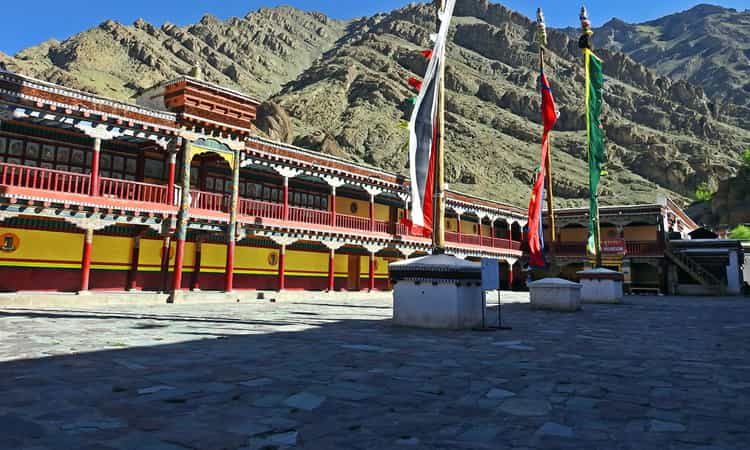
The thousand square meter courtyard of the Hemis Gompa is entered from the north-east. The two prayer flags, in front of the first steps up to the Dukhang, form which there is a good view of the dancers during the festival. A few places are reserved for guest but it is sometimes possible to buy ‘admission tickets’ to the gallery from business-minded monks!
The day before the two-day festival the part which foreigners can watch begins at 10 am with ceremonies in the courtyard. After prayers in the Dukhang the Rimpoche climbs the steps up to the courtyard, accompanied by musician monks, crosses it and takes his place underneath the gallery.
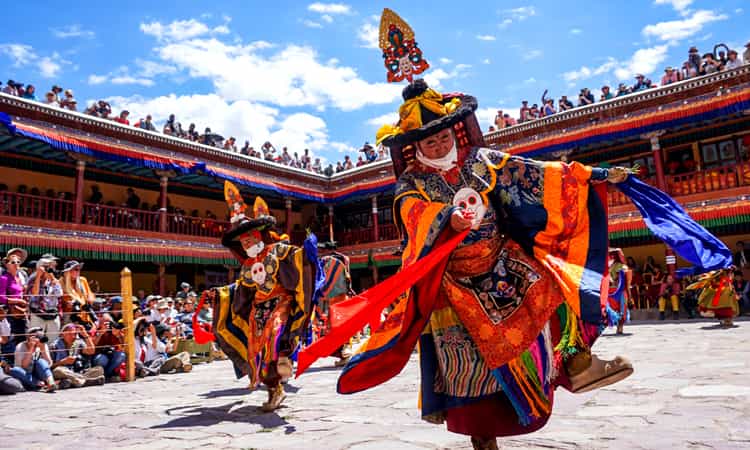
Hemis Festival and Sacred Mask Dances
The Gompa is famous far beyond the borders of Ladakh for its Hemis Festival (Hemis Setchu or Mela of the Hemis Gompa). This takes place every year with mask dances on the 10th and 11th day of the fifth Tibetan month. The date usually falls in the second half of June, although it sometimes extends into early July.
Hemis also houses a gigantic Thangka, one of the largest in the world, which is displayed to the public only once every 11 years during the festival. The festival draws pilgrims from across Ladakh and, since 1975, tourists from all over the world. It is virtually the only major religious festival in Ladakh held in summer when the mountain passes are open.
Shortly afterwards the dances begin, portraying the struggle against evil and the inevitable victory of good and Buddhism. The Padmasambhava Dance, showing the conquest of the Ruta demons, is a highlight. Other figures include Yama (God of Death), Guru Trakpo, and various manifestations of Padmasambhava.
The dances continue until late afternoon with a brief midday pause. Tea, soup, tsampa, sweets and refreshments are sold in the courtyard. Visitors wishing to take photographs should consider the sun’s position when selecting a viewpoint, as it becomes difficult to move in the crowd once the performances begin.
Monastery Interiors and Sacred Art
If you visit the Gompa outside festival time, you will be impressed by the stillness of the valley and have the opportunity to explore the various chapels. Near the Dukhang is the Lakhang, reached by a small set of steps from the yard. Its front room has a roof supported by four poles, and the side walls display partially damaged frescoes of guardians of the heavenly directions.
Inside the Dukhang, the general assembly hall, the throne of the Rimpoche dominates the seating area of the monks. The Lakhang houses a large gilded statue of Buddha Shakyamuni with blue hair, surrounded by silver chortens decorated with semi-precious stones. The Lakhang Nyingpo also contains beautiful frescoes.
Hemis preserves numerous sacred Thangkas and is known for its excellent library, well-preserved wall paintings and impressive Buddha figures.
Lineage of the Rimpoche and Drukpa Order
In the upper storeys near chapels such as the Zankhang lies the Kharrabgysal, the rooms of the Rimpoche or head lama. The Rimpoche, spiritual head of Hemis, is regarded as a reincarnation of the monastery’s founder, Stagshang Raspa, who built Hemis in the first half of the 17th century under King Sengge Namgyal.
After the Chinese takeover of Tibet, communication with the Rimpoche was disrupted. During the 1975 festival, Dugpa Rimpoche, a young reincarnation, was recognized as the new spiritual head. He belongs to the Drukpa Kagyu sect (red-cap order), which historically held influence in Ladakh and Bhutan. He currently resides in Darjeeling, where he completed his training.
How to Reach Hemis Monastery
Hemis is easily accessible by car or jeep from Leh, though public transport options are limited. By road, you follow the Upshi route past Shey and Tikse along the Indus River. After the TCP checkpoint at Karu, turn right to cross the Indus over a bridge and continue on the winding road up to the Gompa. Unlike many other monasteries, Hemis is not visible from a distance and appears only when you are close to it.
There is only one regular bus daily from Leh toward Hemis. You must take the Sakti bus departing around 11 am and get off at Karu Bridge. From there, a six-kilometer uphill walk of about two hours is required. Since the bus returns the same afternoon, a same-day return is not possible. Visitors planning to travel by bus must stay overnight and return the next day. During tourist season, tents are arranged for overnight visitors.


 Call
Call Enquiry