Last Updated on 07/04/2026
If you are planning to visit the Kamakhya temple and are now busy finding the best places to visit near the Kamakhya temple to add more worth to your yatra, then you are at the right place.
Situated on Nilachal Hill in Guwahati, the capital city of Assam, India, Kamakhya Temple and nearby attractions are of the Dus Mahavidya forms of Shakti and have five Shiva temples relevant to Sadhana and removing the fear of enemies. Also, with a series of kunds and within a few km, you can find some of the most scenic places and picnic spots, perfect for family vacations and spiritual experiences.
As people know only about the Kamakhya Temple, these places remain mostly unexplored, and travellers miss a great chance to add more value to their Kamakhya Temple Tour. In our article, we have tried our best to provide you with details on places to visit near Kamakhya Temple in Guwahati so you don’t miss them.
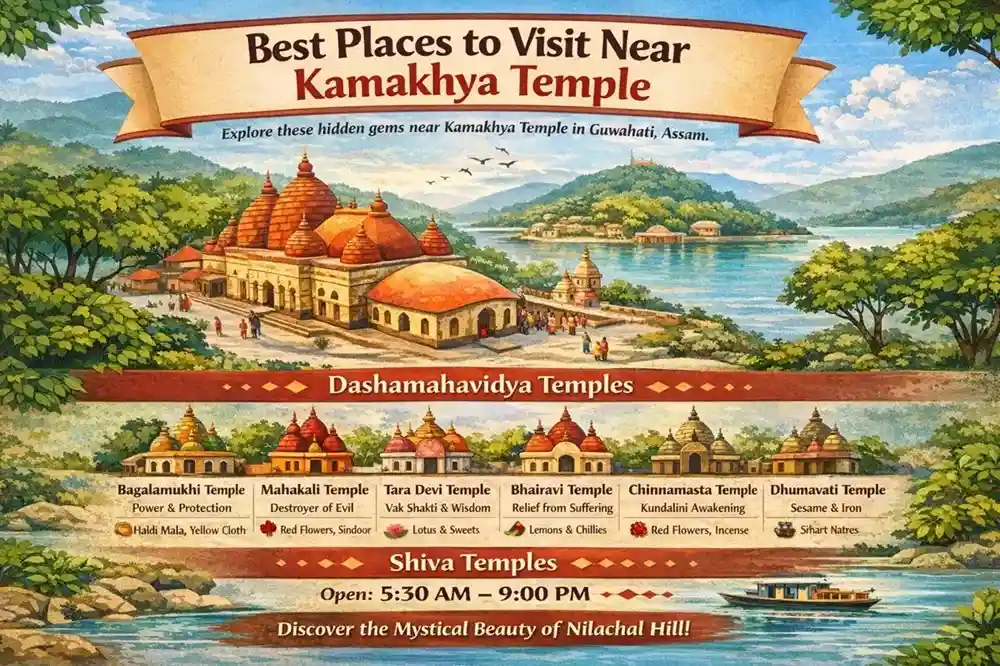
Places Near the Main Kamakhya Shrine Complex
The Bagalamukhi Temple
It is one of the Dasha Mahavidyas’ shrines on Nilachal Hill, located about 500 meters east of Kamakshi. Devi is known as the one who stuns the enemy; she symbolises power to paralyse foes and delusions, drawing tantric devotees at large.
Devotees visit for protection from enemies, victory in court cases or disputes, obstacle removal, financial stability, progeny, blessings and shielding from black magic or Tantra.
Prasad— Yellow items like Haldi mala, yellow cloths, Pila Chandan, coconut flowers, and sweet.
Maa Mahakali Temple
It is also one of the Dasha Mahavidyas, located just a 200-300 meter walk from the main shrine of Kamakhya Devi. Devi is honoured as the fierce form of Kali who destroys evil and ignorance. Also, this temple is framed as the most powerful tantric site.
Devotees seek her blessing for protection from black magic, victory over enemies, removal of obstacles, spiritual purification, and empowerment in tantric Sadhana.
Prasad – Red flower, sweet like Ladoo, Sindoor, coconut and incense.
The Maa Tara Devi Temple
It is located between the Mahakali and Kamakhya temples, at just a short walk of about 200-300 meters from the Kamakhya shrine. Renowned as the second Mahavidya, Tara Devi embodies Nil Saraswati and grants its tantric Sadhak (devotees) the power of speech (Vak-Shakti), meaning that whatever they say turns true. Therefore, consider the best spiritual places near Kamakhya Temple for tantric Sadhana.
Devotees seek her for eloquence, knowledge, protection from fear, guidance to salvation, aid in troubles, and tantric empowerment as Ugrata.
Prasad – blue/black flowers, lotus weapons symbolising her attributes, sweets, and coconuts.
Maa Bhairavi Temple
She is the goddess who controls the three worlds and destroys misery. Located at a short walk (about 300-400 m) from Kamakhaya Temple. Devotees visit for relief from suffering, family welfare, fear removal, tantric protection, marital harmony and the incineration of ego or sins.
Prasad—red flowers, sindoor, lemons, chillies, and sweets like kheer and sesame.
Maa Chinnamasta Temple
Here, the Devi is famed as the self-decapitated goddess, symbolising Kundalini awakening and transcendence of ego and sins, located 160 meters east of the main Kamakhya shrine. Here, the shrine uses a Yantra carving rather than an idol for tantric meditation.
Devotees seek an instant Kundalini rise here, along with the removal of attachments, spiritual realisation, fearless transcendence, and protection during tantric practices.
Prasad – The red flower symbolises blood (“red liquid”) and the lotus sweets and incense.
The Maa Dhumavati
The temple is located a short walk, 300-500 m, from the Kamakhya temple. She is known as the widow goddess of smoke and void, symbolising detachment and inauspiciousness turned to wisdom, and is part of the ancient Tantric cluster. Her shrine uses a Yantra rather than an idol and was recently renovated with a sacred underground water pit for esoteric worship.
Advanced Tantrics and renouncers visit for moksha siddhis, enemy defeats, trouble resolving, and liberation from worldly illusions, especially on Amavasya and Gupt Navratri.
Prasad – sesame seed, iron items, black salt, dry fruit and minimalistic items suit her austere form.
Maa Matangi and Kamala Temples
These are the final two Dasha Mahavidyas shrines on Nilachal Parvat, in which Matangi is located about 400 m northeast, and Kamala is located adjacent to the main entrance. Both include a short walk from the main Kamakhya shrine.
Matangi is tantric Saraswati, who is believed to rule speech arts and outcast wisdom, whereas Kamala is regarded as tantric Lakshmi, who embodies prosperity and lotus purity.
Matangi devotees seek mastery in arts, eloquence, attraction power, and conventional knowledge. Kamala is worshipped for wealth, fertility, beauty, harmony, and material spiritual abundance.
Prasad – Matangi Mata accepts Uchchhishta (leftover food), green fruits, and music.
Whereas Kamala Mata accepts lotus flower milk, sweet yellow items,
Prasad at all these temples—Vibhuti and energised water, along with fruits and sweets—are returned to devotees as Prasad.
Kamakhya Temple Nearby Attractions—Shiva’s temples
Kameswar Temple
Kameswar Temple is a Shiva temple within the main Kamakhya Temple complex on Nilachal Parvat, positioned close to the Chinnamasta shrine. Dedicated to Lord Shiva as Kameswar (lord of desire), it complements the Shakti worship at Kamakhya. It is also part of the five Shiva temples on Nilachal.
Devotees visit this temple for marital harmony, desire fulfillment, Shiva-Shakti balance, tantric siddhis, and purification alongside Kamakhya Darshan.
Prasad – Milk, Bilva leaves, Bel fruits, curd, and honey for Abhishekam.
Siddheswara Temple
Siddheswara Temple is one of the five Shiva temples on Nilachal Hill, reachable by a short trek downhill from the main Kamakhya temple complex. Pilgrims visit for spiritual siddhis, moksha, Shiva blessings, and completing the arduous parikrama of all Nilachal temples for salvation (moksha).
Prasad – Milk, Bilva leaves, Bel fruits, Curd, and Honey for Abhishekam.
Aghora Temple
This is a Shiva temple on a few-step trek from the main Kamakhya complex. Dedicated to Aghora Shiva, the fierce form conquering death and ignorance. Devotees seek Aghora’s grace for overcoming tamas (darkness), fearlessness, ultimate siddhis and tantric transcendence during parikrama.
Prasad – ashes (Vibhuti), Datura alcohol in tantric rites, bilva patra.
Amruteshwar Temple (Also Amra-Tokreshwar)
The temple is connected by a motorable road near the Brahmaputra riverbank, accessible from the Kamakhya complex. Known as Amra-Tokreshwar, it honours Shiva as the nectar-giving lord (amrita). Devotees seek nectar-like blessings for immortality, health, Moksh, and completing Nilachal Parikrama, the ideal endpoint for pilgrims after hill treks.
Kotilinga Temple
Famed for its massive Kotilinga (million Linga form) representing infinite Shiva manifestations, reached by a short downhill trek from the Kamakhya temple complex. Devotees seek boundless Shiva grace in atonement, family prosperity, and fulfilling the arduous Nilachal Parikrama for salvation.
Kedareswara Temple
Located adjacent to the main Kamakhya temple complex, dedicated to Kedar Shiva, lord of the cremation ground, it completes the Shiva-Shakti balance in Nilachal.
Devotees visit for moksha blessings, fearlessness in the face of death, tantric purification, and fulfilling the full Nilachal temple pilgrimage for the ultimate result.
Kamakhya Temple nearby Attractions—Kunds
The Saubhagya temple (or Saubhagya Kunda shrine area)
Refers to the sacred pond and adjacent worship spot next to the main Kamakhya temple. Renowned for bestowing martial bliss, fertility, and good fortune (saubhagya means auspiciousness), one of Nilachal’s sacred Kundas (ponds integral to ritual) never dries up, tied to the Kamakhya Shakti worship tradition.
Devotees perform tarpan (offerings) here for marital harmony, progeny blessings, prosperity, and wish fulfillment during the Kamakhya pilgrimage.
Prasad – Ritual bathing or Tarpan with red thread, flowers, milk and coins.
Ganesh Temple on Nilachal Parvat
Pandunath Devalaya
It is a historic Ganesha temple on the western side of Nilachal Hills by the Brahmaputra riverside, about 2-3 km downhill from Kamakhya Temple via Pandu Port Road. The pre-Ahom era shrine linked to the Mahabharata legend, where Pandavas disguised as Ganesha idols during exile were gifted by the Ahom king Rajeshwar Singh (1751-1769) to Kamakhya priest descendants, is known as the place of success with rock inscriptions.
Devotees seek Ganesha’s blessing for success, obstacle removal, safe travel, prosperity and as part of the Kamakhya pilgrimage circuit before and after hill Darshan.
Prasad-Modak sweet Durva Grass, Red Flower, Coconut Laddoos.
Return Prasad—Modak, fruit, and Vibhuti distribution after post-Aarti.
Timings—All these Dasha Mahavidya temples and Shiva’s temple follow the same timing as the Kamakhya temple solar-based schedule, with possible afternoon breaks.
| Opening time |
5.30 – 6.00 AM |
| Closing time |
8.00-9.00 PM |
Additional Places you May Visit at a Short Distance from the Main Kamakhya Shrine
| 16. Brahmaputra River Heritage Centre |
Cultural hub |
8 km – 13 min |
Riverside view, colonial architecture, cultural shows |
| 17. Navagraha temple |
Astrology temple (Chhatrasal Hill) |
10 km-22 min |
Nine celestial bodies: a bird’s-eye view of Guwahati |
| 18. Sukreswar temple |
Shiva temple on the hilltop |
4-5 km 10 min |
One of the largest Shiva Lingam sunset view boat rides at the ghat |
FAQ
Q1. Nilachal Hill temple Parikrama route?
Ans: The Nilachal Hill Parikrama route circles all Dashamahavidya and Shiva temples, starting from Kamakhya Temple, covering ~2–3 km, including short treks downhill to Siddheswara, Kotilinga, and Pandunath.
Pilgrims complete this sacred circumambulation for moksha, typically following the Mekhala Ujwala Path from 6 AM with stops at all 15+ shrines and kunds.
Q2. Best itinerary for a Kamakhya Temple Yatra with nearby temples?
Ans: Start at Kamakhya Temple at 5:30 AM for Darshan, then immediately complete the Nilachal Parikrama by visiting all 8 Dasha Mahavidya temples. and 5+ Shiva temples within 2 hours on foot. Next, head downhill to Pandunath Ganesha Temple (2–3 km), then take a ferry to Umananda Temple on Peacock Island. In the afternoon, visit Navagraha Temple (10 km, 22 min) and Sukreswar Temple (4–5 km). End your day at the Brahmaputra River Heritage Centre (8 km) for cultural shows, returning to Kamakhya for evening Aarti at 7:30 PM. Total distance ~25 km; hire a taxi for the full day.
Q3. What’s the best time to visit the Dashamahavidya temples on Nilachal Hill?
Ans: The best time to visit the Dasha Mahavidya temples on Nilachal Hill is during October to March (winter season), when the weather is pleasant (15–25°C) and ideal for walking the temple circuit.
Q4. Best places to visit near Kamakhya Temple for a couple?
Ans: For couples visiting Kamakhya Temple, here are the most romantic and memorable spots nearby: Umananda Temple (Peacock Island)/Brahmaputra River Heritage Centre/Sukreswar Temple & Ghat/Saraighat Bridge/Nehru Park (Pan Bazaar)/Assam State Zoo & Botanical Garden/Brahmaputra River Cruise.
Q5. Can childless couples visit Bhubaneswari Temple on Nilachal Hill?
Ans: Yes! Maa Bhubaneswari Temple (690 ft, the highest point) is specifically worshipped by childless couples and those with marital problems. Devi is the Adhisthatri Devi of Shukra (Friday), granting boons for fertility and harmony.
Q6. How much does a Kalashtami/Darshan VIP pass cost for Kamakhya Temple?
Ans:
- General Darshan: Free or ₹50 (long queue, 1–3 hr wait)
- Special/VIP Darshan: Starts from ₹500–₹501 per person (minimal wait, Tahra Darshan)
- Online Booking: Available at the official site—select date/time slot, pay via UPI/card, and download E-ticket.
Q7. Is there a dress code for visiting Dasha Mahavidya temples on Nilachal Hill?
Ans: Yes. Wear traditional or smart-casual attire:
- Women: Saree, salwar-kameez, or long skirt + top (avoid shorts and skirts above the knee)
- Men: Pajama + Kurta or pants + shirt (avoid vests and sleeveless)
Remove footwear before entering any temple. Leather items (belt, bag) may be restricted in tantric shrines.
Q8. Are there parking facilities near Kamakhya Temple?
Ans: Yes. Free parking is available at the base of Nilachal Hill (Kamakhya Gate).
Q9. Is Kamakhya Temple open on all days of the week?
Ans: Yes, open daily except during Ambubachi Mela (3 days in June when the temple closes for Devi’s annual menses)


 Call
Call Enquiry
good