Last Updated on 13/05/2026
It was a Tuesday morning in Port Louis, Mauritius, when Sunita Ramgoolam got the call that changed everything. Her daughter Priya, 26, had said yes. The wedding was set for February, and with just four months to prepare, Sunita did what three generations of Indo-Mauritian women had done before her — she booked tickets to Delhi.
Sunita’s grandmother had brought a Banarasi saree back from Varanasi decades ago, wrapped in muslin and carried like a precious heirloom. Her mother had once shopped the lanes of Chandni Chowk before the internet existed, guided only by a cousin who knew which gali sold the best zardozi work. Now, it was Sunita’s turn. But this time, the family needed more than a saree. They needed a bridal lehenga, gold jewelry, a sherwani for the groom, sarees for 23 female relatives, matching fabric for 11 bridesmaids, return gifts, home décor for the new couple’s apartment, and — because weddings are never simple — a last-minute mandap decoration set.
They landed at Indira Gandhi International Airport on a crisp November morning. A car from Namaste India Trip waited at the arrivals gate, the driver holding a sign with their name. Within 45 minutes, they were checked into their hotel in Karol Bagh. By noon, Priya was standing in a showroom in Chandni Chowk, holding a blush-pink lehenga to her chest with tears in her eyes, whispering: “Maa, this is the one.”
That is what shopping for an Indian wedding in Delhi feels like. It is not just a transaction. It is a homecoming.
If you are an NRI, a family from Mauritius, Fiji, South Africa, the UK, USA, Malaysia, Dubai, Canada, or anywhere else in the Indian diaspora — or if you are a foreign national marrying into an Indian family — this guide is written entirely for you. We will tell you exactly where to go, what to buy, how much to pay, and how to make the most of every single day in Delhi.
Why Delhi Is the Wedding Shopping Capital of the World
Delhi is not merely a city. For Indian weddings, it is a universe. No other city on earth — not Mumbai, not London, not Dubai — offers the combination of variety, craftsmanship, price range, and cultural authenticity that Delhi does.
Here is what makes Delhi incomparable for Indian wedding shopping:
- Scale: Delhi’s markets collectively stock millions of SKUs — lehengas, sarees, sherwanis, jewelry, fabrics, décor, gifts — under one metaphorical roof.
- Price Range: From budget wholesale markets where you can dress an entire baraat for ₹40,000 (~$500 USD) to luxury designer studios where a single bridal lehenga costs ₹5,00,000+ (~$6,000+ USD), every budget is served.
- Craftsmanship: Delhi is the trading hub for India’s finest craft traditions — Banarasi silk from Varanasi, zardozi embroidery from Lucknow, mirror work from Rajasthan, Kanjeevaram silk from Tamil Nadu, Phulkari from Punjab. Everything comes to Delhi.
- Customization: Unlike buying off-the-rack in Dubai or London, Delhi’s designers and tailors will customize your bridal wear to your exact measurements and color preferences, often within 7–15 days.
- Cultural Authenticity: Wearing clothes from Delhi to an Indian wedding is the equivalent of serving aged Bordeaux at a French dinner — it simply cannot be replicated elsewhere.
Suggested Tour: Delhi Tour Packages
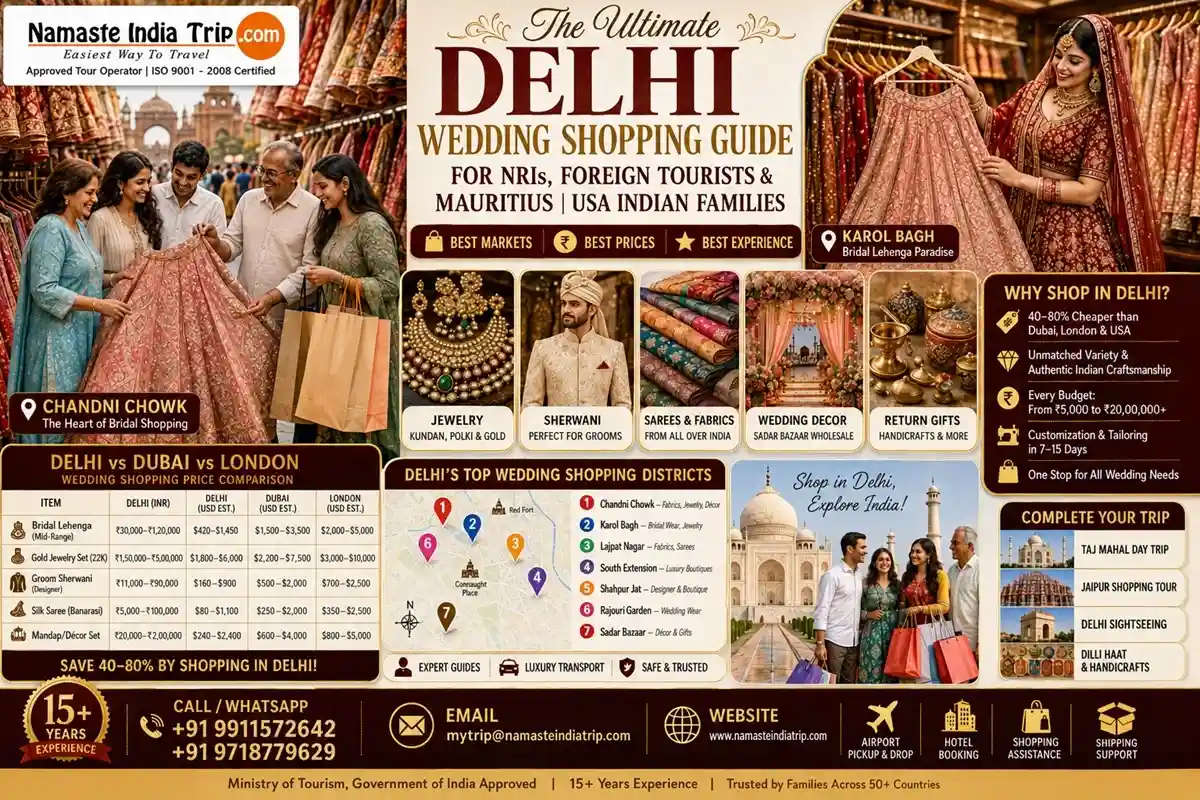
Delhi vs. Dubai vs. London: Wedding Shopping Price Comparison
| Item |
Delhi (INR) |
Delhi (USD est.) |
Dubai (USD est.) |
London (USD est.) |
| Bridal Lehenga (mid-range) |
₹30,000–₹1,20,000 |
$420–$1,450 |
$1,500–$3,500 |
$2,000–$5,000 |
| Bridal Lehenga (designer) |
₹1,00,000–₹10,00,000 |
$2,300–$9,600 |
$4,000–$12,000 |
$5,000–$15,000 |
| Gold Jewelry Set (22K) |
₹1,50,000–₹5,00,000 |
$1,800–$6,000 |
$2,200–$7,500 |
$3,000–$10,000 |
| Groom Sherwani (designer) |
₹11,000–₹90,000 |
$160–$900 |
$500–$2,000 |
$700–$2,500 |
| Silk Saree (Banarasi) |
₹5,000–₹100,000 |
$80–$1100 |
$250–$2,000 |
$350–$2,500 |
| Guest/Family Sarees (×10) |
₹30,000–₹1,50,000 |
$360–$1,800 |
$700–$3,500 |
$1,000–$5,000 |
| Return Gifts (per 100) |
₹10,000–₹50,000 |
$120–$600 |
$300–$1,200 |
$500–$2,000 |
| Mandap/Décor Set |
₹20,000–₹2,00,000 |
$240–$2,400 |
$600–$4,000 |
$800–$5,000 |
Conclusion: Delhi shopping saves NRI and international families 40–80% compared to buying the same items in Dubai, London, or North America. The quality, authenticity, and variety is also dramatically superior.
Best Months for Wedding Shopping in Delhi
Timing your shopping trip to Delhi matters enormously — both for weather and for market conditions.
| Month |
Rating |
Notes |
| October |
⭐⭐⭐⭐⭐ |
Post-monsoon, cool weather begins. Markets fully stocked with winter bridal collections. Best time overall. |
| November |
⭐⭐⭐⭐⭐ |
Peak bridal season. Maximum variety. Slightly crowded but perfect weather (15–25°C). |
| December |
⭐⭐⭐⭐ |
Cold (8–20°C) but excellent shopping. Festive collections still available. |
| January |
⭐⭐⭐⭐ |
Very cold mornings. Good prices -2 wedding wedding season rush. |
| February |
⭐⭐⭐⭐ |
Comfortable weather returns. Good for last-minute shopping. |
| March |
⭐⭐⭐ |
The weather is normal. Summer collections arrive. |
| April–June |
⭐⭐ |
Very hot (35–45°C). Not recommended for shopping-heavy trips. But less crowed, get good rates, and much time to shop and find varieties |
| July–September |
⭐⭐ |
Monsoon season. Humidity and rain can make shopping uncomfortable. |
Our recommendation: Plan your Delhi wedding shopping trip between October and February for the best experience — maximum stock, comfortable weather, and access to seasonal bridal collections.
Wedding season in India
| Peak Months |
November, December, January, and February. |
| Secondary Season |
A smaller, warm-weather season occurs in April and May |
| Cultural Factors |
Based on Hindu Panchang (calendar), families select auspicious dates (Shubh Muhurat) for the ceremony to ensure good fortune |
| Regional Differences |
North Indian weddings:- strongly prefer the cooler months of October/November to March,
southern regions :- weddings can occur year-round in some
North East India :- May to September -Late spring to early autumn, specifically
West India :- October to March, with a heavy concentration in November to February. |
How Many Days Do You Need for Complete Wedding Shopping in Delhi?
This is the single most underestimated part of wedding shopping planning. Most families who come for 3–4 days leave wishing they had stayed longer.
| Shopping Scope |
Recommended Days |
| Bride’s trousseau only (lehenga + jewelry + sarees) |
5–6 days |
| Full wedding shopping (bride + groom + family) |
8–10 days |
| Complete trousseau + décor + gifts + sightseeing |
12–14 days |
| Wholesale buying for entire extended family |
14–18 days |
Namaste India Trip designs custom 8–14 day Delhi shopping itineraries for NRI and international families that combine morning shopping with afternoon sightseeing, ensuring you see the Taj Mahal, Jaipur’s palaces, and Delhi’s iconic landmarks while completing your wedding shopping mission.
The Complete Map of Delhi’s Wedding Shopping Districts
1. Chandni Chowk — The Soul of Bridal India
Best for: Bridal lehengas, Banarasi sarees, gold jewelry, fabrics, wholesale shopping, wedding décor
There is no place on earth quite like Chandni Chowk. Built in the 17th century by Mughal Emperor Shah Jahan, this ancient market district is India’s most legendary shopping destination. For wedding shoppers, it is absolutely unmissable.
Key lanes for wedding shopping:
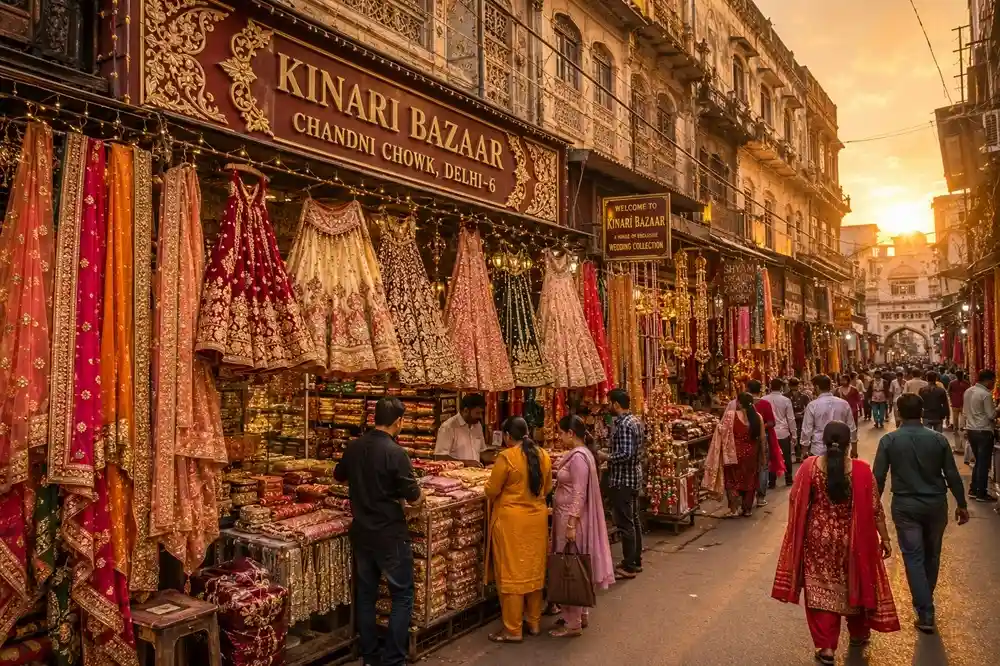
- Kinari Bazaar: The wedding capital within Chandni Chowk. Every shop sells items used in Indian weddings — laces, gota-patti, zari borders, bridal dupattas, decoration items, and embellishments. Walking through Kinari Bazaar during wedding season is a full sensory experience.
- Dariba Kalan: Delhi’s oldest jewelry market. Gold, silver, kundan, meenakari, and polki jewelry at prices far below what you’d pay at a branded jewelry chain.
- Kucha Mahajani:- historic market for gold in Delhi, renowned as one of Asia’s largest bullion and jewellery wholesale markets
- Nai Sarak: The fabric market of Chandni Chowk. Silk, cotton, brocade, chiffon — every fabric used in Indian weddings is available here in wholesale quantities.
- Ballimaran: Known for spectacles historically, but also home to accessory shops, bangles, and trinkets.
- Bhagirath Palace: Asia’s largest wholesale market for electrical goods, but the surrounding lanes have wedding lighting, LED décor, and string lights for mandap decoration.
Price range: Budget to mid-range. Expect to bargain. This is a wholesale-friendly market.
What to buy: Lehengas (₹5,000–₹100,000), Banarasi sarees (₹5,000–₹100,000), fabrics, jewelry, bangles, wedding stationery, décor items.
NRI/Foreigner Tip: Chandni Chowk can be overwhelming. Hiring a local shopping guide through Namaste India Trip is strongly recommended. An expert guide will take you directly to the best shops, help you negotiate, and ensure you are not overcharged.
2. Karol Bagh — The NRI Shopper’s Headquarters
Best for: Designer bridal lehengas, ready-made wedding wear, jewelry showrooms, one-stop shopping
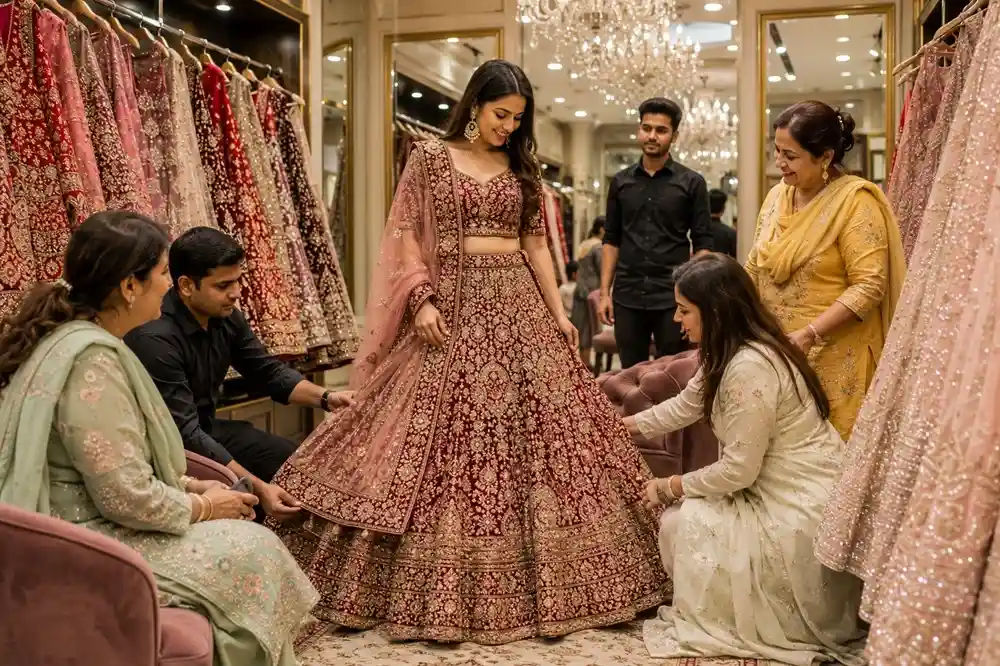
Karol Bagh is where most NRI and international families base their wedding shopping operations — and for good reason. The market is organized, relatively easier to navigate than Chandni Chowk, and offers a perfect mid-range between wholesale markets and luxury boutiques.
Must-visit areas in Karol Bagh:
- Ajmal Khan Road: The main shopping artery, lined with bridal wear showrooms, jewelry shops, footwear stores, and cosmetics retailers.
- Gaffar Market: Electronics, accessories, and imitation jewelry at wholesale prices.
- Tank Road area: Bridal lehenga showrooms and tailoring shops.
Price range: Mid-range to upper-mid. Better fixed prices than Chandni Chowk, but still room for negotiation on large orders.
What to buy: Bridal lehengas (₹15,000–₹2,50,000), groom’s sherwani, suit pieces, wedding footwear, jewelry (both gold and fashion), bangles, makeup, and accessories.
Pro Tip for Mauritius Families: Karol Bagh is extremely familiar to Indo-Mauritians who visit India regularly. Several shop owners in Karol Bagh specifically cater to the Mauritius, Fiji, USA, UK and South African Indian communities and may stock designs popular in these markets.
3. Lajpat Nagar — The South Delhi Fabric Paradise
Best for: Fabrics, sarees, dress materials, budget shopping, home décor fabrics
Lajpat Nagar Central Market is one of South Delhi’s most beloved shopping destinations. It is especially popular among families looking for trousseau fabric, unstitched suit pieces, and sarees at excellent value.
Key highlights:
- Massive selection of printed and embroidered fabrics
- Multiple saree emporiums with regional sarees from across India
- Affordable bridesmaid and family outfit materials
- Home furnishing fabrics and upholstery
Price range: Budget to mid-range.
What to buy: Unstitched suit sets (₹800–₹5,000), sarees (₹1,500–₹30,000), fabrics by the meter, dupatta sets, home décor fabrics.
4. South Extension — Luxury Bridal Boutiques
Best for: Designer wedding wear, luxury lehengas, premium jewelry, high-end accessories
South Extension (Part 1 and Part 2) is Delhi’s luxury shopping corridor, home to high-end designer boutiques, premium jewelry showrooms, and upscale saree stores.
Notable for: Designer bridal lehengas from established Delhi designers, premium silk sarees, branded gold jewelry, luxury accessories, and premium sherwani collections.
Price range: Upper-mid to luxury.
What to buy: Designer lehengas (₹1,50,000–₹8,00,000+), Tanishq and Kalyan Jewellers pieces, premium sarees, international-standard customer service.
Who should shop here: NRI families who want a hassle-free, air-conditioned, English-speaking shopping experience with a slightly higher price point but significantly better service.
5. Shahpur Jat — Delhi’s Boutique Designer Village
Best for: Independent designers, unique bridal wear, contemporary fusion Indian fashion, bespoke pieces
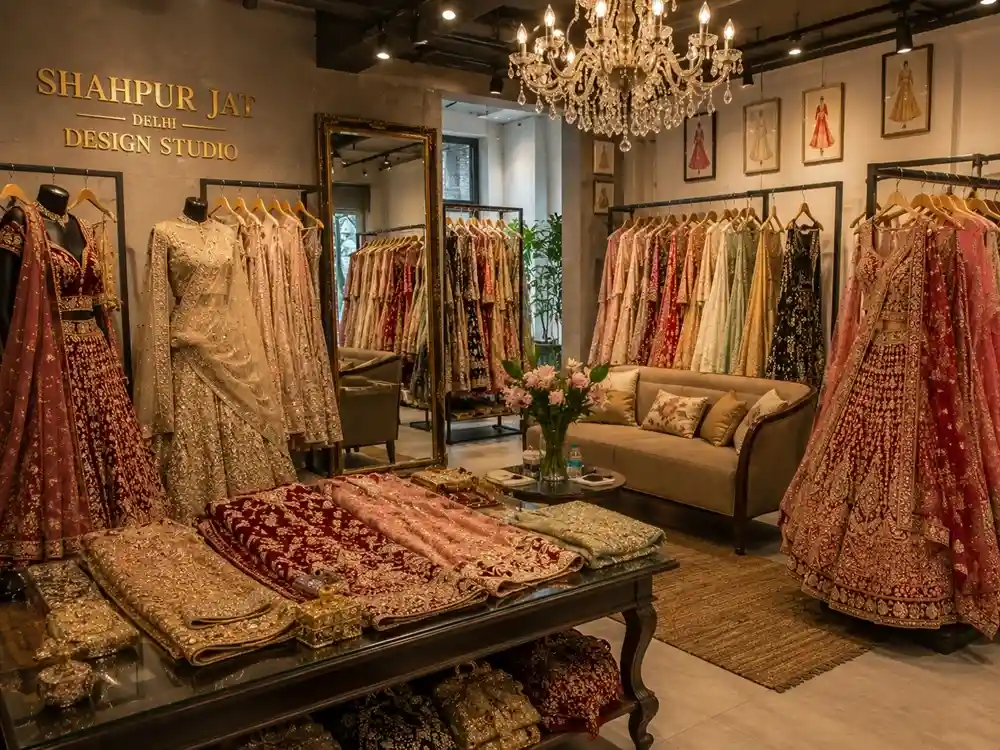
Shahpur Jat is one of Delhi’s best-kept secrets for the fashion-conscious bride. Tucked inside a former village that has been colonized by creative entrepreneurs, this area houses dozens of independent fashion designers who create unique, handcrafted bridal and occasion wear.
Why it’s special:
- Independent designers not found anywhere else in the world
- Bespoke bridal lehengas and sarees made to your exact measurements and color palette
- Contemporary interpretations of traditional Indian bridal fashion
- Artists, jewelers, and accessory designers working out of intimate studio spaces
Price range: Mid to premium, with excellent value for the uniqueness you get.
What to buy: Custom bridal wear, artisan jewelry, contemporary Indian fusion outfits, handmade accessories, craft jewelry.
6. Rajouri Garden — The Punjabi Bride’s Paradise
Best for: Bridal lehengas, wedding wear for families, jewelry, accessories, wedding shoes
Rajouri Garden in West Delhi is a bustling shopping hub enormously popular with Punjabi families — and increasingly with NRIs who want the feel of a vibrant local market with good variety.
Key streets: The main market strip along Ring Road, Raja Garden area, and the cross lanes have multiple bridal showrooms, jewelry stores, and boutiques.
Price range: Budget to mid-range.
What to buy: Lehengas, sherwanis, salwar-kameez sets, bridal shoes, jewelry, bangles, and wedding accessories.
7. Sadar Bazaar — The Wedding Decoration Capital
Best for: Wedding decorations, mandap materials, artificial flowers, LED lights, wedding favors, return gifts, packaging
If Chandni Chowk is the queen of bridal fashion, Sadar Bazaar is the king of wedding decorations. This massive wholesale market near New Delhi Railway Station is where Delhi’s wedding decorators, event planners, and caterers come to source everything from marigold garlands to crystal chandeliers.
What to buy:
- Artificial flowers and garlands (₹50–₹500 per piece)
- Wedding backdrop materials
- Table centerpieces and vases
- LED fairy lights and string lighting
- Wedding favor packaging and boxes
- Return gift items (diyas, small handicrafts, photo frames)
- Mandap decoration sets
Price range: Wholesale prices — some of the best deals in Delhi.
NRI Tip: Most items in Sadar Bazaar are sold in minimum quantities (dozens or hundreds). Ideal for families who need to buy decorations or return gifts in large numbers. Shipping and customs regulations for your home country should be checked before buying large quantities.
Best Bridal Lehenga Markets in Delhi: A Ranked Guide
For the bride herself, the lehenga is the centrepiece. Here is where to look based on your budget:
| Budget (INR) |
Budget (USD) |
Best Markets |
| ₹5,000–₹20,000 |
$60–$240 |
Chandni Chowk (wholesale), Gandhi Nagar |
| ₹20,000–₹80,000 |
$240–$960 |
Karol Bagh, Lajpat Nagar, Rajouri Garden, Chandni Chowk |
| ₹80,000–₹3,00,000 |
$960–$3,600 |
Karol Bagh premium showrooms, South Extension, Chandni Chowk |
| ₹3,00,000–₹15,00,000+ |
$3,600–$9,600+ |
South Extension designer boutiques, Shahpur Jat, Chandni Chowk |
What to Look for in a Bridal Lehenga
- Embroidery type: Zardozi (metal threadwork), Resham (silk thread), Gota-patti (gold ribbon work), Sequence, or Mirror work
- Fabric: Pure silk, velvet, georgette, or net base
- Weight: Heavy bridal lehengas can weigh 3–16 kg. Ensure the bride can carry it comfortably
- Customization: Can the shop alter the blouse, adjust the length, or change the colour?
- Dupatta: Is a matching dupatta included? Check its quality separately
Jewelry Shopping in Delhi: Gold, Kundan, Polki & More
Indian wedding jewelry is an art form. Delhi is home to some of the finest jewelry traditions in the world.
Gold Jewelry Markets
- Dariba Kalan (Chandni Chowk): India’s oldest gold bazaar. 22K and 24K gold jewelry, silver, and precious stones. Prices are close to market gold rates.
- Karol Bagh jewelry lane: Multiple showrooms with traditional and contemporary gold jewelry.
- South Extension: Branded showrooms including Tanishq, PC Jeweller, and Kalyan Jewellers, Malabar Gold & Diamonds, Joyalukkas, CaratLane, Mehrasons Jewellers Hazoorilal Legacy,Amrapali Jewels, Senco Gold & Diamonds.
Kundan, Polki & Meenakari Jewelry
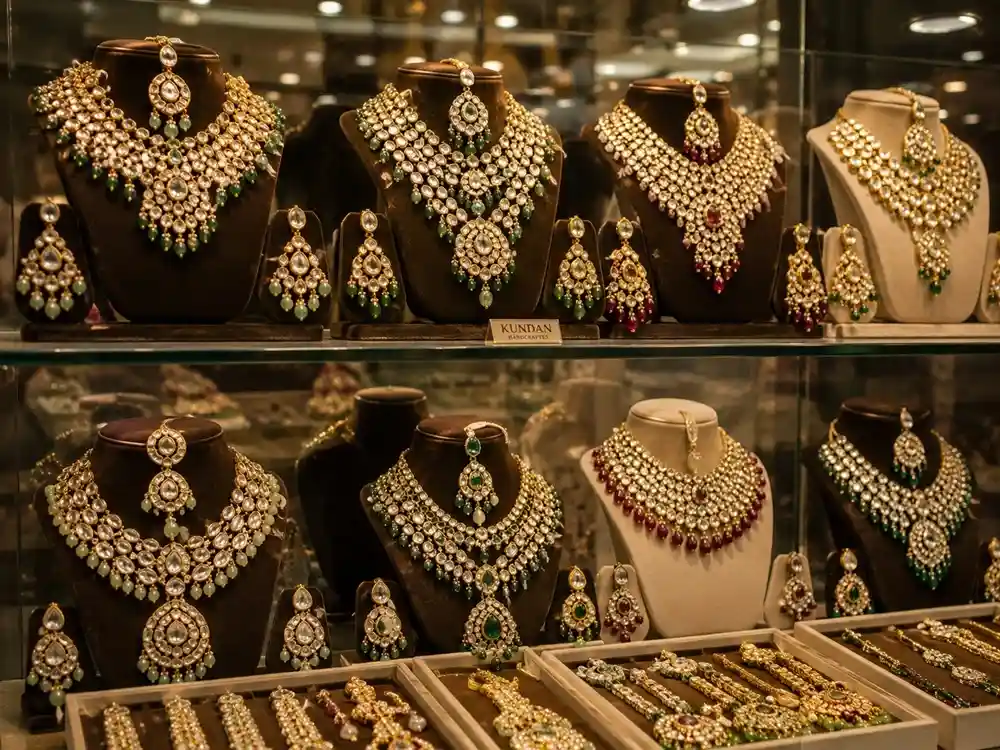
These are traditional Indian bridal jewelry styles that originated in the royal courts of Rajasthan. Kundan involves setting uncut gemstones in a gold foil base. Polki uses uncut raw diamonds. Meenakari involves painted enamelwork on the reverse of jewelry.
Where to buy: Dariba Kalan in Chandni Chowk has specialist Kundan jewelers. Karol Bagh also has good options.
Price range:
- Imitation Kundan set: ₹2,000–₹15,000 ($24–$180)
- Semi-precious Kundan set: ₹20,000–₹80,000 ($240–$960)
- Real gold Polki set: ₹1,50,000–₹8,00,000+ ($1,800–$9,600+)
Temple Jewelry
South Indian-style temple jewelry (heavy gold-coloured jewelry with Goddess motifs) is popular for South Indian brides and also among Mauritius, USA UK Tamil, Telugu, Kankada families.
Where to buy: Lajpat Nagar, Karol Bagh, and specialized South Indian jewelry stores in South Delhi.
Groom’s Sherwani Shopping Guide
The groom’s sherwani is nearly as important as the bridal lehenga. Delhi has extraordinary options at every price point.
Best Markets for Sherwani Shopping
- Karol Bagh: The best all-round destination for groom’s wear. Multiple dedicated sherwani showrooms.
- Chandni Chowk: More traditional and heavily embroidered options at lower prices.
- South Extension: Designer sherwanis and Indo-Western suits.
- Shahpur Jat: Contemporary fusion sherwanis for the modern groom.
Sherwani Styles
- Classic Sherwani: Long coat-style garment with churidar pyjama. The most traditional.
- Achkan: Slightly shorter than a sherwani, more fitted. Very popular among NRI grooms.
- Nehru Jacket set: A waistcoat-style jacket over a kurta. Modern and stylish.
- Indo-Western: Asymmetric cuts, contemporary embellishments, and Western trouser bottoms.
Price range:
- Ready-made (mid-quality): ₹8,000–₹25,000 ($95–$300)
- Designer ready-made: ₹25,000–₹80,000 ($300–$960)
- Custom-made designer: ₹60,000–₹2,50,000+ ($720–$3,000+)
Fabric Markets: Buy by the Meter, Dress the Entire Family
One of the biggest advantages of shopping in Delhi is buying fabric by the meter and having outfits stitched locally. This is particularly valuable for NRI families who want 10–20 matching outfits for relatives.
Best Fabric Markets
- Nai Sarak (Chandni Chowk): The grandaddy of fabric markets. Silk, cotton, georgette, chiffon, Banarasi brocade — all available wholesale.
- Lajpat Nagar: Excellent for printed fabrics, embroidered dress materials, and suit pieces.
- Gandhi Nagar (Shahdara): Delhi’s largest wholesale garment market. Not as well known to tourists, but extraordinary prices.
Popular Fabrics for Indian Weddings
| Fabric |
Use |
Price Range (per meter) |
| Banarasi Silk |
Bridal sarees, lehengas |
₹800–₹20,000 |
| Kanjeevaram Silk |
South Indian bridal sarees |
₹1,200–₹32,000 |
| Pure Georgette |
Lehengas, sarees |
₹200–₹1,500 |
| Raw Silk |
Blouses, sherwanis |
₹300–₹2,000 |
| Velvet |
Winter lehengas, sherwanis |
₹400–₹2,000 |
| Net/Tulle |
Dupattas, layered lehengas |
₹100–₹500 |
| Chanderi |
Light sarees, salwar suits |
₹300–₹10,000 |
Wedding Decoration Markets in Delhi
Planning to decorate a wedding venue yourself or ship decorations back? Delhi has no equal for wedding decoration shopping.
Sadar Bazaar is the number one destination, but also explore:
- Nai Sarak: For fabric-based decorations
- Kinari Bazaar: For embellishments, ribbons, and decorative borders
- Bhagirath Palace area: For lighting and electrical decorations
What to Buy for Wedding Decorations
- Artificial flower sets (marigolds, roses, jasmine strings)
- Backdrop fabric and draping material
- Mandap pillars and arch frames
- Table centrepiece items
- Diya (lamp) sets for ceremony
- Flower vases, trays, and platters
- Wedding banner and signage materials
- LED string lights and fairy lights
- Chair covers and sashes
Indian Wedding Gift Shopping in Delhi
Delhi is paradise for wedding gifts, both for guests to bring to the wedding and for the couple to give as return gifts.
What to Buy as Indian Wedding Gifts
- Handicrafts: Wooden boxes, brass items, marble inlay pieces (Agra-style), terracotta art
- Textiles: Pashmina shawls (₹2,000–₹60,000), embroidered cushion covers, blockprint tablecloths
- Home Decor: Silver or brass idols, decorative thalis, copper water bottles
- Ayurvedic Products: Handmade soaps, essential oils, herbal skincare sets — popular as return gifts
- Jewelry: Silver trinkets, traditional earrings, anklets — ideal as bridesmaid gifts
- Food Hampers: Dry fruits, Indian sweets, spice sets in decorative packaging
Best Markets for Wedding Gift Shopping
- Dilli Haat (INA): A government-run crafts market with artisans from all 29 states of India. Fixed prices. Excellent for authentic handicrafts and textiles. One of the best places for NRIs and foreigners to buy genuine Indian crafts without bargaining stress.
- Sadar Bazaar: For return gifts in bulk
- Janpath Market: Affordable ethnic gifts, bags, and accessories
What To Buy From India: The Complete NRI Shopping List
Whether it’s your first trip or your tenth, here is everything worth buying from India for an Indian wedding:
For the Bride
- Bridal lehenga (main outfit + reception outfit + mehendi outfit)
- Bridal jewelry (full set: necklace, earrings, maang tikka, bangles, haath phool, payal)
- Bridal bangles (glass, gold-plated, or gold)
- Bridal shoes/heels (Kolhapuri chappals or embroidered heels)
- Bridal dupatta (separate statement piece)
- Sarees for post-wedding events
For the Groom
- Wedding sherwani
- Sehra (groom’s floral headpiece base)
- Wedding shoes (mojari/jooti — embroidered leather shoes)
- Kurta sets for pre-wedding functions
For the Family
- Sarees for mothers, aunts, sisters
- Suit pieces (unstitched salwar-kameez sets)
- Kurta-pyjama sets for male relatives
- Children’s ethnic wear
Indian Treasures to Take Home
- Banarasi sarees — authentic, UNESCO-heritage weave
- Pashmina shawls — genuine Kashmiri wool
- Kashmiri carpets — handwoven, intricate patterns
- Phulkari dupattas — Punjabi embroidered fabric
- Rajasthani block-print items — bedcovers, tablecloths, bags
- Ayurvedic products — Patanjali, Forest Essentials, Kama Ayurveda
- Attar (natural perfume) — from Kannauj, the perfume capital of India
- Indian spices — cardamom, saffron (Kashmiri), star anise
- Brass and copper items — urli, lamps, thali sets
Luxury Designer Wedding Shopping in Delhi
For NRI families seeking the finest in Indian bridal fashion, Delhi has a thriving ecosystem of established designers whose work is comparable — in quality and design — to the finest fashion houses internationally.
Luxury Designer Areas
- Emporio Mall (Vasant Kunj): Delhi’s luxury mall. Houses Indian designers including Rohit Bal, JJ Valaya, and more alongside international luxury brands.
- DLF Promenade and DLF Emporio: Premium designer wedding wear.
- Mehrauli: Several luxury designer ateliers in converted havelis and farmhouses.
Price expectation: Couture bridal lehengas from established Delhi designers range from ₹3,00,000 to ₹20,00,000+ ($3,600–$24,000+). Custom pieces for destination weddings or high-profile events can cost significantly more.
Booking note: High-end designers in Delhi typically require appointments, and custom pieces need 4–8 weeks of lead time. Plan your trip accordingly.
Budget Wedding Shopping Markets: Complete Your Trousseau Under ₹2,00,000
For NRI families working with a tighter budget, or those buying for a large number of family members, Delhi’s wholesale markets are extraordinary value.
Best Budget Markets
- Gandhi Nagar (Shahdara): Delhi’s largest garment wholesale market. Ready-made clothing for men, women, and children at manufacturing prices.
- Chandni Chowk wholesale lanes: Buying in quantity unlocks wholesale prices.
- Tilak Nagar Market: Western Delhi’s shopping hub. Less touristed, better prices.
- Sarojini Nagar: Export surplus fashion — original brands at fraction of retail price (not for wedding wear, but great for casual items and gifts).
Wholesale Wedding Markets: Buying for the Entire Baraat
If your wedding guest list runs into the hundreds, or if you are buying for a large joint family, Delhi’s wholesale markets will serve you better than any boutique.
Top Wholesale Wedding Markets
- Gandhi Nagar: Garments wholesale. Minimum order quantities apply (typically 6–12 pieces per design).
- Sadar Bazaar: Decorations and gifts wholesale.
- Nai Sarak: Fabrics wholesale. Buy by the bolt for the best prices.
- Kinari Bazaar: Wedding embellishments, laces, borders, and accessories wholesale.
Wholesale buying tips:
- Always negotiate on quantity. The more you buy, the lower the per-unit price.
- Ask specifically for “wholesale rate” — shops will often quote a higher “retail rate” initially.
- Bring a calculator and know your currency conversion rates.
- Carry cash. Many wholesale vendors offer additional discounts for cash payment.
Shopping Tips for NRIs, Foreign Tourists & Mauritius Travelers
General Shopping Etiquette
- Bargaining is expected in most markets outside luxury boutiques. The first quoted price is rarely the final price.
- Never show extreme excitement about a piece before asking the price — it signals you are willing to pay more.
- Always visit 2–3 shops before making a decision in any category.
- Build rapport before negotiating. A friendly conversation about where you are from often results in better prices.
- Check return policies — most markets have no-return policies. Check garments and jewelry carefully before purchase.
- Fixed-price shops (clearly marked) are exactly that. Do not attempt to bargain in these.
Bargaining Tips for Foreigners
- Start at 40–50% of the quoted price and work upward.
- Always be polite and smile. Aggressive bargaining is counterproductive.
- Be prepared to walk away. The seller will often call you back with a better offer.
- Buy multiple items from the same shop — this gives you more negotiating power.
- Learn a few Hindi phrases: “Thoda kam karo” (reduce a little), “Bahut mehenga hai” (it’s very expensive), “Last price kya hai?” (what is your best price?).
Specific Tips for Mauritius, USA , UK, Dubai Travelers
- Many Chandni Chowk and Karol Bagh shop owners are aware of Mauritius, USA, UK Indian buyers and their preferences. Mentioning you are from Mauritius, USA, UK often triggers familiarity and sometimes better service.
- Check customs regulations for Mauritius, USA, UK before purchasing. Textiles and jewelry have specific import duty regulations.
- Consider shipping your purchases via a reputable courier rather than carrying everything as check-in baggage. DHL and FedEx have offices in Delhi.
- Carry both INR and USD. Most market sellers prefer INR but USD is accepted in many places.
Tips for NRI Shoppers from UK, USA, Canada, Australia
- Your foreign credit/debit cards work at most major showrooms in South Extension and Karol Bagh. Smaller market stalls are cash-only.
- ATMs are plentiful across Delhi. Withdraw INR for market shopping.
- GST (Goods and Services Tax) is included in most quoted prices. Ask specifically if a price includes GST.
- Keep all receipts for customs declaration when returning home.
- The Indian government allows duty-free import of gifts up to a certain limit — check current regulations for your home country.
Safety Tips for Foreign Shoppers in Delhi
Delhi is a large metropolitan city and is generally safe for international visitors, particularly in well-known shopping areas. However, some sensible precautions go a long way.
- Use a trusted local guide: The single most important safety and value tip for foreigners. A knowledgeable local guide prevents overpricing, language barriers, and navigational confusion.
- Keep valuables secure: Use a money belt or inside-pocket wallet in crowded markets like Chandni Chowk.
- Pre-arrange transport: Don’t rely on random auto-rickshaws or taxis near tourist markets. Pre-booked, app-based taxis (Uber/Ola) or your hotel’s arranged transport is always safer.
- Stay hydrated: Delhi’s climate can be harsh. Carry water, especially in summer months.
- Do not carry large amounts of cash at once: Use ATMs as needed rather than carrying all your shopping money simultaneously.
- Trust your instincts: If a deal seems too good to be true, it usually is.
- Keep your hotel’s contact details handy: Save your hotel’s address in Hindi — show it to any driver if needed.
- Travel with your group: Chandni Chowk’s lanes can be disorienting. Stay together, especially in the evening.
Complete “What To Buy From India” Checklist for Wedding Shopping
Use this checklist to plan your shopping by category:
✅ Bride’s Shopping
- Bridal lehenga (main)
- Reception/second function outfit
- Pre-wedding function outfits (mehendi, sangeet, haldi)
- Bridal jewelry set (gold/kundan/polki)
- Bangles (glass, gold, or diamond)
- Maang tikka
- Nath (nose ring)
- Haath phool (hand jewelry)
- Payal (anklets)
- Bridal shoes
- Dupatta (additional statement piece)
- Trousseau sarees (6–12 recommended)
✅ Groom’s Shopping
- Wedding sherwani
- Cocktail/reception outfit (Indo-western or suit)
- Pre-wedding kurtas (2–3)
- Wedding shoes (mojari)
- Accessories (pocket square, brooch, safa/turban fabric)
✅ Family Shopping
- Sarees for mother(s) of bride/groom
- Sarees for aunts and senior female relatives
- Suit pieces for female relatives
- Kurta-pyjama sets for male relatives
- Children’s ethnic wear
✅ Wedding Décor
- Mandap decoration set
- Artificial flowers
- LED lights and fairy lights
- Table décor items
- Fabric draping for venue
✅ Return Gifts
- Gift boxes (minimum 50–200)
- Gift items (diyas, handcrafted items, ayurvedic sets)
- Packaging (tissue paper, ribbons, bags)
✅ Indian Treasures to Carry Home
- Pashmina shawls
- Banarasi sarees (heirlooms)
- Handicrafts (marble, brass, wood)
- Ayurvedic products
- Spices (saffron, cardamom)
- Attar/natural perfumes
Sample 10-Day Delhi Wedding Shopping Itinerary
Day 1: Arrival, airport pickup, hotel check-in, rest, evening stroll in Connaught Place
Day 2: Chandni Chowk full day — Kinari Bazaar (décor & embellishments), Dariba Kalan (jewelry), Nai Sarak (fabrics)
Day 3: Karol Bagh — Bridal lehenga shopping, groom sherwani shortlisting, jewelry showrooms
Day 4: South Extension — Luxury bridal wear, branded jewelry, designer shopping
Day 5: Shahpur Jat — Boutique designers, bespoke orders placed, artisan jewelry
Day 6: Lajpat Nagar — Family sarees, fabric shopping, suit pieces
Day 7: Sadar Bazaar — Wedding decorations, return gifts, wholesale items
Day 8: Rajouri Garden + Gaffar Market — Fashion accessories, electronics, casual wear
Day 9: Collection of orders, alterations, final fittings, Dilli Haat for handicrafts
Day 10: Packing, shipping coordination, departure with Namaste India Trip airport drop
Optional extension: Day trips to Agra (Taj Mahal), Jaipur (jewelry + textiles), and Vrindavan (religious shopping)
FAQ: Wedding Shopping in Delhi for NRIs & Foreign Tourists
Q1: Is Delhi the best city in India for wedding shopping?
Yes, Delhi is widely considered the best city in India for complete Indian wedding shopping. It offers the widest variety of products, the best price range from budget to luxury, access to fabrics and designs from all regions of India, and strong infrastructure for international visitors including easy international flights, good hotels, and English-speaking shop staff.
Q2: How much does a complete Indian bridal trousseau cost in Delhi?
A complete bridal trousseau in Delhi (including bridal lehenga, jewelry, family sarees, accessories, and gifts) typically costs between ₹3,00,000–₹20,00,000 ($3,600–$20,000 USD) depending on quality and quantity. Budget-focused shopping can be done for ₹1,00,000–₹2,00,000 ($1,200–$2,400) for the bride’s essentials alone.
Q3: Can foreigners bargain in Delhi markets?
Yes. Bargaining is standard practice in most Delhi markets outside of fixed-price stores and branded showrooms. It is polite and expected. Starting at 50% of the quoted price and settling at 60–70% of the original price is typical.
Q4: What is the best market in Delhi for bridal lehenga shopping?
Karol Bagh is generally considered the best all-round market for bridal lehenga shopping in Delhi — offering mid-range to premium options with good variety and relatively organized shopping. Chandni Chowk is better for budget and wholesale, while South Extension is better for luxury and designer pieces.
Q5: How should NRIs plan their Delhi wedding shopping trip?
NRIs should plan a minimum of 8–10 days for complete wedding shopping. Arriving in October–November is ideal. Booking accommodation in Karol Bagh or South Delhi provides convenient access to most markets. Hiring a local shopping guide (available through Namaste India Trip) dramatically improves the efficiency and value of the shopping experience.
Q6: Can I ship purchases from Delhi to Mauritius, UK, USA, or Canada?
Yes. DHL, FedEx, and India Post all operate international shipping from Delhi. For large quantities, sea freight is more economical. Check customs and duty regulations for your specific country before purchasing. Jewelry and gold items have specific customs rules in most countries.
Q7: Is it safe for foreign women to shop alone in Delhi markets?
Delhi’s major markets are generally safe, but it is always advisable for foreign visitors, especially women, to shop in groups or with a trusted local guide. Chandni Chowk can be crowded and disorienting. Markets in South Delhi (Lajpat Nagar, South Extension) are more comfortable for solo shopping.
Q8: What are the best months to visit Delhi for wedding shopping?
October through February is the ideal window. November is considered peak bridal shopping season with maximum variety and good weather. Avoid April–September due to extreme heat and monsoon.
Q9: Do shops in Delhi accept credit cards and foreign currency?
Larger showrooms in Karol Bagh, South Extension, and malls accept Visa, MasterCard, and Amex. Smaller market stalls and wholesale vendors are typically cash-only (INR). USD, Euro, and GBP are accepted informally in some tourist-facing shops but always at unfavorable exchange rates. Withdraw INR from ATMs for market shopping.
Q10: Can Namaste India Trip arrange a complete shopping tour of Delhi?
Absolutely. Namaste India Trip specializes in customized shopping tours for NRIs, foreign tourists, and Mauritius Indian families. Services include airport pickup, hotel arrangement, expert local shopping guide, luxury transport between markets, Taj Mahal and Jaipur day trips, and end-to-end travel planning for your India wedding shopping trip.


 Call
Call Enquiry