Last Updated on 08/06/2026
Kamakhya Temple is one of the most powerful and oldest Shakti shrines in India. It is situated in Guwahati, Assam, on Nilachal Hill. The temple dates back many centuries and is deeply rooted in historical references and mythology. The temple is a sacred spot dedicated to the Goddess Kamakhya, who is known to be the source of power and life.
The unique thing about this temple is that in the sanctum, there is no idol, but a natural yoni-shaped stone. Ambubachi Mela is held every year at the temple, celebrating Goddess Kamakhya’s menstruation cycle.
Kamakhya Temple At a Glance
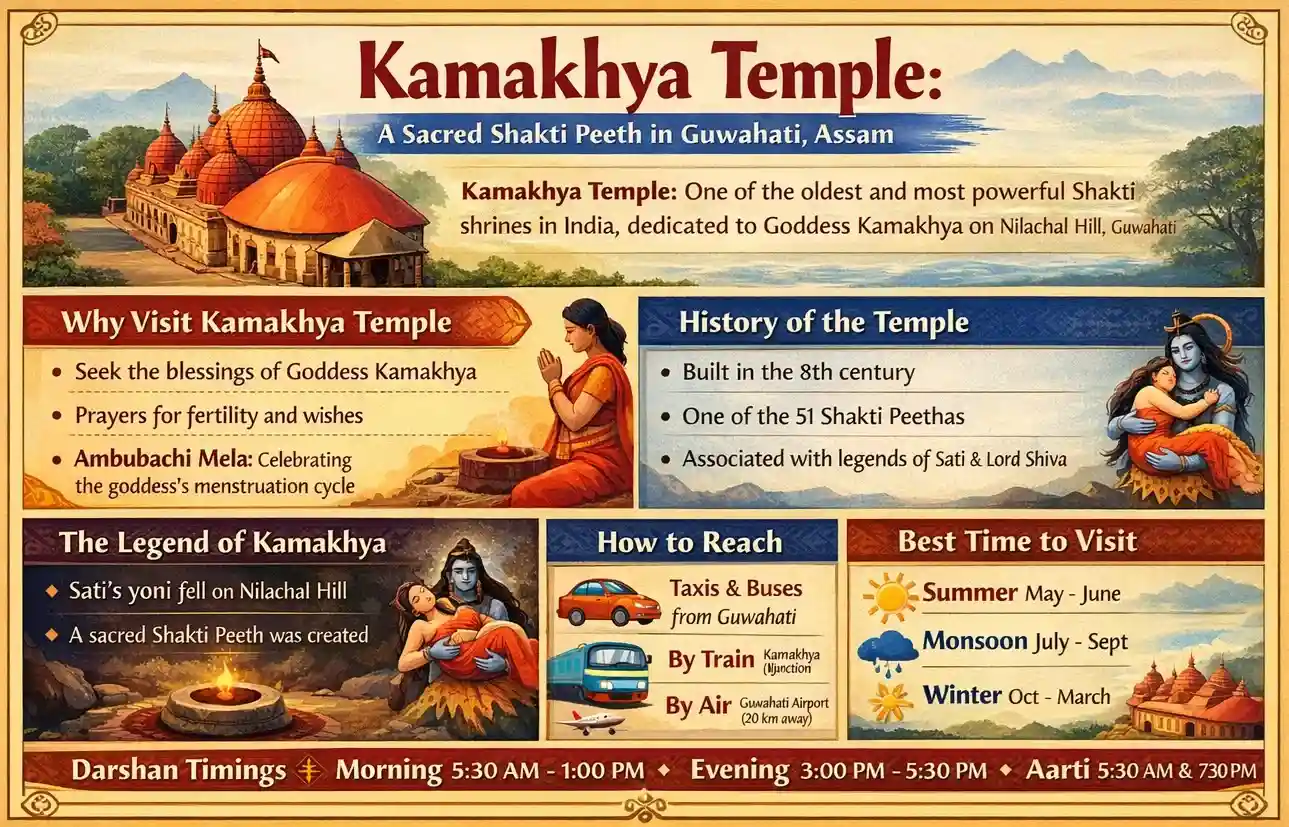
Why Visit Kamakhya Temple
The Kamakhya Temple is situated on the Brahmaputra River’s southern bank above the Nilachal Hills. Every year, the temple is visited by millions of devotees from different parts of the world to seek the blessings of Goddess Kamakhya. Many devotees choose a Kamakhya Temple Darshan Tour to visit the temple and seek the blessings of Goddess Kamakhya in a peaceful and organized way.
Many devotees visit seeking blessings for fertility, family wellbeing, and spiritual guidance. The goddess is worshipped for her divine grace and creative power.
History of Kamakhya Temple
The Kamakhya Temple is a historic Shakti pith. It is said that the goddess fulfils the devotee’s wishes if one truly worships her. According to Hinduism, the temple is considered to be one of the 51 Shakti Peethas. For Tantric practices, it is a major center. Many folk tales and legends are associated with this temple’s construction. Earliest references to the temple complex date back to the early medieval period. The current structure reflects multiple phases of construction and renovation.
Local legends attribute the original shrine to Narakasura, a demon king who is said to have been a devotee of the goddess. However, it is suggested by historical accounts that in the sixteenth century, the Koch king Maharaja Biswa Singha and his sons Chilarai and Naranarayan played an important role in its development. Later, during Ahom king Swargadeo Rajeswar Singha’s reign, renovations were carried out.
The Story Related to the Temple
When Shiva got to know of the tragic end of Sati, in extreme anger and sorrow, he opened his third eye. After this, he carried Sati’s body and started performing the Tandava dance. Lord Shiva was extremely grieved and carried on his shoulder the dead Sati and roamed the whole universe without any destination or purpose.
To save the world from destruction, Lord Vishnu made fifty-one parts of the body of Sati with the help of his Spinning Wheel. The places where Sati’s body parts fell were turned into religious sites for worshiping her. Out of the fifty-one body parts of Sati, the female sexual organ fell above Kamrup’s Nilachal hill.
It is believed that Kamakhya Temple’s current spot is the place where the yoni of Sati fell, and the temple was built there. The unique thing about this temple is that no idol is worshipped here. Instead, Goddess Sati’s yoni is worshipped, which has been enshrined in the sanctum sanctorum.
Architecture of Kamakhya Temple
The Kamakhya Temple follows the Nilachal style of architecture — a distinct regional style specific to Assam. The main temple features a beehive-shaped shikhara (tower) that rises above the sanctum, flanked by smaller towers on three sides. This shikhara design is characteristic of temples built or rebuilt during the Koch and Ahom periods.
The temple complex sits on Nilachal Hill at approximately 800 feet above sea level and contains multiple shrines within its premises. The main sanctum (garbhagriha) is set partially below ground, accessed by a narrow staircase. This underground chamber holds the yoni-shaped cleft in the rock — the main object of worship — which is always moist from underground spring water.
The outer walls and pillars feature carvings of gods, goddesses, and celestial figures. The statue of Lajja Gauri is embedded on the outer wall — a distinctive sculptural element worth looking for on your visit. The Navagraha Temple at the base of the hill was built in the same period and houses nine planetary shrines in a single structure.
Ambubachi Mela — The Mystery of Kamakhya Temple
A mystery related to Kamakhya Temple is the annual Ambubachi Mela that draws lakhs of pilgrims, sadhus, and tantric practitioners from across India and beyond. The Ambubachi Mela is considered to be the goddess’s menstrual period, during which the sacred site remains closed for three days. During this period, the power of creation and worship of holiness takes center stage.
The annual Ambubachi Mela that is held at this temple creates an atmosphere that attracts devotees from different parts of the world. Every year, it is celebrated between June and July during the Assamese month of Ahar.
| Ambubachi Mela 2026 Dates:
Based on the Assamese Hindu calendar, Ambubachi Mela 2026 is tentatively scheduled from June 22 to June 25, 2026. The temple main sanctum will remain closed for 3 days (June 22–24). It reopens on June 25 with grand celebrations. On reopening day, sacred Angodak (water soaked with a cloth placed on the yoni stone) and Angavastra (cloth) are distributed as prasad. Lakhs of pilgrims, sadhus, and tantric practitioners attend. Book accommodation 3–4 months in advance for Ambubachi visits. |
How to Reach Kamakhya Temple
Kamakhya Temple can be accessed easily from different parts of Guwahati. Auto-rickshaws, local taxis, and app-based cabs such as Uber and Ola are available from city centres, railway stations, and airports. Let’s take a look at the other ways to reach the temple.
By Road
Kamakhya Temple has good connectivity by road. You can take an auto-rickshaw or hire a cab from Guwahati city. Private taxis and regular buses are available from ISBT Guwahati. Depending on traffic, the journey takes around half an hour to forty-five minutes. From Fancy Bazaar or Paltan Bazaar bus stands, shared autos and city buses also run to the Nilachal Hill area. Once you reach the base of the hill, a road leads up to the temple parking area.
By Train
Kamakhya Junction is the nearest railway station, just 5 km away from the Kamakhya temple. From Kamakhya Junction, you can take an auto or hire a taxi to reach the temple. Guwahati Railway Station (approximately 7–8 km) is the main hub with better connectivity — trains from Delhi (Rajdhani Express, Poorvottar Sampark Kranti), Kolkata, Mumbai, Chennai, and other major cities stop here. From Guwahati station, take a taxi or auto to the temple (20–30 minutes).
By Air
Lokpriya Gopinath Bordoloi International Airport (LGBI), which is 20 km away from this temple, is the closest airport. Taxis and cabs are readily available from this airport to reach this temple. It would take around 45–60 minutes from this airport to reach this temple. IndiGo, Air India, SpiceJet, and Akasa Air operate regular flights from Delhi, Mumbai, Kolkata, Bangalore, and Chennai to Guwahati. Note: Vistara ceased operations in November 2024 after merging with Air India.
Best Time to Visit Kamakhya Temple
Summer (May to June)
- Summer is marked by warm weather, especially during the day.
- The average temperature is between 30 and 40 degrees Celsius.
- You can attend the Ambubachi festival (June 22–25, 2026) during this time. Plan months in advance for accommodation.
Monsoon (July to September)
- Monsoon is marked by cloudy weather and chances of heavy rainfall.
- The temperature significantly drops during this time and is between 25°C and 35°C.
- When visiting the temple or climbing its stairs, exercise caution as the roads are slippery.
Winter (October to March)
- In winter, the weather is pleasant and cool, with an average temperature ranging from 10°C to 25°C.
- Winter is considered to be the peak season, so the temple and other sightseeing spots are overcrowded.
- You’re advised to book your accommodation beforehand if you’re planning to visit during this season.
Interesting Facts about Kamakhya Temple
Let’s take a look at the interesting facts about Kamakhya Temple that make it special.
- Kamakhya Temple is known for its unique phenomenon of the bleeding or ‘menstruating’ Goddess. It is believed that the Goddess’s menstrual cycle occurs during the Ambubachi Mela, and for three days, the temple remains closed.
- In India, the Kamakhya Temple is considered to be one of the oldest Shakti Peethas. It is considered to be one of the fifty-one holy sites associated with Goddess Sati.
- Inside the temple complex, there is an underground chamber which is known as the ‘Sanctum Sanctorum’ or ‘Garbhagriha.’ The chamber is set below ground level and is accessed by narrow steps. The yoni-shaped cleft in the rock — always moist from underground springs — is the main object of worship here.
- For the occult and followers of tantra, Kamakhya Temple holds immense prominence.
- Alongside the temple, there is a spring called ‘Hemkunda.’ Devotees traditionally believe this spring possesses sacred properties, and bathing in its water is considered spiritually purifying.
- The temple has never been excavated for archaeological purposes — much of its underground structure remains undocumented. This adds to the mystery and aura of the site.
Kamakhya Temple Darshan Timings 2026
The Kamakhya Temple follows a daily schedule with two main darshan windows and brief closure periods for rituals. One important 2026 update: Monday darshan begins at 5:30 AM, while Tuesday to Sunday general darshan begins at 8:00 AM (after the Yoni Pujan closure). Below are the official timings:
| Darshan Type |
Morning Timings |
Evening Timings |
| General Darshan |
5:30 AM – 1:00 PM |
2:30 PM – 5:30 PM |
| Ambubachi Mela Darshan |
5:30 AM – 1:00 PM |
2:30 PM – 5:00 PM |
| Aarti Darshan |
5:30 AM – 6:30 AM |
4:30 PM – 5:30 PM |
| Closed During Yoni Pujan |
6:30 AM – 8:00 AM |
5:30 PM – 7:00 PM |
Daily ritual schedule at Kamakhya Temple:
| Time |
Ritual / Activity |
| 5:30 AM |
Temple opens | Snana (bathing ritual) of the Pithasthana |
| 6:00 AM |
Nitya Puja begins |
| 6:30 AM – 8:00 AM |
Temple closed for Yoni Pujan |
| 8:00 AM |
Temple door opens for general devotees (Mon: darshan from 5:30 AM; Tue–Sun: general darshan begins after Yoni Pujan closure) |
| 1:00 PM |
Temple closed — cooked offerings (bhog) to the goddess | Prasad distribution begins |
| 2:30 PM |
Temple door reopens for afternoon darshan |
| 5:15 PM – 5:30 PM |
Temple begins closing for evening rituals |
| 7:30 PM |
Aarati of Goddess Kamakhya |
| 2026 Timing Note:
Temple timings may shift during festivals including Ambubachi Mela (June 22–25), Navratri, Durga Puja, and on specific auspicious days. Always verify current timings at the official temple website maakamakhya.org or call the temple trust before planning your visit. On Saturdays, Tuesdays, and festival days, queues build by 8:00 AM — arrive by 5:30 AM for the smoothest experience. |
VIP Special Darshan — Booking & Fees 2026
The Special Darshan (also called VIP Darshan) at Kamakhya Temple allows pilgrims to skip the general queue and complete darshan in 30 minutes to 1 hour, compared to 4–7 hours in the regular queue on busy days.
| Detail |
Information |
| VIP Darshan Fee |
₹501 per person |
| Defence personnel |
₹51–₹101 per person (sources vary — confirm at Special Ticket Counter on visit day; no online booking for defence pass) |
| Children below 10 years |
Free with a pass-holding adult |
| VIP Darshan Hours |
8:00 AM – 4:30 PM (morning and afternoon batches) |
| Wait time with VIP pass |
15–60 minutes (vs 2–7 hours general queue) |
| Online booking portal |
mkdonline.in | PRASANG portal (Assam Govt.) |
| Offline purchase |
Special Darshan counter near the temple entrance (arrive early — sell out quickly) |
How to Book VIP Darshan Online — 2026
- Visit mkdonline.in or the PRASANG portal (prasang.assam.gov.in)
- Select ‘Maa Kamakhya Devalaya’ and then ‘Special Darshan’
- Choose your preferred date and time slot
- Enter visitor details — name, contact, government ID number (Aadhaar/PAN/Passport)
- Complete payment of ₹501 per person via UPI, net banking, or card
- Download your e-ticket and save a soft copy on your phone
- Carry printed or digital e-ticket + original government ID on the day of visit
- Arrive at least 30 minutes before your assigned slot time
| Booking Tip:
Online slots open 7–10 days before your visit date. During Navratri and Ambubachi Mela, slots sell out within hours of opening. For festival visits, monitor the portal daily. VIP slots operate from 8:00 AM — do not arrive after your assigned time as entry may be denied. |
Kamakhya Temple Online Booking — Step-by-Step Process
The following is the complete step-by-step booking flow on mkdonline.in for Special Darshan (VIP) tickets, as documented by the temple trust:
| Note:
The VIP Special Darshan section above covers fees, hours, and quick booking overview. This section gives the complete portal step-by-step for first-time users. |
- Visit https://www.maakamakhya.org/.
- On your screen, the webpage’s home interface will open. Here, you need to click on the Online Booking button.
- A new interface will open. Read the Important Notice section carefully and click on Proceed.
- Accept all the conditions and instructions of the temple. A login interface will open.
- In case you are a new User, you will have to click on the New User button. After this, a User Registration form will open.
- You will have to enter your PIN Code, Address, Email, Name, Country, State, and Contact Number.
- Enter the captcha and then click on the OTP button. You will get the OTP.
- Click on the Continue button after verifying the OTP. Now, you will get logged in.
- Select the number of people and enter ID proof and some devotee details.
- Now you can head to the payment page. Here, you will have to pay the charges for Special Darshan.
- After you have made the payment, you will get confirmation. Finally, your e-ticket will be generated.
Prasad at Kamakhya Temple
The prasad at Kamakhya Temple is considered highly auspicious and different from most other Hindu temples:
- During Ambubachi Mela, the most sacred prasad is the Angodak — water that has been in contact with the yoni stone during the three-day period — and the Angavastra — the cloth placed on the yoni stone. Both are distributed on the reopening day (June 26 in 2026) — confirmed by temple Doloi community. Receiving these is considered a rare and powerful blessing.
- On regular days, prasad includes sindoor (vermilion), flowers from the sanctum, and food offerings distributed after the bhog (midday offering). These are available from the designated prasad counter.
- Betel nut (supari) and red hibiscus flowers are considered especially sacred to Goddess Kamakhya and are commonly offered and received as prasad.
Things to Do at Kamakhya Temple
We bring to you a list of the things you can do in Kamakhya Temple.
Temple Darshan
At Kamakhya Temple, you can seek the blessings of Maa Kamakhya and attend the morning aarti. Many women visit this temple to seek a blessing for fertility.
See Animal Sacrifice
Kamakhya Temple is known for its Tantric practices. On most days, chickens and male goats are offered as part of a ritual. It is a part of the long-standing tradition of this temple.
Explore the Temple Complex
After visiting the shrine, you can explore the areas around the temple complex and see the ten Mahavidya shrines. Also, see the statues on the pillars, such as the statue of Lajja Gauri embedded on the outer wall of the temple.
Visit Adjacent Shrines
There are many other shrines within a short walk of the Kamakhya temple. Near the base of Kamakhya is the Navagraha Temple that has nine small shrines dedicated to the nine planets. You can also visit Umananda Temple, which is situated on a river island and can be reached by a short boat ride from Fancy Bazaar ghat.
Attend the Ambubachi Mela (June 22–25, 2026)
If your visit coincides with Ambubachi, attend the reopening ceremony on June 25 — one of the most extraordinary religious gatherings in Northeast India. Hundreds of thousands of pilgrims, sadhus, and tantric practitioners converge on Nilachal Hill. The distribution of Angodak and Angavastra on reopening day is the spiritual high point.
Tips for Travellers
- If you’re visiting Kamakhya Temple during Ambubachi or Durga Puja, you’re advised to book your hotel a month in advance. Prices go up and fill up fast during festivals. In normal times, there are many options, but during peak season, confirm your booking before you arrive.
- Around the temple, you will find many people offering ‘special puja’ services. For darshan tickets, they may also insist on paying extra. Always buy any puja or ticket service from the official temple counter or mkdonline.in. Do not pay unauthorized guides.
- Once inside the road that leads you to the temple, you will have to remove your shoes. For shoe-keepers, keep small change handy.
- The hill steps can be a bit steep. Disabled or elderly people may need assistance. A ropeway (cable car) runs from the base of Nilachal Hill to near the temple — a practical option for senior citizens, those with mobility issues, or anyone who wants to avoid the steep stairway climb. The ropeway operates during temple hours and charges a nominal fee. It offers aerial views of the Brahmaputra and the city.
- The steps themselves are lined with small shops selling puja items, prasad flowers, and offerings — part of the Nilachal Hill experience even if you take the ropeway.
- During darshan, stand in line quietly. Do not run or push anyone.
- You can click photographs outside, but mobile phones and cameras are strictly prohibited inside the main sanctum. This is non-negotiable and enforced firmly.
- Dress modestly. Modest and traditional Indian attire is strongly recommended and expected at this sacred site. Women: saree, salwar kameez, or any covered ethnic wear. Men: kurta-pyjama, dhoti, or formal trousers with a shirt. Avoid shorts, sleeveless tops, and revealing clothing out of respect for the sanctity of the temple.
- Arrive early on Saturdays and Tuesdays — these are the busiest non-festival days. Queue wait times on these days without a VIP pass can exceed 4–5 hours. On regular weekdays, arriving at 5:30 AM gives you the smoothest experience.
- Keep original government-issued photo ID (Aadhaar/PAN/Passport) on you — required for VIP darshan and sometimes checked at checkpoints during festival crowds.
Major Festivals at Kamakhya Temple 2026
| Festival |
2026 Dates (Approx.) |
What Happens |
| Ambubachi Mela |
June 22–25, 2026 (tentative) |
Temple closed 3 days | reopens June 25 | lakhs of pilgrims | Angodak prasad distribution |
| Navratri (Chaitra) |
March 30 – April 7, 2026 |
9-day festival | special pujas | large crowds |
| Navratri (Sharadiya) |
September 22 – October 1, 2026 |
Durga Puja overlap | biggest crowd after Ambubachi |
| Durga Puja |
September 30 – October 4, 2026 |
Major 5-day celebration | cultural programs across Guwahati |
| Pohan Biya |
December – January |
Ritual marriage of Goddess Kamakhya — unique annual ceremony |
| Makar Sankranti |
January 14, 2026 |
Sacred dip in Brahmaputra | special prayers |
Where to Stay Near Kamakhya Temple
- Budget-friendly lodges and guesthouses are available near Kamakhya Temple. Several properties are situated within 2–3 km of the temple on the Nilachal Hill approach road. Search for current options on MakeMyTrip or booking.com with the filter Near Kamakhya Temple for up-to-date availability and pricing.
- You can also plan to stay in central Guwahati. From there, the temple is a short cab ride. You will find many good-quality hotels in the city, such as Radisson Blu, Kiranshree Grand, Novotel, Vivanta by Taj, and Ginger Hotel.
- Smaller heritage homes or guest houses can be found in Fancy Bazaar and Ambari. Hostels and dormitories are available for those who have a limited budget. Affordable accommodation options are also available near the Fancy Bazaar bus stand.
Frequently Asked Questions
Q-1: Do you need to pay an entry fee?
Ans: For general darshan, an entry fee is not required. However, before entering the temple, you need to get online or from the counter a free entry coupon. For a faster VIP darshan, a special ticket for about ₹500 is needed.
Q-2: What is special about Kamakhya Temple?
Ans: The Kamakhya Temple is a historic Shakti pith. It is said that the goddess fulfils the devotee’s wishes if one truly worships her.
Q-3: Are tantra practices done at Kamakhya Temple?
Ans: For the occult and followers of tantra, Kamakhya Temple holds immense prominence. Shakti sadhana, Aghori practices, and many other rituals are performed here.
Q-4: What festivals are celebrated at the temple?
Ans: The Ambubachi Mela is the most famous festival that is celebrated every year in June. It honors the yearly menstrual cycle of the goddess. Another major celebration is Navaratri/Durga Puja.
Q-5: What are darshan timings?
Ans: The Kamakhya Temple opens at around 8:00 AM and closes at 1:00 PM. Morning rituals begin at around 5:30 AM. The evening aarti is performed at around 7:30 PM. The schedule may change during festivals.
Q-6: Is there any dress code at the temple?
Ans: Since Kamakhya Temple is a sacred site, you should dress modestly. Both women and men should cover their legs and shoulders, and can even wear traditional Indian attire (such as a saree/salwar-kameez) or kurta-pajama. Avoid wearing sleeveless, short tops or revealing clothes.
Q-7: Is photography allowed inside the temple?
Ans: Mobile phones and cameras are strictly prohibited inside the temple. You may click pictures of the temple courtyard or outer architecture.
Q-8: What is the mystery behind Kamakhya Temple?
Ans: The mystery behind Kamakhya Temple is its connection to Tantra. The goddess is believed to menstruate during the Ambubachi Mela. During this time, the temple doors close for around three days. Many secret rituals are done here.
Q-9: Who should visit Kamakhya Temple?
Ans: Kamakhya Temple is ideal for spiritual seekers, people interested in Tantra practices, and Hindu traditions. If you believe in Shakti worship, you should definitely visit this site.
Q-10: What is unique about Kamakhya Temple?
Ans: The unique thing about Kamakhya Temple is that in the sanctum, there is no idol, but a natural yoni-shaped stone. Ambubachi Mela is held every year at the temple, celebrating Goddess Kamakhya’s menstruation cycle.


 Call
Call Enquiry