Last Updated on 20/07/2026
The journey begins the moment you leave Kathgodam, not when the peak appears. The places to visit on the way to Adi Kailash Yatra — from ancient Jageshwar Dham to the Vyas Valley villages — are chapters of the same story. This guide maps the full Adi Kailash Yatra route with distances, permits, and ground-level advice.
What is Adi Kailash?
Adi Kailash, or Chhota Kailash, is a 5,945 m (19,505 ft) sacred peak in Pithoragarh district, Uttarakhand, near the Indo-Tibet border. Revered as a mirror of Mount Kailash and second among the Panch Kailash, it is viewed from Jolingkong (~4,600 m); the summit is never climbed.
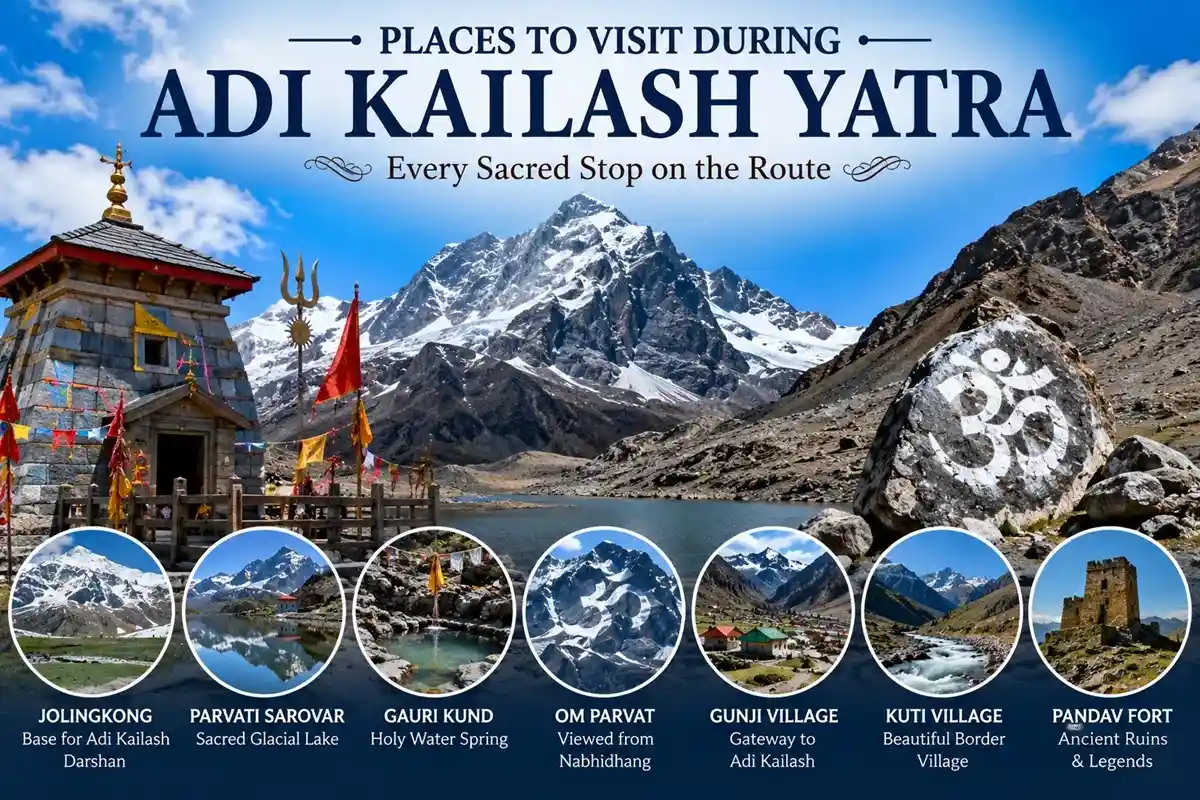
Adi Kailash Yatra Route from Kathgodam
The standard Adi Kailash Yatra route from Kathgodam runs: Kathgodam/Haldwani → Bhimtal → Almora → Pithoragarh → Jauljibi → Dharchula → Tawaghat → Gunji → Kuti → Jolingkong, with a second arm from Gunji to Kalapani → Nabhidhang (Om Parvat). Dharchula is the dividing line — beyond it lies the Inner Line Permit zone with ITBP check posts. Plan 7–9 days with a buffer day; BRO stretches near Mangti often close temporarily after rainfall.
Distance Chart (Approximate)
| Stretch |
Distance |
Time |
| Kathgodam → Bhimtal |
22 km |
45 min |
| Bhimtal → Almora |
62 km |
2 hrs |
| Almora → Jageshwar (detour) |
35 km |
1.5 hrs |
| Jageshwar → Patal Bhuvaneshwar → Chaukori |
~125 km |
5 hrs |
| Chaukori → Pithoragarh |
~85 km |
3 hrs |
| Pithoragarh → Jauljibi → Dharchula |
~95 km |
3.5 hrs |
| Dharchula → Gunji |
~85–90 km |
5–6 hrs |
| Gunji → Nabhidhang (Om Parvat) |
~20 km |
1.5 hrs |
| Gunji → Kuti → Jolingkong |
~40–44 km |
3 hrs |
Distances vary slightly each season after BRO realignments.
Places to Visit on the Way to Adi Kailash Yatra
Kathgodam to Pithoragarh
- Bhimtal & Kainchi Dham: Lakeside breakfast halt; Kainchi Dham is a short detour — weekdays skip the queues.
- Almora: Lunch stop with the Nanda Devi Temple and Bal Mithai — last town with full ATM and repair services.
- Jageshwar Dham: Around 124 ancient stone temples (7th–12th century) in deodar forest, linked to the Nagesh Jyotirlinga tradition.
- Patal Bhuvaneshwar: A limestone cave descending ~90 feet to formations worshipped as Sheshnag — skip if you have claustrophobia, knee, or heart issues.
- Chaukori: Ridge-top sunrise views of Nanda Devi, Nanda Kot, and Panchachuli — the classic night halt.
- Pithoragarh: The last big town — hospitals, fuel, banks, airstrip, helicopter darshan base. Refuel and withdraw cash here.
Pithoragarh to Dharchula
- Askot: The road skirts Askot Wildlife Sanctuary — watch for langurs and Himalayan birdlife.
- Jauljibi: Kali–Gori river confluence with Nepal across the water; quick prayer halt, historic November fair.
- Dharchula: Base camp town (~940 m) on the Kali River — permits, medical checks, vehicle change, riverside Kali Temple. Spend a night here.
The Vyas Valley: Dharchula to Adi Kailash and Om Parvat
- Tawaghat & Narayan Ashram: The Darma Valley road splits at Tawaghat; a steep climb reaches Narayan Ashram (~2,734 m, founded 1936) — serenest spot, best on the return leg.
- Chialekh Valley: Alpine meadow above Budhi, wildflower-carpeted in June — the “gateway of Vyas Valley.”
- Budhi & Garbyang: Budhi is a halt of the old Kailash Mansarovar trail; Garbyang, the “sinking village,” has tilted century-old houses.
- Gunji: Hub village (~3,200 m) where the two darshan roads divide — ITBP posts, Rang homestays, essential acclimatisation night.
- Kalapani: Its Kali Temple is believed to mark the river’s origin — a traditional prayer stop in a security-sensitive zone.
- Om Parvat (Nabhidhang): From Nabhidhang (~4,300 m), snow naturally forms “ॐ” on the 5,590 m face — go early, before clouds. The Lipulekh viewpoint ahead opens only with administration permission.
- Nabhi & Kuti: Kuti (~3,600 m), the last village, is linked to Kunti of the Pandavas — Pandav Fort and Vyas Gufa sit en route.
- Jolingkong & Parvati Kund: Road’s end (~4,600 m); the kund mirrors Adi Kailash on still mornings — PM Modi prayed here in October 2023. Reach by 7–8 AM.
Best Time to Visit Adi Kailash Yatra
The best time to visit Adi Kailash Yatra is May–June and September–October. The yatra generally opens around early May, subject to administration and weather clearance, and usually stays open till late October or beyond depending on snowfall and BRO road conditions.
| Month-wise Road Condition |
Status |
| May–June |
Open; snow walls near Jolingkong |
| July–August |
Risky; frequent landslides |
| September–October |
Best surface, clearest views |
| Winter |
Closed |
Adi Kailash Yatra Permit Process
The Adi Kailash Yatra permit process requires an Inner Line Permit (ILP) from the SDM office, Dharchula, available offline and via the official online portal.
- Prepare Aadhaar/passport, photos, and a medical fitness certificate (screening can apply to all travellers, not just seniors).
- Apply via a registered operator, the SDM office, or the portal — a few days early in peak weeks.
- Collect the route-specific, date-bound, non-transferable permit; carry photocopies.
- Show it at every ITBP/police check post.
Age and foreign-national rules vary — verify the latest District Pithoragarh guidelines and avoid agents selling “instant permits.”
Essential Travel Information
| Need |
Ground Reality |
| Mobile network |
BSNL most reliable beyond Tawaghat; Jio/Airtel intermittent |
| ATMs |
Last dependable ones at Pithoragarh; carry cash beyond |
| Fuel |
Fill at Pithoragarh; last pumps near Dharchula |
| Emergency |
District Hospital Pithoragarh, Dharchula CHC, ITBP posts, dial 112 |
| Drones |
Prohibited without permission — sensitive border zone |
| Oxygen |
Carry via your operator; none sold en route |
Budget, Stay and Getting There
Where to stay during Adi Kailash Yatra: hotels/KMVN till Dharchula (₹800–2,500), then Rang homestays and KMVN huts at Gunji, Nabhi, and Kuti (₹800–1,500 with meals) — book early for May–June.
Budget: roughly ₹16,000–22,000 self-planned; packages ₹28,000–45,000. Helicopter darshan costs more; subsidy schemes appear only in selected seasons — confirm on the official UTDB portal.
Reach: Kathgodam/Tanakpur by train, Pantnagar by air, then road via Haldwani–Almora–Pithoragarh. Beyond Dharchula, only experienced local jeeps operate.
Quick Tips and Common Mistakes
- Acclimatise a night at Gunji — AMS symptoms appear here first; descend if they worsen.
- Pack layers, down jacket, grippy shoes, SPF-50, ORS, torch, power bank, cash.
- Seniors should prefer September, carry oxygen, or take the helicopter option.
- Don’t rush Kathgodam–Dharchula in a day; avoid monsoon; never photograph military posts.
Responsible Tourism
Carry waste back, avoid single-use plastic, respect Rang customs, and stay on permitted routes — this fragile valley deserves the same reverence as the peak.
Fact note: Distances are approximate and shift after BRO repairs; permit rules and dates follow District Pithoragarh updates. Himalayan weather changes fast — reconfirm locally.
FAQs
Q1. Which are the best stopovers before Adi Kailash?
Jageshwar Dham, Patal Bhuvaneshwar, Chaukori, Dharchula, Narayan Ashram, Gunji, and Kuti.
Q2. What is the Adi Kailash Yatra route from Kathgodam?
Kathgodam → Almora → Pithoragarh → Dharchula → Gunji → Kuti → Jolingkong; roughly 360–380 km one way.
Q3. What is the height of Adi Kailash?
5,945 metres (19,505 ft); darshan happens from Jolingkong at about 4,600 m.
Q4. Why is Adi Kailash called Chhota Kailash?
Because it closely resembles Mount Kailash in Tibet and serves as its most revered Indian counterpart.
Q5. What is the best time to visit Adi Kailash Yatra?
May–June and September–October; closed in winter, risky in monsoon.
Q6. What is the Dharchula to Adi Kailash distance?
Around 125–130 km by road to Jolingkong via Gunji and Kuti.
Q7. What is the Adi Kailash Yatra permit process?
Apply for the Inner Line Permit at SDM Dharchula or the online portal with ID, photos, and medical certificate.
Q8. Can Adi Kailash be done without trekking?
Yes — vehicles reach Jolingkong; only short walks remain to Parvati Kund.
Q9. Is Om Parvat on the same route?
Yes, the road splits at Gunji; one ILP generally covers both darshans.
Q10. How difficult is the Dharchula–Gunji road?
Rough 85–90 km border road, 5–6 hours; only experienced local drivers should attempt it.
Q11. Where do pilgrims stay during Adi Kailash Yatra beyond Dharchula?
In Rang homestays and KMVN huts at Gunji, Nabhi, and Kuti (~₹800–1,500 with meals).
Q12. Is mobile network available?
BSNL works patchily beyond Tawaghat; other networks are largely absent — inform family in advance.
Q13. Can children visit Adi Kailash?
Depends on current administration rules and medical fitness — verify before booking.
Q14. Can foreigners do this yatra?
Access is restricted; check the latest District Pithoragarh guidelines before planning.
Q15. Is oxygen available on the route?
No shops sell it en route — carry portable oxygen through your tour operator.
Q16. Is there a helicopter service?
Yes — weather-dependent darshan flights from Pithoragarh in select seasons; book via official channels.
Q17. Can I see Mount Kailash (Tibet) from this route?
Rarely, and only near Lipulekh with special permission — not part of the standard itinerary.
Q18. How many days are needed for Adi Kailash Yatra?
Plan 7–9 days from Kathgodam, including a buffer day for weather delays.
Conclusion
Give the road the respect you give the peak. The places to visit on the way to Adi Kailash Yatra — Jageshwar’s temples, Chialekh’s meadows, Parvati Kund’s mirror-still dawn — are the pilgrimage itself. First-timers should pick May–June, seniors and photographers September, and everyone should book permits and Gunji beds early. Treat every scenic halt as part of the darshan, and the mountain will feel earned, not just reached.


 Call
Call Enquiry