Last Updated on 27/05/2026
Chardham Yatra is one of the most demanding pilgrimages in the world — not because of its spiritual weight, but because of its physical and logistical challenges. Four high-altitude shrines, Himalayan roads, unpredictable weather, altitude from 3,048 metres to 3,583 metres, and treks that challenge even fit pilgrims. Every year, thousands of devoted families make avoidable mistakes that turn their once-in-a-lifetime journey into a medical emergency, a financial loss, or a deeply disappointing experience.
In the 2026 Chardham Yatra season, 53 pilgrims died within the first month alone, according to SEOC data released in May 2026. Kedarnath recorded the highest toll with 28 deaths, followed by Badrinath (10), Yamunotri (8), and Gangotri (7). By 14 May, the count had crossed 40 — with cardiac arrest and altitude complications as the dominant causes. Health officials and emergency doctors say consistently: the vast majority of these deaths were preventable. Pilgrims came without medical check-ups, without preparation for high altitude, without acclimatization, and without understanding their own physical limits.
This guide is built on real incident data, official health advisories, ground-level experience from Himalayan routes, and the documented patterns of what goes wrong during Chardham Yatra every season. Read it before you pack a single bag.
Quick Overview:
- Skipping a medical check-up before high-altitude travel
- Not registering at registrationandtouristcare.uk.gov.in
- Driving on mountain roads at night
- Ignoring altitude sickness symptoms
- Overpacking for the Kedarnath trek
- Travelling during the July–August monsoon
- Not booking accommodation in advance
- Avoid these mistakes with proper planning and preparation.
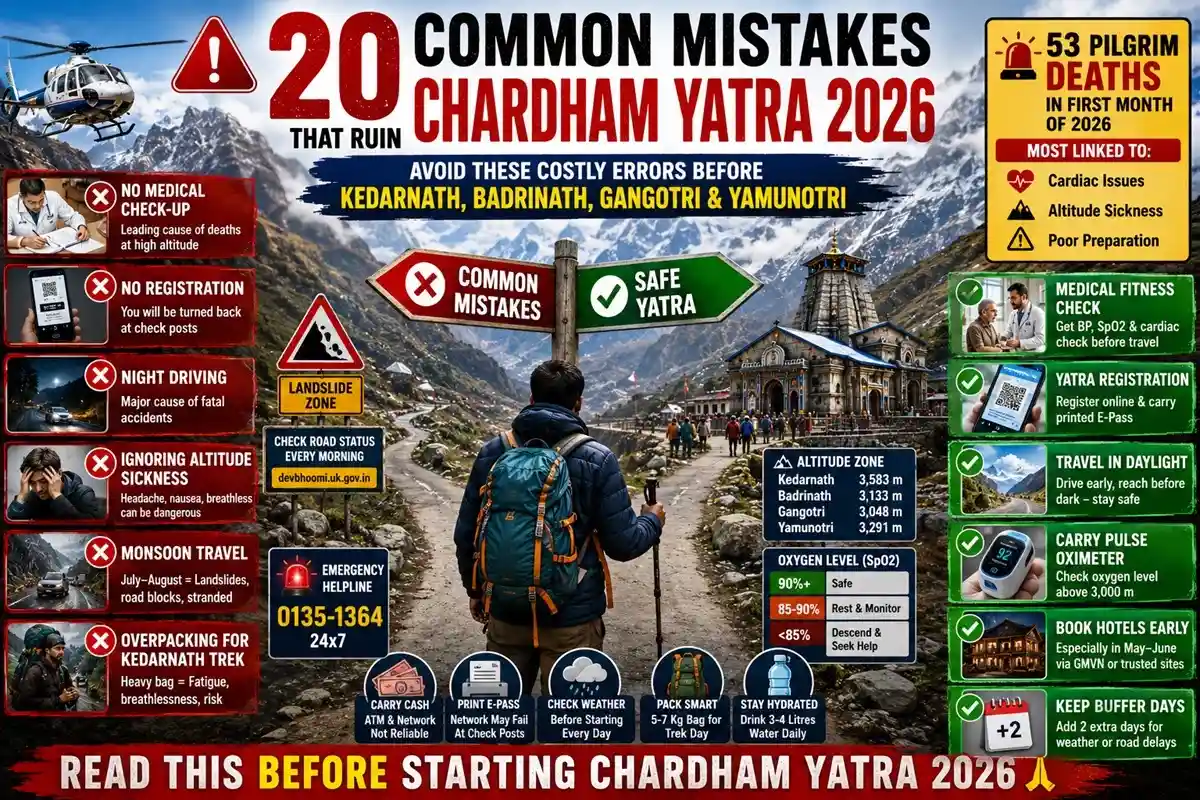
Key Takeaways — 2026 Chardham Yatra Mistakes
- 53 pilgrims died in the first month of 2026 Chardham season (SEOC, May 2026) — Kedarnath 28, Badrinath 10, Yamunotri 8, Gangotri 7 — first 26-day count was 38; primarily cardiac arrest and altitude complications
- In 2024, 183 pilgrims had died by August alone (PTI/SEOC); in 2023, 149 pilgrims died across the full season; in 2022, 99+ died in just the first 25 days — every year, most deaths were from preventable health causes
- Registration at registrationandtouristcare.uk.gov.in is mandatory — skipping it gets you turned back at check posts
- Medical fitness certificate is mandatory for pilgrims above 50 years — health kiosks operate at Haridwar, Sitapur, and Sonprayag from 6 AM to 8 PM
- Helicopter services are now strictly regulated under DGCA 2026 rules — sunrise to sunset operations only
- Night driving on any Chardham route is the leading cause of fatal road accidents — never drive after dark
- Over 30 active landslide zones on Rishikesh–Devprayag stretch alone as of April 2026
- July–August travel is strongly inadvisable — roads close repeatedly; multiple pilgrims stranded every season
Data Snapshot 2026
- 38 pilgrim deaths reported in the first 26 days of the yatra
- 53 deaths recorded in the first month of the 2026 season (SEOC, May 2026)
Deaths by Shrine
- Kedarnath — 28
- Badrinath — 10
- Yamunotri — 8
- Gangotri — 7
Previous Years
- 2024: 183 deaths reported by August alone (PTI/SEOC)
- 2023: 149 deaths
- 2022: 99+ deaths within the first 25 days
Main Cause
- Cardiac arrest at high altitude remains the leading cause every year.
Most Vulnerable Group
- Pilgrims aged 50+, especially those travelling without proper medical check-ups.
Sources: SEOC Uttarakhand & PTI verified reports.
Category 1: Planning & Preparation Mistakes
Mistake #1: Not Registering Before Departure — The Most Avoidable Mistake
Chardham Yatra registration is mandatory for all four dhams in 2026. The official portal registrationandtouristcare.uk.gov.in has been open since 6 March 2026. Despite this, every season begins with hundreds of pilgrims being physically turned back at check posts — at Rishikesh, Rudraprayag, Sonprayag, and Pandukeshwar — because they either didn’t know about the requirement or assumed they could register on arrival.
You cannot. At Sonprayag for Kedarnath, there is a strict barrier where guards scan QR codes. Without a valid E-Pass, you do not pass — regardless of how far you’ve already travelled. This is one of the most common mistakes, and it causes enormous distress to families who have driven 8+ hours from Haridwar only to be turned back.
Registration is free, takes 15 minutes online, and must be completed before travel. The portal is registrationandtouristcare.uk.gov.in. You can also register via WhatsApp: send ‘Yatra’ to +91-8394833833, or call 0135-1364.
Carry BOTH a digital copy (screenshot or app) AND a printed copy of the QR code. Mobile network is unreliable near Badrinath and Kedarnath — a printed copy has saved many pilgrims from check post problems.
Mistake #2: Travelling Without a Medical Check-Up — The Leading Cause of Death
Dr. Pradeep Bhardwaj of Six Sigma Healthcare, who provides free medical services on the Chardham route, stated clearly: ‘They are coming directly from low altitudes to places situated at 10,000–12,000 feet. How can they cope with such an abrupt climatic change? No medical check-up is being done before the start of the journey.’
Uttarakhand’s Health Secretary R. Rajesh Kumar confirmed cardiac arrest is the most common cause of Chardham deaths. The most affected are elderly pilgrims who travel without any cardiac evaluation. Kedarnath recorded 89 deaths in the 2025 season alone — the majority were health-related, and the majority were among pilgrims who had not undergone any pre-travel medical examination.
For 2026: health screening at government kiosks is mandatory for all pilgrims above 50 at key points including Sitapur, Sonprayag, and Gaurikund — these kiosks test BP, SpO2, and pulse. A medical fitness certificate from a doctor is strongly advised (and conditionally mandatory at registration if you declare a condition like heart disease, asthma, BP, or diabetes). Pilgrims found with SpO2 below 85% at Sonprayag’s altitude can be stopped from proceeding. Government health kiosks operate from 6 AM to 8 PM. Use them proactively before your kiosk check, not as a substitute for a doctor visit at home.
- Get a BP check, cardiac evaluation, and blood oxygen (SpO2) test before departure
- If you have existing BP, diabetes, cardiac, or respiratory conditions — get specialist clearance
- Carry a pulse oximeter — below 90% SpO2 at altitude requires immediate descent
- Helicopter to Kedarnath is strongly recommended for pilgrims above 65 with any cardiac history
Mistake #3: Not Accounting for Buffer Days — The Weather Trap
One of the most frustrating Chardham mistakes is building a tight, day-by-day itinerary with no flexibility. Himalayan weather does not operate on a schedule. In July 2025, all four Chardham roads were blocked simultaneously in a single day due to cloudbursts. Pilgrims who had return flights booked for the next day were left stranded. In 2026, the Rishikesh–Devprayag stretch has 30+ active landslide zones — delays are built into any realistic travel plan.
Most experienced Chardham pilgrims build at least 2 buffer days into a 10–12 day itinerary. If you have a flight or train to catch, add those buffer days at the end of the trip — not in the middle, where a road block at Joshimath cannot be ‘recovered’ by speeding up the next dham.
Recommended: A 12–14 day itinerary for all four dhams allows one buffer day per dham for weather-related delays. Rushing Chardham in 8 days is not recommended — physically or spiritually.
Mistake #4: Planning Chardham Yatra in July or August
This is perhaps the most predictable mistake — and the most consistently repeated. The Himalayan monsoon between late June and August is severe, relentless, and directly dangerous on Chardham routes. Cloudbursts cause landslides. Swollen rivers flood crossings. Roads close. Pilgrims get stranded for 2–5 days in remote locations with no hotels and limited food.
In 2025, over 40 Kedarnath pilgrims were stranded overnight near Sonprayag after a single cloudburst blocked the road. A family from Rajasthan waited four days at Joshimath when the Badrinath highway was blocked by a multi-point landslide. This is not unusual — it is the monsoon pattern, every year, without exception.
| Month |
Road Condition |
Crowd Level |
Risk Level |
Verdict |
| April (late) |
Open, debris clearing |
Low |
Low |
Good — scenic, quiet |
| May |
Best condition |
Peak |
Low-Moderate |
Excellent — book early |
| June (early-mid) |
Good with watch zones |
Peak |
Moderate |
Good — check forecasts |
| June (late) – August |
Frequent closures |
Low (risky) |
Very High |
Avoid — monsoon danger |
| September |
Post-monsoon, clearing |
Low-Moderate |
Low |
Very Good — hidden gem |
| October |
Clear, excellent |
Moderate |
Very Low |
Ideal — calm & beautiful |
| November (early) |
Closing progressively |
Very Low |
Moderate |
Limited — check dates |
Mistake #5: Booking Everything Last Minute During Peak Season
During May and early June, Chardham is at its peak. Budget guesthouses in Barkot, Guptkashi, and Joshimath fill up by 3–4 PM. Kedarnath helicopter slots on the IRCTC portal fill within 90 minutes of opening on booking day. Pilgrims who arrive without advance bookings often find themselves either paying 3x the rate for last-minute rooms or sleeping in dharamshalas with no hot water after a 10-hour mountain drive.
For 2026: GMVN bookings are open until 30 November at gmvnonline.com. Kedarnath helicopter booking opened 15 April 2026 at heliyatra.irctc.co.in. For May–June travel, book accommodation 4–6 weeks in advance. Book your helicopter slot as early as possible — Sirsi helipad slots sell out first, followed by Phata.
Category 2: Health & Altitude Mistakes
Mistake #6: Ignoring Altitude Sickness Warning Signs
Altitude sickness, technically called Acute Mountain Sickness (AMS), is not always dramatic. It starts subtly: a persistent headache that doesn’t respond to paracetamol, mild nausea, unusual fatigue, or breathlessness while resting. Most pilgrims push through these symptoms, treating them as tiredness from the journey. This is dangerous.
At Kedarnath (3,583 m) and Badrinath (3,133 m), the oxygen level is approximately 65–70% of sea level. Even fit, healthy adults can experience AMS. The treatment protocol is simple and non-negotiable: if symptoms appear, stop ascending, rest, hydrate, and descend if symptoms worsen. Continuing upward with AMS symptoms risks High Altitude Pulmonary Edema (HAPE) or High Altitude Cerebral Edema (HACE) — both are life-threatening.
AMS Warning Signs: Persistent headache | Nausea or vomiting | Dizziness | Breathlessness at rest | Disturbed sleep | Loss of appetite. If two or more appear simultaneously at altitude — stop ascending. Descend if symptoms worsen within 30 minutes of rest.
A common mistake is taking Diamox (acetazolamide) without a prescription. This medicine has real side effects and should only be taken after medical consultation, not as a general preventive measure.
Mistake #7: Skipping Acclimatization at Joshimath
Most pilgrims travelling to Badrinath make a direct drive from Rishikesh — 297 km, 10–12 hours — and want to reach Badrinath the same day. Local drivers and experienced pilgrims consistently recommend stopping for one night at Joshimath (1,890 m) before proceeding to Badrinath (3,133 m). The altitude change between Rishikesh (~372 m) and Badrinath in a single day is extreme for the human body.
During peak season, the road from Joshimath to Badrinath (47 km) can take 3–5 hours anyway due to traffic. Using Joshimath as a base for one night, resting, and ascending the next morning is not just recommended — it is the difference between arriving at Badrinath with energy for darshan and arriving exhausted and symptomatic.
- Joshimath is also an excellent base for Auli side visit
- Several mid-range hotels and GMVN properties are available
- SpO2 check at Joshimath helps gauge acclimatization before higher altitude
Mistake #8: Cold Water Baths at High Altitude
Tapt Kund at Badrinath is a naturally hot sulfur spring where pilgrims traditionally bathe before darshan. Many pilgrims also bath in cold river water at various points along the route — at Sonprayag, near Gangotri, or at Kedarnath itself. For healthy young pilgrims, this is manageable. For elderly pilgrims, those with BP conditions, or cardiac patients, a sudden cold water immersion at high altitude causes rapid blood pressure fluctuation and can trigger cardiac events.
A 64-year-old woman from Gujarat died of cardiac arrest at Kedarnath immediately after deboarding from a helicopter — she had not even had time to stress her heart with the trek. Cold exposure combined with altitude is a serious cardiac trigger. Senior pilgrims should avoid cold water baths at altitude, and even Tapt Kund dips should be brief.
Mistake #9: Not Carrying a Pulse Oximeter
A pulse oximeter costs Rs 300–600 and fits in a shirt pocket. At altitude, it tells you your blood oxygen saturation (SpO2) — the single most important health metric for Himalayan travel. A reading below 90% at altitude is a medical warning signal that requires immediate rest and possible descent. A reading below 85% is a medical emergency.
Many pilgrims who have experienced altitude sickness describe how they thought they were ‘just tired’ — until a doctor checked their SpO2 and found it at 82%. Without the oximeter, they had no objective measure of how serious their condition was. Carry one. Check it morning and evening at altitudes above 3,000 m.
Normal SpO2 at sea level: 95–100%. At 3,500 m (Kedarnath), 88–92% is common for unacclimatized pilgrims. Below 90%: rest and monitor. Below 85%: descend immediately. Below 80%: medical emergency.
Mistake #10: Dehydration and Eating Oily Food at Altitude
High altitude reduces the sensation of thirst while increasing fluid loss through increased respiration. Most Chardham pilgrims don’t drink enough water — and then compound this with eating heavy, oily food at high-altitude dhabas. At 3,000+ metres, the digestive system functions differently, and greasy food frequently causes nausea, vomiting, and severe indigestion that can mimic or worsen AMS symptoms.
Most pilgrims prefer light, easily digestible food during the trek and at high-altitude locations — dal, rice, khichdi, and simple sabzi. Energy bars, dry fruits, glucose tablets, and ORS sachets are far more effective than three large meals at altitude.
- Drink at least 3–4 litres of water daily at altitude — even if you don’t feel thirsty
- ORS sachets in water help with electrolyte balance, especially after the Kedarnath trek
- Avoid alcohol entirely — it worsens altitude effects and dramatically increases dehydration
- Skip greasy parathas, heavy curries, and fried food above 2,500 m
Category 3: Road & Travel Mistakes
Mistake #11: Driving at Night on Chardham Routes — Never Do This
Night driving on Chardham highways is one of the most consistently documented causes of fatal road accidents on these routes. The combination of narrow mountain roads, no central dividers, poor visibility, falling rocks (which cool and contract at night, causing loosening), and fatigue-related judgment lapses makes night driving on NH-7 and connecting Chardham roads extremely dangerous.
Local drivers with 10–15 years on these routes have a simple, non-negotiable rule: stop before dark. This means leaving Rishikesh before 6 AM, timing drives to arrive at your destination by evening, and — if delayed — stopping at the nearest town rather than pushing through to the next location. There are no exceptions to this rule that an experienced Himalayan driver would make.
2026 Active Risk Zones: Tota Ghati, Mulya Gaon, NHPC Bend (Rishikesh–Devprayag) | Lambagad, Helang, Vishnuprayag (near Joshimath) | Tilwara–Manthali (Kedarnath route) | Bhatwari, Dharali (Gangotri route) | Hanuman Chatti–Janki Chatti (Yamunotri). Cross these zones only in daylight.
Mistake #12: Not Checking Road Status Before Departure Each Day
The Chardham Yatra road status can change within hours after a cloudburst. A road that was open at 8 PM can be blocked by a landslide by 6 AM. Most pilgrims check road status once, before the trip, and then assume it remains constant throughout. This is a serious mistake, especially during June (pre-monsoon) and September (post-monsoon), when residual instability is high.
Check road status every single morning before starting. The most reliable sources:
- devbhoomi.uk.gov.in — official Uttarakhand Police traffic portal
- @BROindia on X (Twitter) — Border Roads Organisation posts real-time clearance updates
- Helpline 0135-1364 — Uttarakhand government’s dedicated Chardham helpline
- Your hotel at the next destination — they have ground-level real-time intelligence
Mistake #13: Driving an Unprepared Vehicle
Every year, vehicles break down on narrow Himalayan stretches, blocking one-lane roads for hours and stranding hundreds of pilgrims behind them. The most common causes: overheated engines, failed brakes on steep descents, flat tyres with no spare, and radiator problems from the constant climbing.
Before starting Chardham Yatra by private vehicle: full engine service, brake check, radiator flush, two spare tyres (not just one), engine coolant check, and a tow rope. SUVs and 4WD vehicles are far better suited to this terrain than sedans. Local mechanics in Rishikesh who specialise in Chardham vehicle preparation are available near the main highway.
Mistake #14: Ignoring the Weather Forecast
A clear sky in Rishikesh or Haridwar can coexist with a cloudburst 100 km away in the Himalayan catchment area. Pilgrims who check the weather at their departure point and assume it reflects conditions at Kedarnath or Badrinath make a dangerous assumption. The micro-climate of the Garhwal Himalayas is highly localised — conditions at Joshimath can differ dramatically from conditions at Badrinath just 47 km away.
Check the weather specifically for Kedarnath, Badrinath, Uttarkashi, and Joshimath — not just Rishikesh. The India Meteorological Department (IMD) issues specific warnings for Uttarakhand via its mausam.imd.gov.in portal and the Uttarakhand SDMA at sdma.uk.gov.in. Yellow, orange, and red weather alerts are issued in the morning — check before departing.
Category 4: Trek & Physical Preparation Mistakes
Mistake #15: Overpacking for the Kedarnath Trek
The Kedarnath trek is 16 km one-way from Gaurikund, starting at 1,984 m and reaching 3,583 m. The altitude gain alone is 1,599 m. Doing this with a 15 kg backpack in thin air is not just uncomfortable — it is medically dangerous. Every extra kilogram significantly increases oxygen demand, heart rate, and fatigue. It also increases the risk of slipping on steep sections.
Most experienced Chardham pilgrims carry maximum 5–7 kg in a daypack for the Kedarnath trek. Everything else is left at a guesthouse in Gaurikund, Sonprayag, or Guptkashi. Porters and ponies are available from Gaurikund — use them for anything beyond a small daypack. Palki (palanquin) services are available for those who cannot trek.
| Trek |
Start Point |
Altitude Gain |
Distance |
Pony/Palki Available |
| Kedarnath |
Gaurikund (1,984 m) |
1,599 m |
16 km one-way |
Yes — book in advance |
| Yamunotri |
Janki Chatti (2,650 m) |
643 m |
6 km one-way |
Yes |
| Gangotri |
Gangotri town (3,048 m) |
None (motorable) |
— |
N/A |
| Badrinath |
Badrinath town (3,133 m) |
None (motorable) |
— |
N/A |
Mistake #16: Rushing the Kedarnath Trek Without Physical Preparation
The Kedarnath trek is not a walk in a park. It is 16 km of uphill Himalayan terrain at steadily increasing altitude. Dr. Sandeep Gore, Director of Emergency Medicine at Fortis Mumbai, stated: ‘At Kedarnath, you have to walk for sixteen kilometres at a height from about 2,000 to 3,500 metres. If you go for a pilgrimage without preparation, your health can be severely affected.’
Most pilgrims who complete the trek comfortably have spent at least 4–6 weeks before travel building basic fitness — daily walks of 3–5 km, stair climbing, basic cardiovascular exercise. This does not mean you need to train like an athlete. It means arriving at Gaurikund with a body that can handle sustained uphill walking at low oxygen levels.
During peak season, starting the trek before 5 AM is strongly recommended. By 8–9 AM, the trail is crowded, and by afternoon the weather on the upper sections can change rapidly. Morning darshan is also better because the queue at the temple is shorter and the air is clearest.
Mistake #17: Not Using the Pony / Palki / Helicopter Options
A persistent and harmful misconception among pilgrims — especially those influenced by the religious view that the journey must involve physical hardship — is that using a pony, palki, or helicopter is somehow less spiritually valid. This thinking costs lives. A 72-year-old pilgrim from Andhra Pradesh died of cardiac arrest at a Yamunotri hotel. A 64-year-old woman from Gujarat died immediately after landing at Kedarnath by helicopter — she was already stressed from the journey before the trek began.
For senior citizens, those with health conditions, and anyone above 65: using pony, palki, or helicopter for Kedarnath is not an alternative to the ‘real’ pilgrimage. It is the responsible choice. The darshan at the end is identical — the spiritual merit does not diminish based on the mode of arrival.
- Kedarnath pony: available from Gaurikund; book through registered operators near the helipad area
- Palki: available from Gaurikund; cost approximately Rs 5,000–8,000 one way for Kedarnath
- Helicopter: only via heliyatra.irctc.co.in | Sirsi (₹6,390 RT), Phata (₹10,164 RT), Guptkashi (₹12,762 RT)
- 2026 DGCA rule: helicopter operations are strictly sunrise to sunset — book morning slots
Category 5: Logistics & Financial Mistakes
Mistake #18: Carrying Only Digital Payments — No Cash
ATMs are scarce and frequently non-functional in remote Chardham locations. Network connectivity for UPI or card payments is unreliable above Joshimath, in Badrinath, near Kedarnath, and in Gangotri. During peak season traffic jams, roads block and small dhabas, porter services, and emergency supplies can only be paid for in cash.
Most pilgrims carry a mix — Rs 3,000–5,000 in small denomination cash (Rs 100 and Rs 500 notes) per day per person for high-altitude locations, and rely on UPI only where signal is confirmed. Carry cash for the entire trek day and the nights immediately before and after Kedarnath or Badrinath.
- ATMs at Rishikesh and Haridwar are reliable — withdraw before the mountain journey
- Joshimath has ATMs but lines during peak season are long
- Badrinath, Kedarnath, Gangotri, Yamunotri: assume cash-only
- Keep cash in a money belt or inner pocket — not loose in a trek bag
Mistake #19: Trusting Unofficial Agents for Bookings
The Chardham booking scam environment in 2026 is well-documented. The I4C (Ministry of Home Affairs) issued a formal advisory. Uttarakhand STF has blocked 76+ fraudulent websites. The consistent pattern: fake websites with real hotel photos, WhatsApp-only agents demanding personal UPI payment, and phantom helicopter booking operators.
The three safest booking channels for 2026 are: GMVN at gmvnonline.com for accommodation, IRCTC at heliyatra.irctc.co.in for Kedarnath helicopter shuttle tickets, and registrationandtouristcare.uk.gov.in for yatra registration. Any agent who cannot provide a GSTIN, directs you to pay to a personal UPI account, or refuses to share the property’s direct phone number is operating a fraud.
If a price seems too low (e.g., ₹500/night near Badrinath in May, or a complete Chardham package for ₹5,000) — it is. The operating economics of high-altitude remote properties make rock-bottom prices structurally impossible. Unrealistically low prices are a scam signal, not a bargain.
Mistake #20: Packing Wrong — Too Heavy, Too Light, or Missing Critical Items
Two opposite packing mistakes are equally common: bringing a 20 kg suitcase that becomes unmanageable on mountain roads and the Kedarnath trek, or packing so light that essential medical items, warm clothing, and rain gear are missing.
The Himalayan weather at Chardham altitudes is cold even in May — mornings at Kedarnath and Badrinath frequently drop to 5–8°C even at peak season. An afternoon rain in June can become hail or snow above 3,000 m within minutes. Every pilgrim needs thermal inners, a waterproof rain jacket, and warm layers regardless of the season.
What most first-timers forget: a small personal first aid kit, their prescription medicines in carry-on (not checked baggage), a pulse oximeter, ORS sachets, sunscreen SPF 50+ (UV is intense at altitude), and UV-protection sunglasses.
| Category |
Must Carry |
Do Not Pack |
| Documents |
Aadhaar (original + 2 copies), E-Pass printout, Medical certificate (50+), Emergency contact card |
Unnecessary documents; leave originals at home if copies suffice |
| Clothing |
Thermal inners (3-4 sets), fleece jacket, waterproof rain jacket, trekking shoes, woollen cap + gloves |
Heavy formal clothes, jeans (heavy when wet), fashion footwear |
| Health |
Pulse oximeter, personal medicines, ORS sachets, first aid kit, SPF 50+ sunscreen, UV sunglasses |
Oxygen cylinder (not needed; tour operators carry), Diamox without prescription |
| Tech & Money |
Power bank, torch, emergency cash (3000-5000/day in small notes), downloaded offline maps |
Expensive electronics, laptop |
| Trek Day |
Daypack max 5-7 kg, water bottle (1L), energy bars, dry fruits, rain cover for bag |
Full luggage, suitcases — leave these at Gaurikund/Sonprayag guesthouse |
5 Additional Mistakes First-Time Pilgrims Often Make
Consuming Alcohol During the Yatra
Alcohol is religiously prohibited during Chardham Yatra. Beyond religious considerations, it is medically dangerous at high altitude. Alcohol dramatically worsens dehydration, impairs oxygen utilisation, and magnifies altitude sickness symptoms. A pilgrim who consumes alcohol at Joshimath before ascending to Badrinath is genuinely putting themselves at risk. This is not a minor inconvenience — it is a documented contributing factor in Himalayan travel fatalities.
Photographing Inside Temple Premises
Photography inside the temple sanctum at Kedarnath, Badrinath, Gangotri, and Yamunotri is prohibited. This is enforced by temple committees and violating it can result in confiscation of devices and being asked to leave the premises. Many pilgrims arrive unaware of this and cause disruption during darshan. Respect the darshan queue, follow temple rules, and keep photography to designated exterior areas.
Littering on Trek Routes and Near Shrines
The Kedarnath trek passes through some of the most ecologically sensitive Himalayan terrain in India. Littering on the trail, disposing of plastic near the Mandakini or Bhagirathi rivers, or leaving food waste in the temple area is illegal under NGT orders and causes real ecological harm. Most organised tour operators now carry litter bags — use them. Plastic bags are prohibited in the eco-sensitive zone around Kedarnath.
Skipping Emergency Contacts and Not Sharing Your Itinerary
Every Chardham pilgrim should leave a day-by-day itinerary with a contact person at home, share their hotel phone numbers for each night, and set up a daily ‘check in’ message system. In the event of a road blockage, medical emergency, or phone battery failure, a family member who knows your exact itinerary can initiate help through local contacts or the Chardham helpline (1364) far faster than a general emergency call. This simple step is almost universally skipped by first-time pilgrims.
Choosing the Cheapest Tour Package Without Verification
Tour operators offering complete Chardham packages exist across a wide spectrum — from trusted, registered companies with GSTIN and physical offices to fraudsters operating from a mobile phone. The mistake is choosing purely on price. A verified, registered tour operator with a real address and references is worth paying 15–20% more than an unverified WhatsApp agent with an attractive price. Check their GSTIN at gst.gov.in, look at reviews on Google spanning multiple years, and call the hotels they claim to use — directly.
Special Section: Mistakes Senior Citizens Must Absolutely Avoid
Senior citizens above 60 are the most vulnerable demographic on Chardham Yatra. The combination of high altitude, physical exertion, unpredictable weather, and variable medical access creates a set of risks that demand specific preparation.
- Attempting the Kedarnath trek on foot above age 65 without cardiac clearance — use pony, palki, or helicopter
- Skipping the medical fitness certificate — now mandatory at registration for 50+; health kiosks at Haridwar, Sitapur, Sonprayag
- Not acclimatizing at Joshimath (1,890 m) before ascending to Badrinath (3,133 m)
- Taking a cold dip in Tapt Kund at Badrinath with unstable BP — keep it brief if BP is controlled, skip it if not
- Carrying heavy hand luggage on trek days — use porter or palki
- Not informing trek companions of medical history — travel with people who know your conditions and medications
- Assuming religious faith alone will protect against altitude-related cardiac events — it will not, and this belief has cost lives every season
Quick Reference: Chardham Yatra Do’s and Don’ts 2026
| ✅ DO This |
❌ DO NOT Do This |
| Register at registrationandtouristcare.uk.gov.in (free, before travel) |
Assume you can register at the check post — you cannot |
| Get a medical check-up — especially cardiac evaluation, BP, SpO2 |
Travel without health clearance if you are above 50 or have existing conditions |
| Drive only in daylight — stop before dark every night |
Drive on Chardham mountain roads after sunset under any circumstances |
| Check road status every morning at devbhoomi.uk.gov.in |
Assume the road that was open yesterday is still open today |
| Carry printed E-Pass + digital copy |
Rely only on mobile network near Badrinath or Kedarnath |
| Build 2 buffer days into 10-12 day itinerary |
Plan a tight schedule with no weather contingency |
| Travel in May, September, or October |
Plan Chardham in July or August (peak monsoon) |
| Book accommodation 4-6 weeks ahead; use GMVN as safe option |
Arrive without bookings in peak season and hope for availability |
| Carry a pulse oximeter — check SpO2 above 3,000 m |
Ignore headache, nausea, and breathlessness at altitude |
| Use pony, palki, or helicopter if above 65 or physically limited |
Attempt the 16 km Kedarnath trek without health preparation if unfit |
| Carry Rs 3,000-5,000 cash per day per person at high altitude |
Rely exclusively on UPI/cards at remote Chardham locations |
| Book helicopter ONLY at heliyatra.irctc.co.in |
Book helicopter through WhatsApp agents or unofficial websites |
| Drink 3-4 litres of water daily; eat light food at altitude |
Drink alcohol or eat heavy oily food above 2,500 m |
| Wear layers — thermal inner, fleece, waterproof jacket |
Pack only for expected weather; mountain weather is unpredictable |
Emergency Contacts for Chardham Yatra 2026
| Service |
Contact |
Available |
| Chardham Yatra Helpline |
0135-1364 |
24/7 during season |
| National Disaster Management |
1070 |
24/7 |
| Police (Emergency) |
100 |
24/7 |
| SDRF Uttarakhand |
9411112985 |
24/7 |
| Uttarakhand Tourist Helpline |
1364 |
24/7 during season |
| National Cybercrime Helpline |
1930 |
24/7 |
| Ambulance |
108 |
24/7 |
| BRO Road Clearance Updates |
@BROindia (X/Twitter) |
Real-time |
| Road Status Portal |
devbhoomi.uk.gov.in |
Online 24/7 |
| SDMA Uttarakhand |
sdma.uk.gov.in |
Online — alerts & advisories |
Frequently Asked Questions
Q1. What is the most common cause of death during Chardham Yatra?
Cardiac arrest at high altitude is the leading cause every year without exception. In 2026, SEOC data confirmed 53 pilgrim deaths in the first month of the season — Kedarnath: 28, Badrinath: 10, Yamunotri: 8, Gangotri: 7. In 2024, 183 deaths were recorded by August alone. In 2023, the full-season toll was 149. Every year, the majority of deaths involve pilgrims above 50 who travelled without a pre-trip cardiac evaluation. Most were pilgrims who had no pre-travel medical evaluation and were not prepared for the physiological demands of 3,000–3,500 m altitude. Kedarnath records the highest deaths of all four dhams every season, due to its altitude (3,583 m) combined with the 16 km physical trek.
Q2. Is the Kedarnath trek safe for elderly pilgrims?
The 16 km Kedarnath trek is not safe for elderly pilgrims without physical preparation and cardiac clearance. Pony, palki (palanquin), and helicopter services exist precisely for this reason. For pilgrims above 65, or those with BP, cardiac, or respiratory conditions, helicopter via heliyatra.irctc.co.in or palki from Gaurikund is the responsible choice. The spiritual merit of darshan is not reduced by the mode of travel.
Q3. What happens if I skip Chardham Yatra registration?
You will be turned back at the check post — most critically at Sonprayag (for Kedarnath) and Pandukeshwar (for Badrinath). This happens even if you have driven hours from Rishikesh. Registration is free and takes 15 minutes at registrationandtouristcare.uk.gov.in. Carry both a digital and printed copy of the QR code E-Pass, as mobile network fails near Badrinath and Kedarnath.
Q4. What should I do if I get altitude sickness symptoms at Kedarnath?
Stop ascending immediately. Rest, hydrate with water and ORS, and check SpO2 with a pulse oximeter. If SpO2 is below 90% — descend. If symptoms worsen within 30 minutes of rest — descend immediately and seek medical help. Do not take Diamox unless it was prescribed by your doctor before the trip. Government health posts are located at Gaurikund, Kedarnath base, and along the trek — approach them at the first sign of serious symptoms.
Q5. Can I travel Chardham in June without monsoon risk?
Early to mid-June (until approximately 15–20 June) is generally safe and is actually one of the best times — roads are in good condition and crowds thin out slightly from the May peak. Late June carries increasing monsoon risk. By July, the risk is high enough that most experienced pilgrims advise against it. Monitor the IMD Uttarakhand forecast at mausam.imd.gov.in and SDMA at sdma.uk.gov.in daily during June travel.
Q6. How many buffer days should I add to my Chardham itinerary?
At minimum two buffer days for a 10–12 day Chardham itinerary. Place these at the end of the trip — after the last dham — rather than distributing them. A road block at Joshimath cannot be recovered by having a buffer day after Yamunotri. The most common scenario requiring buffer days: monsoon-related road closures in June or post-monsoon debris in September.
Q7. What is the recommended packing weight for the Kedarnath trek?
A daypack of maximum 5–7 kg for the Kedarnath trek itself. Leave all other luggage at your Gaurikund or Sonprayag guesthouse. The trek is 16 km uphill in thin air — every extra kilogram is a real physical burden. Use a porter for anything above 7 kg, or book a pony for both you and your bag. The financial cost of a porter for the trek day is trivial compared to the physical benefit.
Q8. Is it safe to drink river water on the Kedarnath or Yamunotri trek?
No. Despite the apparent purity of Himalayan streams, contamination from human activity along the trail makes river water unsafe to drink without purification. Carry a reusable water bottle from your guesthouse, filled with treated water. Refill points are available along the Kedarnath trek. Water purification tablets are useful as backup. Dehydration is a real risk on the trek — do not skip water intake because you’re worried about river purity.
Q9. What are the biggest mistakes first-time Chardham pilgrims make?
Based on documented patterns: (1) no medical check-up before high-altitude travel, (2) no registration before arriving at check post, (3) overpacking for the Kedarnath trek, (4) planning in July-August (monsoon), (5) no buffer days in the itinerary, (6) ignoring altitude sickness symptoms, (7) not carrying cash for remote locations, (8) booking through unverified agents or paying to personal UPI accounts.
Q10. Is morning darshan at Kedarnath and Badrinath better?
Significantly better. Queue lengths at both Kedarnath and Badrinath build through the morning and become very long by 10 AM–12 PM during peak season. Early morning darshan (before 7–8 AM) is shorter, the air is clearest, and the mountain views from the temple area are at their most spectacular. Most pilgrims who start the Kedarnath trek before 5 AM and reach the temple before 8–9 AM describe the experience as deeply peaceful compared to the afternoon crowds.
Q11. What should I do if I get stranded due to a road block?
Stay calm. Identify the nearest safe town — Joshimath for Badrinath, Rudraprayag or Guptkashi for Kedarnath, Uttarkashi for Gangotri, Barkot for Yamunotri. Call 0135-1364 (Chardham helpline) for road status updates. Do not attempt to cross a blocked stretch on foot or by motorcycle. BRO typically clears minor blockages within 6–48 hours. Carry enough food, water, warm clothes, and cash for an unplanned overnight stay. GMVN rest houses often have walk-in capacity.
Final Advice: Respect the Mountains, Prepare Seriously, Travel Safely
The Chardham Yatra is extraordinary — but it is not a journey that forgives carelessness. Every single mistake in this guide is avoidable. Every death documented in official statistics is, in the words of Dr. Sandeep Gore of Fortis Mumbai, preventable with adequate preparation.
The mountains ask nothing of you except respect — for the altitude, for the terrain, for the weather, and for your own body’s limits. Pilgrims who complete Chardham safely share a consistent profile: they registered in advance, got a medical check-up, built buffer days into their itinerary, chose their travel months wisely, drove only in daylight, listened to their bodies on the trek, and used pony or helicopter when it was the right choice rather than a compromise.
For families planning this trip for elderly parents: be their safety filter. A 70-year-old who has waited their whole life for this journey deserves to complete it safely. That means making the responsible choices — helicopter to Kedarnath, acclimatization night at Joshimath, medical check-up before departure, and a pace that matches their body, not your schedule.
The blessing of Char Dham awaits. Go prepared to receive it fully.


 Call
Call Enquiry