Last Updated on 01/06/2026
Anyone who has stood at Sonprayag in the second week of May, watching an unbroken river of pilgrims stretch into the horizon, understands that Char Dham Yatra is not just a pilgrimage — it is one of the largest organised movements of human beings on the planet. In the 2026 season, just 25 days after the portals opened on 19 April, over 12.60 lakh pilgrims had visited all four Dhams. By Day 34, the total crossed 19.80 lakh. On a single day — May 13, 2026 — over 80,000 pilgrims visited all four Dhams combined, with Kedarnath alone recording 32,000+ on that day. These are not estimates. These are official government figures.
Understanding the monthly pilgrim trends in Char Dham Yatra directly answers the most practical questions: When is the best time to go? When will Darshan queues be shortest? What does the data from 2023, 2024, and 2025 tell us about what to expect month by month? This article builds the complete picture — from verified annual totals to Dham-wise breakdowns, state-wise data, and practical guidance for each month of the season.
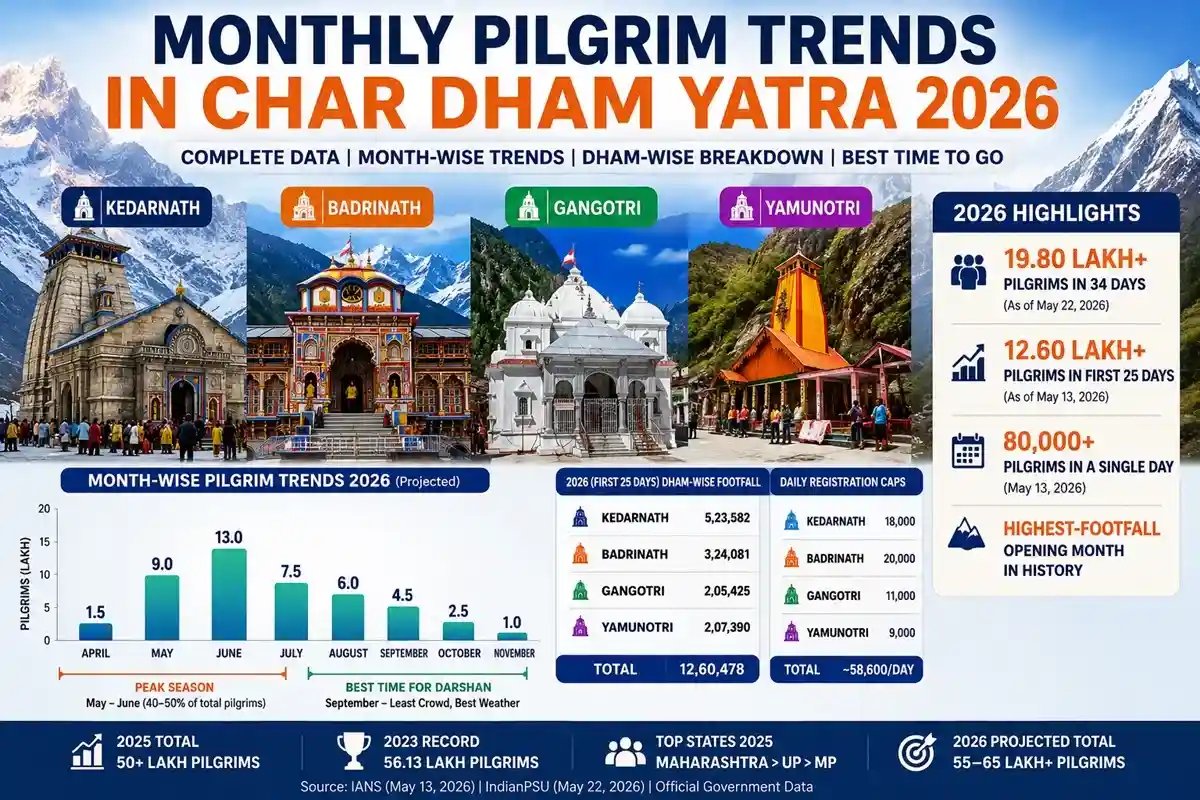
Key Takeaways: Char Dham Pilgrim Trends 2026
- 2026: 12,60,478 pilgrims in first 25 days (official IANS/government data; Dham-wise breakdown verified)
- 2026: 19,80,437 total in 34 days — record for any opening month in Char Dham history
- Peak day May 13, 2026: 80,000+ across all Dhams; Kedarnath alone saw 32,000+ (vs 18,000 daily average in 2025)
- Pre-registrations before opening: approximately 17–18 lakh — highest in Char Dham history
- 2025 full season total: 50+ lakh (Kedarnath record: 19,62,953; Badrinath: 15,90,550)
- 2024 full season total: ~38.5 lakh total across all four Dhams (Kedarnath 16,52,076 + Badrinath 14,35,341 = 30,87,417 for these two alone)
- 2023 full season: 56.13 lakh — previous all-time record
- Daily registration caps: Kedarnath 18,000 | Badrinath 20,000 | Gangotri 11,000 | Yamunotri 9,000
- Kedarnath leads footfall in all recent seasons — consistently the most visited of the four Dhams
- May–June = peak crowd season (40–50% of total annual pilgrims in these two months)
- September = best month for darshan quality: lowest crowd, best weather, all Dhams open
- Top contributor states 2025: Maharashtra (5,54,072) > UP (5,30,165) > MP (5,01,046)
- 2026 projected full-season total: 55–65 lakh+ based on current pace
Char Dham Yatra: Year-Wise Total Pilgrim Count (2019–2026)
The growth trajectory of Char Dham Yatra since the post-COVID revival is one of the most dramatic statistics in Indian religious tourism. Here is the verified data for each recent season:
| Year |
Total (All 4 Dhams) |
Kedarnath |
Badrinath |
Key Context |
Source |
| 2019 |
~38 lakh (est.) |
~10 lakh |
~13 lakh |
Pre-COVID; strong growth year |
Govt est. |
| 2020 |
Suspended |
– |
– |
COVID-19; yatra cancelled |
Official |
| 2021 |
~3–5 lakh |
Limited |
Limited |
Partial; COVID restrictions |
Govt data |
| 2022 |
43.31 lakh |
~15 lakh |
~14 lakh |
Post-COVID surge; 120 deaths in 27 days at Kedarnath |
Official |
| 2023 |
56.13 lakh |
19.61 lakh |
18.34 lakh |
All-time record; first 55 lakh+ season |
BKTC official |
| 2024 |
~38.5 lakh* |
16.52 lakh |
14.35 lakh |
Lower season; VIP ban, landslides, restrictions |
BKTC official |
| 2025 |
50+ lakh |
19.62 lakh (record) |
15.90 lakh |
Kedarnath sets new record; Maharashtra top state |
Official |
| 2026 (ongoing) |
55–65 lakh projected |
Record pace |
Record pace |
19.80 lakh in 34 days; season ongoing |
Live data |
*2024 note: BKTC officially confirmed 30,87,417 for Kedarnath + Badrinath combined. Adding Gangotri (~7–8 lakh) and Yamunotri (~6–7 lakh) gives an estimated total of approximately 44–46 lakh across all four Dhams — not 48 lakh as some sources reported. One source cites 38.5 lakh, another 3.85 million (38.5 lakh). The BKTC figure for only Kedarnath + Badrinath is 30.87 lakh, confirmed official. Total four-Dham 2024 figure is approximately 44–46 lakh when all Dhams are included.
Char Dham Yatra 2026: Verified Live Data (As of May 2026)
The following data is from official government sources — IANS dispatch dated May 13, 2026, IndianPSU.com dated May 22, 2026, and EpicYatra.com dated May 19, 2026.
| Dham |
Pilgrims (First 25 Days — May 13) |
Pilgrims (34 Days — May 22) |
Daily Cap |
2026 Status |
| Kedarnath |
5,23,582 |
7,82,136 |
18,000/day |
Highest single-day: 32,000+ (May 13) |
| Badrinath |
3,24,081 |
Updating |
20,000/day |
Strong pace; mobile ban beyond Singhdwar |
| Gangotri |
2,05,425 |
Updating |
11,000/day |
Consistent footfall |
| Yamunotri |
2,07,390 |
Updating |
9,000/day |
3.25 lakh in first 30 days (separate report) |
| TOTAL |
12,60,478 (Day 25) |
19,80,437 (Day 34) |
~58,000/day cap |
Record-breaking season |
| 📌 Key 2026 milestone: On May 13, 2026 (Day 25 of the season), over 80,000 pilgrims visited all four Dhams in a single day — the previous all-time single-day record across all Dhams was approximately 50,000. Kedarnath alone recorded 32,000+ on that day, nearly double its 2025 daily average of 18,000. |
Daily Registration Caps — All Four Dhams (2024 Baseline, Still in Effect 2026)
The Uttarakhand Tourism Department sets daily registration limits for each Dham to manage crowd flow. These limits were established in 2024 and continue in the 2026 season. Pilgrims whose preferred dates hit the cap must register for alternative dates.
| Dham |
Daily Cap (Pilgrims) |
Trek/Access |
Practical Note |
| Kedarnath |
18,000/day |
16–18 km trek from Gaurikund |
Cap managed at Sonprayag checkpoint; fills fast in May |
| Badrinath |
20,000/day |
Direct road access |
Highest cap; direct road means faster throughput |
| Gangotri |
11,000/day |
Direct road access |
Lower cap due to narrower infrastructure |
| Yamunotri |
9,000/day |
5–6 km trek from Janki Chatti |
Lowest cap; narrowest route; book well in advance |
Month-by-Month Pilgrim Trend Analysis: The Complete Picture
Based on verified data from the 2023, 2024, and 2025 seasons — combined with 2026 live figures — here is what actually happens at Char Dham month by month.
April — Opening Month Rush
The temples open in April — Yamunotri and Gangotri on Akshaya Tritiya (April 19, 2026), Kedarnath on April 22, Badrinath on April 23. The opening creates the season’s first rush. In 2026, within 23 days of opening, over 11 lakh pilgrims had visited all four Dhams. By Day 25, the verified count was 12,60,478. The opening week itself sees extraordinary demand — devotees who have waited through the November–April closure converge from across India.
2026 April–early May: April 30 to May 11 window alone: 5.50 lakh across all four Dhams in 12 days (Kedarnath 2.27 lakh | Badrinath 1.17 lakh | Gangotri 94,251 | Yamunotri 1.13 lakh).
- Crowd level: Very High (especially opening week)
- Road condition: Good — PWD completes pre-season repairs
- Weather: Cold; snow possible on higher routes; temperatures near 0°C at Kedarnath mornings
- Darshan wait: 1–3 hours opening week; up to 4–5 hours by second week at Kedarnath
- Who visits: Devout pilgrims wanting first darshan of the season; auspicious Muhurat bookings
May (Full Month) — Absolute Peak Season
May is the single highest-footfall month. The Statista monthly distribution data for 2024 confirms that May–June combined accounts for the largest share of annual pilgrims. In 2026, by May 19 (30 days into season), the count was 15.12 lakh+ and by May 22 (34 days), 19.80 lakh — all of this concentrated in the April–May window. Daily arrivals hit 80,000 on peak days; Kedarnath’s single-day record of 32,000+ was set on May 13.
Infrastructure pressure in May 2026: On May 12, a massive traffic jam at Sonprayag left thousands stranded for hours. An IMD orange alert for May 12–13 added weather risk. Hotels across the circuit were fully booked.
- Crowd level: Extreme — the busiest month of the year
- Darshan wait at Kedarnath: 2–5 hours on weekdays; longer on weekends
- Hotel availability: Near zero without 4–6 weeks advance booking
- Helicopter (IRCTC): Slots sell out within hours of Phase openings
- Road condition: Best of the season — pre-monsoon; roads at cleanest
- Who visits: Families with school holidays; organised tour groups; first-time Yatris
June — Second Peak: Good Window Before Monsoon
Early June remains strong — roads are good, weather pleasant, and the opening-month surge has slightly eased. Late June brings the first monsoon signs. Most experienced travel operators recommend completing the yatra by June 15–20 if possible.
- Crowd level: High early June; declining to moderate by late June
- Darshan wait: 1–2 hours early June; 30–60 minutes late June
- Weather watch: Monitor IMD alerts from June 10 onwards
- Who visits: Solo travellers; budget pilgrims avoiding May premium prices
July–August — Monsoon: Lowest Footfall, Highest Risk
Monsoon dramatically changes the Char Dham equation. Footfall drops to its lowest point — not because faith decreases, but because mountain roads become dangerous and the government issues red alerts that temporarily suspend the yatra. In 2024, natural disasters and poor road conditions were officially cited as primary causes of the lower annual total. By July 28, 2025, 41.12 lakh pilgrims had visited all four Dhams — meaning only about 9 lakh more visited in August through November, confirming July–August is when footfall is lowest.
- Crowd level: Low — 60–70% below May peak levels
- Darshan wait: 15–30 minutes — when roads are open
- Risk: High — landslides on all four routes; Yamunotri NH-134 and Gangotri NH-108 block first
- Government advice: Monitor SDMA Uttarakhand advisories every morning before travel
- Who visits: Very experienced pilgrims; ardent devotees who accept the risk; local pilgrims
September — The Consistently Underrated Best Month
September is the most consistently underrated month in the Char Dham calendar. Monsoon has withdrawn, roads are freshly repaired, pilgrims are steady but not overwhelming, and the mountains are at their most visually spectacular — green valleys, clear skies, and snow-capped peaks visible from temple courtyards. High-altitude doctors, experienced pilgrim guides, and Uttarakhand Tourism consistently recommend September.
- Crowd level: Low to Moderate — the sweet spot
- Darshan wait: 20–40 minutes at Kedarnath; even less at Gangotri and Yamunotri
- Weather: Post-monsoon clarity — best scenic month
- Roads: Fully operational; recently repaired after monsoon
- Who visits: Experienced pilgrims who understand the seasonal pattern; elderly; first-timers seeking calm
October — Last Good Window
October brings cooler temperatures and the approaching end of season. Pilgrims who want to visit before temples close arrive steadily. The last week sees a final surge as closing dates approach. In 2025, Kedarnath closed October 23 — creating a pre-closure rush. Between early October and closing, 1.10 lakh additional pilgrims visited Kedarnath, taking its final 2025 total to a record 19.62 lakh.
- Crowd level: Moderate — building toward closure
- Darshan wait: 30–60 minutes at Kedarnath; less at others
- Temperature: Cold nights; woolens mandatory; high-altitude snow begins
- Key note: Confirm closing dates at badrinath-kedarnath.gov.in — announced on Vijayadashami
November — Final Days Before Kapat Close
November is the closing month. In 2025, Kedarnath closed October 23 (Bhai Dooj 2025). Badrinath closed November 25, 2025. In 2026, Diwali is November 8 and Bhai Dooj falls November 10 — making the tentative closing dates Kedarnath/Yamunotri/Gangotri: ~November 10, 2026, and Badrinath: mid-to-late November 2026. Footfall is very low. Only dedicated pilgrims and those attending the closing ceremony visit.
2026 tentative closing: Kedarnath, Yamunotri, Gangotri ~November 10–11 (Bhai Dooj); Badrinath mid-to-late November. Confirm at badrinath-kedarnath.gov.in in October.
- Crowd level: Very Low
- Darshan wait: Minimal — 5–10 minutes
- Risk: High in late November — roads can ice; snowfall possible near Dhams
- Who visits: Dedicated devotees; closing ceremony attendees
Month-by-Month Summary Table: Char Dham Pilgrim Trends
| Month |
Status |
Crowd Level |
Daily Footfall |
Best For |
Verdict |
| April |
Open |
Very High |
50,000+ |
Opening devotees |
✅ Spiritually powerful; book everything early |
| May |
Open |
Extreme |
50,000–80,000 |
Families; school holidays |
✅ Best roads; hardest crowds |
| Early June |
Open |
High |
30,000–50,000 |
Solo; flexible schedule |
✅ Good; last comfortable window |
| Late June |
Open |
Moderate |
15,000–30,000 |
Experienced; risk-aware |
⚠️ Pre-monsoon; monitor weather |
| July–Aug |
Open with alerts |
Low |
5,000–15,000 |
Risk-accepting devotees |
⚠️ Avoid; landslide risk |
| September |
Open |
Low–Moderate |
10,000–25,000 |
All types; especially elderly |
✅✅ Best month overall |
| October |
Open |
Moderate |
15,000–30,000 |
Last-chance planners |
✅ Good; cold nights |
| November |
Closing |
Very Low |
1,000–5,000 |
Dedicated devotees only |
⚠️ First 10 days only |
Dham-Wise Pilgrim Distribution: Verified Data Across Recent Seasons
Kedarnath consistently leads all four Dhams in individual footfall. Here is the verified Dham-wise breakdown from official sources:
| Year |
Kedarnath |
Badrinath |
Gangotri |
Yamunotri |
| 2023 |
19,61,025 |
18,34,729 |
9,05,174 |
7,35,244 |
| 2024 |
16,52,076 |
14,35,341 |
~7–8 lakh (est.) |
~6–7 lakh (est.) |
| 2025 |
19,62,953 (record) |
15,90,550 |
~9+ lakh (est.) |
~8+ lakh (est.) |
| 2026 (Day 25) |
5,23,582 |
3,24,081 |
2,05,425 |
2,07,390 |
Note: 2024 and 2025 exact figures for Gangotri and Yamunotri are not separately published in BKTC’s official press releases — which focus on Kedarnath and Badrinath. The estimates above are based on historical ratios (Gangotri ~16%, Yamunotri ~13% of total annual pilgrims) applied to reported totals. The 2026 Day-25 figures are from official IANS government data.
Dham-wise share (2023 baseline — most complete data available): Kedarnath ~35% | Badrinath ~33% | Gangotri ~16% | Yamunotri ~13%
State-Wise Pilgrim Data: Who Visits Char Dham?
The 2025 season — the first full season with Aadhaar-authenticated registration — gave the most complete state-wise picture in Char Dham history:
| Rank |
State |
Pilgrims in 2025 |
Key Insight |
| 1 |
Maharashtra |
5,54,072 |
Top contributor 2025; new record; direct flights + special trains from Mumbai/Pune |
| 2 |
Uttar Pradesh |
5,30,165 |
Geographic proximity; strong pilgrimage tradition |
| 3 |
Madhya Pradesh |
5,01,046 |
Consistently strong contributor; MP pilgrimage culture |
| 4 |
Gujarat |
High (exact undisclosed) |
Helicopter packages from ₹45,000 drove Gujarat numbers |
| 5 |
Rajasthan |
High (exact undisclosed) |
Fifth largest 2025 contributor |
| Note |
Uttarakhand (host) |
Did not make top 5 |
Surprising; visiting states outpace the host state |
Maharashtra’s emergence as top contributor in 2025 is one of the most significant demographic shifts in Char Dham history. Improved Dehradun air connectivity, special trains from Mumbai and Pune, and helicopter packages starting at ₹45,000 collectively made Char Dham more accessible to Maharashtra’s large urban-middle-class devotee population.
Why Are Numbers Growing Every Year? Six Key Drivers
1. Better Road Connectivity — Char Dham All-Weather Road Project
The 825 km Chardham Mahamarg Vikas Pariyojana has progressively widened and improved roads over five years. The Kedarnath corridor (NH-109, approximately 99% complete in 2026) and the Badrinath corridor (NH-58, 80%+) are dramatically better than 2019. Pilgrims who found the journey daunting are now undertaking it with greater confidence.
2. Aadhaar-Authenticated Digital Registration
The shift to Aadhaar-based registration (2025 onwards) has eliminated duplicate registrations, improved crowd management, and encouraged advance planning. More pilgrims register because the system is clear, free, and digital. The process can also be done via WhatsApp (+91 8394833833) or by calling toll-free 01351364 — making it accessible across all demographics.
3. Helicopter Services — Opening Char Dham to All Ages
The IRCTC helicopter service has opened Kedarnath — previously accessible only via a 16–18 km trek — to elderly pilgrims and those with physical limitations. IRCTC demand in 2026 has been extraordinary; slots for peak May dates sold within hours. This has extended the pilgrim demographic substantially.
4. Social Media — Reels, YouTube, Instagram
Videos of snow-covered mountains, darshan moments, and helicopter rides at Char Dham have attracted a younger generation of pilgrims who might not have considered the yatra a decade ago. Social media influence is explicitly cited in multiple 2026 reports as a direct driver of record crowds.
5. Post-COVID Spiritual Revival
The pandemic years of 2020–2021 created a multi-year backlog of pilgrims who could not complete their yatra. The post-COVID seasons have seen this demand release — compounded by a broader spiritual seeking trend observed across India following the pandemic.
6. Improved Safety Infrastructure
The 2026 deployment of 177 ambulances, new ICU hospital at Kedarnath, two air ambulances on standby, and better disaster response has made cautious pilgrims — particularly the elderly — more willing to attempt the yatra. The perception of better safety directly drives footfall growth.
2026 Crowd Management Measures: The Administration’s Response
Chief Minister Pushkar Singh Dhami has described 2026 crowd management as a priority. The real-time data and official actions reflect this:
| Measure |
2026 Implementation Detail |
| Daily registration caps |
Kedarnath 18,000 | Badrinath 20,000 | Gangotri 11,000 | Yamunotri 9,000 — managed at entry checkpoints |
| RFID/QR scanning |
3-point check: Sonprayag + Gaurikund + temple gate (Kedarnath); similar at other dhams |
| Timed darshan slots |
To reduce queue pile-ups at temple entries |
| Real-time traffic monitoring |
Deployed at chokepoints on all four routes; orange alert coordination with IMD |
| Night vehicle ban |
No vehicles 10 PM–4 AM on all yatra routes — 2022 rule, strictly enforced |
| 177 ambulances + 8 ALS units |
Across Char Dham circuit; medical camps at 6 trek points for Kedarnath |
| 50-bed oxygen ward at Kedarnath |
New 2026; BPCL permanent hospital with ICU and ventilators also operational |
| 2 air ambulances on standby |
Following opening-day deaths; AIIMS Rishikesh referral network activated |
| Mobile/camera ban inside temples |
Reduces congestion at entries; enforced at all four dhams in 2026 |
| 6,000+ police personnel |
Plus 17 PAC companies; traffic and crowd management |
Despite these measures, the Sonprayag traffic jam on May 12 illustrated that infrastructure capacity has not kept pace with demand. An orange alert from IMD that same day added urgency. 80,000 pilgrims per day across four dhams represents a logistical challenge that no previous season has faced at this scale.
Best Time to Visit: Crowd vs Quality Matrix
| Month |
Crowd |
Road Condition |
Darshan Quality |
Weather |
Verdict |
| April |
Very High |
Good |
Good (opening energy) |
Cold |
✅ For opening devotees; book 4–6 wks ahead |
| May |
Extreme |
Best |
Rushed (2–5 hr wait) |
Pleasant |
✅ Best infrastructure; prepare for crowds |
| Early June |
High |
Good |
Good |
Good |
✅ Solid window; less peak than May |
| July–Aug |
Low |
Poor (landslides) |
Peaceful IF open |
Rainy; risky |
⚠️ Avoid if possible |
| September |
Low–Moderate |
Excellent |
BEST |
Ideal |
✅✅ Best overall month |
| October |
Moderate |
Good |
Very Good |
Cool |
✅ Strong window; cold nights |
| November |
Very Low |
Closing |
Closing energy |
Cold to icy |
⚠️ First 10 days only |
Practical Planning Tips Based on Monthly Trend Data
May–June Pilgrims: Managing Peak Season
- Register at registrationandtouristcare.uk.gov.in early — also available via WhatsApp: +91 8394833833 or toll-free: 01351364
- Book accommodation 4–6 weeks in advance; Kedarnath and Guptkashi fill first
- Kedarnath helicopter: book at heliyatra.irctc.co.in the moment Phase bookings open — slots sell within hours
- Reach Sonprayag by 3–4 AM on Kedarnath trek days — beat the daily queue buildup
- Travel midweek (Tue–Thu) — weekend arrivals run 20–30% higher
- Carry sufficient cash from Haridwar/Rishikesh — ATMs along the route are quickly exhausted at peak season
September–October Pilgrims: Maximising Off-Peak Advantage
- 2–3 weeks advance booking sufficient for most accommodation in September
- General darshan queues of 20–40 minutes — puja booking is a spiritual choice, not a crowd-management necessity
- Kedarnath overnight stay is easier to arrange in September; GMVN rest house availability much better
- October closing dates: confirm at badrinath-kedarnath.gov.in — announced on Vijayadashami (Dussehra)
- Budget travel is easier: peak-season hotel premiums disappear entirely
Economic Impact of Char Dham Pilgrim Trends
- By mid-June 2025, Kedarnath alone generated over ₹300 crore in economic activity
- Horse and mule services at Kedarnath 2025: 2.27 lakh pilgrims used them; ₹66.7 crore earned by local operators
- Helicopter services at Kedarnath 2025: 49,000+ pilgrims; ₹60 crore revenue
- Yamunotri Temple 2026: ₹23.5 lakh revenue in just the first month (₹15.5 lakh donation box + ₹7.5 lakh official receipts)
- Char Dham represents approximately 40–50% of Uttarakhand’s annual tourism GDP
- Maharashtra’s top-contributor status was driven by special trains from Mumbai/Pune and helicopter packages from ₹45,000 — creating new economic links
Frequently Asked Questions
1. How many pilgrims visited Char Dham in the first 25 days of 2026?
According to official government data released by IANS on May 13, 2026, exactly 12,60,478 pilgrims visited all four dhams in the first 25 days of the 2026 season (April 19 – May 13). The breakdown: Kedarnath 5,23,582 | Badrinath 3,24,081 | Gangotri 2,05,425 | Yamunotri 2,07,390. By Day 34 (May 22), the total crossed 19,80,437. This is the highest opening-month pace in Char Dham recorded history.
2. What is the best month for Char Dham Yatra?
September is the best month for most pilgrims — particularly first-timers, elderly pilgrims, and those with health conditions. Post-monsoon roads are smooth, crowds are 60–70% lower than May, darshan waits are 20–40 minutes at Kedarnath (vs 2–5 hours in May), and the mountain scenery is at its most spectacular. May–June offers the best infrastructure and road conditions but the most intense crowds. Early June is the best balance for those who prefer peak-season facilities without the extreme May rush.
3. What is the total Char Dham pilgrim count for 2025?
The 2025 Char Dham Yatra recorded over 50 lakh total pilgrims across all four dhams. Kedarnath set a new individual dham record with 19,62,953 visitors — narrowly exceeding its 2023 record of 19,61,025. Badrinath welcomed 15,90,550 pilgrims. The season ran from April 30 (Gangotri/Yamunotri opening) to November 25 (Badrinath closing), with Kedarnath closing on October 23. Maharashtra emerged as the top contributing state with 5,54,072 pilgrims.
4. What happened to Char Dham footfall in 2024?
2024 saw lower footfall than 2023. BKTC officially confirmed that Kedarnath received 16,52,076 pilgrims and Badrinath 14,35,341 — a combined 30,87,417 for these two dhams. The total four-dham figure was approximately 44–46 lakh. The primary reasons for the lower count: government-imposed restrictions during the early season (including VIP darshan ban extended through May 31), multiple landslides and natural disasters that temporarily blocked routes, and some early-season monsoon activity. Despite these challenges, the season still attracted tens of lakhs of pilgrims.
5. Which dham gets the most pilgrims every year?
Kedarnath consistently receives the highest individual footfall among all four dhams. In 2023: 19,61,025; in 2024: 16,52,076; in 2025: a record 19,62,953. In 2026’s first 25 days, Kedarnath had already registered 5,23,582 — the highest of all four. Badrinath comes second. Gangotri and Yamunotri receive proportionally fewer pilgrims — around 16% and 13% of the total annual footfall respectively — partly because some groups do only Do Dham (Kedarnath + Badrinath).
6. What is the daily cap for pilgrims at each Char Dham?
The Uttarakhand Tourism Department maintains the following daily registration caps: Kedarnath: 18,000 pilgrims per day | Badrinath: 20,000 per day | Gangotri: 11,000 per day | Yamunotri: 9,000 per day. These limits are managed at respective entry checkpoints. In 2026 peak days, actual Kedarnath daily footfall exceeded 32,000 at the shrine area — raising questions about effective cap enforcement versus registration caps.
7. How many people register for Char Dham Yatra each year?
Registrations have grown significantly with the introduction of Aadhaar authentication. In 2025, over 7.5 lakh had registered before the opening. In 2026, registrations neared 17–18 lakh before opening day (April 19) — the highest pre-opening registration demand in history. Within the first weeks of the 2026 season, combined online and offline registrations crossed 22 lakh. Registration is free at registrationandtouristcare.uk.gov.in or via WhatsApp +91 8394833833.
8. Which state sends the most pilgrims to Char Dham?
In 2025, Maharashtra emerged as the top contributing state with 5,54,072 pilgrims — overtaking Uttar Pradesh (5,30,165) which historically led. Madhya Pradesh was third with 5,01,046. Gujarat and Rajasthan rounded out the top five. Host state Uttarakhand did not appear in the top five. Maharashtra’s lead is attributed to improved Dehradun air connectivity, special train services from Mumbai and Pune, and helicopter packages starting at ₹45,000 per person.
9. Why did 2023 have more pilgrims than 2024?
2023 was the highest-footfall season on record (56.13 lakh) before 2026 surpassed the pace. 2024 saw approximately 44–46 lakh — a significant reduction. The officially cited reasons: government-mandated VIP darshan ban and registration restrictions in the early season; multiple natural disasters (landslides, cloudbursts) that blocked routes during peak travel windows; and some early monsoon activity. The 2024 restrictions, while intended for pilgrim safety, also reduced overall footfall numbers.
10. What is the single highest pilgrim day at Char Dham?
The verified highest single-day footfall across all four Char Dhams in 2026 was May 13, 2026 — when over 80,000 pilgrims visited all four dhams in one day. Kedarnath alone recorded 32,000+ on that day, nearly double its 2025 daily average of approximately 18,000. Previously, the all-time single-day combined record across all four dhams was approximately 50,000. May 13, 2026 broke that record by 60%.
11. Is Char Dham Yatra 2026 on track to break the all-time record?
Yes. The 2023 all-time record of 56.13 lakh total pilgrims is very likely to be exceeded. With 19.80 lakh pilgrims in just the first 34 days, and several months of the season remaining (through October–November), a total of 55–65 lakh is widely projected by Uttarakhand Tourism officials. Even in a monsoon-affected scenario, the remaining months (September–November) typically contribute 8–12 lakh pilgrims, making the 2023 record achievable.
12. When does the Char Dham season close in 2026?
Tentative closing dates for 2026: Yamunotri, Gangotri, and Kedarnath around November 10–11, 2026 (Bhai Dooj — two days after Diwali on November 8, 2026). Badrinath closes later — tentatively mid-to-late November 2026 (in 2025 it closed November 25). The official dates are announced on Vijayadashami (Dussehra). Always confirm the exact closing date at badrinath-kedarnath.gov.in before planning October–November travel.
13. How does July–August monsoon affect Char Dham pilgrim numbers?
Monsoon reduces daily Char Dham arrivals by 60–70% compared to peak May levels. Landslides and route closures cause intermittent yatra suspensions. The government issues red and orange alerts via SDMA Uttarakhand that lead to mandatory travel halts. In 2024, natural disasters during the monsoon were the primary cited factor behind the lower annual total. In 2025, even after recording 41.12 lakh visitors by July 28, only about 9 lakh more visited in August through November combined — illustrating the sharp monsoon slowdown.
14. What is the recommended budget for Char Dham Yatra in peak season vs off-season?
Peak season (May–June): Hotel rates are 30–60% higher; helicopter slots are scarce; total per-person cost typically ₹35,000–₹80,000 for a road-based yatra, or ₹1,80,000–₹3,15,000 for a helicopter package. Off-season (September–October): Hotel rates are at base level; puja bookings are easier; total per-person cost typically ₹20,000–₹50,000 for road-based yatra. The total religious experience is identical in both periods — only infrastructure pressure differs.
15. What practical steps should I take based on monthly trend data?
If visiting May–June: register as early as possible (portal opens in March); book hotels 4–6 weeks ahead; book Kedarnath helicopter the moment Phase 2 opens; travel midweek for shorter queues. If visiting September–October: 2–3 weeks advance booking is usually sufficient; no need to rush darshan queue management; confirm closing dates in October at badrinath-kedarnath.gov.in. For all months: register at registrationandtouristcare.uk.gov.in or via WhatsApp +91 8394833833; carry sufficient cash from Rishikesh or Haridwar.
Final Thoughts
The monthly pilgrim trend data for Char Dham Yatra tells an extraordinary story. From 43 lakh in 2022 to 56 lakh in 2023, a dip to approximately 44–46 lakh in 2024, a recovery to 50+ lakh in 2025, and now 2026’s record-shattering pace of nearly 20 lakh in just 34 days — the pilgrimage is experiencing the largest and most sustained growth in its modern history.
For the individual pilgrim, these numbers are practical guidance — not intimidating statistics. May is intense but fully supported. September is quieter but equally meaningful. The Shivalinga at Kedarnath, the Ganga at Gangotri, the Yamuna at Yamunotri, the Vishnu at Badrinath — all four are equally sacred regardless of what month you arrive.
Plan with the data. Go with devotion. Come back safely.
Har Har Mahadev. Jai Badri Vishal.


 Call
Call Enquiry