Last Updated on 15/07/2026
Good Adi Kailash Yatra travel tips can save your trip; wrong assumptions can end it at a checkpoint. This journey through the restricted Vyas Valley of Pithoragarh, Uttarakhand, needs an Inner Line Permit, careful acclimatisation, and mountain common sense. The route is now largely drivable, which fools people into treating it like an ordinary road trip — it isn’t. Based on recent traveller experiences and official guidelines, these tips cover permits, health, packing, money, and the mistakes that catch first-timers every season.
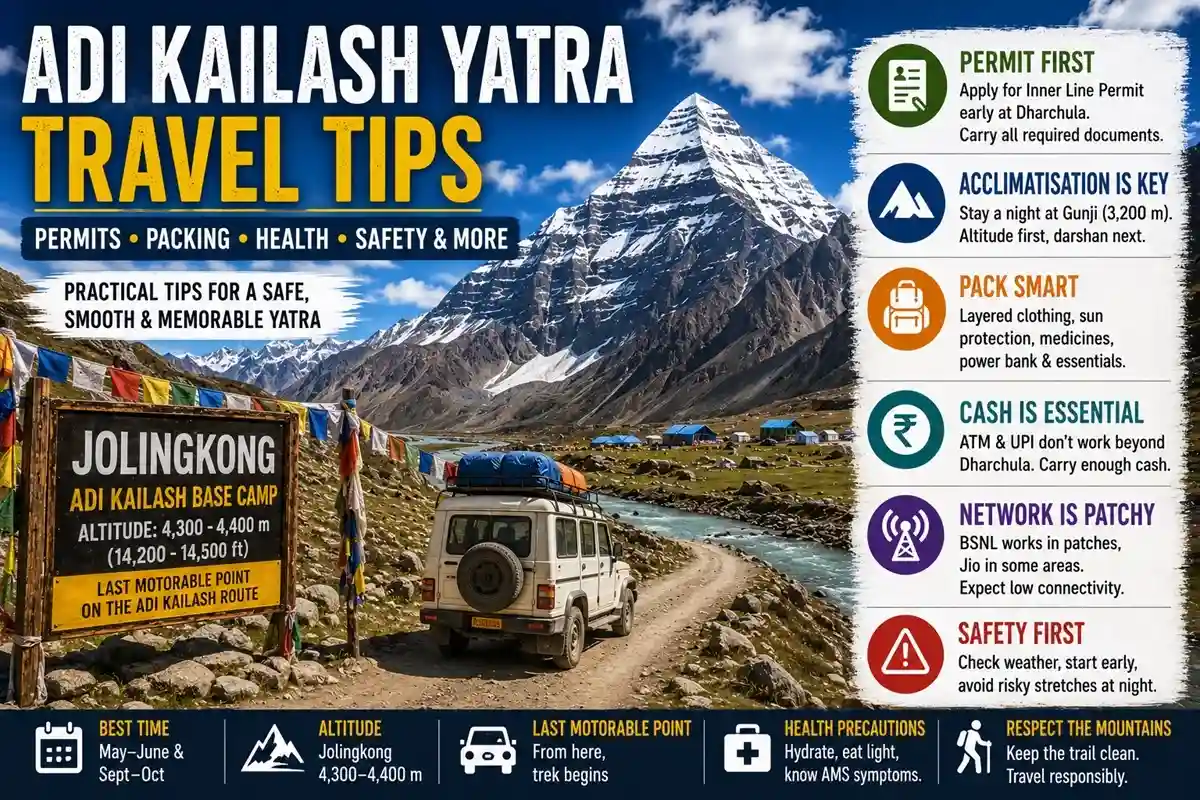
Tip 1: Time Your Yatra Right
Travel in May–June or September–October. Both windows are generally considered good for clear Om Parvat “ॐ” views — May–June for the season’s energy, late September–October for the sharpest post-monsoon skies. July–August is monsoon; landslides at points like Mangti Nala regularly hold batches at Dharchula for days.
Two habits pay off: start each day’s drive early, since mountain weather deteriorates after noon, and build one buffer day into the plan. Most ruined itineraries fail not from bad planning but from zero slack.
Tip 2: Sort the Inner Line Permit Early
The ILP is checked at multiple ITBP and police posts, so treat paperwork as seriously as packing:
- In peak season, begin the permit process several weeks in advance — permits, vehicles, and stays all run out in the May–June rush.
- Reach Dharchula on a working day, before noon; processing time varies with police verification and seasonal workload.
- Carry a government ID, 2–4 passport photos, and a medical certificate from a registered doctor.
- Keep photocopies plus digital copies — a lost permit cannot be replaced mid-route.
Only Indian citizens qualify under current rules. If an agent promises “guaranteed permits” or entry for foreigners, walk away.
Tip 3: Respect Acclimatisation — It’s the Whole Game
Altitude, not walking, is what troubles yatris. You sleep at Gunji (3,200 m, near the confluence of the Kuthi Yankti and Kali rivers) and visit Jolingkong and Nabhidhang above 4,300 m, where Acute Mountain Sickness (AMS) is a real risk.
- Never drive from Dharchula straight to Jolingkong; sleep a night at Gunji first.
- Stay well hydrated through the day and skip alcohol — it worsens AMS.
- Ask your doctor about altitude medication in advance, not at Gunji.
- If headache, nausea, or breathlessness worsens, descend immediately.
Seniors and anyone with heart, lung, or blood-sugar conditions should get honest medical clearance first — screening exists for your safety, not as a formality.
Tip 4: Pack for Two Climates
Dharchula is warm; Jolingkong can be freezing the same day. Layers beat one heavy jacket.
| Category |
Essentials |
| Clothing |
Thermal layers, fleece, windproof jacket, rain cover, cap, gloves |
| Footwear |
Broken-in sturdy shoes, warm socks |
| Sun protection |
Sunglasses, SPF 50 sunscreen, lip balm — high-altitude sun is harsh |
| Health |
Personal medicines, basic first aid, water bottle, ORS |
| Practical |
Power bank (10,000+ mAh), torch, toilet paper, ID photocopies, photos |
Underrated tip: download offline maps and write key phone numbers on paper before leaving Dharchula — paper doesn’t run out of battery.
Tip 5: Handle Money, Fuel & Network Like a Local
- Cash: Withdraw sufficient cash for the whole trip in Dharchula’s market — the last dependable ATMs are there. Higher stops run on cash; UPI fades fast.
- Fuel: Fill up in Dharchula; dependable pumps beyond it are effectively absent.
- Network: BSNL usually offers the widest coverage, Jio works in patches, and connectivity stays unreliable beyond Tawaghat. Tell family you may be unreachable for two–three days.
- Charging: Up-valley electricity is erratic and often solar-based; ration your power bank.
Budgets vary by style: shared jeeps with homestays at the low end, KMVN packages in the middle, private-vehicle and premium tours higher. Indicatively, 5–7 day road packages run ₹20,000–40,000 per person — confirm current rates with KMVN or registered operators.
Tip 6: Choose Vehicles and Operators Wisely
Access rules for outside private vehicles vary by season and administration orders, and they are generally stopped beyond Dharchula — park in town and switch to a registered local taxi or your operator’s vehicle. Local drivers know exactly where the road misbehaves.
When comparing operators, start with KMVN, the government body, then judge private agencies on four things: registration, transparent ILP handling, a Gunji acclimatisation night, and oxygen backup. Cheap packages that skip the Gunji night cut the one corner you cannot afford.
Tip 7: Set Realistic Expectations for Food & Stay
Accommodation is homestays and KMVN huts — thick blankets, shared toilets, simple vegetarian food like dal-bhat and Kumaoni mandua roti. Hot water is a luxury; kitchens close by 9 pm.
Travellers expecting hotel comfort struggle; those expecting a pilgrimage are charmed by Byansi hospitality in Gunji, Nabi, and Kuti. Carry dry fruits, chocolate, glucose, spare spectacles, and extra doses of regular medicines — replacements don’t exist up there.
Tip 8: Follow Border-Zone Etiquette
This is a sensitive frontier under army and ITBP watch, and the rules are enforced:
- No drones, under current regulations.
- Never photograph check posts, bridges, or military installations — landscapes and temples are fine.
- Cooperate at every checkpoint; verification is routine.
- Don’t bathe in or pollute the sacred Parvati Sarovar; offer prayers at the shore.
- Carry litter back down and avoid single-use plastic; the valley has no waste management.
7 Common Mistakes to Avoid on the Adi Kailash Yatra
- Skipping the Gunji acclimatisation night to “save a day.”
- Arriving at Dharchula on a weekend expecting a same-day permit.
- Carrying one ATM card instead of cash.
- Packing for summer because “it’s May.”
- Booking the cheapest package without oxygen backup.
- Drinking alcohol at altitude.
- Planning zero buffer days.
FAQs
What is the most important Adi Kailash Yatra travel tip?
Never skip acclimatisation — sleep at Gunji before going above 4,000 m. Altitude fails more yatras than roads do.
How many days should I plan?
4–6 days from Dharchula, 7–10 from Delhi or Kathgodam, plus one buffer day for weather.
How much walking is involved?
Only short optional walks, such as around Parvati Sarovar and Gauri Kund near the base camp (~17 km from Kuti village); vehicles cover the rest.
Can I take my own car on the yatra?
Generally no beyond Dharchula; park in town and hire a registered local taxi or travel in your operator’s vehicle.
Is a bike trip allowed?
Rules on private bikes change with administration orders — confirm current policy with the SDM office before riding up.
Which SIM card works best on the route?
BSNL generally covers the most; carry Jio as backup, and expect no signal beyond Tawaghat.
What fitness preparation is needed?
Begin regular walking and light cardio several weeks before the trip; altitude readiness matters more than strength.
What documents should I keep handy every day?
Your Inner Line Permit, original ID, and photocopies of both — they are checked at every ITBP and police post.
Are toilets available on the route?
Homestays have basic shared toilets; higher camps use dry-pit setups. Carry toilet paper and sanitiser.
Is non-veg food available?
The route is effectively vegetarian, in keeping with its sacred character — plan accordingly.
Can solo women travellers do the yatra?
Yes — the valley is heavily monitored by ITBP and police; a registered group still makes logistics easier.
What should I carry for Adi Kailash Yatra?
Layered warm clothing, rain cover, broken-in shoes, medicines, power bank, torch, ID copies, photos, and cash — see the table above.
Which shoes are best?
Sturdy, broken-in trekking or walking shoes with good grip — never new shoes, and never sandals at altitude.
Can I use UPI on the route?
UPI works in Dharchula but is unreliable beyond it — carry cash for Gunji, Nabi, Kuti, and higher stops.
Is oxygen available on the route?
Good operators carry portable cylinders and Gunji has basic medical support; no hospital-grade care exists above Dharchula.
What about power cuts up-valley?
Electricity is erratic and often solar-based — carry a 10,000+ mAh power bank and ration charging.
What should I not carry?
Drones, alcohol, excess luggage, and single-use plastic — heavy bags burden shared vehicles and homestays alike.
What if AMS symptoms start at Jolingkong?
Descend immediately and inform your operator or the nearest ITBP post — never wait it out at altitude.
Is travel insurance worth it for this yatra?
Yes — pick a policy covering high-altitude travel and emergency evacuation; care above Dharchula is basic.
Whom do I contact in an emergency on the route?
The nearest ITBP or police post, then your operator and the SDM office, Dharchula.
Key Takeaways
- Start the ILP process several weeks early and carry a registered doctor’s medical certificate.
- Acclimatise at Gunji, hydrate, and skip alcohol — AMS is the trip’s main risk.
- Carry sufficient cash and fuel up in Dharchula; expect no reliable network beyond Tawaghat.
- Use registered local taxis and operators with oxygen backup; KMVN is the safest starting point.
- Pack in layers for two climates and keep one buffer day.
Final Word
Most of these Adi Kailash Yatra travel tips reduce to one principle: the Vyas Valley rewards preparation and punishes shortcuts. Sort your permit early, give your body time at Gunji, carry cash and warm layers, and let the mountain set the pace. Do that, and this Chhota Kailash journey becomes what it should be — demanding, remote, and unforgettable. For deeper planning, read our How to Get Adi Kailash Inner Line Permit and Adi Kailash Yatra Route Map next.


 Call
Call Enquiry