Last Updated on 11/07/2026
The Adi Kailash Yatra Health Advisory exists for one reason: this pilgrimage climbs from Dharchula’s 3,000 feet to Jolingkong’s roughly 14,500–15,000 feet in just a few days, and altitude sickness doesn’t check how devoted you are before it hits. Before you book, you need to know what documents you need, who should think twice, and how to actually prevent AMS instead of just reading about it.
This article is written for general educational and travel-planning purposes. It doesn’t replace advice from a qualified doctor or the current official notification issued by the Pithoragarh district administration, and all rules mentioned should be reconfirmed closer to your travel date.
Quick Answer:
- Medical Fitness Certificate (RMP): Mandatory for the ILP.
- Diamox: Optional; take only on a doctor’s advice.
- Health Conditions: Avoid the yatra if you have uncontrolled heart, lung, or kidney disease.
- Medical Check: Basic health screening is conducted at Gunji.
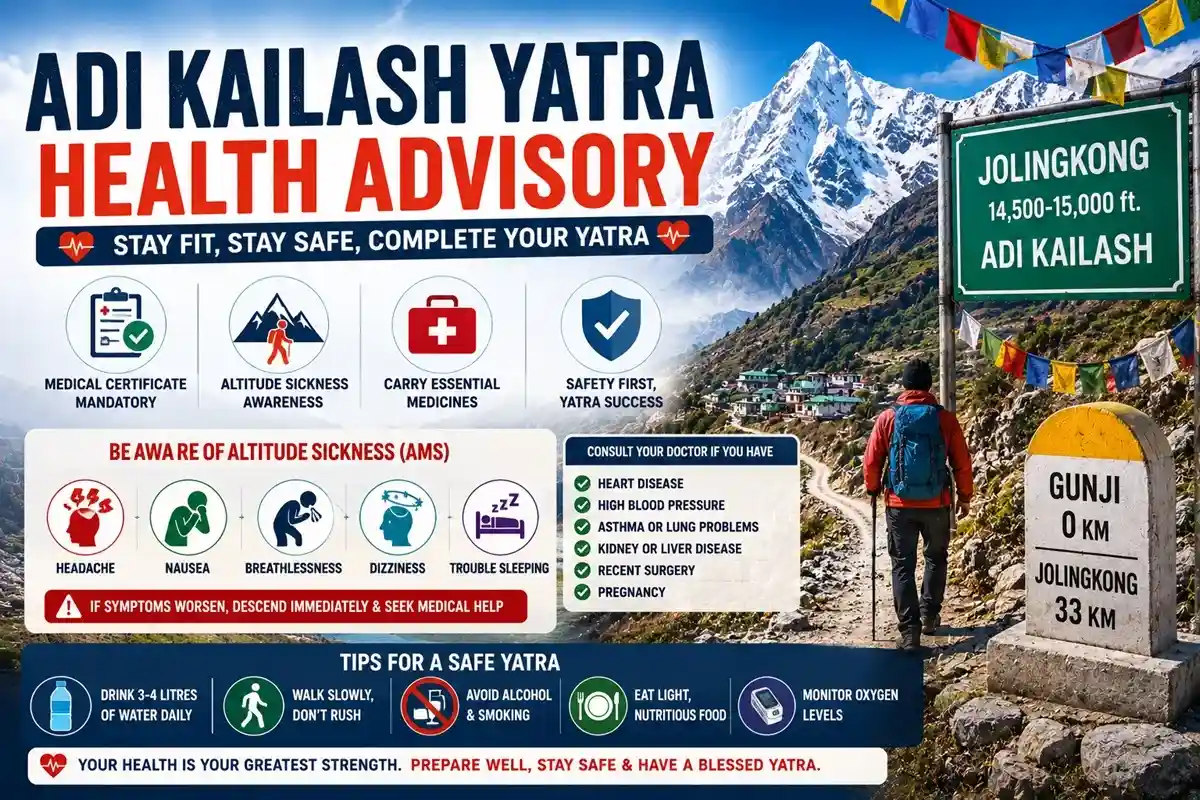
Why This Health Advisory Matters More Than You’d Think
Roads now run almost to Jolingkong, so people assume the yatra is easy. It isn’t, medically speaking. You still sleep two nights above 10,000 feet at Gunji and stand at nearly 15,000 feet for darshan, where oxygen saturation naturally runs lower than what your body is used to at sea level — this drop in available oxygen is what doctors call high-altitude hypoxia. From practical experience with pilgrims on similar Himalayan routes, fitness alone doesn’t protect you — pace and acclimatization do. That’s exactly what these health guidelines are built around, and why this Adi Kailash Yatra Health Advisory exists in the first place.
Medical Certificate for Adi Kailash Yatra: What’s Typically Required
Your Inner Line Permit application at Dharchula won’t move forward without proper documentation. Based on current registration guidance through the Pithoragarh ILP process and KMVN/Uttarakhand eDistrict portals, pilgrims are generally expected to carry:
- A medical fitness certificate from a Registered Medical Practitioner (RMP) confirming fitness for high-altitude travel
- A self-declaration/affidavit stating you’re undertaking the yatra at your own risk
- Basic vitals on the certificate — blood pressure, heart rate, and often oxygen saturation
- An ECG report, commonly asked for pilgrims above 50 (varies by operator and season)
- A certificate not older than roughly 30 days from your travel date
Note: Exact requirements shift season to season and sometimes by operator. Treat this as a starting checklist, and cross-check the current requirement on the official Pithoragarh ILP portal or with the SDM Dharchula office before you travel.
One mistake many people make: getting the certificate a week before departure from a doctor who’s never discussed altitude medicine. Get it done 15–20 days out, and be upfront about your medical history — a vague certificate often gets rejected at the counter.
Who Should Avoid This Yatra
- Uncontrolled blood pressure or heart disease
- Severe asthma or chronic respiratory conditions
- Acute kidney or liver disease
- Recent surgery or a recent cardiac event
- Pregnant women (confirm current operator and administration policy, as this varies by season)
This list isn’t meant to discourage genuine devotees. It exists because the nearest proper hospital is hours away once you cross Dharchula, and it’s always worth a direct conversation with your doctor rather than self-assessing.
AMS, HAPE and HACE: Know the Difference
Acute Mountain Sickness (AMS), sometimes called mountain sickness or high-altitude illness, usually shows up within 12–24 hours of gaining altitude — headache, nausea, dizziness, breathlessness, and disturbed sleep are the early signs. Left unmanaged, AMS can progress into two dangerous conditions:
- HAPE (High Altitude Pulmonary Edema): fluid in the lungs, marked by a persistent cough, chest tightness, and breathlessness even at rest
- HACE (High Altitude Cerebral Edema): fluid affecting the brain, causing confusion, loss of balance, and severe headache
Both are medical emergencies requiring immediate descent. A pulse oximeter can help you track your oxygen saturation trend, but medical literature is clear that a single reading isn’t diagnostic on its own — what matters more is a saturation level that keeps dropping alongside symptoms like breathlessness or confusion. Don’t wait for morning, and don’t try to “push through” a worsening symptom.
How to Avoid Altitude Sickness on Adi Kailash Yatra
- Spend at least one full night at Gunji before pushing to Jolingkong or Nabhidhang — this single step prevents most AMS cases
- Drink 3–4 litres of water daily, even when you don’t feel thirsty
- Skip alcohol and smoking completely for the yatra’s duration
- Discuss Diamox (Acetazolamide) with your doctor well before departure — ideally 2–3 weeks out — so there’s time to check it suits you; if prescribed, doctors typically have you start it a day before you gain significant altitude
- Eat light, carbohydrate-rich meals instead of heavy or oily food
- Walk slowly. Local drivers usually recommend an unhurried pace even during the short walk at Jolingkong — rushing at altitude catches up with you fast
Weather, Temperature and What It Means for Your Health
| Location |
Approx. Altitude |
Daytime Temp |
Night Temp |
| Dharchula |
~3,000 ft |
15–24°C |
8–13°C |
| Gunji |
~10,500 ft |
3–14°C |
-5 to 2°C |
| Jolingkong |
~14,500–15,000 ft |
-2 to 8°C |
-12 to -4°C |
These are seasonal averages, not official weather records — mountain weather shifts fast, so check the latest forecast close to your travel dates. During peak season (May–June, September–October), daytime sun at Gunji can burn exposed skin fast, while temperatures drop sharply after sunset. Carry layered clothing rather than one heavy jacket — you’ll need to adjust through the day.
Should You Attempt This Yatra? A Quick Self-Check
- Can you walk briskly for 30–40 minutes without severe breathlessness?
- Do you have a diagnosed heart, lung, or kidney condition? Get specific doctor clearance first.
- Are you comfortable spending nights without hospital access nearby?
- Can you build in at least one extra acclimatization day at Gunji?
- Are you travelling with someone who can notice symptoms you might miss?
Mostly positive answers make you a reasonable candidate for this yatra, subject to your doctor’s final call — this quick check is part of the Adi Kailash Yatra Health Advisory precisely because self-honesty here matters more than fitness-app numbers.
Adi Kailash Yatra Safety Tips for Senior Citizens
This part of the safety advisory matters most for older pilgrims. Senior citizens should prefer the motorable 4×4 route, since driving now covers almost the entire stretch to Jolingkong. A few extra precautions still apply:
- Carry existing prescription medicines in original packaging with a doctor’s letter
- Add one extra acclimatization day at Gunji instead of a tight itinerary
- Skip the Gauri Kund walk if you have knee or cardiac concerns — Parvati Sarovar darshan is closer and equally sacred
- Travel with a companion who can notice symptoms you might brush off yourself
Can Children Join the Adi Kailash Yatra?
Reported age limits range roughly from 7–10 years at the lower end to 70 at the upper end, but this isn’t fixed — it depends on the season’s administration notification and the operator’s own policy. If travelling with children, get clearance from a pediatrician familiar with altitude exposure rather than assuming they’ll acclimatize like an adult.
Common Mistakes Pilgrims Make
- Booking a rushed 4–5 day itinerary that skips acclimatization at Gunji
- Assuming a motorable road means no altitude risk
- Carrying summer clothing only, ignoring the sharp night drop at Jolingkong
- Not consulting a doctor before self-medicating with Diamox
- Underestimating cash needs — UPI and card payments barely work past Dharchula
- Not checking the current official notification before travel, and relying only on last year’s rules
Health & Safety Packing List
Beyond documents, a few practical fitness guidelines apply to what you carry:
- Personal medicine kit: paracetamol, ORS sachets, motion sickness tablets, prescribed altitude medication
- Sunscreen SPF 50+ and lip balm — UV exposure is sharp at this altitude
- A sleeping bag rated to around minus 10°C if you’re travelling independently — most organized packages provide bedding, so confirm with your operator first
- A basic pulse oximeter, useful for tracking trends rather than a single reading
- Copies of your medical certificate and ID, stored separately from originals
Food, Water, Connectivity and Insurance
Meals beyond Dharchula are simple home-cooked Kumaoni food — dal, rice, roti, seasonal vegetables. Drink only boiled or properly filtered water, and avoid raw salads at high-altitude homestays where washing water may not be treated. Mobile network is patchy past Dharchula, with BSNL offering the widest but still unreliable coverage; Jolingkong and Nabhidhang are often complete network dead zones. Carry sufficient cash, since digital payments are unreliable beyond Dharchula. Travel insurance that covers high-altitude emergency evacuation is strongly recommended and, in practice, one of the most overlooked parts of trip planning.
Emergency Protocol: What to Do If AMS Symptoms Appear
- Stop ascending immediately — do not go higher with symptoms present
- Rest, hydrate, and monitor for worsening signs over the next few hours
- If symptoms don’t improve or worsen, descend to a lower altitude without delay
- Report to the nearest medical post for assessment — basic ITBP health screening facilities have historically been maintained at Gunji
- For severe symptoms — confusion, breathlessness at rest, or a cough with frothy sputum — arrange emergency evacuation to Dharchula or Pithoragarh immediately
Beyond Dharchula, there are no proper pharmacies or hospitals at Kuti, Nabi, or Jolingkong. Prevention through pacing and honest health disclosure is your strongest safety net once you’re past Gunji.
Registration Process and 2026 Season Notes
Registration for this yatra runs through the Pithoragarh ILP portal, KMVN, and Uttarakhand eDistrict services, with final document verification still required in person at SDM Dharchula. Vehicle movement beyond Dharchula has historically been restricted to KMVN or registered-operator 4×4 vehicles rather than private cars, though this and other operational rules can be revised season to season. Treat this section as general orientation and reconfirm exact 2026 rules — registration windows, fees, and vehicle policy — directly with SDM Dharchula or your operator before finalizing travel.
Key Takeaways
- A medical fitness certificate from a Registered Medical Practitioner is required for Inner Line Permit processing
- Gunji (~10,500 ft) is your acclimatization stop before Jolingkong (~14,500–15,000 ft) or Nabhidhang (~14,100 ft)
- Diamox isn’t compulsory but is commonly advised after medical consultation
- Descend immediately if AMS, HAPE, or HACE symptoms appear — never wait it out
- Senior citizens and families with children should build in extra acclimatization time, doctor clearance, and travel insurance covering evacuation
Conclusion
Following this Adi Kailash Yatra Health Advisory isn’t about adding paperwork to your trip — it’s the difference between completing a sacred darshan and being turned back at Gunji. Treat this wellness guide as seriously as your travel bookings: get your fitness certificate early, respect the acclimatization schedule, pack for real temperature swings, and reconfirm current rules before you leave. Do that, and the journey to Jolingkong stays what it should be — demanding, but safe.
9. FAQs (10 Questions, 1–2 Line Answers)
Q1. Is a medical certificate mandatory for the Adi Kailash Yatra?
Yes. A fitness certificate from a Registered Medical Practitioner is required for Inner Line Permit processing at Dharchula.
Q2. What altitude does the Adi Kailash Yatra reach?
Jolingkong sits at roughly 14,500–15,000 feet and Nabhidhang around 14,100 feet; the peak itself is close to 19,500 feet.
Q3. Is Diamox necessary for this yatra?
Not mandatory, but commonly recommended. Discuss timing and dosage with your doctor well before departure.
Q4. What are common AMS symptoms at Jolingkong?
Headache, nausea, dizziness, breathlessness at rest, and poor sleep are the earliest warning signs.
Q5. How to avoid altitude sickness on Adi Kailash Yatra?
Acclimatize at Gunji, hydrate well, skip alcohol, walk slowly, and consider Diamox after medical advice.
Q6. Can BP, diabetic, or asthma patients attempt this yatra?
Possibly, but only with a doctor’s specific clearance and a detailed medical history submitted with your certificate.
Q7. Are Adi Kailash Yatra safety tips for senior citizens different?
Yes — seniors should use the motorable route, add an extra acclimatization day, and carry evacuation-covering travel insurance.
Q8. Can children join the Adi Kailash Yatra?
Age policies vary by season and operator; get pediatric clearance and confirm the current age limit before booking.
Q9. What oxygen saturation level should concern me at altitude?
Saturation naturally runs lower here; a single reading matters less than a level that keeps falling alongside symptoms.
Q10. Is there hospital access along the route?
Only basic medical facilities exist at Gunji; Kuti, Nabi, and Jolingkong have no pharmacies or proper hospitals.
Suggested Tour:


 Call
Call Enquiry