Last Updated on 18/07/2026
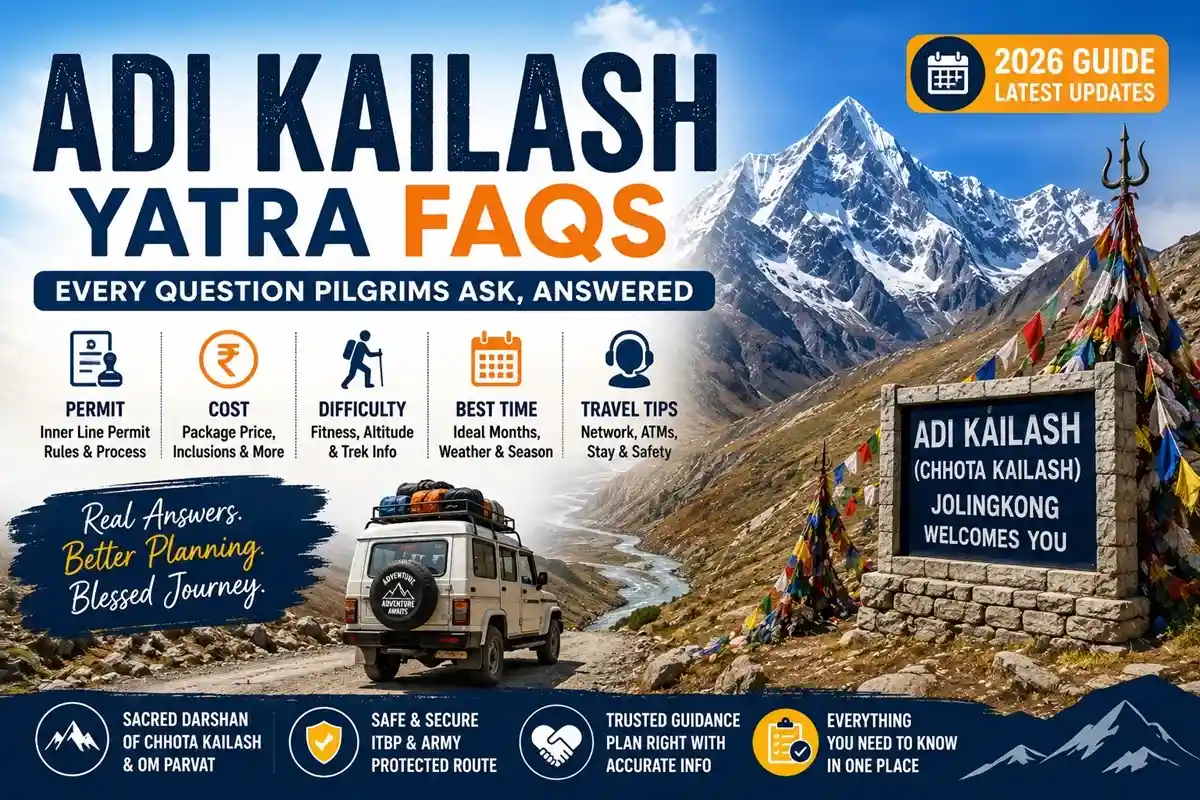
If you’ve searched for the Adi Kailash Yatra before, you know the problem — most pages repeat the same lines about Om Parvat and skip what you actually need to know. Is the permit mandatory? Can seniors manage the altitude? This FAQ page answers those questions for the 2026 season, with figures checked against official and current operator sources rather than guessed.
Permits & Who Can Go
Is the Inner Line Permit mandatory?
Yes, without exception. Adi Kailash sits in a restricted border zone, so SDM Dharchula issues the mandatory ILP, checked repeatedly by ITBP and army posts. Approval timing isn’t fixed — it depends on verification and how busy the office is that week.
Can foreigners visit Adi Kailash?
No. Foreign nationals, NRIs with foreign passports, and OCI cardholders currently aren’t issued the ILP for this route. Only Indian citizens qualify, with rare Ministry of Home Affairs exceptions that take months.
Do I need a passport for this trip?
Not necessarily. Aadhaar, voter ID, or a passport all work as valid ID for Indian citizens applying for the ILP. A passport only matters for the rare foreign-passport or OCI route.
What exactly is the Inner Line Permit?
It’s a government authorisation letting Indian citizens enter protected villages like Gunji, Nabhi, Kuti, and Jolingkong. It’s separate from your tour booking — every pilgrim needs their own ILP, package or no package.
Is Adi Kailash Yatra safe for senior citizens and children?
For seniors, generally yes — most operators accept pilgrims up to around 70 with a medical certificate for the 60–70 band. For children, policy varies by operator, though KMVN usually sets 18 as the practical minimum given the altitude.
Is it safe for solo female travellers?
It can be, through a registered operator or a KMVN batch rather than travelling entirely alone. Homestays are basic but generally safe, with heavy ITBP and army presence throughout the route.
Adi Kailash Yatra Cost, Duration & Registration
What is the cost of Adi Kailash Yatra 2026?
Ground packages are indicatively priced ₹20,000–₹50,000 per person depending on starting point and stay quality — treat this as a planning range, not a fixed quote, and confirm current pricing before booking.
| Travel Mode |
Indicative Cost (Per Person) |
Best Suited For |
| Ground / Road Package |
₹20,000 – ₹50,000 |
Fit travellers who want the full valley experience |
| Helicopter Package |
₹65,000 – ₹1,35,000 |
Senior citizens, limited-time travellers, weather permitting |
How many days are needed for this trip?
Most itineraries run 7–12 days door-to-door, including travel from Delhi or Kathgodam and two acclimatisation halts. Build in one buffer day — road blocks beyond Dharchula aren’t rare.
What is the Adi Kailash Yatra registration process for 2026?
Pre-register online through the Pithoragarh district portal with your ID and medical certificate. The physical ILP still has to be collected in person at SDM Dharchula — it isn’t fully doorstep-digital yet.
Which is the best tour operator, and can I go without one?
There’s no single ‘best’ name — check ILP handling, KMVN or registered 4×4 vehicles, and onboard oxygen. Going without an operator is technically possible, but most independent travellers still book local transport through a Dharchula-based operator anyway.
Is there a helicopter option?
Yes, flying between Pithoragarh, Dharchula, or Gunji and the darshan points. Pricing is indicative and varies by operator and season, and flights are weather-dependent, so always confirm a current quote.
Difficulty, Fitness & Best Time
Is Adi Kailash difficult?
It’s a moderate high-altitude trip, not a technical climb — no rock climbing or glacier crossing. The real challenge is altitude and long, rough mountain roads, not the walking itself.
How fit do I need to be for this yatra?
Basic cardiovascular fitness is enough — walking 5–6 km comfortably. Altitude tolerance matters more and is hard to predict, so start light walking 3–4 weeks ahead and get a medical check if needed.
What is the best time for Adi Kailash Yatra?
May–June and mid-September to mid-October, when roads stay open and skies are generally clear. July–August bring monsoon landslides on the Dharchula–Gunji stretch and are best avoided.
Is it worth doing?
For most pilgrims, yes — Om Parvat’s natural ‘ॐ’ snow formation and the Adi Kailash view from Jolingkong are unlike anything else in India. Much of the value is the journey itself, not just the final darshan.
Do I need to worry about altitude sickness?
Yes, above 3,500 metres it’s a real risk regardless of fitness. Operators typically carry oxygen and oximeters, and KMVN points offer basic medical support. Descend immediately if symptoms show up.
Altitude, Route & How to Reach
What is the altitude and distance covered on this route?
Adi Kailash is cited between 5,945 and 6,191 metres depending on the source — the Pithoragarh district government page lists 6,191 metres. Pilgrims view it from Jolingkong, roughly 4,400–4,700 metres, with the Om Parvat viewpoint near Nabhidhang around 4,300 metres. Dharchula to Jolingkong runs approximately 110–120 km.
How do I reach Adi Kailash from Delhi or Kathgodam?
Pantnagar is the nearest airport, roughly 300 km from Dharchula, with limited flights from Delhi. Kathgodam is the nearest railhead. From either, it’s a multi-day road journey via Almora and Pithoragarh.
What documents do I need to carry?
- Government photo ID (Aadhaar, voter ID, or passport)
- Original ILP plus photocopies
- Medical fitness certificate
- Passport-size photographs
Keep copies separate from originals — checkpoints ask for them repeatedly.
On-Ground Facilities & Rules
Is network or mobile connectivity available?
Patchy at best beyond Dharchula. BSNL has some signal in pockets of Gunji, but Jio and Airtel barely work past that. Jolingkong and the Om Parvat walk are essentially offline.
Is ATM or cash withdrawal available?
No — Dharchula has the last working ATMs and banks. Beyond that, everything runs on cash. Carry ₹10,000–25,000 in smaller notes, as operators on this route routinely advise.
What are the rules on private vehicles, drones, and photography?
Private vehicles are generally not permitted past Dharchula — only KMVN and registered-operator 4x4s go beyond it, and this can change with local security orders. Drones are restricted throughout this border zone, and photography near checkpoints is best avoided.
Where do pilgrims stay overnight near Jolingkong?
KMVN huts and seasonal camps typically operate in Gunji, Nabhi, and near Jolingkong, but availability shifts season to season. Confirm current accommodation status with your operator before finalising dates.
Can I see Mount Kailash (Tibet) from this route?
Sometimes, from the Lipulekh viewpoint, though access depends on administration permission at the time and isn’t guaranteed on every departure. Treat it as a possible bonus, not a fixed part of the itinerary.
Is bathing allowed in Parvati Sarovar?
Visitors are expected to respect local religious customs and avoid bathing in or polluting the lake, rather than treating it as a swimming spot. Many pilgrims perform a brief ritual water-touching instead.
What is the difference between Adi Kailash and Kailash Mansarovar?
Adi Kailash lies entirely within India — no Chinese visa, no crossing into Tibet, and a shorter, cheaper journey. Kailash Mansarovar Yatra crosses into Tibet, roughly 1,200 km away, and costs considerably more.
Can I do Om Parvat darshan in the same trip?
Yes — the Nabhidhang viewpoint is a short detour from Gunji, usually covered the same day or the day after Jolingkong darshan. No need for two separate trips.
What should I pack?
Layered warm clothing, sturdy trekking shoes, a rain jacket, trekking poles, a torch, and personal medicines. Nights stay cold even in June, so don’t skip the warm layers.
Common Mistakes to Avoid
- Booking the cheapest package without confirming ILP handling and vehicle type beyond Dharchula
- Skipping acclimatisation days — this is where most altitude trouble starts
- Assuming ATMs, UPI, or steady network will work past Dharchula
Why Plan This Trip With Namaste India Trip
Namaste India Trip handles Inner Line Permit paperwork directly with SDM Dharchula, uses KMVN and registered 4×4 vehicles beyond the checkpost, and offers custom itineraries for senior citizens, families, and solo travellers who’d rather join a small group.
Final Word
Adi Kailash Yatra rewards pilgrims who prepare properly — the right permit, realistic fitness expectations, and cash in hand for a route with no ATMs. If you’re ready to plan this pilgrimage, reach out to Namaste India Trip for a custom itinerary built around your dates and fitness level.

 Call
Call Enquiry