Last Updated on 03/01/2026
The Kailash Mansarovar Yatra is a journey to Mount Kailash and Lake Mansarovar. They are located in the Tibet Autonomous Region of China. This is a very high-altitude pilgrimage, and devotees have to deal with extreme cold weather and low oxygen levels. To ensure safety, the government has made registration compulsory. Here, we talk about all the Kailash Mansarovar Yatra Registration 2026 steps and discuss eligibility criteria, medical tests, etc. Read on to know more!
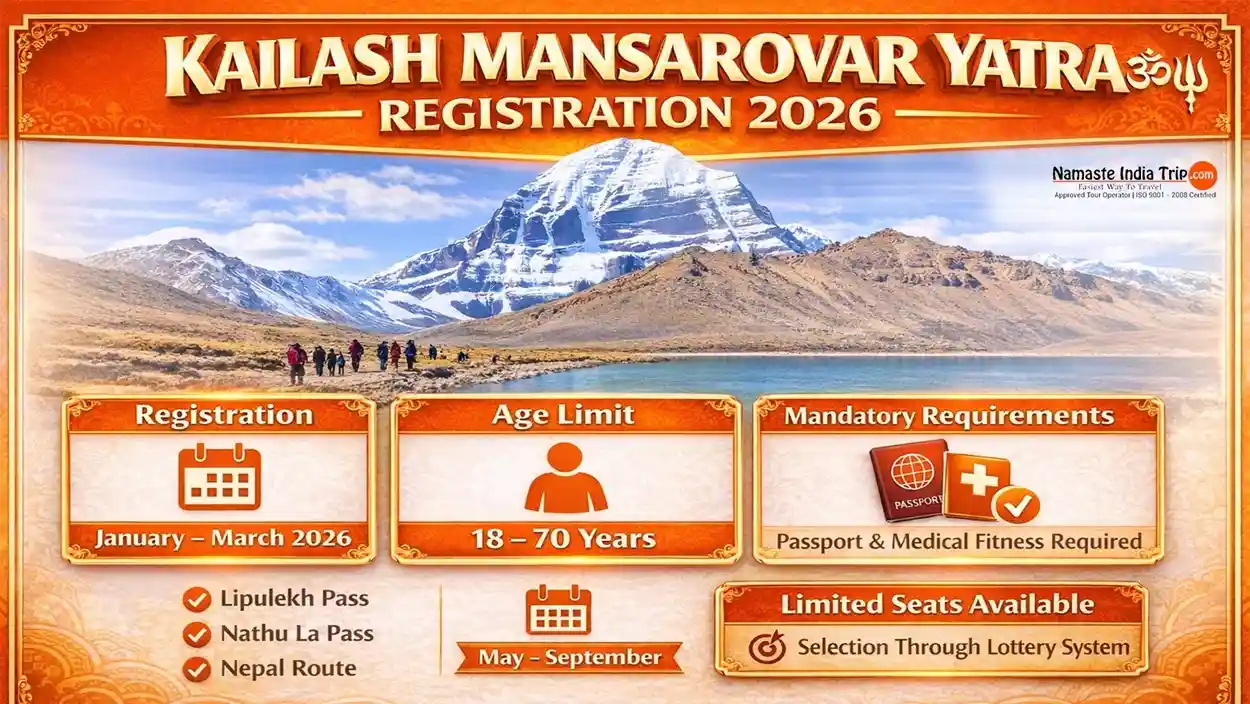
How to Register for Kailash Mansarovar Yatra 2026
Registration for the Kailash Mansarovar Yatra is a mandatory procedure. You can either register directly at the official government portal or book a private tour package that will take care of your registration and all the other logistics of this Yatra.
Government of India Registration Steps
The whole process is handled by the Ministry of External Affairs (MEA). Here is a step-by-step guide:
-
- First of all, visit the Official Kailash Mandir Portal. This is the designated government registration site for Kailash Mansarovar Yatra. The portal stays open during January–March.
- Now, click on ‘Apply for Yatra’ or ‘Registration’.
- You will see a form. Fill up your personal details like name, address, mobile number, email ID, emergency contact, etc.
- Now, it’s time to upload your documents, such as ID proof (Aadhaar Card), valid passport, and passport-size photos.
- After this, complete the medical self-declaration form, stating your fitness.
- Now, submit your application. Note down your application number.
- MEA sometimes conducts a lottery (if the number of applicants is more than the number of seats). This is an unbiased, random computerised draw that selects pilgrims for the Yatra. If you’re a selected pilgrim, you’ll be informed by SMS/email.
- Selected pilgrims will undergo a medical examination at authorised centres. The tests are conducted during March-April.
- If you clear the medical tests, you’ll be required to make online payment for the registration and permit.
- After a successful payment, you’ll receive your confirmation slip and an e-permit. Save these documents, as these will be verified at checkpoints during your journey.
Private Tour Operator Registration Steps
If you’re not selected by the MEA’s lottery system, what you can do is apply again next year, or you can book with a private tour operator where there is no lottery system.
-
- Pick an authorised tour operator registered with the government of India.
- Book the Kailash Mansarovar Yatra Package with them. They will take care of your permits and all the necessary travel documents.
- Provide your basic info to them, such as name, age, passport details, and contact information.
- Submit a copy of your ID proof and passport. Also, provide them with a medical declaration.
- Make a payment for the package. These packages generally include registration support, permits, meals, transfers, accommodation, etc.
- Once your Kailash Yatra application is processed, you’ll get your confirmation and permit. In addition, you’ll also receive the itinerary and other travel details.
- You might also have to go under medical screening. Consult with your tour operator.
- Begin your Yatra in the window of May to September!
Documents Required for Kailash Mansarovar Registration
Here are the important documents that you musts produce for a successful, smooth process:
1. Valid Indian Passport
Your passport must be valid for at least 6 months after your travel dates.
2. Recent Passport-Size Photographs
Provide 2–4 photographs with a white or light background. Make sure you use the same photographs in all the forms.
3. Government-Issued Photo ID
For this, you can provide Aadhaar Card, Voter ID, Driving License, or PAN Card. Make sure your ID details match your passport details.
4. Medical Fitness Certificate
This confirms your fitness for high-altitude travel. This generally includes blood pressure & pulse report, ECG, lung/pulmonary check, and overall a general health status.
5. Medical Self-Declaration Form
This is a signed statement by you about your health status. You must mention if you have any pre-existing conditions. This form is a must for the final permit approval.
6. Emergency Contact Information
You must also provide emergency contact information. This is important for emergency situations and medical coordination. You can provide their name, phone number, and email address, and mention the relationship with this person.
7. Marriage Certificate
This is only required if you’re travelling as a spouse. This is not mandatory though.
8. Additional Permits
Depending on your route, you might also need a China/Tibet visa. Some extra entry permits at border points might also be required.
9. Signed Liability and Risk Acknowledgment
This is where you acknowledge the risks associated with this high-altitude travel. This is a standard form included with the registration process itself.
Registration Fees and Other Charges
Here are the fees required for the registration and other important things like tests and Visa:
Non-Refundable Registration Fees
You must pay ₹5,000 once you’re selected, as stated by MEA.
Medical and Test Charges
The medical test fee may cost around ₹3,100. Other important tests like Stress Echo Test would cost around ₹2,500.
Visa and Permit Charges
Depending on your route, you might also have to pay China/Tibet Visa Fee, which is approximately ₹2,400 per pilgrim.
Medical Tests Required for Registration
Kailash Mansarovar is located at an extremely high altitude. This essentially means low oxygen levels and harsh weather conditions. Therefore medical fitness is a must.
Here are some medical examinations tests that you must undergo to be eligible for this special pilgrimage:
| Test |
Purpose |
| General Physical Examination |
You’ll be tested for:
• Blood pressure (BP)
• Pulse rate
• Body Mass Index (BMI)
• Oxygen saturation (SpO₂)
• Overall physical fitness assessment |
| Electrocardiogram (ECG) |
• Your heart rhythm and cardiac health will be checked
• Mandatory for all age groups, especially for pilgrims above 40 years |
| Treadmill Test (TMT) / Stress Test |
• Your heart performance under physical stress will be assessed.
• Compulsory for pilgrims above 40–45 years |
| Blood Tests |
You’ll be tested for:
• Haemoglobin (Hb)
• Blood sugar
• Kidney function tests (if advised)
• Lipid profile (in some cases) |
| Chest X-Ray |
• Your lung capacity and respiratory health will be evaluated
• Infections or chronic lung conditions can be detected through this test |
| Pulmonary Function Test (PFT) |
• Your lung strength and breathing efficiency are measured
• This test is important because you’ll be exposed to a low oxygen environment during the Yatra |
| ENT and Vision Check |
• Your ear pressure tolerance and hearing is checked
• Your vision adequacy for trekking conditions is also ensured |
| Mental Health and Stress Assessment |
• This one evaluates your psychological readiness
• It’s mainly done to ensure you can cope with isolation and altitude stress |
Medical Screening Stages
There are two stages of medical examination:
Stage 1: Initial Medical Examination
This is conducted after the registration. It’s a basic fitness screening that determines your eligibility to proceed.
Stage 2: Final High-Altitude Clearance
This is conducted when the departure date is closed. This final examination is done to gauge your readiness for extreme altitude environments.
Where to Get Medical Tests Done?
You can get your tests done at government-authorised hospitals. You can also have these done at registered hospitals or approved doctors. Final clearance can be done at Delhi or Kathmandu.
Kailash Mansarovar Yatra 2026 Overview
| Aspect |
Details |
| Yatra Year |
2026 |
| Registration Authority |
Government of India (MEA) & Authorized Tour Operators |
| Modes |
Government Route or Private Package |
| Eligibility Age |
18–70 years |
| Best Time |
May to September |
| Cost |
INR 2 Lakh+ |
| Altitude |
Up to 19,500 ft |
| Difficulty |
High |
Routes for Kailash Mansarovar Yatra
Here are some common routes for this journey:
1. Lipulekh Pass Route (Uttarakhand – Tibet)
| Feature |
Details |
| Starting Point |
India (Uttarakhand) |
| Border Crossing |
Lipulekh Pass (India–Tibet border) |
| Travel Mode |
Road + Trek segments |
| Route Highlights |
Route passes through Dharchula → Dhun – Chitar-Tarkeshwar → Lipulekh Pass → Purang (Taklakot) → Mansarovar → Kailash |
| Terrain |
High-altitude roads + short trekking stretches |
| Best For |
Pilgrims seeking a traditional and scenic route |
| Difficulty Level |
Moderate to high (due to altitude and some trekking) |
| Advantages |
This is the official government route and offers direct access through Uttarakhand |
| Challenges |
• High altitude passes
• Requires good acclimatization |
2. Nathu La Pass Route (Sikkim – Tibet)
| Feature |
Details |
| Starting Point |
India (Sikkim) |
| Border Crossing |
Nathu La Pass (India–Tibet border) |
| Travel Mode |
Road |
| Route Highlights |
Siliguri/Bagdogra → Gangtok → Nathu La → Shigatse → Mansarovar → Kailash |
| Terrain |
Road journey with gradual altitude gain |
| Best For |
Pilgrims who prefer a less trekking-intensive experience |
| Difficulty Level |
Moderate |
| Advantages |
• Easier road journey
• Smoother acclimatization |
| Challenges |
Weather disruptions (rain/mudslides) can affect road access |
3. Nepal Route (Kathmandu – Tibet)
| Feature |
Details |
| Starting Point |
Kathmandu, Nepal |
| Border Crossing |
Nyalam – Zhangmu (Nepal-Tibet entry) |
| Travel Mode |
Road |
| Route Highlights |
Kathmandu → Kodari/Nyalam → Shigatse → Mansarovar → Kailash |
| Terrain |
• Mainly road travel
• Good acclimatization stops |
| Best For |
Pilgrims who prefer smooth travel with minimal trekking |
| Difficulty Level |
Easy to moderate |
| Advantages |
• Shorter road stays
• Suitable for all ages
• Easier logistics |
| Challenges |
• International border formalities
• Visa coordination |
Best Time for Kailash Mansarovar Yatra
The best time for Kailash Mansarovar Yatra is from May to September. In this window, the day temperature swings from 5°C to 15°C, while the night temperature ranges from -5°C to 5°C. Also, expect light snow in this period.
The Yatra is continued only 4-5 months a year because of the extreme weather conditions and high-altitude terrains.
Here is a month-wise weather breakdown:
| Period |
Weather Conditions |
Highlights |
| May – Early June |
· Best Overall Time
· Clear skies and fresh mountain air
· Less rainfall
· Better visibility of Mount Kailash
· Manageable daytime temperatures |
· Most stable weather
· Smooth Parikrama conditions
· Ideal for first-time pilgrims and senior citizens |
| Mid-June – July |
• Beginning of monsoon
• Occasional rain, but the Yatra still continues smoothly
• Slightly warmer temperatures |
· Pilgrims who prefer moderate cold |
| August |
• Increased rainfall, especially on Nepal routes
• Expect slippery trails during Parikrama
• • Enjoy lush landscapes, especially around Mansarovar |
• Monsoon-Affected but manageable
• Physically fit pilgrims
• Travellers with experienced tour operators |
| September (Last & Spiritually Popular Month) |
• You get clear post-monsoon skies
• Crisp air
• Excellent visibility
• Less pilgrim rush compared to peak months |
• Calm atmosphere
• Ideal for meditation and spiritual focus
• Cooler Weather
• Stable conditions |
Months to Avoid
Avoid travelling from October to April. These regions receive extreme snowfall in this period, and temperatures remain below 0°C. Also, routes are closed, and the Yatra is halted.
Eligibility Criteria for Kailash Mansarovar Yatra
Whether you’re applying through the MEA (government) route or a private tour operator, here is the eligibility criteria that you must meet:
Nationality
You must be an Indian citizen and must have a valid Indian passport. It should be valid for at least 6 months beyond the travel dates.
Age Limit
Pilgrims must be between 18 and 70 years of age to cover this pilgrimage.
Medical Fitness
You must be physically and mentally fit. You must also pass the ECG and Stress Test. In addition, your blood pressure and oxygen should pass the saturation checks.
Body Mass Index (BMI)
You BMI should be below 27. Obese candidates are not permitted since there’s more risk for them at high altitudes.
Final Medical Clearance
Pilgrims must pass the crucial final high-altitude medical screening. Failure at this stage leads to disqualification.
Who Gets Rejected?
-
- People with a passport that is out of its validity period.
- Your passport mismatches details with your ID.
- People whose health reports don’t clear the checks.
- People with serious health conditions like heart disease, chronic asthma, severe arthritis, uncontrolled diabetes, etc.
Why Should You Register Early?
There are many advantages of registering early, such as:
-
- There are limited seats, and the demand is high. Early registrants have a higher chance of getting their application selected.
- There are some mandatory medical tests required for this Yatra, and they take time. Early registration gives you enough time for a re-test (in case it is required). You also get time to improve your fitness levels, and manage your BP & sugar.
- If you’re booking with a tour operator, then you get lower package prices and discounts on flights.
- Early registrants get to pick their desired travel month and route.
- Early registration gives you ample time for preparation. You can arrange the necessary clothes, gear, etc. This also eliminates the last-minute anxiety.
- If you register early, you get priority access to trusted tour operators. The slots fill quickly, especially with the reputed operators.
Common Registration Mistakes to Avoid
Here are some mistakes that you can avoid and increase chances of your application getting selected:
-
- Don’t use an invalid passport. Also, refrain from using a near-expiry passport. This will automatically get your application rejected.
- Don’t delay the registration until the last minute. This is because seats are limited and late applicants usually miss out on their preferred dates.
- Make sure details like name, date of birth, and gender match exactly in your passport and your ID proof.
- Do not overlook medical eligibility requirements. Understand them properly and make sure you satisfy the health criteria.
- Do not conceal your health issues. This could lead to disqualification at a later stage.
- Do not submit incorrect medical certificates. Reports from unauthorized doctors can be rejected.
- Do not upload blurry scans of your documents. Also, do not submit old photographs.
- Do not make the assumption that registration guarantees selection. There’s a lottery system that randomly selects candidates (due to limited seats).
- Do not forget to save your application number, payment receipts, and medical reports.
- Do not book with unauthorized tour operators. This could lead to cancellation at the last moment!
Summary
The registration for the Kailash Mansarovar Yatra is the first step towards your spiritual journey. You can do the registration either through the government portal or private tour agencies. You must also clear the medical tests and satisfy the eligibility criteria for this pilgrimage.
FAQs
Q1. When will Kailash Mansarovar Yatra open in 2026?
Ans. The Kailash Mansarovar Yatra 2026 will open from May to September. Usually, the registration for the Yatra opens in January, and the registration portal stays open till March.
Q2. Is registration compulsory?
Ans. Yes, registration for Kailash Mansarovar Yatra is compulsory. You can do so either by MEA or any other authorized tour operators.
Q3. Can senior citizens go for Kailash Yatra?
Ans. Yes, senior citizens can go for Kailash Yatra. However, they must be medically fit and should be able to handle physical & mental challenges that this pilgrimage offers.
Q4. Is passport required for Kailash Mansarovar?
Ans. Yes, a valid Indian passport is a must for undertaking a pilgrimage to Kailash Mansarovar.
Q5. What are the eligibility criteria for joining the Yatra?
Ans. The pilgrims must be between 18 to 70 years of age. They also must have a valid Indian passport. In addition, they must be in good health condition and should pass all the medical examination tests.
Suggested to Read:


 Call
Call Enquiry