Last Updated on 30/06/2026
Travel insurance for Adi Kailash is something most pilgrims only think about after it’s too late. Adi Kailash, also called Chhota Kailash, is a sacred peak near the India-China border in Pithoragarh district, Uttarakhand, with darshan taking place at high altitude. The route involves long jeep transfers through remote mountain terrain, unpredictable weather, and limited medical infrastructure once you cross Dharchula. A well-chosen high-altitude travel insurance policy won’t prevent an emergency — but it can make the financial side of one far more manageable.
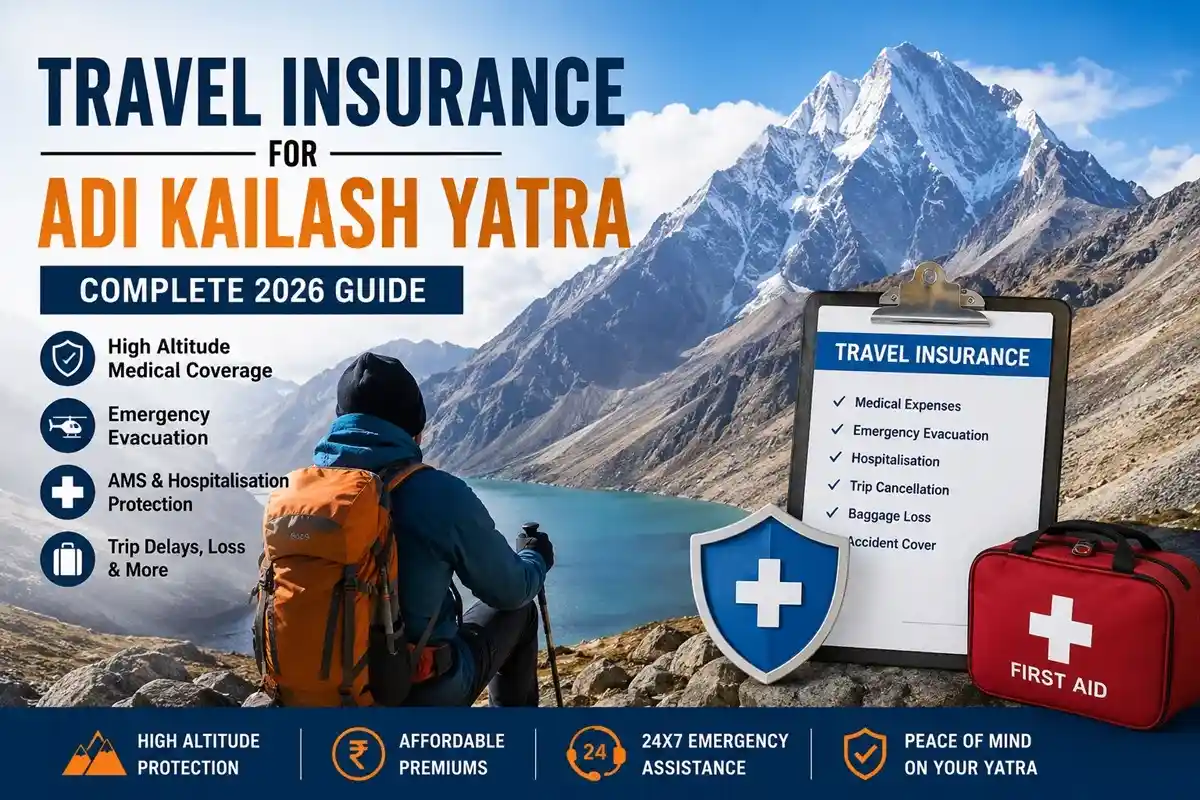
Why You Need Travel Insurance for Adi Kailash
Adi Kailash is widely regarded as a high-altitude Himalayan pilgrimage. The peak rises above 19,000 feet, though pilgrims don’t climb to the summit — darshan typically happens around Jolingkong and Nabidhang, often near 3,800-4,600 metres depending on the itinerary.
At these heights, Acute Mountain Sickness (AMS) is a genuine risk even for fit travelers — symptoms range from headaches and nausea to breathlessness, and rarely, HAPE or HACE, which need urgent attention.
The region is remote with limited, seasonal medical facilities. Emergency evacuation — by helicopter or long road transfer to Pithoragarh — is possible but costs vary significantly depending on weather, availability, and distance. There is no single fixed price. This uncertainty is exactly why dedicated high-altitude travel insurance matters here more than on an average trip.
What Should Adi Kailash Travel Insurance Cover?
Many standard plans exclude trekking above a certain altitude unless you add high-altitude or adventure cover. Before buying Adi Kailash trek insurance, check whether the policy includes the items below.
| Coverage Type |
Why It Matters for Adi Kailash |
| Emergency medical evacuation |
May be the only practical way out of remote stretches during a medical crisis |
| High-altitude sickness (AMS/HAPE/HACE) |
A real risk above 3,500-4,000 m; many basic policies exclude this entirely |
| Hospitalisation & medical expenses |
Covers treatment costs at regional hospitals once evacuated |
| Trip cancellation / curtailment |
Permits, landslides, and road closures can disrupt the yatra without warning |
| Personal accident cover |
Protects against falls and vehicle accidents on hill roads |
| Baggage & gear loss |
Relevant given long transfers and porter-handled luggage |
| Pre-existing disease clause |
Check carefully — many policies limit or exclude pre-existing conditions |
| ⚠ Many budget travel insurance plans exclude “adventure activities above” a stated altitude. Policy wording, altitude limits, and exclusions vary by insurer and change over time — always confirm the exact terms in writing before buying, rather than relying on this or any other article alone. |
Regular Travel Insurance vs Adventure/Trekking Insurance
A standard domestic travel policy is usually not sufficient for an Adi Kailash insurance plan. Here’s the typical difference — exact terms always depend on the specific policy.
| Feature |
Regular Travel Insurance |
Adventure / Trekking Insurance |
| High-altitude AMS cover |
Often excluded |
Usually included |
| Altitude limit |
Often capped ~3,000-4,500 m |
Often extends to 5,500-6,000+ m |
| Helicopter evacuation |
Limited or add-on only |
Commonly included or available as rider |
| Premium |
Lower |
Slightly higher |
Some Indian and international insurers offer adventure or trekking-specific riders for Himalayan trekkers. Always verify directly with the insurer that a plan covers your exact route and altitude — coverage depends on policy wording, not the insurer’s brand name alone.
| 💡 Search “trekking insurance up to 6,000m” rather than generic “travel insurance” to narrow results — but still confirm the fine print yourself. |
How Much Does Travel Insurance for Adi Kailash Cost?
Premiums vary by age, sum insured, trip duration, declared health, and insurer — treat the figures below as a general reference, not a quote.
| Sum Insured (Approx.) |
Premium Range |
Typically Suited For |
| ₹2 lakh – ₹5 lakh |
Lower range |
Basic medical + evacuation cover |
| ₹5 lakh – ₹10 lakh |
Mid range |
Most pilgrims aged 18-60 |
| ₹10 lakh and above |
Higher range |
Senior citizens or health conditions |
*Indicative only — actual premiums vary by insurer and policy terms. Request a live quote before deciding.
Senior citizens often pay more due to age-related risk loading, and some insurers require extra medical disclosures above age 60.
Myth vs Fact: Adi Kailash Travel Insurance
| ❌ Myth: My regular health insurance already covers high-altitude trekking. |
| ✅ Fact: Most standard health policies exclude adventure activities above a set altitude — verify your wording, don’t assume. |
| ❌ Myth: Helicopter rescue is always covered automatically. |
| ✅ Fact: Evacuation cover is often a separate add-on with conditions — confirm it explicitly. |
| ❌ Myth: Travel insurance is legally required for this yatra. |
| ✅ Fact: It is not mandatory like the ILP, but strongly recommended given the remoteness and altitude. |
Medical Fitness Certificate vs Travel Insurance
These are different things. The medical fitness certificate is required for your Inner Line Permit (ILP) from the SDM office in Dharchula — it confirms fitness for high-altitude travel and is a prerequisite for entry into the restricted zone.
Travel insurance is a separate financial product reimbursing medical costs, evacuation, and trip disruptions. The certificate grants permission to go; insurance protects your finances once there. Arrange both well in advance.
Tips for Choosing Adi Kailash Travel Insurance
- Buy early — same 7-10 day window recommended for your Inner Line Permit.
- Declare health conditions honestly — non-disclosure is a leading cause of claim rejection.
- Confirm the altitude clause in writing — ask the insurer if it explicitly covers your itinerary’s elevation.
- Understand cashless vs reimbursement — some policies pay hospitals directly; others need you to pay first and claim later.
- Carry printed and digital copies — mobile network is unreliable beyond Dharchula.
- Save the insurer’s helpline separately — you may have only brief signal near checkpoints.
- Ask your tour operator what bundled cover includes — basic accident cover isn’t the same as dedicated high-altitude insurance.
How to File a Claim During the Yatra
If an emergency occurs near Gunji, Nabidhang, or Jolingkong, contact your insurer’s helpline as soon as you get any signal — a brief call or SMS near a checkpoint often suffices to start the process. Keep every document: medical notes, hospital bills, and evacuation receipts.
Most insurers require claims within a set window after treatment — commonly around 30 days, though this varies. Many now support digital claim submission via app once you’re back in network range, which can speed things up.
| ⚖ Disclaimer: This article is general information for planning purposes only, not insurance or financial advice. Products, exclusions, and premiums vary by provider and change over time — verify current details with IRDAI-registered insurers before purchasing. |
Conclusion
The Adi Kailash Yatra is a profound journey through remote, high-altitude terrain — and that combination is exactly why travel insurance for Adi Kailash deserves real attention. While not legally mandatory, comprehensive coverage is strongly recommended given the genuine medical and logistical risks involved. Buy early, read the altitude and exclusion clauses carefully, and treat this Himalayan trek protection as seriously as your Inner Line Permit.
Frequently Asked Questions
Q-1: Is travel insurance mandatory for Adi Kailash Yatra?
Ans: No, it’s not legally mandatory like the Inner Line Permit. However, given the altitude and remoteness, most operators and experienced pilgrims strongly recommend it.
Q-2: Does regular health insurance cover Adi Kailash trekking?
Ans: Often not. Many standard health policies exclude adventure activities above a set altitude. Check your wording, or get a dedicated high-altitude trekking rider.
Q-3: Does travel insurance cover AMS (Acute Mountain Sickness)?
Ans: Some high-altitude or adventure policies cover AMS-related hospitalisation, but basic plans often exclude it. Confirm this specific clause before buying.
Q-4: Does insurance cover helicopter rescue at Adi Kailash?
Ans: Some adventure policies include or offer evacuation as an add-on, including helicopter rescue where operationally possible. Always verify, as terms vary widely.
Q-5: Can senior citizens get travel insurance for the Adi Kailash trek?
Ans: Yes, though premiums are usually higher and extra medical disclosures may be required above a certain age. Check eligibility limits before booking.
Q-6: Can diabetics or people with pre-existing conditions get covered?
Ans: It depends on the insurer and condition. Many policies cover pre-existing diseases only after a waiting period or with limits. Disclose honestly and ask directly.
Q-7: What’s the difference between trekking insurance and regular travel insurance?
Ans: Trekking insurance is built for higher altitudes and typically includes AMS cover and evacuation support, while regular travel insurance often caps coverage lower and may exclude adventure activities.
Q-8: How do I file an insurance claim from a remote area like Gunji?
Ans: Contact your insurer’s helpline as soon as you get signal, and keep all medical and payment documents. Formal claim submission can usually be completed once back in network range.
Must Read:


 Call
Call Enquiry