Indian weddings are not only ceremonies, but they are festivals, colored celebrations with rituals, colors, music, emotions, and profound cultural significance, and the community uniting for many days. Indian weddings have been the greatest experience of the whole journey for many international travelers.
Namaste India Trip often coordinates traditional Indian weddings in various places in India. Over time, we have noticed growing curiosity from international travelers who wish to experience Indian weddings not as spectators, but as respectful guests. On a few occasions, foreign tourists from Europe and other regions have attended real Indian weddings with full family consent, making it one of the most memorable cultural experiences of their journey.
This growing interest reflects a shift in global travel — from sightseeing to deep, experience-based cultural immersion.
When Sarah from Melbourne first watched an Indian wedding on screen, she was captivated by the colors, the ceremonies, and the music that seemed to go on for days. Two years later, she found herself sitting cross-legged at a Mehendi ceremony in Rajasthan, henna being carefully applied to her hands while the bride’s grandmother explained each symbol’s meaning through her niece’s translation.
This wasn’t a show put on for tourists. It was a real family’s celebration, and Sarah was there because the family had opened their home and their most important day to a respectful stranger who wanted to understand their culture beyond guidebooks and monuments.
Over the past few years, we’ve noticed something shifting in how people want to travel through India. The questions aren’t just about which palace to visit or which beach is cleanest. People are asking: “Can I experience a real Indian wedding? Is it possible to attend one as a foreigner? And if so, how do I do it without being intrusive?”
The answer is yes, but it requires something many travelers claim to value yet rarely practice—genuine cultural humility.
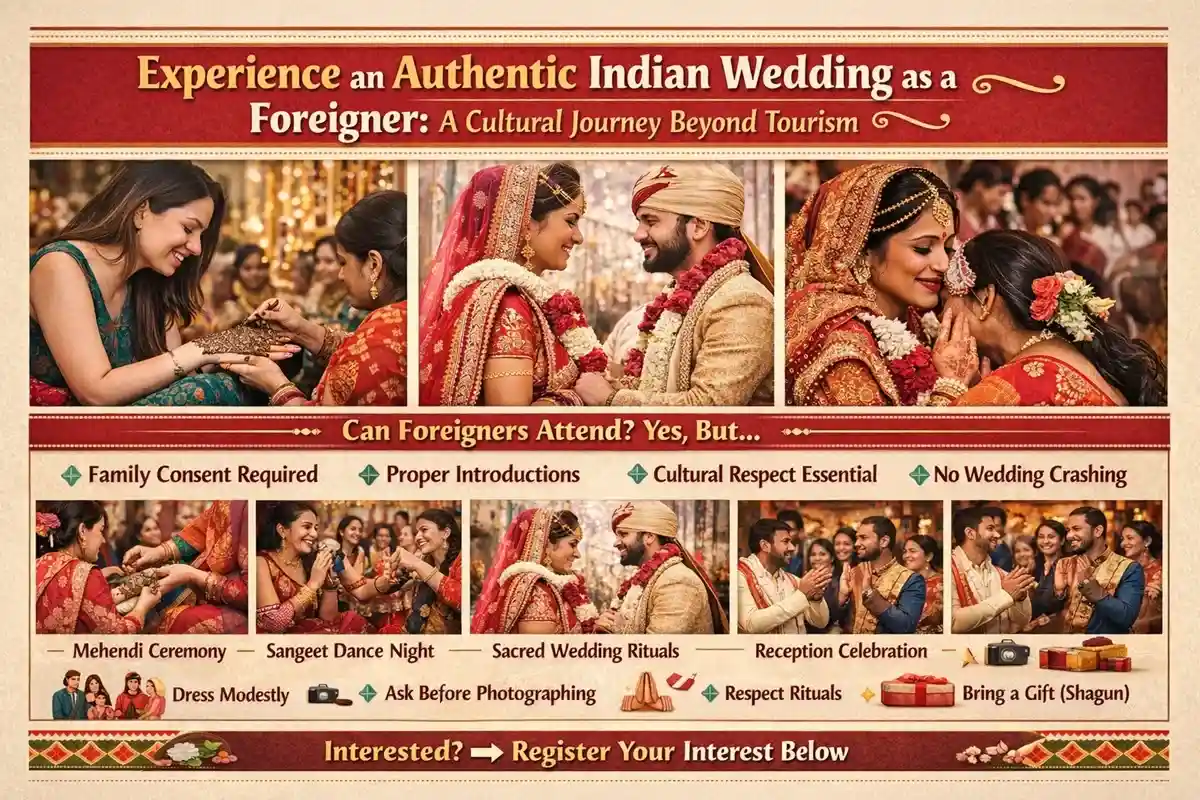
Why Are Foreigners Fascinated by Indian Weddings?
The marriage of Indians has been popular all over in the world as one of the most extravagant and vivid festivals in the world. However, it is not just the Instagram-worthy moments that capture the interest.
It’s about the contrast. In most Western nations, marriages are now smaller and more intimate events- sometimes a wedding ceremony and a feast in a day. Indian weddings, on the other hand, are multi-day celebrations that are attended by the whole family, the whole community, and practices that have been practiced.
It’s about meaning, and every ritual has a story. The seven circles around the sacred fire are not merely a tradition but a symbol of the seven vows. The Haldi paste that is put on the couple in the ceremony is not to beautify them, but rather it is said to cleanse and beautify the couple before they are united. Foreigners who have been to these ceremonies usually report that they could not believe that they were not experiencing something sacred, not festive.
It’s about human connection. Weddings are universal. Everybody can imagine how a parent feels when he or she sees his or her child get married, the anxiety of a bride, and the union of two families. This common humanity renders Indian weddings available to everyone who does not speak Hindi or know the distinction between a Baraat and a Bidaai.
We’ve had guests from Germany, Australia, the United States, and the UK tell us that attending an Indian wedding was their most memorable travel experience—more impactful than seeing the Taj Mahal or riding camels in the desert.
- Suggested Wedding Tour: Triyuginarayan Temple Wedding Package
Can Foreigners Actually Attend Indian Weddings?
Yes, but let’s be clear about what this means.
The Reality of Genuine Invitations
Indian families are remarkably hospitable. It’s not uncommon for wedding guest lists to exceed 500 people, and in smaller towns or villages, sometimes the entire community is invited. Within this context, some families are genuinely happy to extend their celebration to include respectful foreign visitors who are interested in their culture.
However, this only happens when:
- The family explicitly consents and understands that a foreign guest will attend
- Proper introductions are made in advance—families want to know who is coming to their most important celebration
- The visitor demonstrates genuine cultural interest, not just curiosity or the desire for unusual photos
- The person may also help themselves communicate and navigate the culture (a local guide, an English-speaking family member, or a cultural aide).
What This Is NOT
It is not an issue of wedding crashing or coming to big parties without an invitation, expecting to be part of the crowd. That would be deeply disrespectful.
This is not a performance staged for tourists. The ceremonies are real, the emotions are genuine, and the family is celebrating their actual wedding.
This is not about paying to attend someone’s wedding as entertainment. Any ethical facilitation of such experiences involves supporting the celebration (traditional gifts, contributions to wedding expenses the family would incur anyway), never “buying” access to someone’s private moment.
The Indian Wedding Experience of Foreigners: How It Really Works
International tourists can participate in a traditional Indian wedding: This is how it is done respectfully:
Connection Via Close Intermediaries
The best experiences that take place in a wedding occur via a formed relationship. The travel firms that have been operating in India for years form authentic relationships with the families that are not averse to cultural exchange. Other families clearly show interest in the expression of their customs to foreign visitors.
In our case, we’ve worked with families for years on other cultural experiences. When they have upcoming weddings, some proactively ask if we know any respectful foreign guests who might like to attend. The invitation comes from the family, not from us pushing for access.
Pre-Wedding Introduction and Education
Before any wedding attendance, there’s always:
A proper introduction process where the family and potential guest communicate (even if briefly) to ensure comfort on both sides
Cultural preparation sessions where we explain the ceremonies, appropriate behavior, dress codes, gift-giving customs, and how to be a graceful guest
Clear boundary setting about photography (some families welcome it, others prefer certain ceremonies remain private), participation levels, and duration of attendance
Attending as a Respectful Guest
On the actual wedding days, the foreign visitor attends as they would any wedding in their home country—with respect, appropriate attire, and understanding that they are there to honor the couple and family, not to be entertained.
Most international guests we’ve facilitated have attended specific ceremonies (often the Mehendi, Sangeet, or main wedding ceremony) rather than all events over multiple days. This allows for meaningful participation without overwhelming the family or the guest.
Meaningful Cultural Exchange
The experiences that work best are those where genuine exchange happens. The foreign guest learns about traditions, shares about their own culture when asked, and becomes a welcome part of the celebration rather than an observer at a distance.
One Australian couple who attended a Punjabi wedding in Amritsar ended up dancing with the groom’s cousins at the sangeet, teaching them an Australian folk dance in return. Years later, they still exchange messages with the family.
Understanding Cultural Sensitivities and Permissions
Attending an Indian wedding as a foreigner requires awareness of several important cultural dimensions:
Dress Code Matters Deeply
Women should wear modest traditional Indian attire—a salwar kameez, saree, or lehenga that covers shoulders, cleavage, and legs to the ankle. Clothing should never be more elaborate or attention-grabbing than what the bride’s family is wearing. White is generally avoided as it’s associated with mourning in Hindu traditions.
Men should wear kurta pajamas or, for evening events, sherwanis. Western formal wear may be acceptable at some weddings but traditional attire shows greater respect.
We always help guests source appropriate attire before the wedding and explain the specific dress expectations for each ceremony.
Photography Etiquette
Never assume you can photograph everything. Many families welcome photos, but some ceremonies are considered too sacred for cameras. Never take any photos without permission:
- Religious ceremonies in the mandap (wedding altar).
- The bride, when she is in the act of preparation or when she is alone.
- Older relatives (they do not want to be photographed)
The most precautionary measure: enquire before every new ceremony or environment.
Ritual and religious Piety
Indian weddings are accompanied by religious rituals. This means:
- Take off your shoes in the mandap or in the houses.
- Do not pass in between the bride/groom and the sacred fire in ceremonies.
- Only attend rituals when invited (such as putting on Haldi or throwing out petals of flowers)
- Be silent and obedient to prayers and mantras.
- Whenever you do not get something, ask silently or ask later.
Gift-Giving Customs
Indian culture does not allow one to attend a wedding without a gift. The amount of money given in an envelope (Shagun) is considered a traditional gift, and its value varies depending on how close you are to the family. To the foreign visitors who come based on a cultural exchange, we usually suggest:
- Standard cash present according to guest etiquette (we recommend the right amounts)
- A considerate present that you can bring with you, which the family can use as a reminder of you.
- Providing financial assistance to certain wedding costs (flowers, food) to the wedding as a sign of appreciation.
The Reason Why this is an increasing Experiential Travel Trend
The modern traveler—especially those spending significant money to visit India—wants more than sightseeing. They want understanding.
Beyond Surface Tourism
We have seen the evident change within the last ten years. Customers are becoming more and more disgruntled with the experiences that are either canned or faked. They desire to know how people really live, what they appreciate, and how they party.
Weddings provide an insight into these underlying cultural realities. They reveal:
- The functioning and joint decision-making by families.
- The elders, traditions, and their place in the modern Indian life.
- The scales between the old and the new.
- The significance of society and the general celebration.
- Local differences in traditions, cuisine, and rituals.
The Authenticity Economy
There is also an overall movement towards authenticity in travel. UNESCO has also recorded the increase in interest in intangible cultural heritage; the living traditions that characterize cultures, not only monuments and museums.
Indian weddings are one of the most prosperous living cultural heritages. The rituals are thousands of years old, but every single wedding is modern, original, and full of point.
Human Relationships in a Digital World
Most importantly, maybe, weddings help people connect with people at a very real level in a time when travelling can be so transactional. You are not just observing culture—you’re being welcomed into someone’s most important life event. That creates bonds that transcend typical tourist-local interactions.
Several guests have told us that their wedding experience changed how they see India entirely. They went from seeing it as an exotic destination to understanding it as home to real people with rich family lives, deep values, and generous spirits.
What International Guests Experience at Indian Weddings
Based on feedback from dozens of international visitors we’ve facilitated over the years, here’s what typically happens:
The Mehendi Ceremony
This is often the most accessible ceremony for foreign guests. The mehendi (henna application) is festive, informal, and highly visual. Women from both families gather while professional Mehendi artists create intricate designs on the bride’s hands and feet.
Foreign women are almost always invited to have Mehendi applied as well, usually a small design on the hand. The artists love showing off different regional styles, and this often becomes a moment of connection and laughter, especially when the designs are admired by elder women in the family.
There is music all over, in most cases, Bollywood music praising marriage and love. It usually involves much food, sweets, and celebrations.
The Sangeet
Sangeet is a musical event when both families dance in the choreographed rhythms, sing their old songs, and rejoice. This has gained such a fancy in contemporary Indian weddings, where professional-level performances are done.
The sangeet is nothing but fun for the foreign guest. The energy is contagious even without knowing what they are singing. Families often encourage foreign guests to join in the dancing, and we’ve yet to meet someone who didn’t end up on the dance floor by the end of the evening.
One German guest described it as “the most alive I’ve felt at any celebration in my life.”
The Main Wedding Ceremony
This is the holiest aspect, and the highest respect is needed. The Hindu wedding ceremony is usually 2-4 hours long and consists of various rituals that surround the holy fire (Havan).
What captivates the visiting foreigners most:
- The scene when the father of the bride puts her hand in the groom’s (Kanyadana).
- The seven circles surrounding the fire (Saat Phere), with each circle signifying a vow.
- Mangalsutra ceremony in which the groom puts on the sacred necklace around the neck of the bride.
- The heart-rending farewells when the bride gets ready to go to her new home.
Although we do not know every word, guests inform us that the emotional heaviness and spiritual meaning are palpable.
The Reception
Reception is normally the least formal affair of the western wedding receptions that include dinner, speeches, and partying. Foreign guests often feel most comfortable here, and it’s a chance to speak with family members, share impressions, and express gratitude.
Real Experiences from International Guests
Emma, United Kingdom: “I was nervous about attending at first. Would I do something wrong? Would the family feel I was intruding? But from the moment I arrived, I was treated like family. The bride’s mother insisted on helping me drape my saree properly. During the ceremony, the bride’s aunt sat next to me, explaining every ritual. I cried during the Vidaai (farewell) even though I’d only known this family for two days. It was the most emotionally powerful travel experience I’ve ever had.”
Michael, United States: “I’ve traveled to 60+ countries, but nothing prepared me for the generosity and warmth of being welcomed into an Indian family’s wedding. What struck me most was how much the rituals meant to everyone. This wasn’t performance—it was sacred. I felt honored to witness it.”
Sofie, Netherlands: “The best part was the conversations. Between ceremonies, I talked with the bride’s grandmother about arranged marriage, with cousins about modern India, with the groom’s friends about their hopes for the future. I learned more about Indian culture in three days than I had in three weeks of touring.”
How to Find Legitimate Indian Wedding Experiences
If you’re interested in attending a traditional Indian wedding as a foreigner, here’s how to approach it ethically:
1- Work with Established Cultural Experience Providers
Look for travel companies or cultural exchange organizations that:
- Have been operating in India for several years
- Have genuine relationships with local communities
- Clearly explain their ethical approach to wedding access
- Prepare guests thoroughly before attendance
- Prioritize the family’s comfort and privacy over the tourist’s experience
Red flags: Companies that guarantee wedding attendance on specific dates (weddings aren’t scheduled around tourism), that charge excessive fees for “exclusive access,” or that don’t mention family consent and permissions.
2- Allow Sufficient Planning Time
Meaningful wedding experiences can’t be arranged overnight. Families need time to consider, meet (at least virtually), and prepare. If you are interested in this experience, you can ask several months before your trip to India.
We usually require at least 2-3 months to:
- Find families with weddings soon and who are amenable to foreign guests
- Arrange for introductions
- Prepare guests for the culture
- Provide suitable clothing and gifts
3- Be Flexible and Open
You might not be able to choose the region, religion, or type of wedding you attend. Families who are amenable to sharing their weddings come from all walks of life—Punjabi Sikh weddings, South Indian Hindu weddings, Gujarati weddings, Bengali weddings—and all have their own traditions.
The most important thing is to be open to whatever experience comes your way.
4- Come with the Right Mindset
This experience is for people who:
- Are interested in learning about Indian culture, not just accumulating weird and wonderful experiences
- Are comfortable with the idea of being in unpredictable, very social situations
- Are respectful of other people’s cultures and religions, even if they are different from their own
- Are comfortable with being the center of attention (as a foreign guest, you will likely be)
- Recognize that this is a privilege, not a right
Frequently Asked Questions
Q-1: Can anyone attend an Indian wedding as a foreigner?
Not everyone can attend, but respectful foreign travelers can attend when they have a genuine invitation from the family, work through proper cultural intermediaries, and demonstrate sincere interest in understanding Indian traditions. This is never about showing up uninvited—it requires family consent and proper introductions.
Q-2: Do I need to speak Hindi to attend an Indian wedding?
Ans: No, you don’t need to speak Hindi or any Indian language. Many Indian families include English speakers, and cultural guides can help with translation and explanation of ceremonies. However, learning a few basic phrases in Hindi (like “Namaste,” “Dhanyavaad” for thank you, and “badhai ho” for congratulations) shows respect and is always appreciated.
Q-3: What should I wear to an Indian wedding as a foreign woman?
Ans: Foreign women should wear traditional Indian attire—a salwar kameez, saree, or lehenga. The outfit should be modest (covering shoulders, cleavage, and legs to ankle), colorful but not more elaborate than what the bride’s family wears, and avoid white (associated with mourning in Hindu culture). Most cultural experience providers can help source appropriate wedding attire.
Q-4: How much does it cost to attend an Indian wedding as a tourist?
Ans: This isn’t about buying a ticket to someone’s wedding. Ethical facilitation of wedding experiences involves cultural exchange, not commercialization. You generally have to cover your own expenses, like accommodation, travel to the wedding location, provide traditional wedding gifts to the family (cash gift/shagun and thoughtful presents), and possibly contribute to specific wedding expenses. Work only with providers who prioritize the family’s dignity over profit.
Q-5: Is it disrespectful for foreigners to attend Indian weddings?
Ans: It’s not disrespectful when done properly—with family consent, cultural preparation, appropriate attire, and genuine respect for traditions. What would be disrespectful is: showing up uninvited, treating the wedding as entertainment, dressing inappropriately, photographing sacred moments without permission, or being culturally insensitive. Indian families are remarkably welcoming when they see a sincere interest in their culture.
Q-6: How long do Indian weddings last?
Ans: Traditional Indian weddings typically span 2-5 days, with multiple ceremonies including Mehendi (henna), Sangeet (musical evening), Haldi (turmeric ceremony), the main wedding ceremony, and reception. Foreign guests usually attend select ceremonies (often Mehendi, Sangeet, and main ceremony) rather than all events. Each individual ceremony can last 2-6 hours depending on regional customs and family traditions.
Q-7: Can I take photos at an Indian wedding?
Ans: This entirely depends upon family and ceremony. Some families welcome photos, while others consider certain rituals too sacred for cameras. Don’t forget to ask permission before photographing any wedding moment, such as the bride during private moments, elderly family members, and sacred objects. In a doubtful situation, it is always better to put the camera away and be present in the moment.
Q-8: What is the best region in India to experience an authentic wedding?
Ans: Indian weddings vary dramatically across different states, each with its unique traditions. For instance, Punjabi weddings are known for vibrant energy and elaborate baraats. In addition, South Indian weddings include ancient Vedic rituals. Furthermore, Rajasthani weddings are for royal grandeur, and Bengali weddings for cultural sophistication. The best wedding experience is one where the family genuinely welcomes you, regardless of region.
Q-9: Do Indian families really welcome strangers to their weddings?
Ans: Yes, many Indian families do this. Indian culture places a high value on hospitality (“Atithi Devo Bhava”—the guest is god).
Q-10: What is the most important thing to consider when attending an Indian wedding as a foreigner?
Ans: Remember that you are a guest at someone’s most important life celebration, not a spectator at a cultural show. Your role is to honor the couple and family, respect their traditions even when you don’t understand them, dress appropriately, participate when invited, step back when appropriate, and express genuine gratitude for the privilege of being included. Humility and respect matter far more than perfect cultural knowledge.
Experience Indian Culture at Its Most Vibrant Form
Indian weddings are not tourism products. They are living traditions, sacred ceremonies, and moments of profound human connection.
When approached with respect, cultural humility, and genuine interest, attending a traditional Indian wedding can become the most meaningful part of your journey through India. It’s a window into family values, regional customs, spiritual beliefs, and the warm generosity that defines Indian hospitality.
These experiences don’t happen on-demand or on fixed schedules. They happen when the right travelers, at the right time, connect with the right families who are willing to share their most important celebration.
If you’re planning to visit India and would like to be considered for an authentic Indian wedding experience, we maintain a respectful waitlist of culturally prepared travelers. When families we work with have upcoming weddings and are comfortable with international guests, we facilitate introductions based on travel dates and cultural fit.
This is not guaranteed—it depends entirely on family availability and comfort. But for those genuinely interested in deep cultural understanding, we welcome your inquiry.
Interested in experiencing an Indian wedding? Indian wedding experiences depend on family consent, cultural context, and timing. If you are interested in experiencing an authentic Indian wedding as part of your journey, you can register your interest with us.👉Submit your details below, and we will contact you when suitable opportunities are available.

 Call
Call Enquiry