Last Updated on 10/04/2026
Every year, thousands of pilgrims start planning their Char Dham Yatra with the same confusion: Should we go by road or choose the helicopter option?
On paper, the answer looks simple. Road is cheaper. Helicopter is faster. But in reality, the decision is far more layered — shaped by health, age, stamina, time pressure, emotional expectations, weather uncertainty, and even mental preparedness.
Over the years, after observing hundreds of travelers — young backpackers, elderly couples, large families, and first-time pilgrims — one thing becomes clear: There is no universally correct choice. There is only the right choice for your situation.
This guide explains both options as they actually unfold on the ground, not as they are sold in packages.
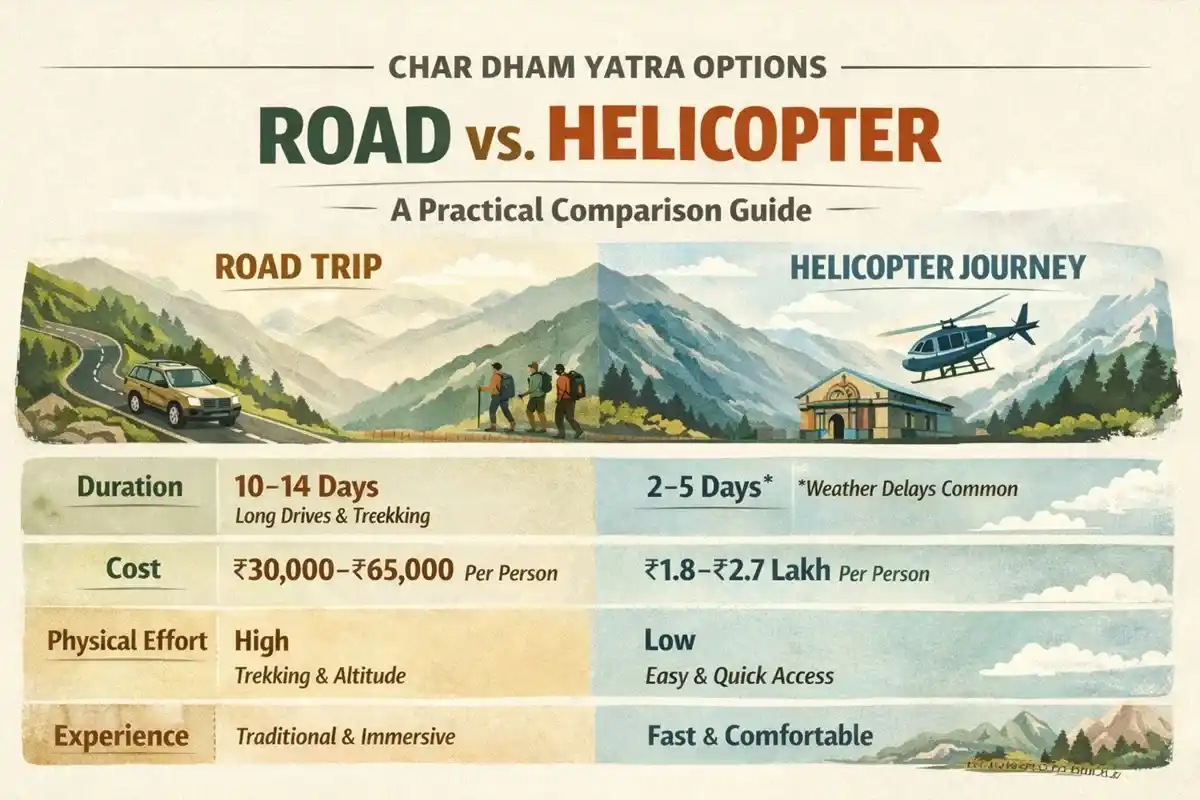
How the Journey Feels: Slow Pilgrimage vs Rapid Completion
A road-based Char Dham Yatra unfolds gradually. Long drives through mountain roads, tea breaks at roadside dhabas, slow ascents, temple queues, evening aartis — everything builds a sense of emotional and spiritual rhythm.
You don’t just reach the dhams. You grow into them.
Helicopter travel, on the other hand, compresses the entire pilgrimage into a few intense days. One moment you’re in Dehradun, and within hours you’re standing at Kedarnath. It feels efficient, impressive — and slightly surreal.
Many elderly pilgrims appreciate this comfort. Many younger pilgrims feel something is missing.
Neither feeling is wrong. They are simply different experiences.
Time Reality: What Schedules Don’t Tell You
Road Yatra
A realistic road itinerary usually needs 10 to 14 days.
This includes:
-
Long mountain drives (sometimes 7–10 hours a day)
-
Trekking at Yamunotri and Kedarnath
-
Waiting time at temples
-
Unavoidable delays from traffic, landslides, or weather
Even well-planned tours face disruptions. Mountain travel rarely runs on clockwork precision.
Helicopter Yatra
Most helicopter packages advertise 2 to 6 days. Under ideal weather conditions, this is achievable.
But reality often looks different.
Cloud cover, fog, wind speed, and sudden rain frequently delay or cancel flights. When this happens, travelers may wait entire days at helipads. Some end up spending 6–7 days instead of 4.
Time-saving is real, but certainty is not.
If your return flight or work schedule is tight, this unpredictability matters.
Cost Comparison: Where the Money Actually Goes
Detailed Cost Comparison Table (2026 Approximate Rates):
| Category |
Budget |
Mid-Range |
Premium |
| Road Yatra |
₹35,000–₹45,000 |
₹50,000–₹65,000 |
₹70,000+ |
| Helicopter Yatra |
₹1.80 lakh–₹2.20 lakh |
₹2.20–₹2.70 lakh |
₹3 lakh+ |
| Hybrid (Partial Heli) |
₹90,000–₹1.20 lakh |
₹1.20–₹1.80 lakh |
₹2 lakh+ |
Note: Prices vary by operator, season (May–June is peak), group size, and inclusions. Always confirm what’s included — meals, accommodation grade, VIP darshan pass, and weather-delay buffer days.
Road Travel Costs
-
Budget tours: ₹30,000 – ₹45,000
-
Comfortable mid-range: ₹45,000 – ₹65,000
-
Premium road tours: ₹70,000+
This usually covers transport, hotels, meals, and sightseeing.
Helicopter Travel Costs
Here, much of the cost goes into aircraft operations, aviation fuel, crew and safety protocols, and limited-seat logistics. The price difference isn’t markup — it’s operational reality.
Physical Demands: The Factor Most People Underestimate
Road Yatra Physical Load
Many first-time pilgrims underestimate how tiring road travel can be.
Kedarnath trek alone tests stamina, especially for people unused to mountain walking. This doesn’t mean older pilgrims cannot do road yatra. Many do — but slowly, with careful pacing and medical clearance.
Helicopter Yatra Physical Comfort
Helicopter travel dramatically reduces physical strain — minimal trekking, reduced walking, short travel times. This makes it suitable for senior citizens, heart or respiratory patients (with doctor’s approval), and families with young children.
But there’s a lesser-known constraint: strict body weight limits. Passengers above 75–80 kg may face flight rescheduling or splitting of group travel.
Weather Risk: The Invisible Decision Factor
Road travel is affected by weather, but rarely stopped entirely. Helicopter travel is extremely weather-sensitive. Even mild fog, light rain, or low visibility can ground flights. During peak season, this leads to multi-hour waiting, sudden itinerary reshuffling, and night stays at unexpected locations.
For some pilgrims, these uncertainties cause significant stress — especially elderly travelers who feel anxious sitting at helipads without clarity. This is where road travel, despite its discomfort, often feels mentally calmer.
Month-wise Road vs Helicopter Travel Advisability
| Month |
Road |
Helicopter |
Reason |
Recommended? |
| May |
Good |
Good |
Season opens, clear weather |
Yes — both |
| June (early) |
Good |
Good |
Peak season, crowded but safe |
Yes |
| June (late) |
Caution |
Caution |
Pre-monsoon clouds begin |
Book flexible dates |
| July–August |
Avoid |
Avoid |
Heavy rain, landslides, flight cancellations |
Not recommended |
| September |
Good |
Good |
Post-monsoon, clear skies |
Best time |
| October (early) |
Good |
Good |
Beautiful weather, light crowds |
Excellent |
| October (late) |
Limited |
Limited |
Temples close around Diwali/Bhai Dooj |
Last window |
Safety: What Changed After Recent Helicopter Incidents?
Following several helicopter accidents near Kedarnath in recent seasons, aviation authorities introduced twin-engine helicopter mandates, tighter weather clearance protocols, and real-time monitoring systems. This has improved safety but increased cancellations.
In simple terms: Flights are now safer — but less predictable. Road safety depends largely on driver skill, road condition, and seasonal timing. Landslides during monsoon remain the biggest risk.
Road Pilgrimage
-
Walking with fellow devotees
-
Night stays in small hill towns
-
Group chanting
-
Slow approach toward each shrine
Many pilgrims describe this as transformational, not just religious.
Helicopter Pilgrimage
-
Fast transitions
-
Comfortable stays
-
Organized darshan
-
Minimal crowd exposure
Spiritually fulfilling — but emotionally condensed.
People seeking deep spiritual immersion usually prefer road journeys.
People seeking darshan completion with comfort lean toward helicopter routes.
Crowd Handling & Darshan Experience
Helicopter packages generally include priority darshan, reducing waiting times.
Road travelers experience:
This is physically taxing but emotionally part of traditional pilgrimage culture.
Who Should Choose Road Yatra?
Road travel suits pilgrims who:
It may not suit:
Who Should Choose Helicopter Yatra?
Helicopter travel suits pilgrims who:
-
Have health or age limitations
-
Need to complete yatra quickly
-
Prefer comfort and structure
-
Can handle schedule uncertainty
-
Have higher budget flexibility
It may not suit:
A Balanced Middle Path: The Hybrid Model
Increasingly, experienced travelers choose a mixed approach. Typical pattern: Yamunotri & Gangotri by road, Kedarnath & Badrinath by helicopter. This reduces trek fatigue, road risk, and total travel days — while maintaining spiritual buildup and scenic road exposure.
Sample 7-Day Hybrid Itinerary
| Day |
Route |
Details |
| 1 |
Arrive Dehradun |
Check-in. Rest. Briefing with tour coordinator. |
| 2 |
Dehradun → Barkot (Road) |
Drive to Barkot (Yamunotri base). Overnight. |
| 3 |
Yamunotri (Road + Trek) |
Trek 6 km to Yamunotri. Darshan. Return to Barkot/Uttarkashi. |
| 4 |
Gangotri (Road) |
Drive to Gangotri. Temple darshan. Night at Uttarkashi. |
| 5 |
Kedarnath (Helicopter) |
Fly from Phata/Sersi. Kedarnath darshan. Overnight near temple. |
| 6 |
Badrinath (Helicopter) |
Morning darshan at Kedarnath. Fly to Badrinath. Evening aarti. |
| 7 |
Badrinath → Dehradun |
Mana Village. Drive/fly back to Dehradun. Depart. |
How to Register for Char Dham Yatra — Don’t Skip This
Registration is mandatory for all pilgrims — whether you go by road or helicopter. You cannot enter the temple zones without your yatra registration slip.
Official registration portal: registrationandtouristcare.uk.gov.in
Offline registration centers available at: Rishikesh, Haridwar, Barkot, Guptkashi, Joshimath.
Final Thought: What Actually Matters Most?
The real question is not road vs helicopter. The real question is: What allows you to complete the yatra peacefully, safely, and without regret?
Some regret exhaustion. Some regret rushing. Some regret missing spiritual depth. Some regret physical strain. The best choice is the one that aligns with your health, your time, and your inner expectations.
FAQS
Q-1: Is helicopter yatra safe now?
Ans: Safety protocols are stricter post-2013 and recent DGCA mandates require twin-engine helicopters on Char Dham routes. Weather remains unpredictable, but the flights themselves are far safer than a decade ago.
Q-2: Can senior citizens do road yatra?
Ans: Yes, with medical clearance and a relaxed pace. Choose packages that allow extra rest days and have local medical support. Avoid peak summer months for road travel if mobility is a concern.
Q-3: How early should helicopter yatra be booked?
Ans: Ideally 2–4 months before season start. May slots fill up fastest. If you’re planning for May 2026, book by February–March.
Q-4: Does helicopter yatra avoid Kedarnath trek completely?
Ans: Mostly yes. The helicopter lands at the Kedarnath helipad which is close to the temple. There is still a short walk of 500 metres – 1 km to the temple entrance, but no full trek is required.
Q-5: Is VIP darshan included in helicopter packages?
Ans: In most helicopter packages, yes. VIP darshan passes reduce waiting time significantly — sometimes you get darshan within 30–45 minutes vs 4–6 hours for general queue.
Q-6: What is the biggest risk of helicopter travel?
Ans: Weather-related delays and rescheduling. Also the physical constraint of strict baggage limits (5–7 kg per person) and weight limits per passenger.
Q-7: Which option gives better scenic experience?
Ans: Road journey offers deeper scenic immersion — you see rivers, valleys, forests, and small villages as you climb. The helicopter gives you aerial views which are spectacular, but brief.
Q-8: Is the hybrid (partial helicopter) model reliable?
Ans: Yes — it is increasingly popular and practical. Doing Yamunotri and Gangotri by road and Kedarnath and Badrinath by helicopter is the most balanced approach for most families.
Q-9: Can children travel by helicopter to Char Dham?
Ans: Yes. Children can fly, but altitude sensitivity must be monitored. Carry motion sickness medication and dress children warmly. Most operators count children above 2 years as full passengers for weight purposes.
Q-10: Which option gives better spiritual satisfaction?
Ans: This is personal. Road travel, for pilgrims seeking emotional depth and a gradual spiritual buildup, tends to feel more complete. Helicopter yatra gives concentrated, intense darshan — deeply satisfying for pilgrims focused on completion.


 Call
Call Enquiry