Last Updated on 24/09/2026
The Yamunotri trek is a 6 km walk from Janki Chatti, the last motorable point, to the temple of Yamunotri Dham at 3,293 metres in the Uttarkashi district of Uttarakhand. Most pilgrims need half a day or more for the round trip once darshan and rest stops are added.
Among the Chota Char Dhams of Uttarakhand, Yamunotri is revered as the origin of the holy river Yamuna and is the first stop of the Char Dham Yatra circuit. The trail climbs through forest and past waterfalls in the Yamuna valley.
In 2026, the Yamunotri Temple opened on 19 April (Akshaya Tritiya). Char Dham Yatra Registration is mandatory for all pilgrims, so register at registrationandtouristcare.uk.gov.in before you leave home.
Yamunotri Trek at a Glance
| Detail |
2026 information |
Source |
| Yamunotri altitude |
3,293 m (10,804 ft) |
Uttarkashi District Administration; Tourist Care Uttarakhand portal |
| Trek start |
Janki Chatti, the last motorable point |
Tourist Care Uttarakhand portal |
| Trek distance |
About 6 km one way, 12 km round trip |
Tourist Care Uttarakhand portal |
| Janki Chatti altitude |
About 2,650 m (height gain roughly 650 m) |
Secondary travel sources |
| Difficulty |
Moderate |
Our assessment |
| Uphill time |
Official estimate 2 to 3 hours; allow 3 to 5 hours with stops and crowds |
Tourist Care Uttarakhand portal; our advice |
| Temple opened |
19 April 2026 (Akshaya Tritiya) |
Tourist Care Uttarakhand portal |
| Temple closing |
Expected around Bhai Dooj (11 November 2026); confirm officially |
Announced on Dussehra each year |
| Darshan and aarti timings |
Not yet published for 2026; confirm locally |
Tourist Care Uttarakhand portal |
| Registration |
Mandatory and free |
Tourist Care Uttarakhand portal |
Latest Yamunotri Updates for 2026
- Registration is free. The official portal accepts Aadhaar, Voter ID, driving licence or passport, along with a phone number. You can register on the website, on the Tourist Care Uttarakhand app, by sending “Yatra” on WhatsApp to 8394833833, or at registration centres. Helplines on the portal: 1364 (toll free), 0135-3520100, 0135-2559898 and 0135-2552627.
- A landslide damaged about 100 metres of the Yamunotri highway near Syanachatti in July 2026. Traffic was restored after repairs. More slips can happen whenever it rains heavily, so check the Uttarkashi district road advisory before you drive up.
- At a review meeting on 15 September 2026, the Chief Minister directed widening of the trek route, a second horse parking about 500 m before the temple, and better crowd control at Surya Kund. These are plans. Don’t expect them to be finished on your visit.
- A Kharsali to Yamunotri ropeway has been planned but is not operating.
Brief History and Significance of Yamunotri
According to Hindu mythology, the Yamuna is the daughter of the Sun God (Surya Dev) and twin sister of Yamraj, the god of death. A bath in her waters is believed to wash away sins and free the soul from the fear of death.
The Yamunotri temple was built by Maharaja Pratap Shah of Tehri Garhwal, according to the Badrinath Kedarnath Temple Committee. Floods and earthquakes have damaged it more than once. Some accounts credit Maharani Gularia of Jaipur with a later reconstruction. Inside is a black marble idol of Goddess Yamuna.
The temple is where the Yamuna is worshipped at her origin. The river’s actual glacial source lies higher up on Kalind Parvat, at about 4,421 m. Pilgrims traditionally begin the Char Dham Yatra here, then continue to Gangotri, Kedarnath and Badrinath.
Best Time to Visit Yamunotri
Go in May to June or September to October. Those are the months when the trail is open, services run and rain is least likely to cut the road.
May and June bring the biggest crowds, and the trail is packed by mid-morning. September and October are quieter, and after the monsoon the air is usually clearer. Weather still changes fast at this height, so pack for cold and rain in any month.
July and August are hard months. Heavy rain makes the trail slippery and landslides can block the highway, as happened near Syanachatti in July 2026. Travel then only after checking official advisories. In November the temple closes around Bhai Dooj and the deity moves to Kharsali village for the winter.
How to Reach Yamunotri
Every route ends at Janki Chatti. Most pilgrims drive from Dehradun or Rishikesh and stay the night at Barkot or Janki Chatti before the trek.
By Road
From metropolitan cities, take a private or government bus to Dehradun or Rishikesh, then a taxi or shared jeep to Janki Chatti. Distances below are approximate and change with the route taken and road conditions.
- From Dehradun, about 180 km: Dehradun → Mussoorie → Kempty Falls → Nainbagh → Damta → Barkot → Syanachatti → Hanuman Chatti → Phool Chatti → Janki Chatti
- From Rishikesh, about 210 km: Rishikesh → Narendranagar → Chamba → Brahmkhal → Barkot → Syanachatti → Hanuman Chatti → Janki Chatti
- From Haridwar, about 220 km, joining the Rishikesh route
From Delhi the road distance is roughly 400 to 450 km depending on the route, so break the journey overnight. Barkot is about 45 to 50 km before Janki Chatti. Taxis fill up in May and June, so book your onward vehicle early.
By Rail
Dehradun, Rishikesh and Haridwar are the railheads. Dehradun is the closest, about 180 km from Janki Chatti. From any of them, hire a taxi or take a shared jeep to Barkot and on to Janki Chatti.
By Air
Jolly Grant Airport in Dehradun is the nearest airport. From there, hire a taxi to Barkot and Janki Chatti.
By Helicopter
The Tourist Care Uttarakhand portal lists chartered helicopter services from Dehradun for Yamunotri, and states that heli services can be booked only through IRCTC (heliyatra.irctc.co.in). Availability depends on operator schedules and weather, so confirm the current service before planning around it. A helicopter cuts out the long drive, but you still walk, ride or take a palki from the landing area to the temple. Never pay for a heli ticket through a WhatsApp link or a personal UPI ID.
Yamunotri Trek Difficulty Level
The Yamunotri trek is moderate, and it gets harder as you go. The first part out of Janki Chatti is a gradual climb on a well-defined path, with cemented steps and railings in the early sections.
The last stretch to the temple is the steepest. Stone steps and a sharp gain in height make this the point where most pilgrims slow right down. You don’t need trekking experience. Fitness and a steady pace matter far more.
Yamunotri Trek for Senior Citizens
For senior citizens, children, or anyone with knee problems or a heart condition, book a pony, palki or kandi at the prepaid counter in Janki Chatti. It is the sensible choice on this climb, and the darshan at the top is the same however you get there.
Janki Chatti to Yamunotri Trek Route
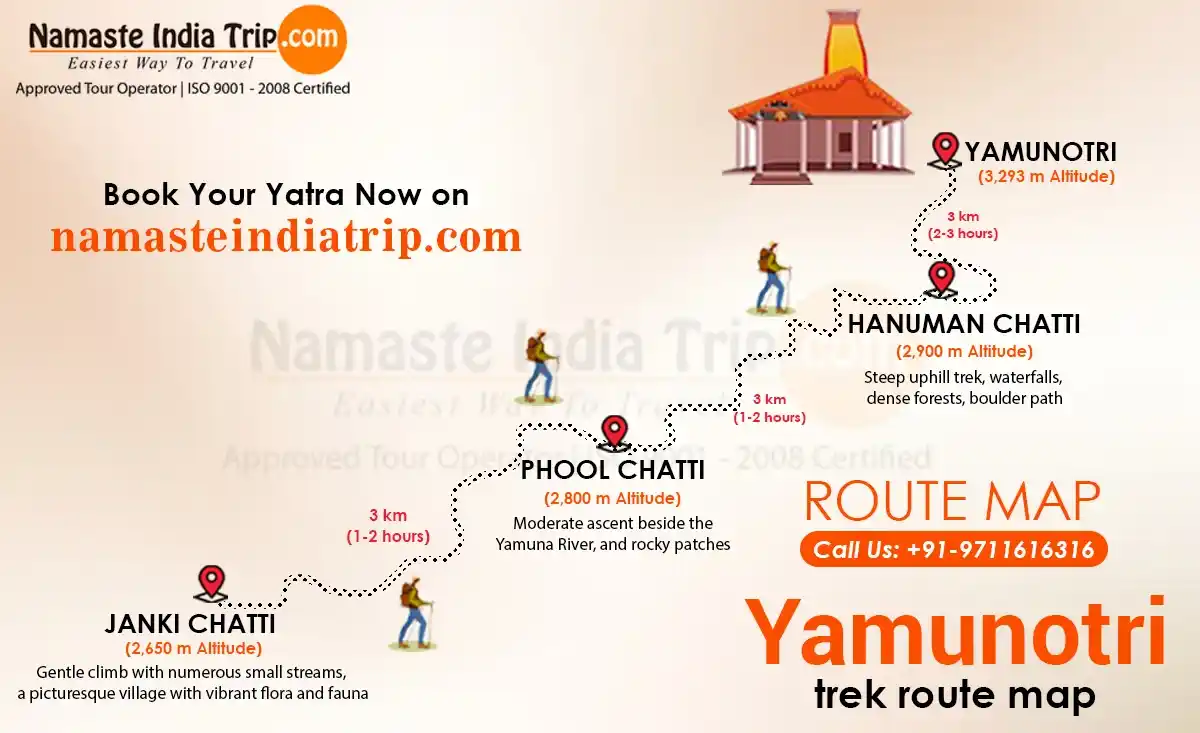
The trek starts at Janki Chatti and climbs along the Yamuna to the temple. The path is paved, with stone steps on the steeper parts, and tea stalls and small dhabas along the way.
- The first half is a steady climb beside the river. Mornings are busy with ponies, so step to the hill side of the path when they pass.
- The second half is steeper and narrower, with more steps. Save your energy for this part rather than racing the easy first section.
- The final climb leads into the temple complex, where Surya Kund, Divya Shila and the main shrine stand close together.
Hanuman Chatti and Phool Chatti are on the road before Janki Chatti, not on the walking trail. Older guides describe a 13 km trek from Hanuman Chatti because the walk used to start there, before the road was extended to Janki Chatti.
Yamunotri Pony, Palki and Kandi Charges: How to Check Current Rates
Pony, palki and kandi services start from the prepaid counter at Janki Chatti. The local administration revises the rates, and figures quoted online for 2026 don’t agree with each other. The rate printed on your counter slip is the one that counts. Book only at the counter, keep the receipt, and ignore touts standing outside.
- Pony (horse or mule): for elderly pilgrims and older children
- Kandi (a basket carried on a porter’s back): mainly for children and lighter adults
- Dandi or palki (a chair carried by four bearers): for senior citizens or those with mobility problems
- Pitthu (porter): carries your luggage
Historical reference only, not 2026 rates: in 2023, Zila Panchayat Uttarkashi fixed round-trip fares of ₹2,500 for a horse or mule and ₹8,000 for a dandi or kandi. In May 2024, a District Magistrate order capped horses and mules at 800 a day (4 AM to 5 PM) and dandis at 300 a day (4 AM to 4 PM). The 2026 limits may differ, so confirm at the counter.
Places to See on the Yamunotri Trek
Yamunotri Temple
The temple enshrines a black marble idol of Maa Yamuna and is the first Dham of the Char Dham circuit. The official portal has not yet published 2026 darshan or aarti timings, so ask at Janki Chatti or your hotel on the evening before the trek.
Surya Kund
Surya Kund is a natural hot spring beside the temple. Its water is hot enough to cook in. Pilgrims tie rice or potatoes in muslin cloth, dip them in the kund and take the cooked food home as prasad. Keep children well back from the edge.
Divya Shila
Divya Shila is a sacred rock pillar near Surya Kund. Pilgrims worship it before offering puja to the deity, so stop here first.
Hanuman Chatti
Hanuman Chatti is a village on the road below Janki Chatti, where the Hanuman Ganga meets the Yamuna. It is the base for the Dodital and Darwa Top treks.
Yamunotri Trek Itinerary: 3 Days from Dehradun
- Day 1: Drive from Dehradun to Janki Chatti (about 180 km). Stay overnight at Janki Chatti, or at Barkot if rooms are full.
- Day 2: Start the trek by 6:00 AM, have darshan, cook prasad at Surya Kund and walk back to Janki Chatti by afternoon.
- Day 3: Drive back to Dehradun, or head on towards Uttarkashi for Gangotri if you are doing the Char Dham Yatra.
What to Carry on the Yamunotri Trek
Most of this list matters because of two things: cold mornings at 3,000 m and a steep final climb.
Clothing & Footwear
- Trekking shoes with ankle support; the stone steps near the top are uneven
- Thermal inner, fleece and a down jacket
- Rain jacket or poncho
- Woollen cap, gloves and warm socks
On the Trail
- At least 2 litres of water
- Energy bars and dry fruits
- A walking stick for the steep final stretch
- Sunscreen and sunglasses
- Personal medicines, ORS, paracetamol, antacids, antiseptic cream and bandages
- Torch or headlamp for a pre-dawn start
Documents & Cash
- Printed copy of your Char Dham registration
- The photo ID you used to register
- Cash for food, pony charges and emergencies; don’t rely on ATMs or UPI past Barkot
Accommodation and Food Options
Janki Chatti has the most places to stay on the route, including guesthouses, basic hotels and the GMVN Tourist Rest House. Sleep here the night before and you can start at dawn. Driving up from Barkot on trek morning means a much later start.
Near the temple there are only a few basic guesthouses and dharamshalas. Barkot, about 45 to 50 km before Janki Chatti, has more hotels and suits pilgrims who want a more comfortable base. Book both well ahead for May and June.
Dhabas along the trail serve tea and simple meals such as rajma chawal, dal roti and Maggi. Carry snacks anyway, because stalls may still be shut at 5 AM. Follow local temple and administration rules on food, alcohol and tobacco.
Tips and Precautions for the Yamunotri Trek
- Register before you leave home and carry a printed copy. Mobile signal is weak on the trail.
- Spend the night before at Janki Chatti or Barkot so your body can adjust to the altitude.
- Walk 30 minutes a day for two or three weeks before the trip. You will feel the difference on the last climb.
- Leave Janki Chatti by 6:00 AM. That leaves time for darshan and Surya Kund before afternoon weather and crowds build.
- If you have a heart condition, breathing problems or high blood pressure, see a doctor before the trip and carry your medicines.
- Severe breathlessness, dizziness or a pounding headache means stop, rest and drink water. If it doesn’t ease, turn back. For emergencies, call 108 for an ambulance; the Uttarkashi district Char Dham Yatra page lists health facilities on the route.
- Check the Uttarkashi weather and road advisory before starting.
- Refill water at dhabas or carry purification tablets instead of drinking from streams.
- Solo trekkers are better off with a companion or group. Tell your hotel when you expect to be back.
Do’s and Don’ts for the Yamunotri Trek
Do’s
- Remove footwear and dress modestly in the temple premises
- Worship at Divya Shila before entering the main temple
- Book pony, palki and kandi services only at the prepaid counter
Don’ts
- Don’t carry single-use plastic; bring your waste back down
- Don’t play loud music on the trail or near the temple
- Don’t push past your limits when a pony or palki is available
- Don’t drink alcohol or smoke on the trail or near the temple
Conclusion
Register before you leave. Sleep at Janki Chatti the night before, start by 6:00 AM, and carry warm layers whatever the month. Do those things and the 6 km climb to Yamunotri is well within reach for most pilgrims, on foot or by pony.
FAQs
How long is the Yamunotri trek?
About 6 km one way from Janki Chatti, or 12 km round trip. The official portal estimates 2 to 3 hours uphill; with stops and crowds, most pilgrims should allow 3 to 5.
Is the Yamunotri trek difficult?
It is moderate. The early part from Janki Chatti is a gradual climb and the final stretch to the temple is the steepest. Ponies, kandis and palkis are available at Janki Chatti.
Can senior citizens do the Yamunotri trek?
Yes. Most senior citizens do it by pony, kandi or palki booked at the Janki Chatti prepaid counter.
What is the best time to go on the Yamunotri trek?
May to June or September to October. July and August bring heavy rain and landslides, so check official advisories before travelling then.
Is it safe to trek to Yamunotri?
Conditions depend on weather, the state of the trail, crowds and your own fitness. Check advisories, start early, and take a pony or palki if the climb is too much.
What medical help is available on the route?
The Uttarkashi district Char Dham Yatra page lists health facilities and emergency contacts for the route. Dial 108 for an ambulance, and carry your own medicines.
What are the Yamunotri temple timings in 2026?
The official portal says 2026 darshan and aarti timings will be announced. Confirm the day’s timings at Janki Chatti before you start.
When does Yamunotri Temple open and close in 2026?
It opened on 19 April 2026. Closing is expected around Bhai Dooj (11 November 2026); the final date is announced on Dussehra, after which the idol moves to Kharsali.
Is Char Dham registration mandatory in 2026?
Yes, and it is free. Register on the official portal, the Tourist Care Uttarakhand app, WhatsApp (8394833833) or at a registration centre, using Aadhaar, Voter ID, driving licence or passport.
What are the pony and palki charges at Yamunotri in 2026?
The administration revises them and online figures conflict. Check the rate chart at the Janki Chatti prepaid counter and keep your receipt.
Is helicopter service available for Yamunotri?
The official portal lists chartered services from Dehradun and says heli bookings are made only through IRCTC. Confirm availability before you plan around it.
Where do I stay near Yamunotri?
Janki Chatti is the best base, with guesthouses and a GMVN Tourist Rest House. Barkot, about 45 to 50 km away, has more hotels.
Check out: Yamunotri Yatra Tour Packages
Sources
- Tourist Care Uttarakhand (official Char Dham registration portal): Yamunotri page, FAQ and home page, accessed 24 September 2026: uk.gov.in
- Uttarkashi District Administration, Yamunotri Dham page: nic.in
- Shri Badrinath Kedarnath Temple Committee, Yamunotri page: badrinath-kedarnath.gov.in
- Amar Ujala: 2023 Zila Panchayat fares (March 2023) and Syanachatti highway reopening (July 2026)
- Mountain Valley Today: District Magistrate order on animal and dandi limits (May 2024)
- The News Mill: Chief Minister’s Char Dham review meeting (15 September 2026)


 Call
Call Enquiry