Last Updated on 28/02/2026
Muktinath Temple, a sacred Lord Vishnu temple, is situated in the Himalayan foothills of Nepal. Holding spiritual significance for both Hindu and Buddhist travellers, here the lord is worshipped mainly in the form of a Shaligram (a stone from the Gandaki River). Therefore, it is believed that whoever visits this temple attains salvation (Moksh), as the name Mukti’ signifies itself.
Also being one of the four Chardham of Nepal, if you are planning to Muktinath trip, then here is a detailed Muktinath Yatra guide covering the complete route map, best travel options from India, transportation details, and top places to visit near Muktinath Temple.
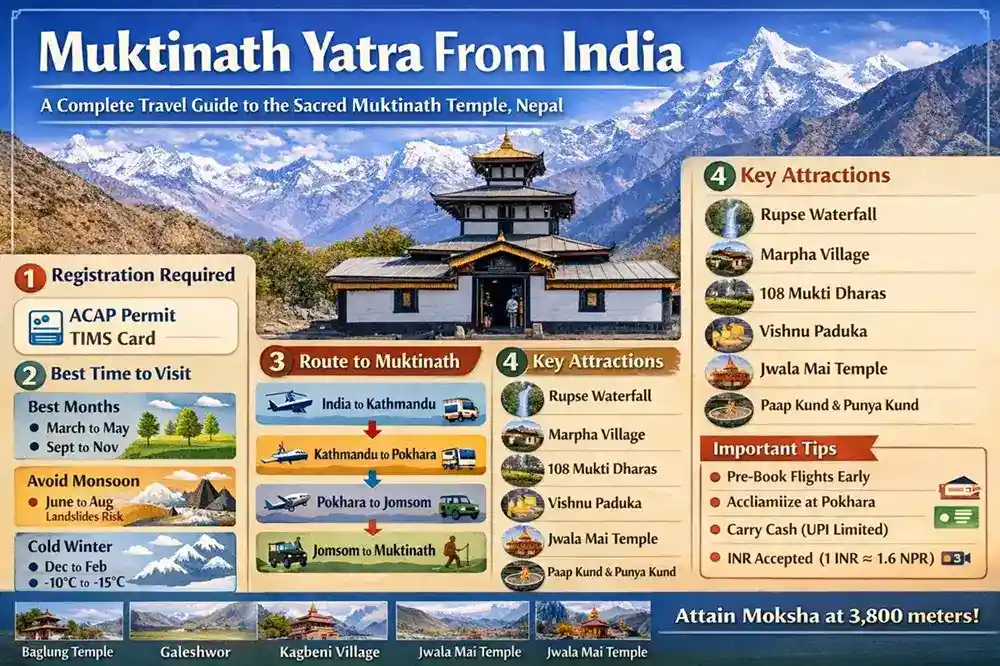
Registration and Best Time To Visit
Muktinath Temple is located in the Annapurna Conservation Area Project. Therefore, all visitors need to collect an ACAP Permit from Kathmandu or Pokhara. Failing to do so may lead to penalties and double the amount as a fee; therefore, it is always recommended to collect it beforehand from the online portal.
The best months for Muktinath Yatra are March, April, May, September, October, and November. During these months, the weather is clear, and the temperature is comfortable for Darshan and scenic mountain views.
June, July, and August are the monsoon season in Nepal; therefore, it is always recommended to avoid the Muktinath Yatra during this time, as there is danger of landslides and roadblocks. With no guarantee of the reopening of roadways and shops, people also complain of the disrupted supply of rations.
December, January, and February are the months of snowfall and winter; therefore, it is always recommended to avoid them, but if you want to experience extreme -10 to -15°C. Temperature: You may undertake the Yatra with precautions.
| Best months to travel |
Monsoon season |
Months to avoid |
| March, April, May, September, October, and November |
June, July, and August |
December, January, and February |
Muktinath Yatra Route and the Best Option
| Stage |
Origin → Destination |
Transport Options |
Duration |
Approx. Cost (INR) |
| 1 |
Delhi/Mumbai/Kolkata → Kathmandu |
Flight |
1.5-2 hours |
5,000-10,000 |
| 2 |
Kathmandu → Pokhara |
Flight, Bus, Drive |
Flight: 25-30 min; Bus/Drive: 7-9 hours |
Flight: 7,000-10,000; Bus: 1,200-1,500 |
| 3 |
Pokhara → Jomsom |
Flight, Helicopter, Drive/Jeep, Trek |
Flight: 20 min; Jeep: 8-10 hours; Trek: 1-2 days |
Flight: 12,000-14,000; Jeep (shared): 4,000-6,000 |
| 4 |
Jomsom → Muktinath |
Trek, Jeep |
Trek: 6-8 hours; Jeep: 1-1.5 hours |
Jeep: 1,000-2,000; Trek: Free/minimal |
India to Kathmandu
Kathmandu has good connectivity with the megacities of India (Delhi/Mumbai/Kolkata) via air and road, but it still lacks train connectivity; therefore, Yatris need to deboard at Gorakhpur or Raxaul railway station and then continue their journey to the Nepalese capital by bus or taxi. (6-7 hours duration)
From Kathmandu:
Option 1 – Charter Helicopter
With just a 1.15-hour flight one way, you can complete the Muktinath Yatra in a duration of 4 hours, making it the best option for elderly children or people who need to cover the journey in one day.
Option 2 – Rented Taxi
Taxi rides allow Yatris to witness scenic mountainous peaks and have fun while travelling, but its 2-day-long route requires 8-9 hours of daily driving; therefore, the elderly people and those with motion sickness are advised to plan accordingly.
Option 3 – Flight
Board an every-hour flight from Kathmandu to Pokhara, generally available with seats, but during peak season it is recommended to book 2-3 days in advance to avoid any last-minute disruption. Also at Pokhara, you will need an overnight stay, as there are only 2 operators available for Jomsom flights with 18-seater planes, usually operating early morning at 6 and 10 am. Therefore, you will need a 2-3 month advance booking to avoid any problems at the last moment. Later at Jomsom, you may hire a local taxi and continue your Yatra to the Muktinath Temple.
- You may consider trekking from Pokhara, a nearby area from Nayapul (1-hour drive), which will take a 7-8 day journey, resting/staying on the way at various local teahouses.
- You may consider a charter helicopter from Pokhara for 35 minutes to Muktinath Temple, where it lands near the temple, and you just need to climb 130 steps to the temple (with the Doli option also available for convenience). The helicopter waits for only an hour.
- You may hire a taxi from Pokhara, 197 km away from Muktinath Temple, with a duration of 8 hours. The roads are mostly smooth, but some rocky and bumpy sections are midway through; after the drive, you will need 45 minutes of trekking to reach the temple, and in between, you may witness many key attractions while driving, as mentioned below–
Key Attractions on the Route from Pokhara to Muktinath
| ● Baglung Kalikamai Mandir |
● Shaligram Museum, |
| ● Galeshwor Mahadev Shakti Peetha |
● Natural Hot Spring |
| ● Rupse Waterfall |
● Marpha Village |
| ● Jomsom Village |
● Kagbeni Dham |
Key Aattractions Near Muktinath Temple
- Samba Gompa is situated to the left of the main entrance to the Muktinath temple complex, the main deities being Shakyamuni, Chenrezig and Guru Rinpoche.
- Muktinath Yagyashala travellers can offer their Yagna here at this Yagyashala.
- Vishnu Paduka: After crossing Muktinath Yagyashala, we can see Vishnu Paduka on the right-hand side; also, an idol of Swaminarayan Nilkanth Varani is placed there, marking the place of this penance (Tapasya). Therefore, this place is also popular among the Swaminarayan Sampraday.
- Mukteshwar Mahadev Temple is just in front of Vishnu Charan Paduka. There is a temple of Mukteshwar Mahadev residing with Mata Parvati, also called Gandaki Chandi Shakti Peeth, as Mata Sati’s right cheek (Gaal) fell upon this place; therefore, it is considered one of the 52 Shaktipeeth.
- 108 Mukti Dharas at the back of the temple is the 108 water springs popularly known as Mukti Dhara, where water is pouring from a cow’s head, and it is believed that taking a bath in this chilled water has the power to rinse past sins and bad karmas, which will purify the soul and help attain moksha at last.
- Paap Kund and Punya Kund, with the water from 108 cow heads, make two Kundas popularly known to ease Paap by bathing in Paap Kund and raise Punya by bathing in Punya Kund.
- Narsingh Gompa: This is a monastery dedicated to Guru Rinpoche (Padmasambhava). His huge clay image is placed at the centre of the altar along with the Bon deities: red Trakpo on the right side and blue Singe Doma on the left side. Since Singe Doma is a lion-headed deity, Hindus worship the deity as Narsinha and name the monastery Narsingh Gompa.
- Jwala Mai Temple. This monastery is known as the Monastery of the Miraculous Flame. Manjushri, Avalokiteshvara, and Bajrapani are the main deities of this monastery, beneath which a natural gas blue flame burns continuously. Hindus regard this miraculous flame as an offering made by Brahma. The monastery is located south of the Muktinath temple.
Important Travel Recommendations
- Pre-registration for the Yatra, as the non-availability of a permit may lead to double the fee or denial of entry.
- Pre-book a flight from Jomsom, as flights are limited with few seats; therefore, you always need to pre-book (90 days in advance) to travel on time. – Cancellation is common.
- It is recommended to carry cash, as UPI is spotted after Jomsom.
- Acclimatise for 1 day at Pokhara, as AMS hits hard at the 3,800 m Muktinath Temple.
- Check for weather conditions before the Yatra, as conditions may get worse at high altitude at any moment; therefore, it is always advisable to avoid winter (-10 degree temperature) or heavy monsoon, which eventually leads to road blockages or landslides.
- If travelling by road, remember it’s a two-day, 8-9-hour journey; don’t rush, as it may lead to an accident on narrow, winding, mountainous roads. It is recommended to acclimatise and then proceed to high altitude slowly to avoid sickness and health risks.
- Always remember to carry a voter ID or PAN card with you, as Nepal and India have open borders, but at a checkpost, you need to show your official IDs to proceed. (No visa or passport needed).
People Also Asked –
Q-1: Is there any direct train to Kathmandu, Nepal?
Ans: No, there is no direct train to Nepal; you need to deboard at Gorakhpur (GKP).
Or Raxaul (RXL) railway station to proceed further by bus/taxi towards Kathmandu.
Q-2: Does Kathmandu have flight connectivity from India?
Ans: Yes, Kathmandu does have flight connectivity from all megacity airports in India, like Delhi, Mumbai, Varanasi, Kolkata and Bangalore, from operators like Indigo, Air India and Nepal Airlines. Fares start at INR 5,000-10,000 one-way (economy, varies by season); there are around 15-20 daily flights from India
Q-3: Do we need a passport to travel to Nepal?
Ans: No, we just need a photo ID like a voter card or PAN card to travel to Nepal. In photocopy form.
Q-4: Do we need a visa to travel to Nepal?
Ans: No, we do not require a visa or any other permission to travel to Nepal. We have an open border with Nepal.
Q-5: Is the Indian rupee acceptable in India, or do we need to convert?
Ans: Mostly, people accept Indian currency, but you can also exchange it for convenience at a rate mostly around 100 rupees (INR), equivalent to 160 Nepalese rupees (NPR). Or check at their Nepal Rastra Bank (official) portal for recent rates.
Q-6: Can we drive our own vehicle to Muktinath Temple?
Ans: No, beyond Pokhara, you are not allowed to drive your own vehicle. You will need to board a local bus or taxi from this hub. Till Pokhara, you may drive with a Lower Mustang vehicle permit (500 NPR/day ≈ INR 300) with RC, licence, ID, pollution cert, and insurance
Q-7: Do Nepalese people know Hindi or English?
Ans: Yes, many Nepalese in tourist-prone areas are fluent in Hindi due to Indian cultural influence, but expect a moderate level of English from them
Q-8: Is Nepal expensive?
Ans: No, Nepal is not expensive for Indians; it is comparatively cheaper compared to Shimla, Darjeeling, etc.
Q-9: Does UPI work there?
Ans: Yes, UPI does work in Nepal at tourist hubs, not everywhere, with FonePay QR codes scannable through PhonePay and GPay, but it’s always recommended to carry cash, as after Jomsom, internet connectivity fails.

 Call
Call Enquiry
ham 1men, 1 ladies,or2child