Last Updated on 03/07/2026
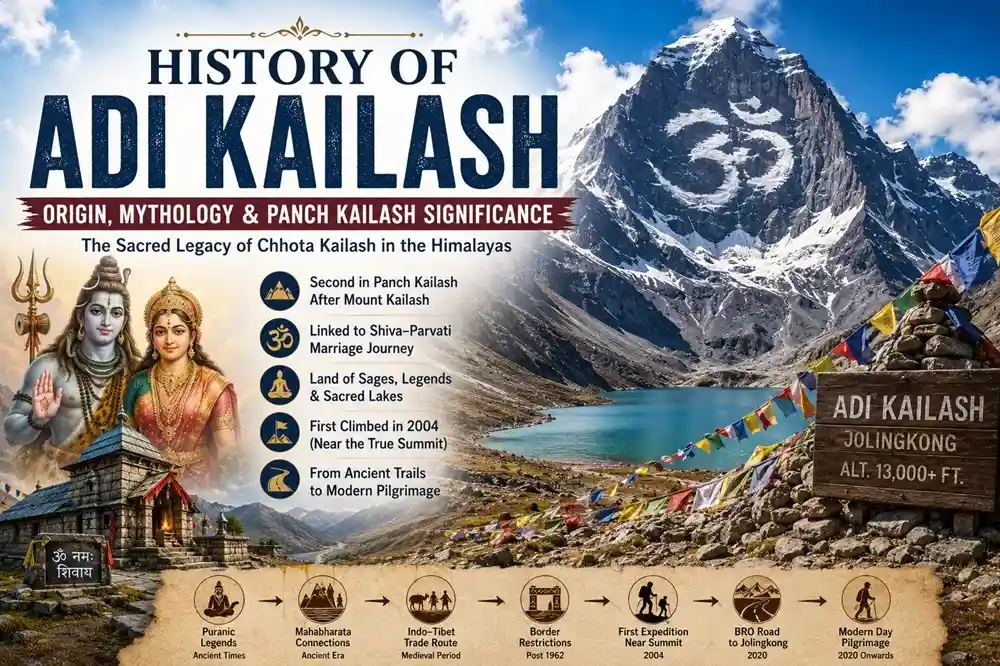
The history of Adi Kailash blends Hindu mythology with real, documented events — Puranic legend, a 1962 border closure, a 2004 mountaineering expedition, and a 2020 road project. Located in Pithoragarh, Uttarakhand, this peak is popularly called Chhota Kailash. This guide separates verified facts from devotional tradition so you get an accurate picture.
Key Facts at a Glance
- Height: Generally listed at 5,945 m; some expedition surveys report figures closer to 5,975 m.
- Location: Pithoragarh district, Uttarakhand, near the India-Nepal-Tibet tri-junction.
- Religious status: Widely regarded as the second peak in the Panch Kailash tradition.
- First climb: 2004, by a British-Scottish-American team, halted just below the true summit.
- Access: Opened up gradually after a 1962 border closure, aided by a 2020 BRO road.
Why Is It Called Adi Kailash?
“Adi” means original or first. Devotees use the name because Hindu tradition regards this peak as Shiva’s earlier, more accessible manifestation, alongside the primary Mount Kailash in Tibet. It’s also called Chhota Kailash (Little Kailash), Shiva Kailash, Baba Kailash, or Jonglingkong Peak.
Religious and Mythological Background
According to Hindu tradition, Shiva and Parvati are believed to have halted at this site during their wedding journey from Kailash Mansarovar toward the Triyuginarayan temple. Regional retellings connected to the Skanda Purana’s Kedarkhand section associate the peak with Shiva’s presence, though the exact scriptural lineage is debated among scholars.
Some local traditions also link the mountain to Shiva’s Tandava dance and a meeting with the sage Ashtavakra — a story with limited textual backing, kept alive mainly through oral memory. Nearby Kuti village is popularly said to derive its name from Kunti, mother of the Pandavas, tying the valley to Mahabharata folklore. No archaeological evidence currently confirms these mythological traditions; they remain part of living devotional heritage rather than documented history.
Adi Kailash and the Panch Kailash Tradition
Adi Kailash is widely regarded by devotees as the second-most revered peak in the Panch Kailash — five Himalayan peaks each treated as a manifestation of Shiva. This ranking is a devotional convention, not an official classification.
| Rank (by tradition) |
Peak |
Location |
| 1 |
Mount Kailash |
Tibet |
| 2 |
Adi Kailash (Chhota Kailash) |
Pithoragarh, Uttarakhand |
| 3 |
Shrikhand Mahadev Kailash |
Himachal Pradesh |
| 4 |
Kinnaur Kailash |
Himachal Pradesh |
| 5 |
Manimahesh Kailash |
Himachal Pradesh |
Myth vs. History
| Belief (Mythology) |
Status |
| Shiva-Parvati halted here on their wedding journey |
Hindu religious tradition |
| Kuti village named after Kunti |
Local folklore |
| Panch Kailash ranking |
Devotional convention |
| 2004 successful climb |
Documented mountaineering record |
| 2020 BRO road to Jolingkong |
Verified infrastructure development |
Historical Timeline of Adi Kailash
- Ancient period: Regional Puranic and Mahabharata traditions associate the area with Shiva and the Pandavas.
- Pre-1962: The Bhotiya (Rung) community used the Lipulekh Pass and nearby routes for trans-Himalayan trade with Tibet, also guiding pilgrims toward Kailash Mansarovar.
- 1962: The Sino-Indian war closed the India-Tibet border, ending centuries of trade and cutting off civilian access to the region for decades.
- Late 20th century: ITBP presence and restricted permits kept the area largely off-limits to ordinary travelers.
- 2002: A Moran-led team attempted the peak via its north face but withdrew due to unstable snow conditions.
- 2004: A British-Scottish-American team completed the first documented climb, stopping short of the true summit.
- 2020: The Border Roads Organisation completed a motorable road from Gunji toward Limpiyadhura, sharply cutting travel time to Jolingkong.
- Present: Organized pilgrimage packages combine Adi Kailash with Om Parvat, and tourism has grown steadily since the road opened.
Adi Kailash vs Mount Kailash
| Feature |
Adi Kailash (India) |
Mount Kailash (Tibet) |
| Altitude |
~5,945 m |
~6,638 m |
| Permit |
Inner Line Permit |
Chinese visa and permits |
| Parikrama |
Limited, terrain-dependent |
Traditional 52 km route |
| Summit status |
Climbed once (2004), just below the top |
Never officially climbed |
| Access |
Largely motorable, weather-dependent |
Longer international travel |
FAQs
Q-1: Why is Adi Kailash called Adi Kailash?
Because Hindu tradition treats it as Shiva’s earlier or “original” Himalayan manifestation alongside Mount Kailash in Tibet.
Q-2: Is Adi Kailash older than Mount Kailash?
No verified evidence supports that; it’s ranked second in devotional Panch Kailash tradition, not proven historically older.
Q-3: Is Adi Kailash mentioned in the Puranas?
Regional tradition links it to the Skanda Purana’s Kedarkhand section, though scholars debate the exact textual reference.
Q-4: Why was Adi Kailash closed for decades?
The 1962 Sino-Indian war shut the border, restricting civilian access to this frontier region for years.
Q-5: Which community historically used this route?
The Bhotiya (Rung) community traded across the Lipulekh Pass with Tibet before the 1962 border closure.
Q-6: Has anyone climbed Adi Kailash?
Yes, a British-Scottish-American team climbed it in 2004, stopping just below the true summit out of respect.
Q-7: What is the Panch Kailash?
A devotional grouping of five Himalayan peaks, including Mount Kailash and Adi Kailash, each linked to Shiva.
Q-8: Is Adi Kailash historically proven?
Its modern history (climbs, roads, permits) is documented; its mythology remains religious tradition, not archaeological fact.
Q-9: Is Adi Kailash the same as Om Parvat?
No. Adi Kailash and Om Parvat are different sacred peaks, often visited together on the same pilgrimage.
Q-10: When did the road to Adi Kailash open?
A BRO road from Gunji toward Limpiyadhura was completed in July 2020, easing access significantly.
Q-11: Do I need a permit for Adi Kailash?
Yes, an Inner Line Permit is required from Dharchula; fees are revised periodically by the administration.
Q-12: What is the best time to visit Adi Kailash?
May–June and September–October, avoiding monsoon landslides and heavy winter snow.
Q-13: Can foreign nationals visit Adi Kailash?
Eligibility depends on current border-area rules, so foreign travelers should confirm with district authorities first.
Q-14: How is Adi Kailash linked to the Mahabharata?
Nearby Kuti village is popularly said to be named after Kunti, mother of the Pandavas.
Q-15: Why is Adi Kailash famous?
For its Panch Kailash status, its Shiva-Parvati legend, and its dramatic pyramid shape mirroring Mount Kailash.
Q-16: Is there an age limit for the Adi Kailash Yatra?
Most operators suggest around 70, subject to fitness, though this varies by tour operator.
Q-17: What is the difference between Adi Kailash and Kailash Mansarovar?
Adi Kailash is in India and needs no visa; Kailash Mansarovar is in Tibet and requires international permits.
Q-18: Is the road to Adi Kailash always open?
No, monsoon landslides and winter snow can close sections, so buffer days are recommended.
Conclusion
The history of Adi Kailash works on two tracks: a devotional legacy rooted in Puranic and Mahabharata tradition, and a documented modern history shaped by the 1962 border closure, a 2004 climb, and a 2020 road. Understanding both separately — origin story and verified record — gives a fuller, more accurate picture of why this Kumaon peak matters to pilgrims and historians alike.
Must Reads on:
Travel Insurance for Adi Kailash Yatra
Best Time to Visit Adi Kailash
How to Plan Adi Kailash Yatra


 Call
Call Enquiry