Last Updated on 13/07/2026
Some temples you visit. Patal Bhuvaneshwar, you descend into. Tucked away in Bhubneshwar village near Gangolihat in Pithoragarh district, Uttarakhand, this ancient limestone cave temple takes you about 90 feet below the surface into chambers that devotees revere as the abode of Lord Shiva.
At roughly 1,350 metres in the Kumaon hills, this is no roadside darshan. The nearest big railhead is 6 hours away, entry happens in guided batches, and phones stay in your pocket. Yet almost everyone who grips those iron chains and squeezes through the tunnel calls it unforgettable.
Quick Overview:
- Best time to visit: March to June and September to November.
- Opening hours: Generally 6:00 AM to 6:00 PM (shorter hours during winter).
- Entry fee: A nominal fee payable at the ticket counter.
- Guided entry: Visitors descend into the cave in small batches with an authorised local guide.
- Advance booking: No advance registration is required.
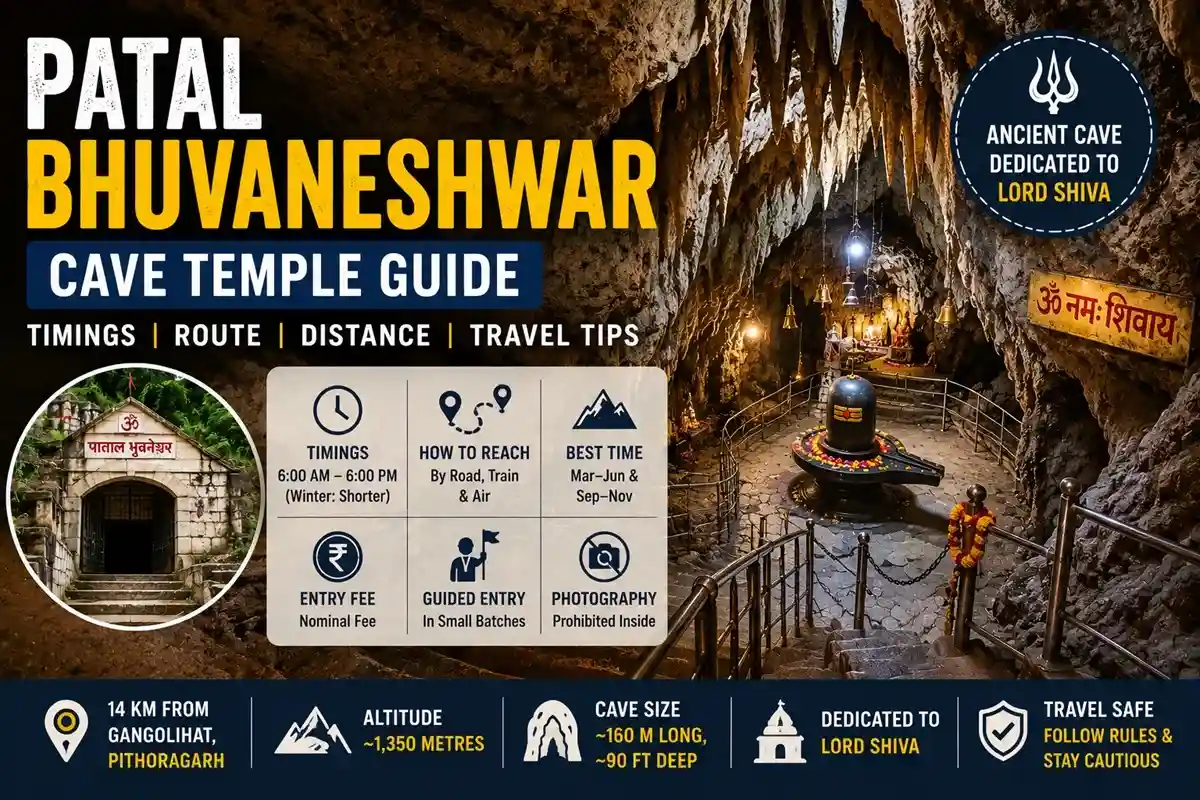
Key Facts
| Fact |
Detail |
| Location |
Bhubneshwar village, 14 km from Gangolihat, Pithoragarh |
| Altitude |
~1,350 m |
| Cave size |
~160 m long, ~90 ft deep |
| Deity |
Lord Shiva |
| Entry |
Guided batches; nominal fee; no permit needed |
| Photography |
Generally prohibited inside |
What Is Patal Bhuvaneshwar?
Patal Bhuvaneshwar is a naturally formed limestone cave shrine dedicated to Lord Shiva — Patal means the netherworld, Bhuvaneshwar means Lord of the Universe. Inside, stalactite and stalagmite formations are worshipped as deities and scenes from Hindu mythology.
It’s not one cave but a “cave city” — caves within caves. According to Hindu belief, all 33 koti devas (traditionally interpreted as categories of deities) are symbolically present here, and local tradition holds that darshan at this cave shrine equals visiting all four Char Dhams of Uttarakhand.
History and Legend
The cave is described in the Manaskhanda of the Skanda Purana. According to legend, King Rituparna of the Surya dynasty discovered it in the Treta Yuga, guided by Sheshnag, and the Pandavas are believed to have meditated here.
Local tradition credits Adi Shankaracharya — who lived in the 8th century CE — with rediscovering and reviving worship at the cave. Since then, local priest families have carried the rituals forward across generations. Legend also speaks of four gates — Randwar, Paapdwar, Dharamdwar, and Mokshadwar — of which two are said to have closed after Ravana’s death and the Mahabharata war.
Best Time to Visit Patal Bhuvaneshwar
March–June: peak season, pleasant 15–25°C days, dry roads. September–November: quieter, crisp air, clear Panchachuli views from Chaukori. July–August: avoid — landslide-prone roads and slippery cave floors. December–February: possible, but cold with short daylight hours.
From practical experience, join the first morning batch. Crowds are thinner before 10 AM and you keep daylight for the return drive — night driving on Kumaon roads is best avoided.
| Season |
Months |
Temp |
Verdict |
| Summer |
Mar–Jun |
15–25°C |
Excellent |
| Monsoon |
Jul–Aug |
15–20°C, heavy rain |
Avoid |
| Autumn |
Sep–Nov |
10–20°C |
Excellent |
| Winter |
Dec–Feb |
0–12°C |
Okay, cold |
How to Reach Patal Bhuvaneshwar
By Air: Pantnagar Airport (~244 km, 7–8 hrs by road) is the nearest with scheduled flights. Naini Saini airstrip near Pithoragarh has irregular services — don’t rely on it.
By Train: Two railheads, and this confuses first-timers:
- Kathgodam (~190 km, 6–6.5 hrs): best Delhi connectivity (Ranikhet Express, Shatabdi); route via Almora–Berinag.
- Tanakpur (~155–165 km): route via Champawat–Lohaghat; connected to Lucknow, Agra and UP-side trains.
By Road: Delhi is about 500–530 km (12–14 hrs) via Haldwani–Almora–Berinag. Local drivers usually recommend breaking the journey at Almora or Bhimtal. Roadways and KMOU buses reach Berinag/Gangolihat; shared cabs cover the last 14 km. The motorable road ends about half a kilometre from the cave — the final stretch is a short walk.
Distance Chart
| From |
Distance |
Time |
| Gangolihat |
14 km |
30–40 min |
| Berinag |
20 km |
45 min |
| Chaukori |
35–38 km |
1–1.5 hrs |
| Pithoragarh |
~90 km |
3 hrs |
| Almora |
~110 km |
3.5–4 hrs |
| Tanakpur (rail) |
~155–165 km |
5.5–6 hrs |
| Kathgodam (rail) |
~190 km |
6–6.5 hrs |
| Pantnagar (air) |
~244 km |
7–8 hrs |
| Delhi |
~500–530 km |
12–14 hrs |
Cave Timings, Entry Fee and Registration
The temple generally opens around 6 AM to 6 PM in summer, with later starts and earlier closings in winter. Timings aren’t rigidly published — confirm locally in the off-season.
Entry costs a nominal fee, with guide charges paid separately per group. Rates are revised periodically, so carry small cash and verify at the counter.
Registration: none needed. No permit, no online booking — buy the ticket on the spot and join the next batch. On Mahashivratri and Shravan Mondays, expect 30–60 minute queues.
Inside the Cave: How the Visit Works
- Park near the village; walk the short stretch to the entrance.
- Remove footwear; leather items are traditionally left outside.
- Join a batch — visitors normally enter only with an authorised local guide, and the stories make the formations come alive.
- Descend the narrow tunnel — around 82 steep rock-cut steps with iron chains for support. Take 10–15 careful minutes.
- Spend 30–45 minutes inside viewing formations revered as Sheshnag’s hood, Kal Bhairav’s tongue, Ganesha, the four Yuga stones, and Shiva lingams.
- Climb out the same way. Total: 1–1.5 hours.
Photography is generally prohibited inside, and drones are not permitted around the temple area.
The Geology, Briefly
The chambers formed over thousands of years as mineral-rich water seeped through limestone, depositing calcium carbonate as stalactites (hanging) and stalagmites (rising). The damp, dim interior you experience is exactly what keeps these formations growing.
Facilities: Parking, Food, Network
- Parking: available near the village entrance; fills up on festival days.
- Toilets: basic facilities near the temple complex.
- Food: small dhabas and tea stalls at the village; proper restaurants are in Berinag and Chaukori.
- Network & UPI: mobile signal is patchy beyond Berinag and UPI often fails — carry cash and offline maps.
Safety Tips and Who Should Avoid It
For most reasonably fit visitors, the descent is safe. Be honest with yourself, though:
- Avoid the cave if you have claustrophobia, a heart condition, or serious knee/back trouble. The outer temple offers darshan without descending.
- The limestone floor stays wet year-round — keep both hands on the chains.
- Road conditions keep improving, but landslides and temporary closures remain possible in monsoon — check locally before starting.
Common mistakes to avoid: attempting the descent right after a heavy meal, wearing slippery footwear, reaching after 3 PM on festival days, and skipping the guide’s briefing.
Senior Citizens
Many seniors complete the darshan daily — pacing is everything. Senior citizens should prefer the first morning batch, descend slowly, and let the guide set the speed. Those with cardiac or joint issues should enjoy the courtyard instead.
Where to Stay
- Chaukori (35–38 km): best base — KMVN resort and mid-range hotels with Himalayan views. Families usually choose Chaukori.
- Berinag (20 km): budget hotels and homestays.
- Gangolihat (14 km): simple lodges; pairs well with Hat Kalika temple.
- Near the cave: a KMVN rest house and village homestays for first-batch entry.
Booking early is recommended for the May–June rush and Mahashivratri.
Budget (Per Person, 3-Day Trip from Delhi)
| Expense |
Budget |
Mid-Range |
| Transport |
₹2,500–3,500 |
₹7,000–10,000 (cab) |
| Stay (2 nights) |
₹1,600–2,500 |
₹4,000–8,000 |
| Food + local costs |
₹1,000–1,600 |
₹1,800–3,000 |
| Total |
₹5,000–7,500 |
₹13,000–21,000 |
Packing essentials: grippy shoes, a light jacket (the cave stays cool year-round), backup torch, power bank, cash, motion-sickness tablets.
Nearby Places & Ideal Itinerary
Pair the sacred cave with Hat Kalika Temple (Gangolihat), Chaukori’s tea gardens, Berinag, and Jageshwar Dham (~115 km). If you’re planning this seriously, the classic 4–5 day Kumaon circuit — Almora → Jageshwar → the cave → Chaukori — is what most repeat travellers settle on. A rushed one-day dash from Kathgodam is possible but exhausting; two days is the sweet spot.
Latest Updates (2026)
- Batch entry managed by the temple committee continues; weekend/festival waits run 30–60 minutes.
- Road improvement work continues on stretches of the Almora–Berinag route — add buffer time.
- UPI and mobile coverage remain unreliable beyond Berinag; cash is still king.
- Monsoon advisories apply to the Almora–Berinag and Champawat–Lohaghat routes in July–August.
- Winter timings shift with daylight — confirm locally between December and February.
FAQs
Q-1: Where is the temple located?
In Bhubneshwar village, 14 km from Gangolihat, Pithoragarh district, Uttarakhand — at about 1,350 m in the Kumaon hills.
Q-2: What are the cave timings and entry fee?
Generally around 6 AM–6 PM (shorter in winter); nominal entry fee plus guide charges — verify current rates at the counter.
Q-3: What is the best time to visit Patal Bhuvaneshwar?
March–June and September–November. Avoid July–August due to landslide risk.
Q-4: How to reach Patal Bhuvaneshwar from Delhi?
Train to Kathgodam or Tanakpur, then a 5.5–6.5 hour drive; by road it’s roughly 500–530 km.
Q-5: Which is the nearest airport and railway station?
Pantnagar Airport (~244 km); Kathgodam (~190 km) and Tanakpur (~155 km) railheads.
Q-6: Is a guide compulsory?
Visitors normally enter only in batches with an authorised local guide — plan for it.
Q-7: Is photography allowed inside the cave?
No, it’s generally prohibited inside; the exterior and village can be photographed freely.
Q-8: Is the cave suitable for senior citizens?
Yes, for fit seniors who descend slowly using the chains; those with heart or joint issues should stay at the outer temple.
Q-9: Can children visit?
Children above 6–7 generally manage well with an adult holding their hand.
Q-10: Is any registration or permit required?
No — buy the ticket on arrival and join the next batch.
Q-11: How much walking and climbing is involved?
A short village walk plus around 82 steep steps down and back up; total visit takes 1–1.5 hours.
Q-12: Is parking available?
Yes, near the village entrance, though it fills up on festival days.
Q-13: Is the cave slippery or claustrophobic?
The floor stays damp and some passages are tight — skip it if enclosed spaces trouble you.
Q-14: Can foreigners visit?
Yes, the temple is open to all visitors; the same batch-entry rules apply.
Q-15: Is mobile network available?
Signal is patchy beyond Berinag and UPI is unreliable — carry cash and offline maps.
Final Word
Patal Bhuvaneshwar rewards travellers who plan well. Visit in March–June or September–November, base yourself in Chaukori or Berinag, arrive for the morning batch, and go with the guide. This underground Shiva temple suits devotees, geology lovers, and adventure-minded families — and is best skipped by anyone uneasy in tight, dark spaces. If Kumaon has been on your list, stop postponing; the cave feels exactly as ancient as the legends promise.


 Call
Call Enquiry