


Delhi → Mandawa → Bikaner → Jaisalmer → Jodhpur → Udaipur → Pushkar → Jaipur → Agra
Colorful Rajasthan Tour
- Hotel
- Meals
- Transfer
- Tour
- Guide

For both domestic and foreign travellers, Rajasthan is one of the most well-liked tourism sites in India. Rajasthan’s tagline, “Padharo Mhare Desh,” draws tourists with its historical forts, palaces, art, and culture. As the capital of Rajasthan and one of the three cities that make up the Golden Triangle, Jaipur which is also known as the Pink City is a very popular tourist destination. The Land of Kings and Kingdoms always welcomes their guests with warmth in their heart and open arms. This incredible 15 days / 14 nights tour will take you through all the exotic places of Rajasthan with the touch of royalty.
| Day | Tour Program | Distance / Time | Major Highlight / Sightseeing | Meals | Overnight |
|---|---|---|---|---|---|
| 01 | Delhi Arrival | Local / 4–8 hrs | Delhi, Rajasthan forts and havelis, Thar Desert and heritage villages | Dinner | Delhi |
| 02 | Delhi Sightseeing | Local / 4–8 hrs | Delhi, Rajasthan forts and havelis, Thar Desert and heritage villages | Breakfast & Dinner | Delhi |
| 03 | Delhi to Mandawa | Approx. 275 km / 5.3 hrs | Delhi, Mandawa, Rajasthan forts and havelis | Breakfast & Dinner | Mandawa |
| 04 | Mandawa to Bikaner | Approx. 230 km / 4.4 hrs | Mandawa, Bikaner, Rajasthan forts and havelis | Breakfast & Dinner | Bikaner |
| 05 | Bikaner to Jaisalmer | Approx. 340 km / 6.5 hrs | Bikaner, Jaisalmer, Thar Desert and heritage villages | Breakfast & Dinner | Jaisalmer |
| 06 | Jaisalmer Sightseeing | Local / 4–8 hrs | Jaisalmer, Rajasthan forts and havelis, Thar Desert and heritage villages | Breakfast & Dinner | Jaisalmer |
| 07 | Jaisalmer Desert Tour | Local transfer | Jaisalmer, Rajasthan forts and havelis, Thar Desert and heritage villages | Breakfast & Dinner | Jaisalmer |
| 08 | Jaisalmer to Jodhpur | Approx. 285 km / 5.5 hrs | Jaisalmer, Jodhpur, Rajasthan forts and havelis | Breakfast & Dinner | Jodhpur |
| 09 | Jodhpur to Luni | Road / transfer time varies | Jodhpur, Luni, Rajasthan forts and havelis | Breakfast & Dinner | Luni |
| 10 | Luni to Deogarh | Road / transfer time varies | Luni, Deogarh, Rajasthan forts and havelis | Breakfast & Dinner | Deogarh |
| 11 | Deogarh to Udaipur | Approx. 135 km / 2.6 hrs | Deogarh, Udaipur, Rajasthan forts and havelis | Breakfast & Dinner | Udaipur |
| 12 | Udaipur Sightseeing | Local / 4–8 hrs | Udaipur, Rajasthan forts and havelis, Thar Desert and heritage villages | Breakfast & Dinner | Udaipur |
| 13 | Udaipur to Jaipur via Pushkar | Approx. 425 km / 8.2 hrs | Udaipur, Pushkar, Jaipur | Breakfast & Dinner | Jaipur |
| 14 | Jaipur Sightseeing | Local / 4–8 hrs | Jaipur, Rajasthan forts and havelis, Thar Desert and heritage villages | Breakfast & Dinner | Jaipur |
| 15 | Jaipur to Delhi via Agra | Approx. 305 km / 5.9 hrs | Delhi, Jaipur, Agra | Breakfast | Tour Ends |
On arrival at Delhi, Namaste India Trip Representative will greet you and Drive to Mandawa in Rajasthan. Check in at a heritage hotel for dinner and overnight stay.
Mandawa: In the heart of the Shekhawati region of Rajasthan lays the beautiful small town Mandawa, known throughout the state for its forts and Havelis. Mandawa is situated in the north Indian state of Rajasthan around 190 km from Jaipur, the capital of the state.
Morning After breakfast drive to Bikaner. Check in at a hotel on arrival. Later visit local sightseeing. Overnight stay.
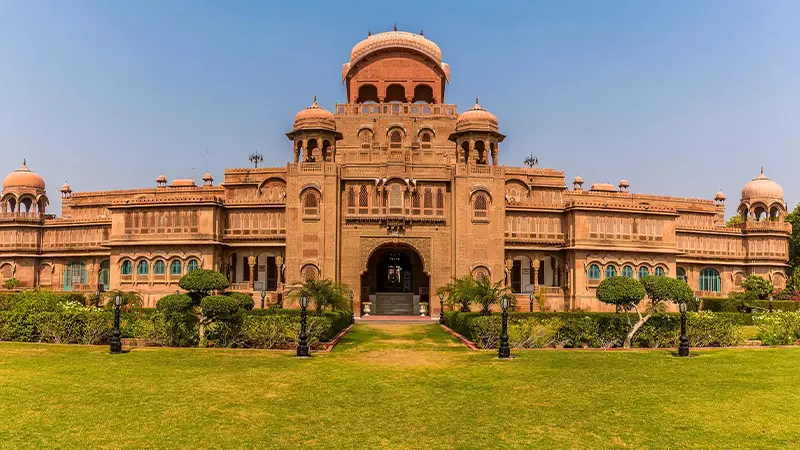
Tour the Junagarh Fort that was built by Raja Rai Singh; see the Lalgarh Palace that was constructed by Maharaja Ganga Singhji. The other attractions you may tour the Camel Breeding Farm, Karni Mata Temple etc. Stay overnight at the hotel in Bikaner.
Bikaner: If ever beauty has bloomed in a desert, it has been at Bikaner. Founded in 1488 AD by Rao Bika Ji, it’s located in North West part of Rajasthan state in India. The imposing palaces, beautiful and richly sculptured temples of red and yellow sandstones display some of the finest creations of Rajput civilization. It’s lust for “dessert” or affection for “desert” that tickles every heart to visit Bikaner.
Morning half Day visits fabulous Junagarh Fort & Lalgarh Palace and proceeds for Jaisalmer. Visit Kheechan on the way, and reach Jaisalmer Check-in at a hotel in Jaisalmer. Overnight stay at Jaisalmer.
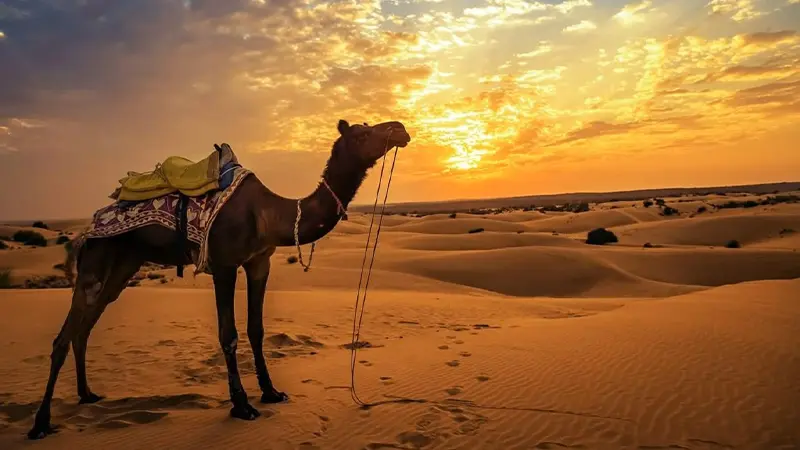
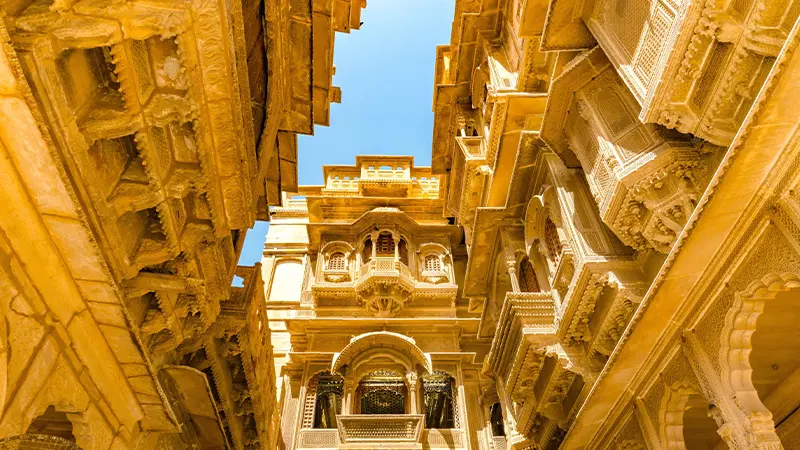
Visit Jaisalmer Fort & Museum after breakfast. Also, see the Jain Temple. Take a walk through the back streets to the Patwon ki Haveli & Kothari Haveli. After lunch proceeds to Kuldhera – an abandoned habitation, and then to Sam Sand Dunes. Here camp stay will be provided with folk dance and songs with Rajasthani Dinner.
Sam Sand Dunes: Sam sand dunes are becoming the major attraction in Jaisalmer. This is the closest place from where you can lose yourself in ‘the Great Thar Desert’. Sam has a truly magnificent stretch of sweeping dunes, with sparse or no vegetation.
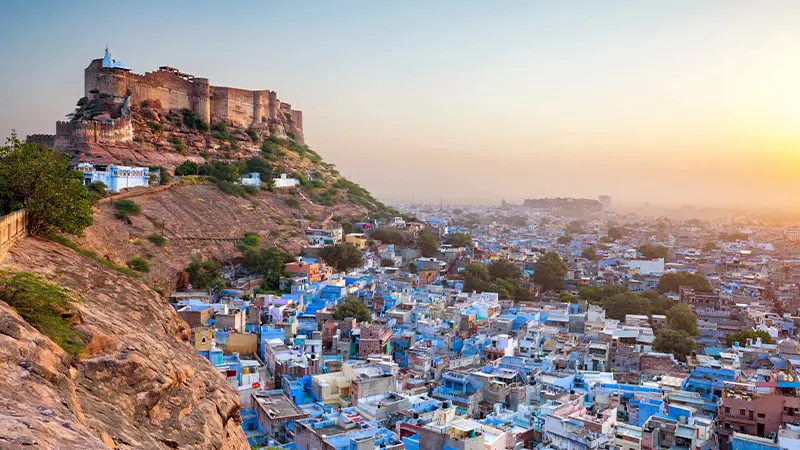
The morning after breakfast transfer to Jodhpur, The Sun City. On the way to Jodhpur, you can have your lunch at Fort Pokaran which literally means the palace of five mirages. Enroute you can also visit Bishnoi Villages where people believe in conserving the natural environment and animal hunting is banned there. You can spot numerous deer in Bishnoi Village. Arrive Jodhpur and get assisted check into the hotel. After taking some rest in the hotel we begin the city tour of Jodhpur which comprises of visit to the impressive Mehrangarh Fort – This magnificent fort was built in the 15th century and has seven gates which still witness marks of the battle fought by armies of Jodhpur to protect their people, Jaswant Thada – Looks like a temple, this white marble was constructed in the memory of Maharaja Jaswant Singh II, last but not to miss is Umaid Bhawan Palace – This stunning palace which today also serves as the residence to the royal family and a part of it is transformed into a luxurious hotel. The evening is free to relax and overnight stay is in Jodhpur.
Today we will go for Luni Excursions. Evening back to Jodhpur. Overnight stay at Jodhpur.
Luni: is situated 35 kms away from Jodhpur, it is a charming and cloistered village which reflects the royal past of Rajasthan. In Luni, many artisans are still pursuing their ancestral profession of carving metal, clay or wood into intricate forms.
Major attractions in Luni is Fort Chanwa. Fort Chanwa is a major attraction of Luni. It is famous for its elegance in Indian architecture. This entire fort is carved out of the famous red sandstone of Jodhpur. It reminds of the grandeur and grace of bygone age. The traditional paintings on the walls are evidence of the skill of craftsmen and the bygone days. Maharaja Dalip Singh Ji and his wife Rani Madhu, fort’s former rulers have restored its old charm.
After breakfast, leave for Deogarh. Enroute visit the Jain temples at Ranakpur – The cluster of temples, made of intricately sculpted white marble, come across as a marvelous feat of architecture. It would take anyone by surprise to learn that they were built in 1460, so well preserved & sparkling is the marble. The main temple is supported on 1,444 pillars – none of which is similarly carved. After the visit, continue drive to Deogarh.
Arrive Deogarh and check in at Deogarh Mahal. Overnight stay at Deogarh.
Deogarh: is an imposing structure built in the 17th century. It stands atop a hill and offers a commanding view of the Aravalli mountain range and the numerous lakes, strewn across the countryside with its graying battlements, domes, turrets, Jharokhas and huge gateways; it is a picturesque sight from the town below. At a height of about 2100 ft above sea level, it is cooler than surrounding Rajasthan. Built-in 1670 A.D. by Rawat Dwarka Dasji as a family residence, it soon became the hub of village activity. The family interacted with the villagers and invited a host of feasts and festivities to be performed within the Mahal precincts. Some of these traditions are still practiced. And the gates, that always remained closed, to ward off enemies, are now open to the guests. Deogarh lies on the borders of Mewar, Marwar and Merwara, about 80 miles north-east of Udaipur. Its chieftain known as ‘The Rawat’ was one of sixteen Umraos (feudal barons) privileged to wait upon the Maharana of Udaipur, the capital of Mewar such feudal estates, called ‘Thikanas’ were granted by the ruling Maharana to a nobleman either due to blood relationship or for an act of bravery.
Morning, free to explore the Palace & its surroundings. Afternoon, leave for Udaipur – The city of Lakes. Arrive Udaipur in the evening and check-in at the hotel.
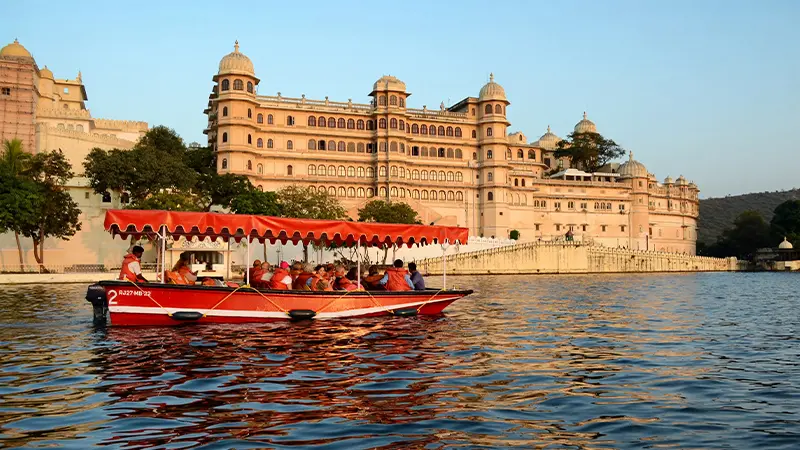
Udaipur is a lovely blend of water, lush green hills that set fire and passion in poet. Its palaces are straight out of a fairy-tale book, lakes, forts, palaces, temples, gardens, mountains and narrow lanes lines withdrawn with stalls, relives the reminisces of a heroic past, valor and chivalry. Their reflection in the placid waters of the Lake Pichola is excitement that defines imagination. Udaipur is one of the most romantic cities of world, also known as the Venice of East.
Morning, at leisure. After breakfast, visit the romantic city of Udaipur. Visit the City Palace which is the largest palace complex in Rajasthan; Jagdish temple, a fine Indo Aryan temple built in 1651; Sahelion ki Bari or Garden of the Maids of Honour, which is a small garden with its fountains, kiosks, marble elephants & lotus pool. Evening, boat ride on Lake Pichola. Overnight stay at Udaipur.
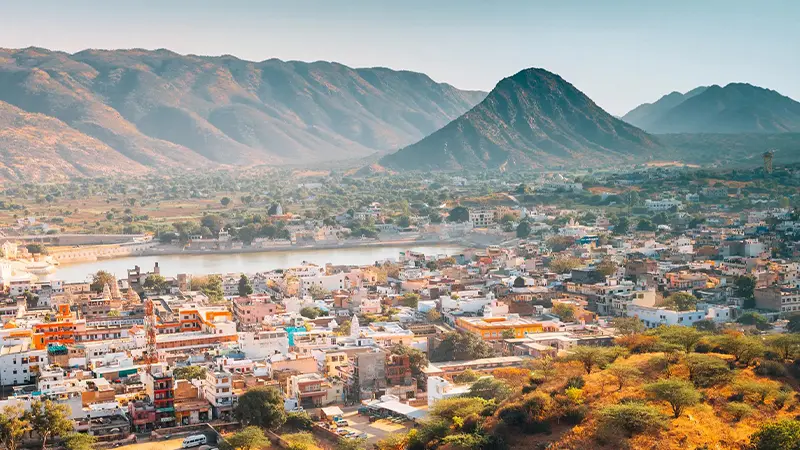
The morning after breakfast drive by surface to Pushkar. On arrival check into the hotel. Afternoon proceeds for sightseeing tour of Dargah (Indian’s Macca) in Ajmer and Lord Brahma Temple at Pushkar. This little town is hugely known for the “Pushkar Fair’ (where the mass trading of camels takes place), “the Lord Brahma Temple”, a “picturesque lake’ and “camel fair”. Rest of the day free for leisure activities. Overnight at the hotel.
The morning after breakfast transfer to Jaipur. Enroute stop for the worship of saint Khwaja Moinuddin Chishti who came with Muhammad Ghori from Persia in 1192 settled here. Thus the place where he was buried is today known as the Dargah Sharif. Later drive to Jaipur. Evening free for shopping. At night we are set for local cousins, music and dance at Chokhi Dhani. Overnight stay at Jaipur.
This morning, after breakfast, visits the ancient capital of the Kachwaha Rajputs, Amer. One can take an elephant ride or the jeep ride up to the fort. Thereafter, enjoy a photo-stop at Hawa Mahal – the Palace of Winds. Later, visit the City Palace and the apartment housing museums with an array of textiles, costumes, arms, weapons and paintings and finally visit Jantar Mantar, the observatory built by Maharaja Jai Singh-II. The founder of Jantar Mantar is Maharaja Jai Singh II, he had built Jantar Mantar in five different locations of India, out of which Jantar Mantar at Jaipur is the largest. The observatories, or ‘Jantar Mantar’ as they are commonly known, incorporate multiple buildings of unique form, each with a specialized function for astronomical measurement.
Later you are free to enjoy shopping in the local market. The market of Jaipur will delight you with the exotic blue pottery, the batik painting, block printed textiles of Sanganer and Bagru, tie and dye fabrics, Mojari – (the local shoe), sandalwood carving items, beautiful stone carvings etc.
Morning, leave for Agra. Enroute visit the abandoned Mughal city of Fatehpur Sikri: built by Emperor Akbar in 1569, was the old capital of the Mughals, which was abandoned after 15 years due to Scarcity of water. Agra fort See the graceful buildings including the Jama Masjid, Tomb of Salim Chisti, Panch Mahal & other Palaces which are still preserved in its original glory. Continue drive to Agra. Arrive Agra and check-in at prebooked hotel. Rest of the day at leisure.
After breakfast, city tour of Agra. Visit Red Fort, which was built by Emperor Akbar in 1565, and additions were made up until the time of his grandson, Shah Jahan. It contains the hall of public and private audiences amongst many other beautiful structures; Itmad-ud-daulah, which was constructed by Nur Jahan between 1622 and 1628 and is very similar to the tomb she constructed for her husband, Jahangir, near Lahore in Pakistan; the highlight of the day – The Taj Mahal, which was constructed by Shah Jahan in memory of his wife Mumtaz Mahal. Construction of the Taj began in 1631 and was not completed until 1653.
Afternoon, leave for Delhi Enroute visit Sikandra – Mughal Emperor Akbar’s Mausoleum. Continue to drive to Delhi. Arrive Delhi and check-in at the hotel. Overnight stay in Delhi.
Today after breakfast, transfer to the airport/ Railway station for your onward destination.
Book first, decide later. If your plans shift, you get a simple and flexible window to update or cancel your booking without stress.
Your money is safe with us. book today and enjoy the benefit of flexible travel dates and money back guarantee.
We understand that booking online can be a bit daunting, which is why we offer our customers a peace of mind Money Back Guarantee. This includes a 7-day cooling-off period. If you change your mind about your purchase or wish to cancel for any reason within this time, we will provide a 100% refund, no questions asked.
This guarantee is only applicable for those canceling their tour 60 days or more before their travel date.
Would you like help making a booking or have a few questions? Whatever the reason, don't hesitate to get in touch.
Tourists are drawn to Rajasthan by its mediaeval forts, palaces, art, and culture. Rajasthan is a popular destination for tourists from outside India because it is a component of the Golden Triangle.
Along with its textiles, semi-precious stones, and handicrafts, Rajasthan is widely known for its bright and historic art. Rajasthani furniture is noted for its intricate carvings and vibrant colours. Block prints, tie-dye prints, Bagaru prints, Sanganer prints, and zari embroidery are examples of well-known prints.
Dal baati churma is the state’s iconic traditional dish. In Rajasthan’s desert regions, hard, unleavened bread called as baati is made. Because it requires little water to prepare and has a long shelf life, baati is highly regarded. Always accompanied by dal (lentil curry).
Maru-Gurjara architecture, commonly referred to as “Solak style,” first appeared in Rajasthan and the neighbouring state of Gujarat in the eleventh century. It has been revitalised and disseminated throughout India and the rest of the world by Jains and Hindus alike.
Rajasthan’s unique culture is characterised by brightly coloured attire, heavy jewellery, lavish homes, joyful festivals and fairs, etc.
Recommended
Delhi → Mandawa → Bikaner → Jaisalmer → Jodhpur → Udaipur → Pushkar → Jaipur → Agra


Delhi → Samode → Mandawa → Gajner → Bikaner → Jaisalmer → Jodhpur → Rohet → Udaipur → Deogarh → Jaipur → Bharatpur → Agra

Delhi → Agra → Jaipur → Pushkar → Jodhpur → Jaisalmer → Udaipur


