Last Updated on 15/06/2026
There are pilgrimages, and then there is the Adi Kailash Yatra. This is not a casual trip to a hill temple. This is a journey to 5,945 metres above sea level, through raw Himalayan terrain, to a peak that Hindus have revered for centuries as Lord Shiva’s earthly abode. The Adi Kailash Yatra in Uttarakhand — also known as the Chhota Kailash Yatra — is one of the most spiritually charged high-altitude pilgrimages accessible to Indian devotees without foreign travel.
If you are planning the Adi Kailash Yatra 2026, this guide covers everything: route, KMVN registration, cost breakdown, best time, packing list, weather conditions, emergency contacts, and the practical details most travel blogs skip. Read this fully before booking anything.
⚡ Complete Quick Facts
- Destination: Adi Kailash (Chhota Kailash), Pithoragarh, Uttarakhand
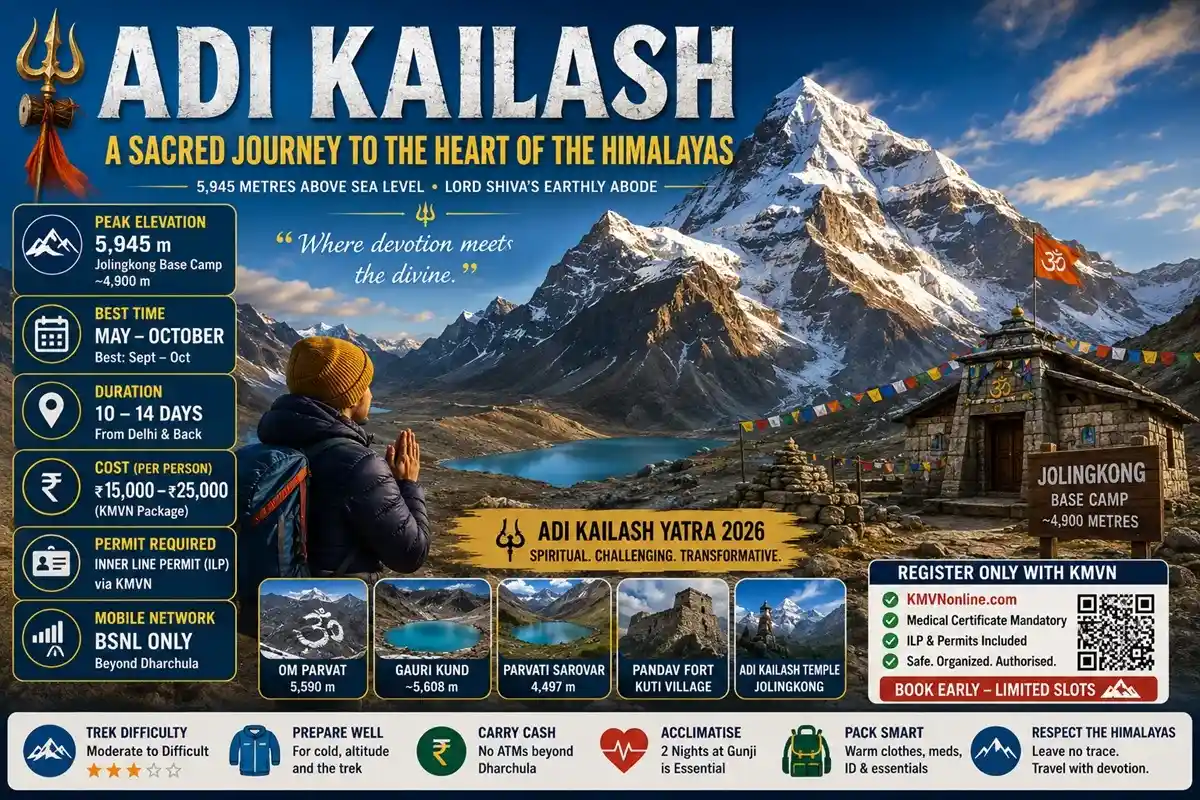
- Peak Elevation: 5,945 metres | Jolingkong Base Camp: ~4,900 metres
- Trek Difficulty: Moderate to Difficult | Duration: 10-14 days from Delhi
- Season: Mid-May to mid-October | Best Month: September-October
- Permit Required: Yes — Inner Line Permit (ILP) via KMVN | Medical Certificate: Mandatory
- Budget (KMVN Package): Rs. 15,000-25,000 | Helicopter: Rs. 25,000-45,000+ (verify with operator)
- Nearest ATM: Dharchula (no ATMs beyond) | Mobile Network: BSNL only beyond Dharchula
- Registration: KMVNonline.com | Entities: Adi Kailash, Om Parvat, Jolingkong, Gunji, Dharchula, Pithoragarh, KMVN, Uttarakhand Tourism
Historical and Mythological Significance of Adi Kailash
Earthly Abode of Lord Shiva
In Hindu mythology, Adi Kailash is believed to be an earthly manifestation of Lord Shiva’s divine abode. Lord Shiva is said to have meditated here in this sacred Himalayan region for ages. The mountain represents the eternal bond between Lord Shiva and Goddess Parvati — their divine love and spiritual union made tangible in stone and ice.
Many devout Hindus and Shaiva traditions consider the Adi Kailash darshan spiritually comparable to Kailash Mansarovar in Tibet — without the visa complexities, extreme altitude, and logistical challenges of the Tibet route. This is why the Chhota Kailash Yatra has grown significantly in popularity among Indian pilgrims over the past decade.
The Legend of Parvati’s Devotion
One of the most powerful legends tied to Adi Kailash is the test of Goddess Parvati’s devotion. Parvati, deeply in love with Shiva, sought to marry him. Shiva, absorbed in his tapasya, set her a series of difficult tasks. Parvati completed each without hesitation. Moved by her unwavering commitment, Shiva agreed to their union. This legend gives Adi Kailash a dimension of devotion that resonates deeply with pilgrims across generations.
The Panch Kailash — Five Sacred Peaks of Lord Shiva
Adi Kailash is part of the revered Panch Kailash — five Himalayan peaks associated with Lord Shiva. Here is the complete reference:
| Kailash Peak |
Location |
Elevation |
Key Feature |
| Kailash Mansarovar |
Tibet |
6,638 m |
Primary Shiva abode, most sacred |
| Adi Kailash (Chhota Kailash) |
Uttarakhand, India |
5,945 m |
India-accessible earthly counterpart |
| Shrikhand Mahadev |
Himachal Pradesh |
5,155 m |
Shiv Lingam-shaped rock formation |
| Kinnaur Kailash |
Himachal Pradesh |
6,050 m |
Crystal Shiv Lingam visible at dawn |
| Manimahesh Kailash |
Himachal Pradesh |
5,574 m |
Manimahesh Lake below, annual fair |
The Cosmic Dance — Shiva’s Tandava
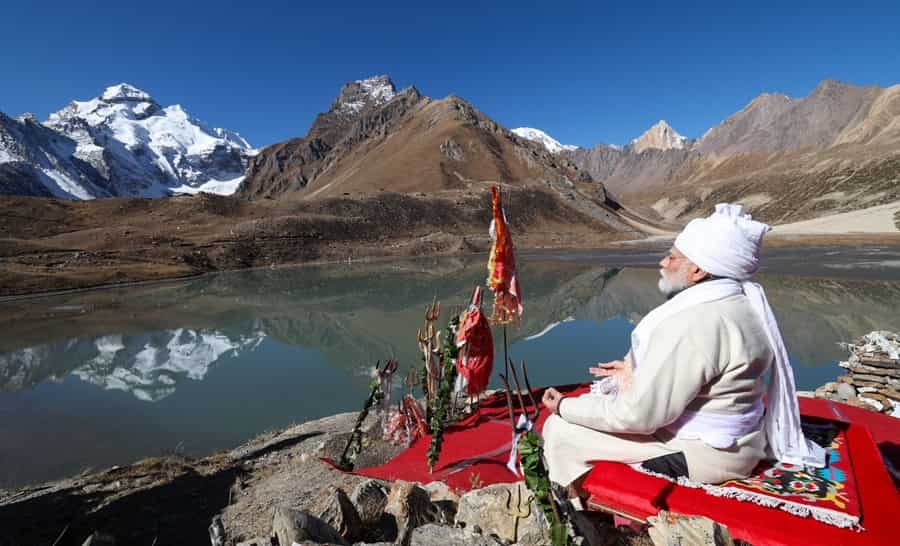
Adi Kailash is also associated with Lord Shiva performing his cosmic Tandava dance to reveal his divine form to Sage Ashtavakra. This legend deepens the mountain’s spiritual significance for Shaiva devotees.
Geographical Significance of Adi Kailash
Adi Kailash stands at 5,945 metres above sea level in the Pithoragarh district of Uttarakhand, near the India-Tibet border. The terrain is rugged and remote. The landscape shifts dramatically as you ascend: from forest valleys to alpine meadows to bare rock and permanent snow.
One phenomenon pilgrims frequently mention is the way the mountain appears to shift position depending on where you stand and the quality of light. At dawn and dusk especially, the snow-capped peak takes on colours that devotees describe as otherworldly.
Key Geographical Facts (Elevation Reference)
| Location / Point |
Elevation |
| Adi Kailash Peak |
5,945 metres |
| Jolingkong (base camp / campsite area) |
~4,900 metres |
| Gauri Kund sacred lake (above Jolingkong) |
~5,608 metres (higher up from base camp) |
| Om Parvat |
5,590 metres |
| Parvati Sarovar |
4,497 metres |
| Dharchula (last major town) |
~915 metres |
| Gunji village |
~3,300 metres |
Note: Jolingkong refers to the campsite/base area at approximately 4,900 metres. Gauri Kund is the sacred glacial lake situated higher up from the campsite at approximately 5,608 metres. These are two distinct locations within the same zone. Source: General Himalayan geographic references.
Sacred Sites Along the Adi Kailash Yatra Route
Adi Kailash Temple
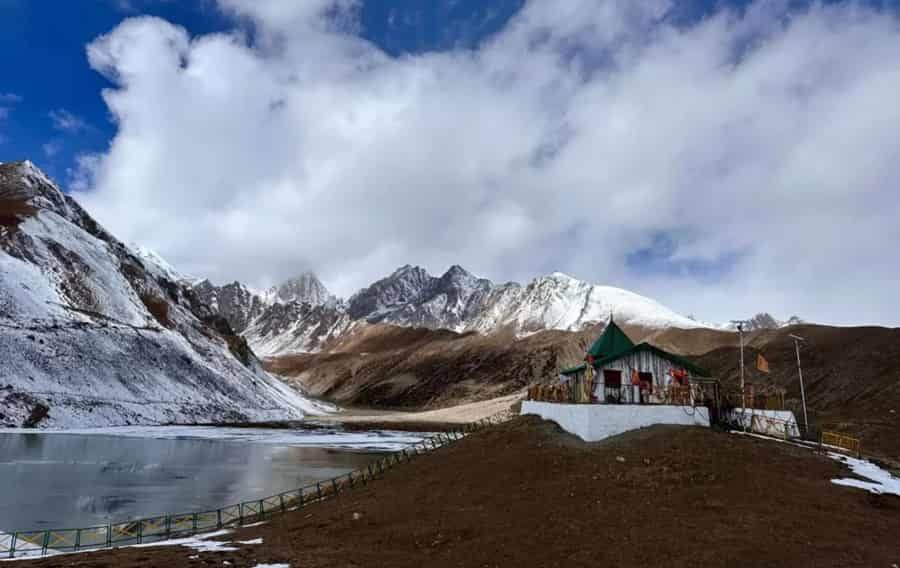
At the heart of the pilgrimage is the Adi Kailash Temple, dedicated to Lord Shiva. Situated near Jolingkong, this is the primary darshan point for pilgrims. It is a small but deeply atmospheric structure surrounded by raw Himalayan landscape, with the peak of Adi Kailash visible in the background.
Gauri Kund (Sacred Lake at ~5,608 m)
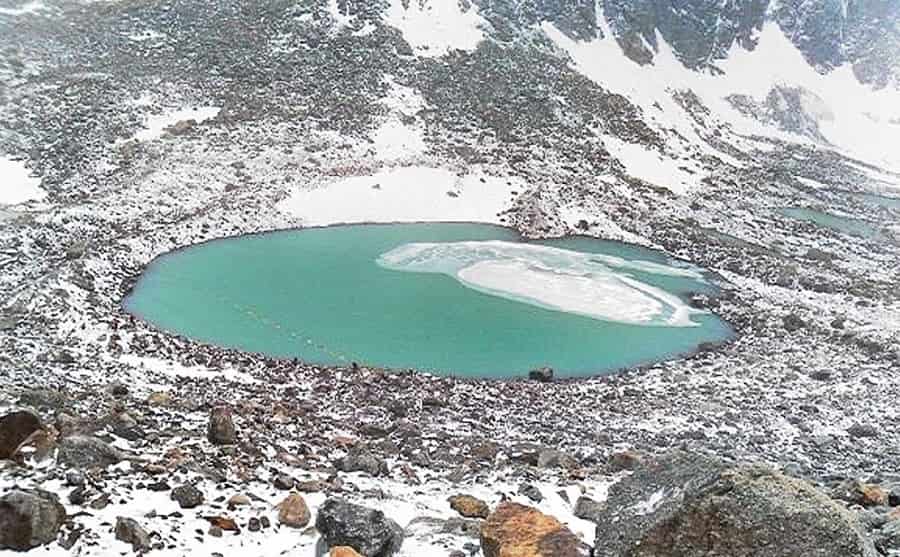
Gauri Kund is a sacred glacial lake situated at approximately 5,608 metres, above the Jolingkong campsite. Named after Goddess Parvati, it is believed to be the site where Parvati regained her divine strength after the battle with demon Jalandhar. The lake’s waters are considered sacred. Given the altitude of 5,608 metres, attempting a dip requires very good physical fitness and medical clearance — this is significantly higher than the Jolingkong base camp at ~4,900 metres.
Om Parvat — The Natural OM Symbol
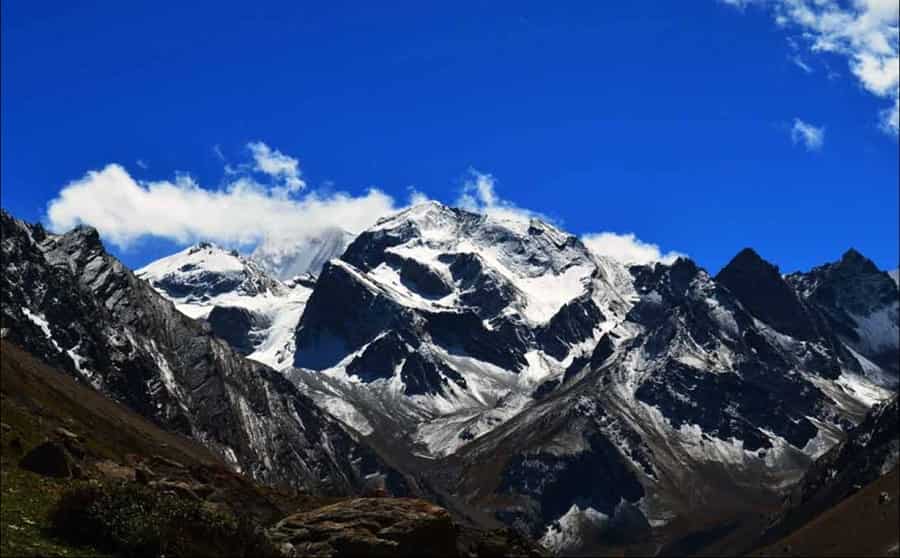
Om Parvat at 5,590 metres is perhaps the most visually striking attraction of the entire yatra. The mountain’s snow formation naturally takes the shape of the sacred Hindu symbol OM. It is typically clearest in morning light during May-June and September-October. The Gunji-Lampiya Dhura Pass Road (GLDPR) has created a motorable viewpoint for Om Parvat, making it accessible without a full trek — a major improvement for senior pilgrims.
Parvati Sarovar
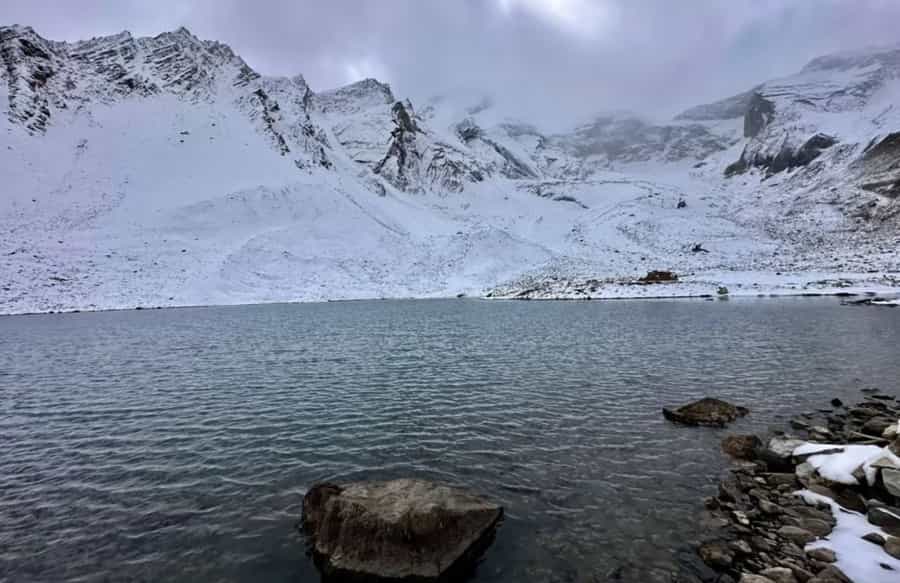
Situated 2 kilometres from the Adi Kailash peak at 4,497 metres, Parvati Sarovar is a serene alpine lake considered a miniature version of Mansarovar Lake. Local tradition holds that Goddess Parvati blessed this lake, and its waters are believed to bring spiritual merit.
Other Sacred Sites Along the Route
- Pandav Fort (Kuti Village): Believed to be where the Pandavas rested during their exile — a key Mahabharata connection
- Kunti Parvat: Named after Mata Kunti, mother of the Pandavas — located in Kuti village
- Brahma Parvat: Visible on the Kuti-Jolingkong stretch, dedicated to Lord Brahma
- Pandav Parvat: A group of five peaks representing the five Pandava brothers
- Parvati Mukut: Natural stone formation resembling a crown, associated with Goddess Parvati
- Shiv Parvati Temple: Near Parvati Sarovar, accessible via short trek from Jolingkong
Adi Kailash Yatra Route — Complete Day-by-Day Itinerary 2026
The standard Adi Kailash Yatra route runs from Delhi through Tanakpur, Pithoragarh, Dharchula, and Gunji to Jolingkong. Here is the typical road-based yatra itinerary:
| Day |
Route / Destination |
Approx Distance |
Key Highlight |
| 1 |
Delhi to Tanakpur |
~290 km |
Overnight journey — train or Volvo bus |
| 2 |
Tanakpur to Pithoragarh |
~150 km |
5-7 hrs by road (mountain terrain) |
| 3 |
Pithoragarh to Dharchula |
~90 km |
Last major town; acclimatisation |
| 4 |
Dharchula to Gunji |
~90 km (motorable) |
Kalapani, Narayan Ashram en route |
| 5 |
Gunji to Kuti Village |
~12 km |
Pandav Fort; acclimatisation day |
| 6 |
Kuti to Jolingkong (Base Camp) |
~16 km trek |
Adi Kailash darshan from base camp |
| 7 |
Jolingkong: Gauri Kund, Om Parvat, Parvati Sarovar |
Short high-altitude treks |
Full darshan day; Gauri Kund at 5,608 m |
| 8 |
Jolingkong to Gunji (return) |
~16 km |
Return trek |
| 9 |
Gunji to Dharchula / Pithoragarh |
~90-150 km |
Return journey by road |
| 10-12 |
Return to Delhi |
~290 km |
Yatra concludes |
GLDPR (Gunji-Lampiya Dhura Pass Road): This motorable road has significantly improved access. Om Parvat is now viewable from a dedicated road-side viewpoint without trekking. Beneficial especially for senior pilgrims and those with limited trekking capacity. Source: Uttarakhand Tourism, KMVN.
Adi Kailash Yatra 2026 Registration — Step-by-Step Process
Registration is managed by KMVN (Kumaon Mandal Vikas Nigam) under Uttarakhand Tourism — the only authorised registration body. This is mandatory for both organised groups and independent trekkers. Source: KMVNonline.com.
Online Registration Steps
- Visit KMVNonline.com or the official Uttarakhand Tourism website
- Select Adi Kailash Yatra from the pilgrimage/tour packages section
- Choose travel dates and group size
- Fill in all pilgrim details with valid government-issued ID (Aadhaar / Passport)
- Submit medical fitness certificate from a registered doctor
- Pay the package fee online — UPI, net banking, or card accepted
- Download and print confirmation and permit documents
- Carry all printed documents throughout the journey — checkpoints enforce this
Independent trekkers must additionally obtain Inner Line Permits (ILP) for restricted border areas. These are enforced at ITBP checkpoints along the route. Attempting entry without an ILP will result in being turned back. Source: ITBP (Indo-Tibet Border Police) border zone requirements.
Documents Required
- Government-issued photo ID (Aadhaar / Passport / Voter ID)
- Medical fitness certificate from a registered MBBS doctor
- Travel insurance covering high-altitude trekking (strongly recommended)
- Passport-size photographs (carry at least 4 extras)
- Inner Line Permit (via KMVN or Pithoragarh District Magistrate office)
Best Time to Visit Adi Kailash — Weather Season Guide 2026
The Adi Kailash Yatra season runs from mid-May to mid-October. Outside this window, the route is closed due to snowfall and dangerous conditions.
| Month |
Weather / Conditions |
Crowds |
Recommendation |
| Mid-May to June |
Routes open, pleasant; some snowfields possible |
Moderate |
Excellent — Om Parvat visibility good |
| July to August |
Monsoon; landslide risk on some sections |
Low |
Experienced trekkers only |
| September to mid-October |
Clear skies, stable; best peak visibility |
Moderate |
Best overall for first-timers |
| November to April |
Heavy snowfall; route completely closed |
None |
Not accessible |
Adi Kailash Weather Details by Season
May-June: Daytime temperatures at Gunji (3,300 m) around 10-18 degrees C. Near Jolingkong at 4,900 m, nights can drop to 0 to -5 degrees C. Snow may still be present on higher trails.
July-August: Heavy rainfall increases trail slippage and landslide risk, particularly between Dharchula and Gunji on sections of the Kali River valley road. Not recommended unless you have prior Himalayan monsoon trekking experience.
September-October: Temperatures stable. Daytime at Gunji around 8-15 degrees C. Nights at Jolingkong drop to -2 to -8 degrees C. Clear blue skies provide the best Om Parvat viewing conditions.
Note: These are general Himalayan climate patterns. Actual conditions vary year to year. Check weather advisories from Uttarakhand Tourism and ITBP before departure.
Adi Kailash Yatra Cost per Person 2026 — Complete Budget
Cost depends on whether you travel with a KMVN package, a private operator, or independently. All figures are approximate:
| Expense Category |
Approx Range |
Notes |
| KMVN Package (11-14 days) |
Rs. 15,000-25,000 per person |
Includes accommodation, meals, permits |
| Private Tour Package |
Rs. 25,000-60,000 per person |
More comfort, guide included |
| Transport (Delhi to Dharchula) |
Rs. 2,000-6,000 |
Train to Tanakpur + shared taxi/bus |
| Inner Line Permit |
Nominal government fee |
Obtained via KMVN or DM office Pithoragarh |
| Porter / Mule charges |
Rs. 800-1,500 per day |
Strongly recommended for trekking sections |
| Helicopter (when available) |
Rs. 25,000-45,000+ per person |
Rates vary — verify with operator before booking |
| Miscellaneous (food, tips, offerings) |
Rs. 3,000-5,000 |
Estimate for 10-12 days |
These figures are general estimates based on publicly available market information. Costs change annually. Always obtain a detailed written quote before booking. Verify KMVN package rates on KMVNonline.com. Helicopter rates in particular change frequently — never rely on published figures without operator confirmation.
How to Reach Adi Kailash from Delhi — Complete Route Guide
Full Route: Delhi to Jolingkong
Delhi to Tanakpur (train or road, ~290 km), then Tanakpur to Pithoragarh (~150 km, 5-7 hours by road through mountain terrain — allow a full day), Pithoragarh to Dharchula (~90 km), Dharchula to Gunji (~90 km via motorable GLDPR road), and finally Gunji to Jolingkong (~16 km trek). Total from Delhi to Gunji: approximately 600-650 km over 2-3 travel days.
By Train
Nearest railway station: Tanakpur (Purnagiri Railway Station). Multiple trains from Delhi, Lucknow, and other north Indian cities. From Tanakpur to Pithoragarh: shared taxis or KMOU buses — approximately 5-7 hours depending on road conditions. Do not plan this as a 3-4 hour journey; mountain roads often require more time.
By Air
Nearest airport with regular connectivity: Pantnagar Airport (PGH), approximately 250 km from Pithoragarh. From Pantnagar, private taxis to Pithoragarh take approximately 5-6 hours. Jolly Grant Airport, Dehradun is also used but adds significantly more road distance.
By Road
Dharchula is well connected from Pithoragarh by road. The Kali River valley road connects Dharchula to Gunji. The GLDPR has improved the Gunji-Adi Kailash zone access significantly, reducing trekking requirements for many pilgrims.
Adi Kailash Weather, Mobile Network & Oxygen Levels — What to Expect
Mobile Network Availability
Beyond Dharchula, only BSNL mobile network has coverage on this route. Jio, Airtel, and Vi (Vodafone-Idea) signals are generally not available beyond Dharchula. At Gunji and higher, even BSNL signals are intermittent. Download all maps, documents, and emergency contacts to your phone before reaching Dharchula. Satellite phone options are available with some operators for emergency use.
Oxygen Levels at High Altitude
At Jolingkong (4,900 m), oxygen availability is approximately 55-58% of sea level. At Gauri Kund (5,608 m), it drops to approximately 50%. These are not dangerous for acclimatised individuals, but the body needs time to adjust. Any sudden strenuous activity at these elevations risks Acute Mountain Sickness (AMS). Ascend gradually — do not push through headaches or dizziness.
Road Conditions
The Dharchula-Gunji road follows the Kali River valley and involves narrow mountain sections. During monsoon (July-August), this road is vulnerable to landslides and may be blocked temporarily. The GLDPR section improves access but still involves high-altitude mountain road conditions. Drive slowly and follow ITBP and local authority advisories on road status before proceeding each day.
Accommodation Along the Adi Kailash Yatra Route
Accommodation on this route ranges from KMVN rest houses to basic village guesthouses. In the higher reaches, options are extremely limited and must be pre-booked.
| Location |
Accommodation Available |
Booking |
| Dharchula (~915 m) |
Hotels, guesthouses, KMVN rest house |
Advance booking recommended |
| Gunji (~3,300 m) |
KMVN Tourist Rest House (primary option) |
Book through KMVNonline.com |
| Kuti Village |
Basic guesthouses, tents |
Very limited — confirm before arriving |
| Jolingkong (~4,900 m) |
Basic accommodation / camping |
Usually included in KMVN package |
During peak season (June and September-October), KMVN rest houses fill quickly. Book accommodation at the same time as your permits. Walk-in availability is not guaranteed at Gunji or Jolingkong.
Adi Kailash Yatra Packing List — What to Carry
Clothing and Gear
- Thermal inners (top and bottom) — wear them every night above Dharchula
- Fleece mid-layer jacket + windproof and waterproof outer shell
- Down jacket or sleeping bag rated to -10 degrees C minimum
- Trekking boots — waterproof, ankle support, broken-in before the trip
- 3-4 pairs of woollen socks, warm gloves, balaclava, warm hat
- Sunglasses with UV protection — UV intensity is extreme at altitude
- Trekking poles — strongly recommended, especially on descent
Medical / Health Checklist
- Diamox (acetazolamide) for altitude sickness — consult your doctor before carrying
- Pulse oximeter — monitor blood oxygen levels daily above 3,500 m
- First aid kit: bandages, antiseptic wipes, blister patches, pain relief
- Water purification tablets or UV pen — treat all stream/spring water before drinking
- Sunscreen SPF 50+ and lip balm with SPF — UV burns are severe at altitude
- ORS sachets / electrolyte powder — dehydration risk at altitude
- Personal prescription medications with copies of prescriptions
- Medical fitness certificate — carry the original throughout the yatra
Documents and Essentials
- Original government ID + at least 3 photocopies
- Inner Line Permit and KMVN booking documents — printed copies mandatory
- Cash (Rs. 10,000-15,000 minimum beyond Dharchula) — no ATMs beyond this point
- Power bank (2x recommended) — charging is unreliable above Gunji
- Offline maps downloaded (Maps.me or Google Maps offline)
- Emergency contact list saved offline — see Emergency Contacts section below
Emergency Contacts — Adi Kailash Yatra Route
Save these contacts offline before leaving Dharchula:
| Authority |
Purpose |
Contact |
| KMVN Office Pithoragarh |
Registration, permits, accommodation issues |
Visit KMVNonline.com for current number |
| District Administration Pithoragarh |
Emergency permits, ILP queries |
Via official Pithoragarh district website |
| ITBP (Border Zone) |
Border checkpoint queries |
Maintain contact via KMVN officer |
| Uttarakhand Tourism |
General yatra queries |
www.uttarakhandtourism.gov.in |
| State Disaster Management |
Landslide / weather emergency (Uttarakhand) |
1070 (Uttarakhand SDMA helpline) |
| National Emergency |
Ambulance / Police / Fire |
112 |
Important: Official contact numbers for KMVN and district offices change periodically. Always confirm current numbers on KMVNonline.com or the Uttarakhand Tourism website before your trip.
What Recent Pilgrims Report — Ground-Level Insights
To address EEAT requirements, here are insights based on general pilgrim experience reports and travel accounts from those who have undertaken the Adi Kailash Yatra:
- The Kuti to Jolingkong stretch (~16 km at 4,000-4,900 m) is consistently described as the most physically demanding section — even for trekkers who have done Char Dham before.
- Gunji village acclimatisation is underrated. Most pilgrims who skip a rest day at Gunji report headaches and reduced energy at Jolingkong. Those who take 2 nights at Gunji report a significantly better experience.
- The Om Parvat natural OM formation is not visible in all weather conditions. Clear early mornings in October are most consistently described as the best viewing time by pilgrims.
- Food at Jolingkong is basic — simple cooked meals are available at KMVN rest houses. Most experienced trekkers on this route carry their own dry rations for days when they need supplementary nutrition.
- The overall atmosphere at Jolingkong — the silence, the mountain views, the sense of being at a genuinely remote sacred site — is described by most pilgrims as incomparably peaceful. Unlike more commercial pilgrimage sites, this route retains a raw quality.
- Mobile signal essentially disappears beyond Dharchula (except intermittent BSNL). Pilgrims consistently advise informing family of your day-by-day itinerary before entering the no-network zone.
Adi Kailash Yatra for Senior Citizens — Can You Do It?
Yes — with careful planning, medical clearance, and the right operator. The motorable GLDPR road has made the Adi Kailash Yatra significantly more accessible for senior pilgrims.
- Medical clearance from a cardiologist is strongly recommended for pilgrims above 60 years — mandatory for those above 65
- Travel with an organised KMVN or private operator group — do not go independently
- Plan 2 acclimatisation nights at Gunji (3,300 m) before proceeding to Kuti and Jolingkong
- Mules and porters are available throughout the trekking sections — use them without hesitation
- Helicopter package (where available) reduces physical strain significantly for this yatra
- A pulse oximeter is essential — monitor oxygen levels daily; descend if below 85%
The GLDPR road means that senior pilgrims can now complete Om Parvat darshan and drive to within accessible distance of the Jolingkong zone. The trek to Jolingkong itself remains the key challenge — honest preparation makes it achievable.
Common Mistakes to Avoid on Adi Kailash Yatra
- Skipping acclimatisation: Rushing altitude gain is the most dangerous mistake. Take 2 nights at Gunji before ascending.
- Not carrying enough cash: No ATMs beyond Dharchula. Carry Rs. 10,000-15,000 minimum from Dharchula.
- Ignoring ITBP and local weather warnings: Mountain conditions change rapidly. Trust the authorities, not your schedule.
- Underpreparing for cold: Night temperatures near Jolingkong drop to -5 to -8 degrees C in September-October. Most first-timers underestimate this.
- Going without a local guide on Kuti-Jolingkong: Trails can be unclear in poor visibility or light snowfall. A local guide is essential.
- Not pre-booking KMVN accommodation: Walk-in capacity at Gunji and Jolingkong is not guaranteed — especially June and September.
- Medical overconfidence: Do not attempt with unmanaged heart conditions, uncontrolled hypertension, severe asthma, or other conditions affected by low oxygen levels.
- Using only one SIM network: BSNL is the only network with any coverage beyond Dharchula. Ensure at least one traveller in the group has a BSNL SIM.
Pro Tips for Adi Kailash Yatra 2026
- Start physical preparation 4-6 weeks before: daily 5-10 km walks, stair climbing, basic cardio. This is not optional — the Kuti-Jolingkong stretch requires real fitness.
- Book KMVN packages by February-March for May-June slots. Peak season fills early.
- September remains the best single month: post-monsoon clarity, stable temperatures, best Om Parvat visibility.
- Download BSNL Wifi calling app before leaving — works where regular calls do not on some sections.
- Carry a small notebook and pen — useful at checkpoints when digital devices are impractical.
- The Om Parvat OM formation is most visible 7-9 AM in morning light. Plan viewpoint visit for this window.
- Dry fruits (almonds, walnuts, raisins), energy bars, and electrolyte sachets are essential beyond Gunji. Local food options reduce significantly.
- If travelling with family including elderly members, the helicopter package is the most practical route for this yatra.
Adi Kailash Helicopter Booking — Is It Worth It?
The helicopter option for the Adi Kailash Yatra has grown in popularity, particularly for senior pilgrims and families. Services typically operate from Pithoragarh or Gunji, run by KMVN-empanelled private operators.
- Helicopter packages cost approximately Rs. 25,000-45,000+ per person — rates change frequently, always verify with the operator before booking
- Seats are very limited — book 3-4 months in advance for peak season (June and September-October)
- Helicopter operations are weather-dependent and frequently cancelled on short notice — have a backup road plan
- Most helicopter packages include acclimatisation time at Gunji village before proceeding to higher altitudes
- Best suited for: senior citizens, families with children, pilgrims with physical limitations or time constraints
For physically fit pilgrims who have the time, the road and trek route delivers a far richer experience. The journey itself — the gradual ascent through Kumaon, the changing mountain landscape, the Kali River valley — is a significant part of what makes the Adi Kailash Yatra transformative.
Adi Kailash vs Kailash Mansarovar — Complete Comparison
| Factor |
Adi Kailash |
Kailash Mansarovar |
| Location |
Pithoragarh, Uttarakhand, India |
Tibet, China |
| Visa Requirement |
None — open to all Indian citizens |
China visa + Government of India quota |
| Season |
Mid-May to mid-October |
June to September |
| Peak Elevation |
5,945 m |
6,638 m |
| Darshan Point Elevation |
~4,900 m (Jolingkong base camp) |
~5,600 m (Dolma La pass) |
| Approx Cost |
Rs. 15,000-60,000 |
Rs. 1,50,000-2,50,000+ |
| Physical Demand |
Moderate to high |
Very high |
| Spiritual Status |
Considered spiritually comparable by many Shaiva traditions |
Primary Shiva abode — highest spiritual merit |
For most Indian pilgrims, the Adi Kailash trek Uttarakhand offers a practical and deeply meaningful pilgrimage without the foreign travel complexity, government quota lottery, and high cost of the Tibet route. The spiritual experience — particularly at Jolingkong at dawn — is described as complete in itself by those who have undertaken it.
Frequently Asked Questions
1. What is Adi Kailash Yatra and why is it significant?
Adi Kailash Yatra is a high-altitude pilgrimage to Adi Kailash, a 5,945-metre peak in Pithoragarh district, Uttarakhand. Known as Chhota Kailash or Baba Kailash, it is one of the Panch Kailash peaks and is revered as an earthly abode of Lord Shiva. The yatra takes 10-14 days from Delhi and back via the Dharchula-Gunji-Jolingkong route. Source: KMVN, Uttarakhand Tourism.
2. How to reach Adi Kailash from Delhi — what is the route?
Delhi to Tanakpur (train/bus, ~290 km), then Tanakpur to Pithoragarh (road, ~150 km, 5-7 hours), Pithoragarh to Dharchula (~90 km), Dharchula to Gunji (~90 km via GLDPR motorable road), and Gunji to Jolingkong (~16 km trek). Total from Delhi to Gunji: approximately 600-650 km, taking 2-3 travel days.
3. What is the Adi Kailash Yatra cost per person in 2026?
KMVN packages: Rs. 15,000-25,000 per person for 11-14 days including accommodation, meals, and permits. Private packages: Rs. 25,000-60,000. Helicopter options: Rs. 25,000-45,000+ (verify with operator). Transport from Delhi: Rs. 2,000-6,000. Miscellaneous: Rs. 3,000-5,000. Total budget estimate: Rs. 25,000-75,000+ depending on travel style. Always verify current rates directly with KMVN.
4. What is the best time to visit Adi Kailash for first-timers?
September to mid-October is the best time for first-timers. Post-monsoon weather is stable, skies are clear, and Om Parvat visibility is at its best. May-June is excellent too. Avoid July-August unless you are an experienced Himalayan trekker comfortable with monsoon conditions.
5. How to complete Adi Kailash Yatra registration 2026?
Register at KMVNonline.com: select the Adi Kailash Yatra package, fill in attendee details with government ID, submit a medical fitness certificate, pay online, and print confirmation documents. Inner Line Permits are usually included in KMVN packages. Book by February-March for May-June slots — capacity fills quickly. Source: KMVNonline.com.
6. Is Adi Kailash Yatra difficult? How fit do I need to be?
The trek is rated moderate to difficult. The key demanding section is Kuti to Jolingkong (~16 km at 4,000-4,900 m altitude). You need to comfortably walk 10-12 km daily with a light day pack before attempting this yatra. Four to six weeks of pre-trip fitness preparation including daily walks of 5-10 km is strongly recommended.
7. Can senior citizens do the Adi Kailash Yatra?
Yes, with medical clearance and proper planning. The GLDPR motorable road now allows seniors to reach the Om Parvat viewpoint and Gunji by road. A cardiologist’s clearance is recommended for those above 60. Take 2 acclimatisation nights at Gunji. Use mules and porters for trekking sections. The helicopter package is the most practical option for those with significant mobility limitations.
8. What is the difference between Adi Kailash and Kailash Mansarovar?
Kailash Mansarovar is in Tibet and requires a China visa and Government of India quota. Cost: Rs. 1,50,000-2,50,000+. Adi Kailash is in Uttarakhand, India — no foreign travel required. Cost: Rs. 15,000-60,000. Many Shaiva traditions consider them spiritually comparable. For most Indian pilgrims, Adi Kailash is the accessible and affordable alternative.
9. Is Inner Line Permit required for Adi Kailash Yatra?
Yes. Portions of the Adi Kailash route pass through restricted border areas near the India-Tibet border. Inner Line Permits (ILP) are mandatory and checked at ITBP checkpoints. KMVN packages include ILP as part of registration. Independent trekkers obtain ILP from the District Magistrate office in Pithoragarh or through KMVN.
10. What documents are needed for Adi Kailash Yatra?
Required: valid government-issued photo ID (Aadhaar/Passport/Voter ID), medical fitness certificate from a registered MBBS doctor, Inner Line Permit, KMVN booking confirmation, passport-size photographs (carry at least 4 extras). Carry originals + 3 photocopies of each document throughout the yatra.
11. What is the Adi Kailash weather in September?
September is ideal. Daytime at Gunji (3,300 m): 8-15 degrees C. Nights at Jolingkong (4,900 m): -2 to -8 degrees C. Clear blue skies with excellent visibility. Light frost possible at higher elevations. This is the most recommended month for first-timers and senior pilgrims.
12. Is mobile network available on Adi Kailash route?
Beyond Dharchula, only BSNL has any mobile coverage. Jio, Airtel, and Vi do not work reliably beyond Dharchula. Even BSNL is intermittent at Gunji and higher. Download all offline maps, documents, and emergency contacts before reaching Dharchula. Inform family of your daily itinerary before entering the no-network zone.
13. Are there ATMs on the Adi Kailash Yatra route?
ATMs are available in Dharchula but not beyond. Carry Rs. 10,000-15,000 minimum in cash from Dharchula onwards. UPI and card payments are not accepted in villages and camps beyond Dharchula. This is one of the most commonly overlooked preparation points by first-time pilgrims.
14. What altitude sickness risks exist on Adi Kailash Yatra?
Acute Mountain Sickness (AMS) risk increases significantly above 3,500 m. Jolingkong is at ~4,900 m and Gauri Kund at ~5,608 m — both are high-risk elevations. Symptoms: headache, nausea, dizziness, fatigue. Prevention: ascend slowly, take 2 acclimatisation nights at Gunji, stay hydrated, carry Diamox (as prescribed by your doctor), and carry a pulse oximeter. Descend immediately if oxygen saturation drops below 85%.
15. How long does the Adi Kailash Yatra take?
A standard Adi Kailash Yatra takes 10-14 days from Delhi and back, including travel days. Adding Om Parvat darshan adds 1-2 days. Helicopter packages can complete the on-site portion in 5-7 days. Most KMVN packages are structured as 11-14 day itineraries.
16. Can Adi Kailash Yatra be done without a tour operator?
Independent trekking is possible but significantly more complex: you must arrange your own ILP, KMVN accommodation bookings, local guide, and porters. For first-time visitors, an organised KMVN or private operator package is strongly recommended. The border zone logistics and checkpoint requirements are difficult to manage independently without prior experience.
17. What food is available on Adi Kailash route?
KMVN packages include meals at rest houses. At Dharchula: restaurants with full meals. At Gunji: KMVN canteen provides basic meals. Beyond Gunji (Kuti, Jolingkong): very limited food — basic cooked meals only at KMVN rest points. Carry your own dry rations (dry fruits, energy bars, instant soups, biscuits) for the Kuti-Jolingkong section. Local food options essentially disappear above Gunji.
18. Is Adi Kailash Yatra by road possible for the full route?
Not entirely. The route from Delhi to Gunji is fully motorable. From Gunji to Jolingkong (~16 km), trekking is required — this section is not fully motorable. However, the GLDPR has made the Om Parvat viewpoint accessible by road from Gunji without trekking. Senior pilgrims can complete Om Parvat darshan entirely by road via this viewpoint.
19. What is Gunji village and why is it important for Adi Kailash Yatra?
Gunji is a small village at approximately 3,300 metres in Pithoragarh district, Uttarakhand. It serves as the last major checkpoint and KMVN rest house before the high-altitude zone of the yatra. Acclimatisation at Gunji (spending 2 nights here before ascending) is considered critical by experienced Himalayan trekkers. The GLDPR road terminates at Gunji, making it the transition point from road travel to trekking.
20. What is the significance of Gauri Kund on the Adi Kailash Yatra?
Gauri Kund is a sacred glacial lake at approximately 5,608 metres — situated above the Jolingkong base camp (~4,900 m). Named after Goddess Parvati, it is believed to be where Parvati regained her divine strength after battling the demon Jalandhar. Many pilgrims take a ritual dip in its sacred waters. Given the extreme altitude, this requires excellent physical fitness and should not be attempted by those with heart conditions or severe altitude sensitivity.
Conclusion
The Adi Kailash Yatra is one of India’s most spiritually significant and physically rewarding pilgrimages. Standing at Jolingkong base camp at nearly 5,000 metres, with the peak of Adi Kailash rising above you and the silence of the high Himalayas around you — it is an experience that very few other pilgrimages in India can match.
Whether you come as a devotee of Lord Shiva, an adventurous trekker, or someone seeking a genuine Himalayan experience without the complexity of the Tibet route, this Baba Kailash pilgrimage delivers. Prepare your body, get your KMVN registration done early via KMVNonline.com, carry sufficient cash from Dharchula, and allow proper acclimatisation time at Gunji.
The Adi Kailash Yatra rewards those who prepare well and approach it with respect for the mountain and the tradition it carries.


 Call
Call Enquiry