Last Updated on 04/02/2026
There are monuments that impress with scale. Some with ornamentation. Others with historical drama.
Dhamek Stupa does none of these loudly.
It stands quietly in Sarnath, a few kilometres from the crowded lanes of Varanasi, carrying one of the most powerful moments in human intellectual history. It was here that Gautama Buddha, after attaining enlightenment in Bodh Gaya, spoke publicly for the first time.
That first teaching shaped not just Buddhism, but centuries of philosophical thinking across Asia.
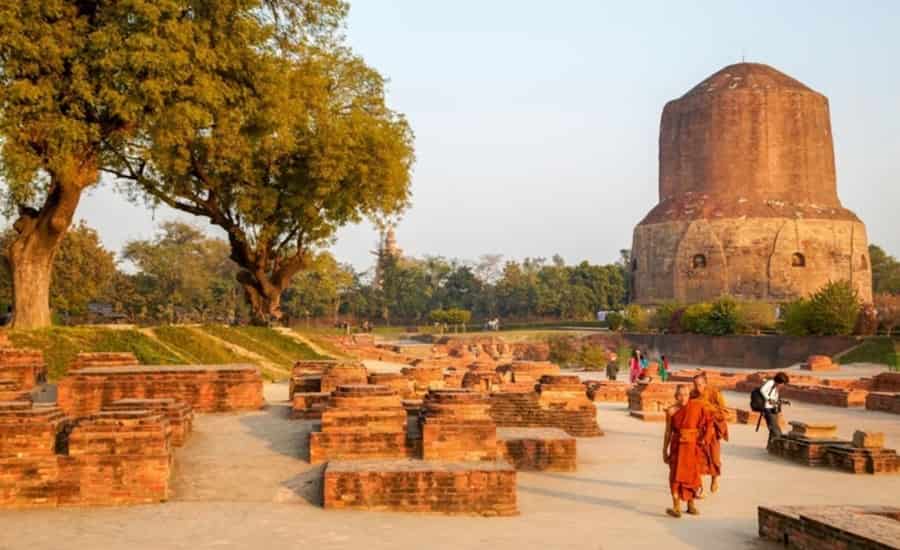
Yet, when you arrive, there is no sense of spectacle. No overwhelming design. No grand decoration. Just a tall, calm structure rising from a well-kept lawn, surrounded by open sky and soft stillness.
And perhaps that is exactly why this place works.
Why Dhamek Stupa Still Matters
In Buddhist tradition, the event that took place here is known as “Dhammacakkappavattana” — the turning of the wheel of Dharma.
In simple words, this is when Buddha introduced:
- The Four Noble Truths
- The Eightfold Path
- The idea that suffering can be understood, not merely endured
Until this moment, enlightenment had been a personal experience. Here, it became shared wisdom.
What began as a conversation between a teacher and five former companions slowly travelled across India, Sri Lanka, Southeast Asia, China, Korea, Japan, and beyond.
That makes Dhamek Stupa more than a religious site. It marks a shift in how humans approached life, suffering, discipline, and compassion.
Few places anywhere in the world can claim that kind of intellectual influence.
A Brief Historical Context
The earliest structure at this site is believed to date back to the 3rd century BCE, during the reign of Emperor Ashoka. After witnessing the destruction of the Kalinga war, Ashoka turned toward Buddhism and became its greatest patron.
He commissioned stupas, pillars, monasteries, and inscriptions across the subcontinent. Sarnath, because of its spiritual importance, naturally became one of his major projects.
However, what we see today is not purely Ashokan.
Archaeological studies show that the present structure largely reflects Gupta-period reconstruction (5th–6th century CE). This was a period known for artistic maturity and architectural refinement. The stupa was enlarged, strengthened, and encased in stone.
Over time, invasions, neglect, and natural decay buried much of Sarnath. By the medieval period, the entire complex lay largely forgotten.
It was only in the 19th century, during systematic excavations, that Dhamek Stupa re-emerged.
The Archaeological Survey of India now maintains the site.
Architecture: Simple, Purposeful, Unpretentious
At around 44 metres high, Dhamek Stupa is tall, but not dramatic. Its shape is cylindrical, unlike the dome-shaped profile most people associate with stupas.
There is no excessive decoration. No elaborate sculptural storytelling. The surface carries subtle geometric and floral carvings — enough to show craftsmanship, but restrained.
This restraint feels deliberate.
The structure seems designed to support reflection, not distraction.
One interesting detail: despite extensive archaeological exploration, no relic chamber has been found inside. That suggests Dhamek Stupa was meant more as a symbolic marker of place and memory rather than a reliquary.
In a way, the architecture mirrors Buddhist philosophy — stable, grounded, minimal, and quietly intentional.
The Atmosphere: What You Actually Feel Here
Most people arrive at Sarnath after experiencing the chaos of Varanasi. The contrast is striking.
The traffic noise fades. The crowds thin. The air feels lighter.
Around Dhamek Stupa, monks walk slowly. Some sit in meditation. Others chant softly. Visitors lower their voices instinctively, even without being told.
There is no formal instruction to stay silent. The place itself seems to suggest it.
This is not a site that demands attention. It invites presence.
Many travelers who expected a short stop end up staying far longer than planned — sitting on benches, walking slowly around the structure, or simply watching the light change on the stone.
When Is the Best Time to Visit?
Weather plays a big role in how enjoyable the visit becomes.
October to March is the most comfortable period. Temperatures remain moderate, skies are clear, and walking feels pleasant.
April to June can be harsh. The stone reflects heat, and shade is limited. Midday visits during summer can feel physically draining.
July to September brings monsoon showers. The lawns turn green, the air feels fresh, but humidity can be high.
Early mornings remain the best time, regardless of season.
Practical Visitor Information
Facilities are basic. Carry drinking water, sun protection, and comfortable footwear.
Plan for at least two hours, especially if you intend to visit nearby monuments and the museum.
How to Reach Dhamek Stupa
Sarnath lies about 10 kilometres from Varanasi city centre.
Auto-rickshaws, taxis, and app-based cabs operate regularly. Travel time usually ranges from 30 to 45 minutes, depending on traffic.
The nearest major railway station is Varanasi Junction, while the nearest airport is Lal Bahadur Shastri International Airport, around 25 km away.
What Else Should You See in Sarnath?
Dhamek Stupa is only part of the story. To understand Sarnath fully, nearby sites are essential.
Chaukhandi Stupa marks the spot where Buddha met his five former companions after leaving Bodh Gaya.
Sarnath Museum houses the original Ashoka Lion Capital, now India’s national emblem. Seeing the original sculpture adds context and emotional depth.
Mulagandha Kuti Vihar, built by the Mahabodhi Society, offers beautiful murals depicting scenes from Buddha’s life.
Together, these sites form a coherent narrative — not fragmented sightseeing.
Who Will Truly Appreciate Dhamek Stupa?
Dhamek Stupa resonates deeply with:
- Spiritual travellers
- History enthusiasts
- Cultural explorers
- Philosophy students
It may feel underwhelming to visitors seeking entertainment, dramatic architecture, or fast-paced tourism.
This is not a place that rewards hurry.
Why Dhamek Stupa Feels Relevant Today
In a world shaped by speed, ambition, consumption, and competition, Dhamek Stupa quietly reminds visitors of something else — restraint, awareness, and balance.
The ideas first spoken here do not demand belief. They encourage observation. They suggest that suffering can be understood, not escaped, and that clarity often comes through simplicity.
That message feels surprisingly modern.
Frequently Asked Questions
1. Why is Dhamek Stupa considered so sacred?
Because Buddha delivered his first teaching here after enlightenment.
2. Is Sarnath safe for solo travellers?
Yes, particularly during daytime hours.
3. How long does a visit usually take?
Two to three hours if explored calmly.
4. Can visitors meditate here?
Yes, meditation is common and respected.
5. Is photography allowed?
Yes, for personal use.
6. Is Dhamek Stupa older than Sanchi?
No. Sanchi predates Dhamek, but Dhamek holds greater doctrinal significance.
7. Are guides available?
Licensed guides are available near the entrance.
8. Is Sarnath suitable for children?
Yes, especially for educational visits.
9. What is the best month to visit?
November and February are particularly pleasant.
10. Is Sarnath a UNESCO World Heritage Site?
It is on UNESCO’s tentative list, but not yet formally designated.
Suggested Tour:


 Call
Call Enquiry