
Bangalore → Haridwar → Barkot → Yamunotri → Uttarkashi → Gangotri → Guptkashi → Kedarnath → Joshimath → Badrinath → Rishikesh → Bangalore
Chardham Yatra Package from Bangalore
- Hotel
- Meals
- Transfer
- Tour
- Guide

Chardham Yatra Package from Kolkata
Planning a Chardham Yatra from Kolkata in 2026 means coordinating four high-altitude shrines, mandatory government registration, a 16 km mountain trek at Kedarnath, and hotel bookings across seven different towns, all before you board your train to Delhi. Get your yatra registration done before you reach Haridwar. Pack warm layers too, because nights at Kedarnath (3,583m) are cold even in May.
This page on our Chardham Yatra package from Kolkata gives you the complete picture: 2026 temple opening and closing dates, the full 14-day route with daily timings, three pricing tiers, and how booking works. Our team is Ministry of Tourism registered, has operated this exact Kolkata-origin circuit for over a decade, and has helped more than 4,000 pilgrims complete the full Char Dham circuit.
Quick answer: A Char Dham Yatra from Kolkata takes 14 days, including the Kolkata–Delhi legs. The ground package runs Delhi to Delhi and starts at ₹43,900 per person (twin sharing, minimum 6 persons). Kolkata–Delhi tickets are booked separately, and groups of 8 or more get a Bengali-speaking tour manager from Delhi onward.
| Field | Detail |
|---|---|
| Service / Tour Name | Chardham Yatra Package from Kolkata 2026 |
| Duration | 13 Nights / 14 Days |
| Starting Price | ₹43,900 per person (budget tier, min. 6 persons) |
| Destinations Covered | Kolkata → Delhi → Haridwar → Barkot → Yamunotri → Uttarkashi → Gangotri → Guptkashi → Kedarnath → Badrinath → Joshimath → Srinagar (Garhwal) → Rishikesh → Delhi → Kolkata |
| Meals | Daily breakfast + dinner (vegetarian); packed lunch on the Kedarnath trek day |
| Transport | AC Innova Crysta (up to 4 pax) / AC Tempo Traveller (up to 12 pax); AC functional on plains legs |
| Start / End Point | Ground package: Delhi to Delhi. Kolkata–Delhi flight or train booked separately |
| Best Season | May–June (8°C–22°C at dhams); September to mid-October (5°C–20°C) |
| Yatra Registration | Mandatory. Official portal: registrationandtouristcare.uk.gov.in |
| Ideal For | Families, senior citizens (medically fit), NRI devotees, first-time pilgrims from West Bengal |
All prices are per person, twin-sharing basis, for the ground tour from Delhi back to Delhi. Kolkata–Delhi transport is not included. Prices depend on travel dates, hotel availability and vehicle, so treat them as starting prices until we confirm your quote.
| Tier | Hotel Category | Vehicle | Price Per Person |
|---|---|---|---|
| Budget | 2-star / government guesthouses / dharamshalas at dhams | Tempo Traveller (shared, 10–12 pax) | ₹43,900 |
| Standard | 3-star / deluxe hotels; GMVN properties at dhams | Innova Crysta (6 pax) or Tempo Traveller (8 pax) | ₹45,000–₹55,000 |
| Deluxe | 4-star equivalent; resort at Joshimath and Guptkashi; best available at dhams | Private Innova Crysta (up to 4 pax) | ₹55,900–₹65,000 |
Additional charges:
Solo traveler (single-room): add ₹4,000–₹8,000 depending on tier
Peak season surcharge (May 1–June 20 and Sep 15–Oct 20): ₹2,500–₹4,000 per person
Minimum group size for base pricing: 6 persons; smaller groups are quoted separately
For confirmed 2026 hotel availability and real-time pricing, contact our team before booking, as hotel rates on this circuit change with departure date and season.
| Dham | Deity | Opening Date 2026 | Closing Date 2026 (Tentative) |
|---|---|---|---|
| Yamunotri | Goddess Yamuna | 19 April 2026 (Akshaya Tritiya) | ~11 November 2026 (Bhai Dooj) |
| Gangotri | Goddess Ganga | 19 April 2026 (Akshaya Tritiya) | ~10 November 2026 (Annakoot, day after Diwali) |
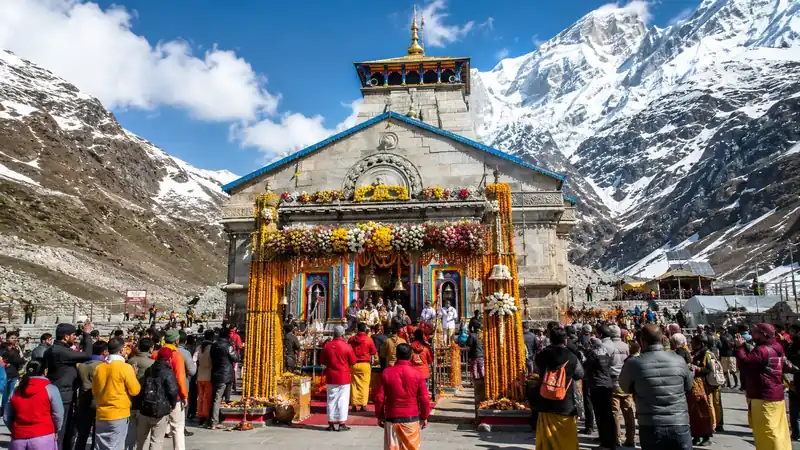
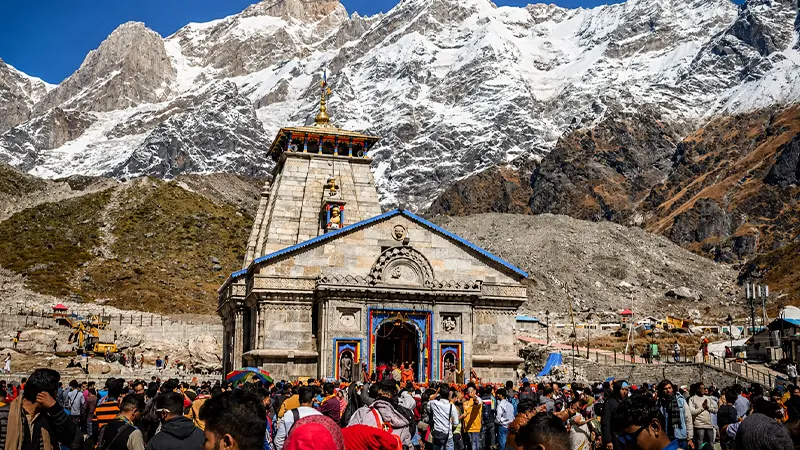
| Kedarnath | Lord Shiva (Jyotirlinga) | 22 April 2026 | ~11 November 2026 (Bhai Dooj) |
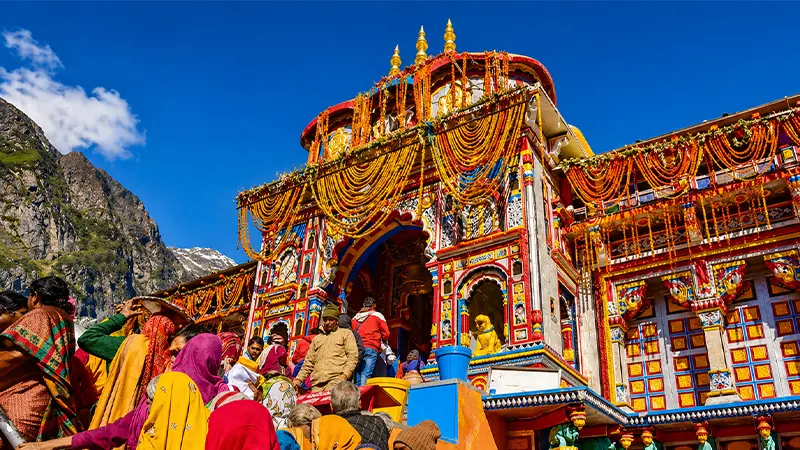
| Badrinath | Lord Vishnu | 23 April 2026 | ~13 November 2026 (announced by BKTC on Vijayadashami) |
Note on closing dates: Gangotri closes on Annakoot, the day after Diwali (about 10 November 2026). Yamunotri and Kedarnath close on Bhai Dooj (about 11 November 2026). The Badrinath–Kedarnath Temple Committee (BKTC) announces the exact Kedarnath and Badrinath closing dates on Vijayadashami, while Gangotri and Yamunotri dates come from their own temple committees. All closing dates above stay tentative until these announcements.
Yamunotri and Gangotri opened on Akshaya Tritiya (19 April 2026). As per tradition, the Badrinath opening date was announced on Basant Panchami and the Kedarnath date on Mahashivratri.
| Dham | Morning Opening | Midday Break | Evening Closing |
|---|---|---|---|
| Yamunotri | 6:00 AM | 1:00 PM–3:00 PM | 8:00 PM |
| Gangotri | 6:00 AM | 2:00 PM–3:00 PM | 9:00 PM |
| Kedarnath | 4:00 AM | 3:00 PM–5:00 PM | 9:00 PM |
| Badrinath | 4:30 AM | 1:00 PM–4:00 PM (approx.) | 9:00 PM |
These are typical timings from past seasons. The official registration portal has not published 2026 temple timings, and they shift with rituals and weather. Always confirm on the day of visit with our on-ground coordinator.
Mandatory for every pilgrim: complete the official registration and carry the QR-code registration letter; it is checked at points such as Janki Chatti, Gangotri, Sonprayag and Pandukeshwar
Official portal: registrationandtouristcare.uk.gov.in (Government of Uttarakhand)
Documents required: a photo ID such as Aadhaar Card, one passport-size photograph and a mobile number
Offline registration counters: Haridwar, Rishikesh, Sonprayag and other points on the route
Health check: the Uttarakhand Health Department's 2026 advisory asks pilgrims from other states to get a medical check-up 2–3 weeks before the yatra, with extra care for the elderly and anyone with heart, diabetes or breathing problems
Our process: Our team completes your online registration before your departure from Kolkata. You get a QR-code registration that is scanned at checkposts, so no counter queue is needed.
The Badrinath–Kedarnath Temple Committee (BKTC) introduced a paid Sugam Darshan slip at Kedarnath in 2026, reported at ₹1,100 per person from 29 May 2026. Check the current rules with BKTC before you rely on it
It shortens the general queue, which can run several hours at Kedarnath during peak season
Our coordinator helps book the slip when slots are open; pilgrims pay the fee
Yamunotri and Gangotri do not have a formal VIP system; queue management is by temple priests on the day
For 2026, mobile phones and cameras are banned inside all four Char Dham temple premises. At Badrinath, phones are not allowed beyond the Singhdwar; at Kedarnath, Gangotri and Yamunotri, they are not allowed anywhere in the temple premises. Deposit your phone at the counter before entry. Ghats and river areas outside the temples are fine for photographs.
| Season | Months | Temp at Dhams (Approx.) | What to Expect | Book This Far Ahead |
|---|---|---|---|---|
| Opening Season | Late April – May 15 | 5°C–15°C | Kapat opening ceremonies at all 4 dhams; snow on passes; thin crowds in last week of April, builds to moderate by mid-May | 60–90 days |
| Peak Summer | May 15 – June 30 | 8°C–22°C | Maximum facilities, highest footfall; long queues at Kedarnath; June slots fill from March | 90+ days; book Feb–March for June |
| Monsoon | July – August | 12°C–20°C | Heavy rain; landslides on Kedarnath corridor; NH 7 (Badrinath highway) closures common; the yatra can be paused on weather alerts; not recommended for first-time pilgrims | Avoid if possible |
| Post-Monsoon | September – October 20 | 5°C–20°C | Clearest mountain views of the year; lighter crowds than June; October evenings below 3°C at Kedarnath | 45–60 days |
| Closing Month | October 20 – November 13 | 0°C–10°C | Kapat closing ceremonies; most facilities shutting down; requires prior confirmation | 30 days; confirm with team |
The usual Char Dham Yatra route from Kolkata is a flight or train to Delhi (or Dehradun), followed by road travel to Haridwar and the four dhams.
The nearest airport to the Chardham circuit is Jolly Grant Airport, Dehradun (IATA: DED), about 36 km from Haridwar. From Kolkata (Netaji Subhas Chandra Bose International Airport, CCU), IndiGo flies nonstop to Dehradun on selected days of the week (about 2 hours 15 minutes); the schedule changes, so check it for your date. On other days, flights connect via Delhi and take approximately 4–5 hours including layover. A second option: fly Kolkata–Delhi (about 2 hours), and our team transfers you directly to Haridwar by road (5–6 hours).
Kedarnath Helicopter: Shuttles fly from Guptkashi, Phata and Sersi helipads. Tickets are sold on the official IRCTC HeliYatra portal (heliyatra.irctc.co.in), and you need a valid Char Dham registration before you can book. Fares differ by helipad and are revised every season, so check the portal for current rates. Avoid agents who offer "confirmed" seats outside the portal. Helicopter tickets are not included in any package tier and must be booked separately well in advance.
The most common route for Kolkata pilgrims is Howrah to Delhi on the Howrah–New Delhi Rajdhani Express (Train No. 12301/12302), approximately 17 hours to New Delhi Station. From Delhi, our vehicle drives to Haridwar (about 220 km / 5–6 hours). An alternative is a direct train to Haridwar Junction; trains from Howrah such as the Kumbha Express take about 24–33 hours. Our team coordinates pickup at either New Delhi Station or Haridwar Junction.
Kolkata to Haridwar is approximately 1,500 km by road, which is too far to drive for the full journey. The practical approach is train or flight to Delhi or Dehradun, after which all travel is by our private vehicle. Our ground tour starts from Delhi; the Kolkata–Delhi leg is booked independently.
| When You Cancel | Charge |
|---|---|
| 60+ days before departure | Full refund minus ₹1,500 processing fee per person |
| 45–59 days before departure | 15% of total package cost |
| 30–44 days before departure | 25% of total package cost |
| 15–29 days before departure | 50% of total package cost |
| 8–14 days before departure | 75% of total package cost |
| 0–7 days before departure | No refund |
Weather / Force Majeure Policy: If temples close mid-tour or roads are blocked due to landslides, government orders, cloudbursts, or any natural event, no cash refund is issued. A full rebooking credit valid for the remainder of the 2026 season (April–November) is provided. Kedarnath helicopter bookings are governed by IRCTC's own cancellation policy and are separate from this package.
Carry Cash from Haridwar: ATMs further up the route are fewer and can run out of cash or lose connectivity. We suggest ₹8,000–₹12,000 per person for pony, palki, prasad, dhabas, and temple pujas.
Start the Kedarnath Trek Early: Authorities can stop pilgrims from starting the climb late in the day, and you need daylight on the trail. We aim to start walking from Gaurikund by 6:00 AM; the 4:30 AM Guptkashi departure is planned for that.
Why We Stay in Guptkashi: Guptkashi (1,319m) is about 30 km from Sonprayag, so the group reaches the jeep stand before the morning rush. On Day 8 you climb from Gaurikund (1,982m) to Kedarnath (3,583m), a gain of about 1,600m in one day. Do not skip rest nights or request a rushed schedule, as altitude sickness is more likely when the body is pushed too fast.
Pack Thermals for Every Dham, Including May: Nights at Kedarnath (3,583m) and Badrinath (3,133m) drop to 3°C–7°C even in May and June. Carry full thermal inner layers, a fleece mid-layer, a windproof outer jacket, and wool socks. Cotton alone will not keep you warm after sunset at these heights.
Mobile Network Beyond Haridwar: Coverage is patchy on the treks and in remote stretches, and it varies by operator. Tell family that you may be out of reach for a day or two around the Kedarnath section.
Sonprayag Vehicle Limit: Private vehicles are not allowed beyond Sonprayag under local administration rules. Pilgrims on every tier take the shared jeep to Gaurikund (about 5 km; fare set locally).
Registration QR Code: Keep a Printed Copy: Checkposts at Janki Chatti (Yamunotri), Gangotri town entry, Sonprayag (Kedarnath), and Pandukeshwar (Badrinath) scan your registration. The QR code on your phone is accepted at most posts, but carry a printout as backup, as mobile signals at checkposts can be weak.
Health Check Before Departure: Get the medical check-up done in Kolkata 2–3 weeks before travel, as the 2026 health advisory asks. Senior pilgrims should carry the report with them.
| Day | Tour Program | Distance / Time | Major Highlight / Sightseeing | Meals | Overnight |
|---|---|---|---|---|---|
| 01 | Kolkata to Delhi | 300 km / 2 hrs | Overview: About 1,300 km by air | Flight: ~2 hours | Overnight train (Rajdhani): ~17 hours Morning / Afternoon: Board your morning or afternoon… | As per plan | train |
| 02 | Delhi to Haridwar | 220 km / 5–6 hrs | Distance: About 220 km | Drive Time: 5–6 hours via Meerut and Roorkee Morning: Depart Delhi by 6:00 AM sharp to beat city traffic on the… | As per plan | Haridwar Meals |
| 03 | Haridwar to Barkot | 215 km / 7–8 hrs | Distance: 215 km | Drive Time: 7–8 hours via Rishikesh–Narendra Nagar–Dharasu Morning: Depart after an early breakfast by 7:00 AM. Route:… | As per plan | Barkot Meals |
| 04 | Barkot to Yamunotri Darshan and Back | 45 km / 1.5–2 hrs | Route: Barkot to Janki Chatti (about 45 km | 1.5–2 hrs drive) + Yamunotri Temple trek (about 6 km one way | 3–4 hrs) Early Morning: The Trek… | As per plan | Barkot Meals |
| 05 | Barkot to Uttarkashi | 90–100 km / 3.5–4.5 hrs | Distance: About 90–100 km | Drive Time: 3.5–4.5 hours via Dharasu Morning: After breakfast, the drive to Uttarkashi (1,158m) follows the… | As per plan | Uttarkashi Meals |
| 06 | Uttarkashi to Gangotri Darshan and Back | 100 km / 3.5–4 hrs | Distance: About 100 km one way | Drive Time: 3.5–4 hours each way Morning: The Source of the Ganga Depart Uttarkashi by 6:00 AM. The road climbs… | As per plan | Uttarkashi Meals |
| 07 | Uttarkashi to Guptkashi | 220 km / 8–9 hrs | Distance: About 220 km | Drive Time: 8–9 hours via Tehri–Rudraprayag Morning: The Long Drive Today you move from the Gangotri side of the… | As per plan | Guptkashi Meals |
| 08 | Guptkashi to Kedarnath (Trek) | 30 km / 1 hrs | Route: Guptkashi → Sonprayag (about 30 km | ~1 hr) → Gaurikund (5 km shared jeep) → Kedarnath Temple (16 km trek, ascending from 1,982m to… | As per plan | Kedarnath |
| 09 | Kedarnath Darshan and Descent to Guptkashi / Rudraprayag | 16 km / 4–6 hrs | Route: Kedarnath → Gaurikund (16 km descent) → Sonprayag → Rudraprayag / Guptkashi (driving) Before Sunrise: Abhishek at the Jyotirlinga.… | As per plan | Rudraprayag / Guptkashi Meals |
| 10 | Guptkashi / Rudraprayag to Badrinath via Joshimath | 160 km / 7–9 hrs | Distance: About 160 km from Rudraprayag, or about 200 km if you stayed in Guptkashi | Drive Time: 7–9 hours via Karnaprayag–Chamoli–Joshimath… | As per plan | Badrinath Meals |
| 11 | Badrinath Darshan, Mana Village, Joshimath | 3 km / 2 hrs | Route: Badrinath Temple + Mana Village (3 km each way, easy walk) Early Morning: Maha Abhishek. Badrinath Temple timings are roughly 4:30… | As per plan | stop at a more manageable |
| 12 | Joshimath to Srinagar Garhwal | 145 km / 5–6 hrs | Distance: About 145 km | Drive Time: 5–6 hours Morning: Depart after breakfast. The descent from Joshimath follows the Alaknanda valley… | As per plan | Srinagar Garhwal Meals |
| 13 | Srinagar Garhwal to Rishikesh via Devprayag | 105 km / 3.5–4 hrs | Distance: About 105 km | Drive Time: 3.5–4 hours Morning: Stop at Devprayag (about 830m), the point where the Bhagirathi (coming from Gangotri)… | As per plan | Rishikesh Meals |
| 14 | Rishikesh to Delhi, Return to Kolkata | 240 km / 6–7 hrs | Distance: Rishikesh to Delhi about 240 km | 6–7 hours Morning: Early departure from Rishikesh. Drop at IGI Airport or New Delhi Railway Station… | As per plan | Tour Ends |
Overview: About 1,300 km by air | Flight: ~2 hours | Overnight train (Rajdhani): ~17 hours
Morning / Afternoon: Board your morning or afternoon flight from Netaji Subhas Chandra Bose International Airport (CCU) to Indira Gandhi International Airport, Delhi. If you prefer the train, the Howrah–New Delhi Rajdhani Express is the most comfortable overnight option; book First AC or AC 2-Tier well in advance during the April–June season.
On arrival at Delhi Airport or New Delhi Railway Station, our representative meets you with a name board. Transfer to hotel takes approximately 30–60 minutes depending on traffic.
Evening: Full trip briefing at the hotel: route map, altitude safety notes, Kedarnath trek guidelines, and a check of your yatra registration on the Uttarakhand portal. Pilgrims who have not registered online will be assisted tonight.
Overnight: Delhi Meals: Dinner at hotel
Distance: About 220 km | Drive Time: 5–6 hours via Meerut and Roorkee
Morning: Depart Delhi by 6:00 AM sharp to beat city traffic on the Meerut–Muzaffarnagar stretch. The drive passes through Roorkee, home of IIT Roorkee and the Ganga Canal, before the Himalayan foothills begin.
Afternoon: Check in at Haridwar hotel by 1:00–2:00 PM. This is your most important logistical stop: visit the nearest ATM and withdraw ₹8,000–₹12,000 cash per person. Beyond Haridwar, ATM availability becomes unpredictable.
If anyone in the group has not registered online, our coordinator takes them to the offline registration counter in Haridwar.
Evening: Attend Ganga Aarti at Har Ki Pauri. The Aarti begins around sunset, at approximately 6:45 PM in May–June and 6:15 PM in September–October. Hundreds of brass lamps are lit on the Ghat together. Arrive 30 minutes early for a good spot.
Overnight: Haridwar Meals: Breakfast, Dinner
Distance: 215 km | Drive Time: 7–8 hours via Rishikesh–Narendra Nagar–Dharasu
Morning: Depart after an early breakfast by 7:00 AM. Route: Haridwar → Rishikesh → Narendra Nagar → Chamba → Dharasu → Barkot.
Tip for this day: The road via Mussoorie and Kempty Falls is a popular detour but adds 45–60 minutes. Our route takes the direct road via Dharasu Bend, which is faster. If your group specifically wants Mussoorie, inform our team in advance for a departure at 5:30 AM instead.
Afternoon: The road narrows significantly after Dharasu, and the vehicle slows down on this hill terrain. Barkot (1,220m) appears in the late afternoon, sitting above the Yamuna River valley. Check in, freshen up, and rest.
Evening: Light dinner. Early to bed: tomorrow's Yamunotri trek starts before dawn. Lay out your trek clothes and carry a small daypack: water (2 litres minimum), glucose biscuits, a windbreaker, and your registration slip.
Overnight: Barkot Meals: Breakfast, Dinner
Route: Barkot to Janki Chatti (about 45 km | 1.5–2 hrs drive) + Yamunotri Temple trek (about 6 km one way | 3–4 hrs)
Early Morning: The Trek Begins Depart Barkot by 5:00 AM. Drive to Janki Chatti (2,650m), the trek base. At Janki Chatti, ponies and palkis are available for those who need them (approx. ₹1,200–₹2,500 one way, payable directly at the stand). Confirm your pony booking at the stand before starting, as availability tightens after 8:00 AM.
The 6 km trail to Yamunotri Temple (3,291m) climbs steadily through pine and deodar forest. The path is stone-paved throughout. The ascent takes 2.5–3.5 hours depending on pace; the descent, 1.5–2 hours.
At the Temple: Darshan timings (summer) are 6:00 AM–1:00 PM and 3:00 PM–8:00 PM. Reaching before noon is essential. The most important ritual here is cooking raw rice in Surya Kund, a natural hot spring of about 88°C. Pilgrims tie rice in a cloth, dip it in the spring, and carry it home as prasad. This ritual is specific to Yamunotri.
Practical note: Phones and cameras are not allowed inside the temple premises in 2026. The ghat area outside is fine for photographs.
Afternoon: Descend to Janki Chatti after darshan. Drive back to Barkot. Freshen up.
Evening: Rest and dinner. The body needs recovery before the next high-altitude section.
Overnight: Barkot Meals: Breakfast, Dinner
Distance: About 90–100 km | Drive Time: 3.5–4.5 hours via Dharasu
Morning: After breakfast, the drive to Uttarkashi (1,158m) follows the Bhagirathi River valley, and the road is noticeably easier than the tight stretch toward Yamunotri. Uttarkashi means "the Kashi of the North," and the town's main street reflects that: ashrams, temple bells, and shops stocked with religious supplies.
Afternoon: Check in, rest, and if time and energy permit, visit the Kashi Vishwanath Temple, an old Shiva temple in the town center. This is also your last big market town before Gangotri. Stock up here: medicines, warm layers, or trek gear you have forgotten may be hard to find further ahead.
Evening: Dinner and an early briefing for tomorrow's Gangotri visit. Note the midday closure: the Gangotri Temple shuts from 2:00 PM to 3:00 PM daily, so your group needs to reach before noon.
Overnight: Uttarkashi Meals: Breakfast, Dinner
Distance: About 100 km one way | Drive Time: 3.5–4 hours each way
Morning: The Source of the Ganga Depart Uttarkashi by 6:00 AM. The road climbs steadily through deodar forests, past waterfalls and narrow gorges. The first snow-capped peaks appear near Harsil (2,620m), where a brief stop is worthwhile. Gangotri (about 3,100m) is reached by approximately 9:30–10:00 AM.
The Gangotri Temple sits directly on the Bhagirathi River, the upstream name of the Ganga. The darshan queue here moves faster than at Kedarnath; your group typically enters the sanctum within 30–45 minutes.
Important temple note: Phones and cameras are not allowed inside the temple premises in 2026; the ghat and riverbank outside are fine for photographs. Priests offer special pujas for ₹500–₹2,000 depending on the puja type.
Afternoon: After darshan, spend some time at the ghat on the Bhagirathi. Lunch at a local dhaba in Gangotri (not included).
Depart for Uttarkashi by 1:30 PM at the latest to safely reach before dark.
Evening: Return to Uttarkashi. Dinner. Rest. Tomorrow is the longest drive of the entire yatra.
Overnight: Uttarkashi Meals: Breakfast, Dinner
Distance: About 220 km | Drive Time: 8–9 hours via Tehri–Rudraprayag
Morning: The Long Drive Today you move from the Gangotri side of the Himalayas to the Kedarnath side. Depart after breakfast by 7:00 AM. Route: Uttarkashi → Tehri → Srinagar (Garhwal) → Rudraprayag → Agastyamuni → Kund → Guptkashi.
The highlight en route is Tehri Dam, India's tallest dam at about 260m, with the large Tehri Lake behind it. At Rudraprayag, the Mandakini and Alaknanda rivers meet, and the confluence is visible from the road bridge.
Afternoon: The final stretch from Agastyamuni to Guptkashi climbs steeply. Guptkashi (1,319m) is reached by 3:00–4:00 PM. Check in, rest, light dinner.
Why Guptkashi matters: Guptkashi is about 30 km from Sonprayag, which lets the group start the Kedarnath day before dawn. Rest well tonight.
Evening Visit the Vishwanath Temple in Guptkashi if energy allows. It is one of the older Shiva temples in the region and is often skipped by tour groups.
Overnight: Guptkashi Meals: Breakfast, Dinner
Route: Guptkashi → Sonprayag (about 30 km | ~1 hr) → Gaurikund (5 km shared jeep) → Kedarnath Temple (16 km trek, ascending from 1,982m to 3,583m)
Before Dawn: The Most Important Day Depart Guptkashi by 4:30 AM. The 16 km trek from Gaurikund to Kedarnath takes 6–8 hours for most pilgrims. Authorities can stop late starters, so the group aims to start walking from Gaurikund by 6:00 AM. The early start leaves enough daylight for the climb.
At Sonprayag: Private vehicles cannot proceed beyond Sonprayag under local administration rules. Shared jeeps run from Sonprayag to Gaurikund (5 km); the fare is set locally and paid at the counter. Our team coordinates the boarding; expect a 15–30 minute wait at the jeep stand.
The Trek: Gaurikund to Kedarnath (16 km | 3,583m) Gaurikund (1,982m) has hot springs, a small market, and pony/palki/doli booking counters. Doli (palanquin) and palki are available for those who cannot walk. Pony rates are roughly ₹3,000–₹5,000 one way depending on season, paid directly at the counter in Gaurikund.
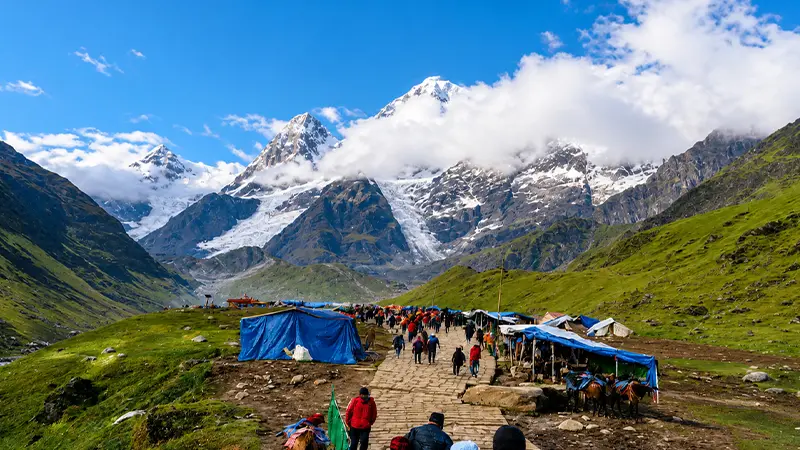
The trail passes through Jungle Chatti, Bhimbali and Lincholi, which are natural rest points with tea stalls and basic medical facilities. The final stretch from Lincholi to the temple is the steepest. Walk slowly, breathe deeply, and do not rush, as altitude sickness is more likely when you hurry.
Kedarnath Valley: The temple complex at 3,583m sits in a high-altitude meadow surrounded by snow peaks. The air is noticeably thinner. If you feel a severe headache, breathlessness or disorientation, tell our coordinator at once. The Uttarakhand Health Department and SDRF run medical and rescue support on the route during the yatra.
Evening: Check in at Kedarnath guesthouses or GMVN camps (basic but sufficient). Dinner. Sleep by 8:00 PM, since the morning puja begins around 4:00 AM.
Overnight: Kedarnath (3,583m) Meals: Breakfast, Dinner (packed lunch on trek)
Route: Kedarnath → Gaurikund (16 km descent) → Sonprayag → Rudraprayag / Guptkashi (driving)
Before Sunrise: Abhishek at the Jyotirlinga. Kedarnath Temple timings are usually around 4:00 AM–3:00 PM and 5:00 PM–9:00 PM (confirm on the day). The first puja of the day is the Maha Abhishek at 4:00 AM, followed by Nirvan Darshan (plain darshan without offerings) from 6:00 AM onward. Mobile phones are not allowed anywhere in the temple premises.
Our coordinator helps book the BKTC Sugam Darshan slip when it is available. The general queue at Kedarnath can run several hours in peak season, and the slip shortens it. The Shiva Lingam in the inner chamber is a natural rock formation, worshipped in Hindu tradition as self-manifested.
The early morning slot usually has the smallest crowd, so be in line before sunrise.
Morning: Descent Begin descent after darshan. The 16 km downhill takes 4–6 hours and is harder on the knees than the ascent, so walk slowly and wear shoes with good grip. Shared jeep from Gaurikund to Sonprayag, then private vehicle.
Afternoon / Evening: Drive to Guptkashi, or on to Rudraprayag if the group comes down early and the road is clear. Your coordinator decides on the day. Dinner and rest.
Overnight: Rudraprayag / Guptkashi Meals: Breakfast, Dinner
Distance: About 160 km from Rudraprayag, or about 200 km if you stayed in Guptkashi | Drive Time: 7–9 hours via Karnaprayag–Chamoli–Joshimath
Morning: Depart after breakfast. The route follows the Alaknanda River northward. Pass through Karnaprayag (confluence of the Pindar and Alaknanda) and Chamoli, the district headquarters.
Afternoon: At Joshimath (now officially Jyotirmath, 1,875m), a brief stop is worthwhile. Adi Shankaracharya established Jyotirmath here, one of the four mathas (monastic centres) he founded along with Sringeri, Dwarka and Puri. The Narsingh Temple here houses an ancient idol said to be losing thickness in one arm; local belief holds that when the arm breaks, the route to Badrinath will close and worship will move to Bhavishya Badri. It is worth a 15-minute visit.
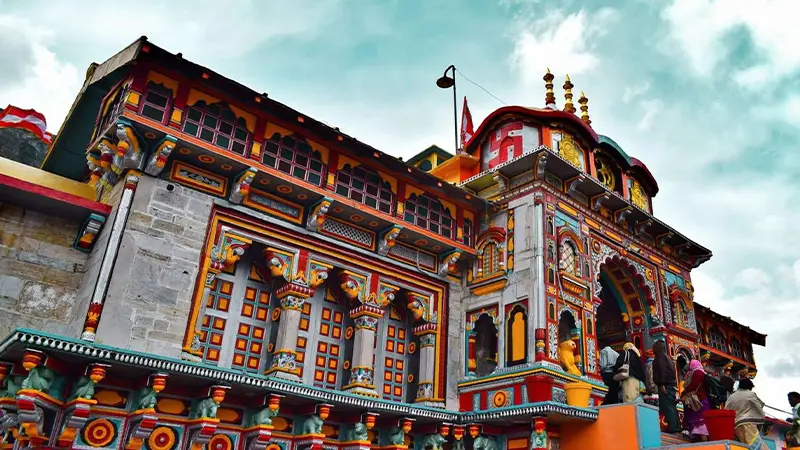
Beyond Joshimath, the road climbs to Badrinath (3,133m), reached by 4:00–5:00 PM. Check in. The temple is open in the evening, but our group rests today and does full darshan tomorrow morning.
Evening: Walk to the temple for a brief preliminary view of the Tapt Kund (hot spring), where pilgrims traditionally bathe before morning darshan. Optional evening darshan if the group is energetic.
Overnight: Badrinath Meals: Breakfast, Dinner
Route: Badrinath Temple + Mana Village (3 km each way, easy walk)
Early Morning: Maha Abhishek. Badrinath Temple timings are roughly 4:30 AM–1:00 PM and 4:00 PM–9:00 PM (they vary by season). Plan to finish darshan by late morning. Attend the Maha Abhishek at 4:30 AM (booked through BKTC), when Lord Vishnu's idol is bathed in ghee, milk, and Gangajal to the sound of Vedic mantras.
Post-abhishek darshan in the Garbhagriha (inner sanctum): in Hindu tradition, the idol of Badrinarayan (Vishnu): here is regarded as one of the eight Swayambhu (self-manifested) forms. Phones and cameras are not allowed beyond the Singhdwar.
Morning: Mana Village: After darshan, go 3 km to Mana village, signposted as the "First Indian Village" near the Tibet border. Mana is a working village where the Bhotiya community lives. Visit:
Vyas Gufa: the cave where sage Ved Vyasa is said to have dictated the Mahabharata to Ganesh
Bhim Pul: a single large rock that forms a natural bridge over the roaring Saraswati River
Saraswati River: visible at Mana, it joins the Alaknanda at Keshav Prayag, close to the village
The Mana visit is mostly easy walking and takes about 2 hours.
Afternoon: Return to Badrinath. Lunch (own expense). Depart for Joshimath in the afternoon, an important overnight stop at a more manageable 1,875m after two nights above 3,000m.
Evening: Dinner at Joshimath hotel. Rest.
Overnight: Joshimath Meals: Breakfast, Dinner
Distance: About 145 km | Drive Time: 5–6 hours
Morning: Depart after breakfast. The descent from Joshimath follows the Alaknanda valley southward through Chamoli, Karnaprayag and Rudraprayag.
Afternoon: Continue to Srinagar Garhwal for the night. Check in, rest, dinner.
Overnight: Srinagar Garhwal Meals: Breakfast, Dinner
Distance: About 105 km | Drive Time: 3.5–4 hours
Morning: Stop at Devprayag (about 830m), the point where the Bhagirathi (coming from Gangotri) meets the Alaknanda (coming from Badrinath) and the combined river takes its name: the Ganga. You have now seen both rivers near the dhams they flow from.
Practical note: Devprayag is a 15–20 minute stop. The confluence is visible from the pedestrian bridge. Steps lead down to the ghat for those who want to touch the water. Continue to Rishikesh, arriving by early afternoon, and check in.
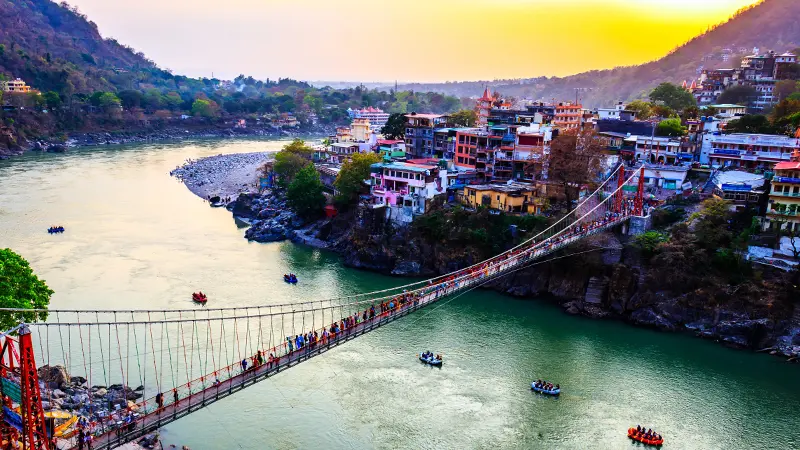
Afternoon: Walk across the Ram Jhula suspension bridge (Laxman Jhula has been closed since 2019). Browse the ghats. Triveni Ghat is where the three sacred rivers (Ganga, Yamuna and the unseen Saraswati) are said to meet. Afternoon is also the right time for optional white-water rafting on the 16 km Shivpuri–Rishikesh stretch (bookable locally at approximately ₹600–₹800 per person, not included in package).
Evening: Triveni Ghat Ganga Aarti begins at approximately 6:00 PM. Smaller and calmer than Haridwar's Har Ki Pauri, this aarti is a fitting close to the yatra that began at Haridwar on Day 2.
Overnight: Rishikesh Meals: Breakfast, Dinner
Distance: Rishikesh to Delhi about 240 km | 6–7 hours
Morning: Early departure from Rishikesh. Drop at IGI Airport or New Delhi Railway Station by 1:00–2:00 PM, giving 2–3 hours for check-in and boarding. Book an evening flight or train back to Kolkata to allow for traffic. Our ground team stays in contact until the Delhi drop, where the tour concludes.
Meals: Breakfast
Book first, decide later. If your plans shift, you get a simple and flexible window to update or cancel your booking without stress.
Your money is safe with us. book today and enjoy the benefit of flexible travel dates and money back guarantee.
We understand that booking online can be a bit daunting, which is why we offer our customers a peace of mind Money Back Guarantee. This includes a 7-day cooling-off period. If you change your mind about your purchase or wish to cancel for any reason within this time, we will provide a 100% refund, no questions asked.
This guarantee is only applicable for those canceling their tour 60 days or more before their travel date.
Would you like help making a booking or have a few questions? Whatever the reason, don't hesitate to get in touch.
The ground package from Delhi starts at ₹43,900 per person on the Budget tier. Standard costs ₹45,000–₹55,000 and Deluxe ₹55,900–₹65,000, all on twin sharing. The Kolkata–Delhi train or flight is booked separately.
14 days, including one day each way between Kolkata and Delhi. Shorter plans usually cut rest days or rush the Kedarnath trek.
Yes, for medically fit seniors. The Kedarnath trek is about 16 km one way and Yamunotri about 6 km, so pony, palki or helicopter is advised for pilgrims above 65 or with knee, heart or breathing problems. Get the medical check-up advised for 2026 done 2–3 weeks before leaving Kolkata.
Yes. Every pilgrim must register on registrationandtouristcare.uk.gov.in. Our team completes it before you leave Kolkata.
This package is by road. Kedarnath by helicopter is a common change to it; the ticket needs advance booking on IRCTC HeliYatra and is paid separately.
The ground package starts and ends in Delhi. You book the Kolkata–Delhi flight or train yourself, and we pick you up at Delhi airport or New Delhi Railway Station. If you take a direct train to Haridwar, our team can pick you up at Haridwar Junction instead.
The ground team holds the group at the nearest safe halt and reroutes once roads reopen. No cash refund is issued for natural-calamity disruptions; a rebooking credit for the same season is provided.
Contact the team by WhatsApp or phone with your dates and group size. We send a quote, confirm hotels on the full route, and collect a ₹5,000 per person advance. The balance is due 21 days before departure.
For May–June departures, book 90+ days ahead, as Guptkashi and Badrinath hotels fill from February–March. For September–October, 45–60 days is usually enough.
Recommended
Bangalore → Haridwar → Barkot → Yamunotri → Uttarkashi → Gangotri → Guptkashi → Kedarnath → Joshimath → Badrinath → Rishikesh → Bangalore
Ahmedabad → Haridwar → Barkot → Yamunotri → Uttarkashi → Gangotri → Guptkashi → Kedarnath → Joshimath → Badrinath → Rishikesh → Ahmedabad
Mumbai → Haridwar → Barkot → Yamunotri → Uttarkashi → Gangotri → Guptkashi → Kedarnath → Joshimath → Badrinath → Rishikesh → Mumbai