Last Updated on 23/05/2026
If you are planning Char Dham Yatra 2026, the single most important question before anything else is: what is the actual road condition right now? Not last year. Not what the brochure says. The real, on-ground picture. This guide gives you exactly that — segment by segment, Dham by Dham, with every new 2026 rule that affects how you travel.
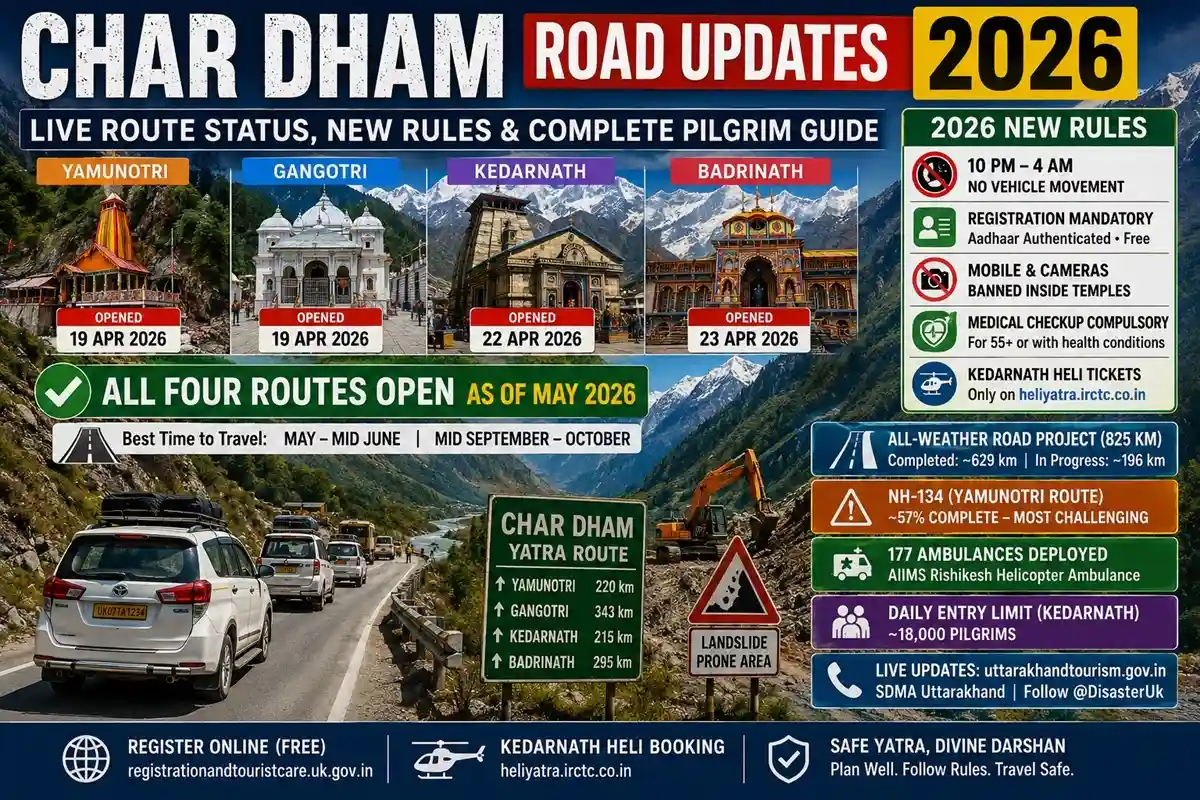
The good news first: all four Char Dham routes are currently open as of May 2026. The yatra season began on 19 April 2026 with the opening of Yamunotri and Gangotri on Akshaya Tritiya, followed by Kedarnath on 22 April and Badrinath on 23 April. Over 19 lakh pilgrims had pre-registered before the opening day alone — the most demand ever recorded for a single Char Dham season. Roads are motorable, but some stretches are still undergoing repair with a PWD deadline of 15 May set for completing pending patchwork.
Key Takeaways: What You Must Know Before You Go
- All four dhams are open — Yamunotri & Gangotri from 19 April, Kedarnath from 22 April, Badrinath from 23 April 2026
- Registration is mandatory and Aadhaar-authenticated — free at registrationandtouristcare.uk.gov.in
- New 2026 rule: No vehicles allowed after 10 PM on any Char Dham route
- Kedarnath daily entry capped at ~18,000 pilgrims; RFID/QR passes checked at Sonprayag and multiple checkpoints
- Mobile phones and cameras banned inside all four temple premises
- Medical checkup compulsory for pilgrims above 55 or with heart disease, hypertension, diabetes, asthma
- Kedarnath helicopter tickets only through IRCTC: heliyatra.irctc.co.in — not through agents
- Government has approved ₹461 crore for landslide mitigation on NH-134 (Yamunotri route)
- 177 ambulances deployed; AIIMS Rishikesh helicopter ambulance operational for emergencies
- Yamunotri NH-134 is the slowest-progressing section — expect narrow roads and construction delays
Confirmed Temple Opening & Closing Dates
| Dham |
Opening Date |
Closing Date (Approx) |
Trek/Road Access |
| Yamunotri |
19 April 2026 |
~11 November 2026 |
5–6 km trek from Janki Chatti |
| Gangotri |
19 April 2026 |
~10 November 2026 |
Direct road access |
| Kedarnath |
22 April 2026 (8:00 AM) |
~11 November 2026 (Bhai Dooj) |
16–18 km trek from Gaurikund |
| Badrinath |
23 April 2026 |
~13 November 2026 |
Direct road access |
Kedarnath closing date is fixed on Bhai Dooj every year. The Utsav Murti of Lord Kedarnath then moves to Omkareshwar Temple in Ukhimath for winter worship. Badrinath typically closes last among all four dhams.
Char Dham All-Weather Road Project: Current 2026 Status
The Chardham Mahamarg Vikas Pariyojana (CMVP) covers 825 km of highways connecting all four dhams. It is divided into 53 packages. Here is where things actually stand as of 2026:
| Route / Stretch |
Completion % |
Current Status |
| NH-109: Fata–Sitapur (Kedarnath) |
~99% |
Almost complete; safest route |
| NH-109: Geometric improvement |
~94% |
Near complete |
| Kund Bypass (Kedarnath route) |
~81% |
Work in progress |
| NH-58: Rishikesh–Badrinath |
~80%+ |
Major improvements done |
| NH-134: Dharasu–Jankichatti (Yamunotri) |
~57% |
⚠️ Slowest; land acquisition pending |
| NH-108: Rishikesh–Gangotri |
~75%+ |
Generally good condition |
Important: The government approved ₹461 crore specifically for landslide mitigation at 17 sensitive locations on NH-134 (Yamunotri route) in April 2026. Works are expected to strengthen slopes and improve drainage — but are not yet complete. Pilgrims heading to Yamunotri should expect the most variable road conditions of the entire circuit.
Char Dham Route: Segment-by-Segment Road Condition
Here is what you will actually experience on the ground — the way experienced local drivers describe it.
Segment 1 — Rishikesh to Rudraprayag (NH-58 / NH-7) → ~140 km
This is the most stable and widest stretch of the entire yatra corridor. Post-improvement, it handles high traffic well. Most pilgrims cover this in 3–4 hours. Devprayag, Srinagar Garhwal, and Rudraprayag are reliable stops for fuel, food, and ATMs. Road widening is substantially done here.
- Good crash barriers and road marking in completed sections
- Rudraprayag is the major junction — Kedarnath route splits left, Badrinath route continues straight
- Fill your fuel tank fully at Rudraprayag
Segment 2 — Rudraprayag to Sonprayag/Gaurikund (Kedarnath) → ~75 km
This is where the real mountain experience begins. Past Tilwara and Agastmuni, the road narrows. The NH-109 Fata–Sitapur widening is 99% complete, which has significantly improved this section compared to previous years. However, Sonprayag to Gaurikund remains the most weather-sensitive 5 km of the Kedarnath route.
- Sonprayag is the mandatory checkpoint — Kedarnath RFID pass is scanned here
- Private vehicles must park at Sonprayag. Government shared vehicles (₹40–50/person) run to Gaurikund
- Gaurikund is the last motorable point — 16 to 18 km trek begins here
- Path between Gaurikund and Lincholi has been resurfaced and improved for 2026
- Daily pilgrim entry at Kedarnath is capped at approximately 18,000 — arrive early or book slots
Segment 3 — Rudraprayag to Joshimath/Badrinath (NH-58) → ~155 km
The Badrinath highway is the best-maintained corridor, partly because it also serves as a strategic defence road toward the India-China border. The Lambagad–Vishnuprayag section can still see occasional rockfall, so do not stop on curves. Badrinath temple is directly road-accessible — vehicles park close to the entrance.
- Joshimath is a key overnight base and the last major town before Badrinath
- Joshimath is also the entry point for Auli (ski resort, ropeway)
- Road condition: generally good, minor patches under repair
Segment 4 — Rishikesh to Uttarkashi to Gangotri (via NH-134 / NH-108) → ~343 km
Rishikesh to Uttarkashi is now quite smooth. Beyond Uttarkashi, the 100 km stretch to Gangotri becomes narrower with winding gorges. The Bhatwari section and area near Harsil can slow traffic. Local drivers consistently recommend leaving Uttarkashi before 7 AM to reach Gangotri and return comfortably in a day.
Gangotri itself is directly road-accessible. There is no trek — the temple is at the roadhead. This makes it the most accessible of the four dhams from a transport standpoint.
- Harsil village is a scenic midpoint and good food stop
- Gangotri is at 3,415 m — some altitude adjustment is needed
Segment 5 — Barkot to Janki Chatti (Yamunotri) → ~50 km via NH-134
This is the most challenging driving section of the circuit in 2026. The Dharasu–Jankichatti stretch of NH-134 is only 57% complete under the all-weather project. Land acquisition between Pauigaon and Jankichatti is still pending. Drivers report narrow single-lane sections, blind turns, and broken patches that are yet to be repaired.
From Janki Chatti, the trek to Yamunotri temple is 5–6 km. Ponies and palanquins are available. The government has approved ₹233 crore for slope stabilisation at 17 identified danger points on this highway — works ongoing.
- ⚠️ Plan extra time on this route — do not rush it
- Start from Barkot by 6 AM to complete the Yamunotri trek and return comfortably
- Do not attempt this stretch after noon if you are behind schedule
Char Dham Distance Chart: Complete Route Reference
| From |
To |
Distance |
Est. Drive Time |
| Delhi |
Haridwar |
~225 km |
4–5 hrs |
| Haridwar |
Rishikesh |
~24 km |
40–45 min |
| Rishikesh |
Rudraprayag (NH-58) |
~140 km |
3–4 hrs |
| Rudraprayag |
Gaurikund (Kedarnath) |
~75 km |
2.5–3 hrs |
| Rishikesh |
Badrinath (NH-58) |
~295 km |
8–10 hrs |
| Rishikesh |
Uttarkashi (Gangotri route) |
~155 km |
4–5 hrs |
| Uttarkashi |
Gangotri |
~100 km |
3–4 hrs |
| Rishikesh |
Janki Chatti (Yamunotri) |
~220 km |
6–7 hrs |
| Yamunotri |
Gangotri (circuit) |
~227 km |
6–7 hrs |
| Gangotri |
Gaurikund (Kedarnath) |
~330 km |
9–10 hrs |
| Gaurikund |
Badrinath |
~245 km |
7–8 hrs |
Best Time to Travel Char Dham: Month-by-Month Road Assessment
| Month |
Road Condition |
Crowd Level |
Verdict |
| April |
Good (early snow clearing) |
High (opening rush) |
✅ Go early — but book well in advance |
| May |
Excellent — best roads |
Very High |
✅ Peak season; ideal road conditions |
| Early June |
Good |
Moderate |
✅ Good choice; less crowded than May |
| July–August |
Poor to very poor (monsoon landslides) |
Low |
⚠️ Avoid; frequent route suspensions |
| September |
Recovering; mostly motorable |
Low-Moderate |
✅ Post-monsoon; scenic, fewer crowds |
| October |
Good; cold nights |
Moderate |
✅ Excellent window before closures |
| November |
Roads close progressively |
Very Low |
⚠️ Only first 10–12 days; plan carefully |
Most experienced pilgrims and local travel operators recommend May–mid June as the safest road travel window for first-timers. During peak May season, the Sonprayag checkpoint for Kedarnath can see 3–5 hour waits on high-footfall days. Early morning arrival (before 6 AM) helps.
2026 New Rules Every Pilgrim Must Know
Traffic and Road Rules (New for 2026)
- 🚫 No vehicle movement after 10 PM on all Char Dham routes — strictly enforced
- Vehicles operate between 4 AM and 10 PM only; violators face penalties
- All commercial and private vehicles must pass a technical fitness test before entering the yatra circuit
- Drivers must have specialised training or demonstrated experience on hilly terrain
- Out-of-state vehicles require prior vehicle permits — check with district administration
Temple and Darshan Rules (New for 2026)
- Mobile phones and cameras banned inside all four temple premises
- Timed darshan slots introduced — arrive at your allocated time or wait
- Non-Hindu entry conditions apply at Kedarnath, Badrinath, and Gangotri — verify local administration guidelines before travel
- Yamunotri remains open to all devotees without religious restriction
Health and Safety Rules (New for 2026)
- Medical checkup mandatory for all pilgrims above 55, or those with hypertension, heart disease, diabetes, or asthma
- Carry a fitness certificate from a registered doctor if you have any of the above conditions
- Health screening at base camps: Gaurikund (Kedarnath) and Janki Chatti (Yamunotri)
- Uttarakhand Health Dept. ‘Swasth, Satark, Safal’ advisory: spend 24–48 hrs at Haridwar/Rishikesh before heading higher
- Carry a portable pulse oximeter; readings below 90 SpO2 require immediate descent
- Alcohol and intoxicants strictly prohibited across the entire yatra circuit
Registration for Char Dham Yatra 2026: Step-by-Step
Registration is mandatory for every pilgrim — whether you are trekking, riding a pony, using a palki, or taking a helicopter. No registration means no entry. It is checked and scanned at multiple points along every route. Registration is free.
How to Register Online
- Go to the official portal: registrationandtouristcare.uk.gov.in
- Create an account with your mobile number
- Enter your Aadhaar card details (Aadhaar authentication is mandatory since 2025)
- Select your travel dates and the dhams you plan to visit
- Receive a URN (Unique Registration Number) and a QR-code registration slip via SMS and email
- Download and print your slip — carry it throughout the yatra along with your Aadhaar card
Your QR-code pass is scanned by Yatrimitras at: entry checkpoints like Sonprayag (Kedarnath) and Janki Chatti (Yamunotri), trek starting points, helicopter boarding, and at the temple entry gates. If you are booking a Kedarnath helicopter, you must have your URN ready — it is mandatory before IRCTC will allow payment.
Offline Registration
Offline centres are set up in Haridwar (near ghats and bus stand) and Rishikesh. 60% of registrations are done online, 40% offline. Centres are open from early morning. If you face any Aadhaar-linked issues, the centres have support staff.
Transport Options: Road, Helicopter & Rail
By Road (Most Common Route)
The majority of pilgrims travel by road — private vehicles, shared taxis, or government buses. The most-used vehicles on the Char Dham circuit are the Mahindra Bolero, Toyota Innova Crysta, and Tata Safari. Smaller hatchbacks can manage most sections but struggle on steeper mountain gradients. Always carry a spare tyre.
- GMVN (Garhwal Mandal Vikas Nigam) buses: fixed routes, affordable, good for budget pilgrims
- UTTC (Uttarakhand Transport Corporation) buses: run from Rishikesh/Haridwar to key yatra points
- Shared jeeps from Haridwar and Rishikesh: economical for solo or small group pilgrims
- Private hired taxis: most flexible; local Uttarakhand drivers know the roads and seasonal conditions best
By Helicopter (Kedarnath — IRCTC Only)
Kedarnath helicopter services are exclusively booked through the official IRCTC portal: heliyatra.irctc.co.in. Do not book through any agent or third-party website — there are active scams every season. IRCTC opened Phase 1 bookings on 15 April 2026 at 6 PM IST.
Helipads for Kedarnath: Sirsi, Phata, and Guptkashi. Confirmed 2026 fares (round trip, base price before GST):
| Helipad |
Round Trip (Base) |
+ ₹300 + 18% GST |
Flight Time (approx) |
| Sirsi |
₹6,390 |
~₹7,854 total |
~9 min each way |
| Phata |
₹10,164 |
~₹12,194 total |
~12 min each way |
| Guptkashi |
₹12,762 |
~₹15,358 total |
~15 min each way |
Daily helicopter shuttles are capped at 184 flights for 2026 — a 30% reduction under DGCA guidelines. Supply is very limited against extremely high demand. Book immediately when slots open; Guptkashi slots in 2025 sold out in under two hours.
By Rail + Road Combination
The nearest major railway stations are Haridwar (best connectivity — linked to Delhi, Mumbai, Kolkata, Chennai, and most major cities) and Dehradun. From Haridwar or Rishikesh, take a hired cab or GMVN tour to begin the yatra circuit. From Dehradun, both road circuits and helicopter departures are accessible.
High-Risk Landslide Zones: Know Before You Drive
Understanding where the vulnerable sections are lets you plan departure times and avoid being caught in clearance delays.
| Zone / Location |
Route (Highway) |
Risk Level |
Notes |
| Silai Band & Ojri |
Yamunotri (NH-134, Uttarkashi) |
🔴 High |
Blocked repeatedly in 2025 monsoon |
| Jangalchatti area |
Yamunotri (NH-134) |
🔴 High |
Road fully destroyed in 2025; repaired |
| Dharasu–Nalupani zone |
Yamunotri / Gangotri |
🟡 Moderate |
Sensitive; early morning start helps |
| Bhatwari area |
Gangotri (NH-108) |
🟡 Moderate |
Slow-down zone in rain |
| Sonprayag–Gaurikund |
Kedarnath (NH-109) |
🔴 High (post-rain) |
Last 5 km; regulated timed traffic |
| Lambagad–Vishnuprayag |
Badrinath (NH-58) |
🟡 Moderate |
Occasional rockfall; do not stop on curves |
| Ummta area |
Near Badrinath |
🟡 Moderate |
Blocked in July 2025 landslide event |
When a landslide blocks a route, JCB machines are deployed immediately. Clearance for minor slides typically takes 2–6 hours. Major events — like the Silai Band cloudburst in June 2025 — can suspend the yatra for 24–72 hours. In those cases, SDRF and NDRF handle evacuations. Alternative routes exist for Kedarnath and Badrinath:
- Alternative Route 1 (Kedarnath/Badrinath): Delhi – Kotdwar – Pauri – Srinagar
- Alternative Route 2 (Kedarnath/Badrinath): Delhi – Rishikesh – Gaja – Devprayag
Char Dham for Senior Citizens: Practical Road Travel Advice
Thousands of elderly pilgrims successfully complete Char Dham every year. With the right planning, it is absolutely doable — even for those above 70. What matters is pacing and choosing the right combinations of road travel and assistance.
- Travel in May or September–October — most stable road and weather conditions
- Plan 12–14 days total; do not rush. Rest days are not wasted days — they prevent altitude sickness
- For Kedarnath: helicopter from Phata or Sirsi is the safest and most comfortable option
- Ponies and palkis (palanquins) available at Gaurikund for the 16–18 km Kedarnath trek
- For Yamunotri: ponies and palkis available at Janki Chatti for the 5–6 km trek
- Badrinath and Gangotri are directly road-accessible — no trek required
- Carry a medical fitness certificate (compulsory if above 55); have your Aadhaar-linked health data ready
- Acclimatize for 24–48 hours at Haridwar or Rishikesh before heading to altitude
- Helicopter packages covering all four dhams (5–6 days, from Dehradun) are the best option for pilgrims with mobility limitations
Packing List for Char Dham Road Yatra 2026
Documents (Non-Negotiable)
- Aadhaar card — original + photocopy (multiple checkpoints will ask)
- Char Dham Yatra registration slip with QR code — print + save digital copy
- Medical fitness certificate (if above 55 or with health conditions)
- Vehicle RC, insurance, and driver’s licence (for self-driven vehicles)
Clothing & Gear
- Warm layers — temperature drops sharply after sunset, even in May at altitude
- Waterproof rain jacket + poncho — non-negotiable; Himalayan rain is sudden and heavy
- Non-slip trekking shoes with ankle support (for Kedarnath and Yamunotri treks)
- Woollen cap, gloves, thermal innerwear — needed from Rudraprayag onwards at night
- Walking stick for trek portions
Health Essentials
- Portable pulse oximeter — mandatory; values below 90 SpO2 need immediate attention
- Diamox (acetazolamide) for altitude sickness — consult your doctor at least one week before travel
- ORS packets, glucose biscuits, and high-energy snacks
- Personal prescription medicines in double the quantity needed — pharmacies are scarce above Uttarkashi/Rudraprayag
- Basic first aid: bandages, antiseptic, pain relief tablets
Practical Essentials
- Cash — carry enough from Rishikesh or Haridwar. ATMs are unreliable past Rudraprayag and Uttarkashi
- Power bank (large capacity) — charging points are scarce on the route and near temples
- Google Maps offline download of all four Char Dham routes — mobile signal is patchy after Srinagar Garhwal
- Small daypack for the trek day (do not carry large luggage up the mountain)
Accommodation Along the Char Dham Route
Book hotels at least 30–45 days in advance for the May–June window. The Kedarnath and Badrinath route hotels fill fastest. GMVN tourist rest houses are a reliable budget option — book through gmvnl.com or GMVN offices in Haridwar/Rishikesh.
| Base Town |
Budget per Night (Approx) |
Notes |
| Haridwar / Rishikesh |
₹800–₹5,000+ |
Widest options; best ATM access; all categories |
| Uttarkashi (Gangotri base) |
₹600–₹2,500 |
Book early; options limited in peak season |
| Rudraprayag |
₹600–₹2,000 |
Good base for starting Kedarnath leg |
| Guptkashi / Sari |
₹700–₹2,500 |
Last major town before Gaurikund trek start |
| Gaurikund |
₹500–₹1,500 |
Very basic; limited availability; book ahead |
| Joshimath |
₹800–₹3,000 |
Base for Badrinath; also Auli access point |
| Barkot (Yamunotri base) |
₹500–₹1,800 |
Small town; very limited options |
Realistic Budget Breakdown
For a 10–12 day road-based yatra from Haridwar, per person:
| Expense |
Budget Travel |
Mid-Range / Comfortable |
| Accommodation (10 nights) |
₹5,000–₹8,000 |
₹12,000–₹22,000 |
| Transport (shared/bus from Hrdwr) |
₹3,000–₹6,000 |
₹9,000–₹18,000 (private) |
| Food (10 days) |
₹3,000–₹5,000 |
₹6,000–₹10,000 |
| Trek help (pony/palki if needed) |
₹0–₹3,000 |
₹5,000–₹14,000 |
| Puja / donations / darshan |
₹500–₹2,000 |
₹2,000–₹12,000 |
| Medicines / misc / contingency |
₹1,000–₹2,000 |
₹2,000–₹4,000 |
| Total Estimate (per person) |
₹12,500–₹26,000 |
₹36,000–₹80,000 |
Helicopter packages covering all four dhams from Dehradun (Sahastradhara helipad) typically start at ₹85,000–₹1,20,000 per person for 5–6 days. For Kedarnath alone (road + IRCTC helicopter), budget ₹7,000–₹16,000 extra per person for the flight, depending on helipad and GST.
How to Reach Char Dham: Air, Rail & Road Connectivity
By Air
Jolly Grant Airport (Dehradun) is the closest airport — approximately 20 km from Rishikesh. It has regular flights from Delhi (multiple daily), Mumbai, and other major cities. From Jolly Grant, taxis to Rishikesh take 30–40 minutes. Delhi IGI airport is the main hub for those travelling from outside Uttarakhand.
By Rail
Haridwar Railway Station is the best gateway — connected to Delhi, Mumbai, Kolkata, Ahmedabad, Chennai, and most Indian cities. The Shatabdi Express (Delhi–Haridwar) is a popular choice. Rishikesh station has fewer trains. From either, board GMVN tours or hire taxis to begin the yatra circuit.
From Dehradun
Dehradun residents and those flying into Jolly Grant have two options: take a shared cab or ISBT bus to Haridwar/Rishikesh and start the circuit from there, or directly board a helicopter package from Sahastradhara helipad in Dehradun. Most local Dehradun travel operators offer custom Char Dham packages departing from the city.
Road Safety Tips: What Local Drivers Actually Tell You
- Start driving by 5–6 AM every day. Afternoon fog, sudden rain, and reduced visibility are the biggest road dangers in the Himalayas
- Respect the 10 PM vehicle curfew — do not attempt to drive after dark on mountain roads, curfew or not
- Never stop your vehicle on a curve or narrow section for photos — move to a designated viewpoint
- Keep the fuel tank full at every major town. Beyond Rudraprayag (Kedarnath route), Uttarkashi (Gangotri), and Joshimath (Badrinath), petrol stations become very sparse
- Do not ignore weather red or orange alerts from SDMA Uttarakhand — these directly cause yatra suspensions
- Download SDMA Uttarakhand updates or follow @DisasterUk on social media for real-time alerts
- Always carry a physical map or download Google Maps offline before entering the hills — signal drops sharply past Srinagar Garhwal and Uttarkashi
- Tell someone your daily route plan every morning before you drive
- If your route is blocked, do not attempt to cross active landslide debris — wait for JCB clearance
| ⚠️ Monsoon Warning: If you are travelling between 1 July and 31 August 2026, check SDMA Uttarakhand advisories every single morning before starting. Red alerts have led to full yatra suspensions in past years — sometimes without advance notice. The Gangotri and Yamunotri highways (NH-108 and NH-134) are the first to block and the slowest to clear. |
Frequently Asked Questions: Char Dham Road Updates 2026
1. Are all four Char Dham routes open as of May 2026?
Yes. All four routes are currently open and motorable. PWD has set 15 May 2026 as the deadline to complete remaining repair patchwork on weather-damaged sections. Roads are in workable condition overall, with the Yamunotri NH-134 being the most variable of the four corridors.
2. What are the Char Dham 2026 opening dates?
Yamunotri and Gangotri opened on 19 April 2026 (Akshaya Tritiya). Kedarnath opened on 22 April at 8 AM. Badrinath opened on 23 April 2026. Temples are expected to close in October–November 2026, with Badrinath typically last to close (around 13 November).
3. What is the new night driving rule for Char Dham 2026?
Vehicle movement on all Char Dham routes is banned after 10 PM and before 4 AM. This applies to both private and commercial vehicles. The rule was introduced to reduce accident risk caused by fog, landslide debris, and low visibility on narrow mountain roads. Violations attract penalties.
4. How do I register for Char Dham Yatra 2026? Is it free?
Registration is completely free. Visit registrationandtouristcare.uk.gov.in, create an account with your mobile number, and complete Aadhaar authentication. You receive a QR-code registration slip. Carry it throughout the yatra — it is scanned at all checkpoints. Offline registration centres are at Haridwar and Rishikesh.
5. How do I book a Kedarnath helicopter in 2026?
Only through IRCTC’s official portal: heliyatra.irctc.co.in. You must have your Char Dham Yatra URN (registration number) before you can book. IRCTC opened Phase 1 bookings on 15 April 2026. Three helipads: Sirsi (cheapest at ~₹7,854 round trip), Phata, and Guptkashi. Do not use agents — it is a scam.
6. What is the Char Dham All-Weather Road Project status in 2026?
Of the 825 km total project, approximately 629 km had been completed by mid-2025. In 2026, the Kedarnath route (NH-109 Fata–Sitapur section) is 99% complete. The Yamunotri NH-134 is the most incomplete at 57%, with land acquisition still pending between Pauigaon and Jankichatti. The government approved ₹461 crore for landslide mitigation on NH-134 in April 2026.
7. Which is the hardest Char Dham road to drive in 2026?
The Yamunotri route (NH-134, Dharasu to Jankichatti) is the most challenging in 2026. It is only 57% complete under the all-weather project, has active construction sections, narrow single-lane stretches, and historically the most frequent landslide closures. Allow extra time and start early from Barkot.
8. Is night driving allowed on Char Dham roads?
No. A strict ban on vehicle movement after 10 PM applies to all Char Dham routes in 2026. Plan your daily itinerary to reach your overnight stay before this time. Never drive past 9 PM as a personal safety buffer — mountain road visibility becomes dangerous rapidly after sunset.
9. What should senior citizens or elderly pilgrims plan for Kedarnath?
Senior citizens have three options: trek with pony or palki assistance (available from Gaurikund, 16–18 km), take a helicopter from Sirsi/Phata/Guptkashi (most comfortable), or skip Kedarnath and complete the other three dhams by road. Medical checkup is compulsory for those above 55. A fitness certificate from your doctor is strongly recommended. Travel in May or September–October for the most stable conditions.
10. Are there ATMs along the Char Dham route?
ATMs are available in Haridwar, Rishikesh, Devprayag, Srinagar Garhwal, Rudraprayag, Uttarkashi, Joshimath, and Barkot. Beyond these towns, cash availability is very uncertain. Carry enough cash from Haridwar or Rishikesh to cover the entire trip, especially for ponies, palkis, dhabas, and donations at remote points.
11. What happens if a landslide blocks the road during my journey?
Wait at the nearest safe point — never cross active landslide debris. JCB machines and response teams are deployed on all major routes and typically reach within 1–2 hours. Minor clearance takes 2–6 hours, major events up to 24–72 hours. SDRF and NDRF are stationed for evacuations. Follow route police and Yatramitra instructions.
12. Can I visit Char Dham during the monsoon (July–August)?
It is possible but significantly riskier. The yatra has been suspended multiple times during July–August in 2025 and prior years due to landslides and cloudbursts. If you must go, check SDMA Uttarakhand advisories every morning before starting. The Yamunotri and Gangotri highways block most frequently. September is a much safer post-monsoon option.
13. How many days does Char Dham Yatra take by road?
A comfortable road-based Char Dham Yatra from Haridwar takes 10–14 days. First-timers should plan 12–14 days to include rest and buffer days for weather. The circuit can technically be done in 8–9 days but is physically exhausting and leaves no buffer. Families and senior citizens should always plan 12+ days.
14. Is there mobile network on the Char Dham route?
BSNL has the widest coverage on mountain routes. Airtel and Jio work well up to Rishikesh, Uttarkashi, and Rudraprayag but become patchy beyond. Above Joshimath, Gaurikund, and Barkot, signal is very unreliable. Download offline Google Maps for all four routes before leaving Rishikesh/Haridwar. Save all emergency numbers in your phone.
15. What are the key 2026 rules I must follow inside the temples?
Mobile phones and cameras are banned inside all four temples — this is strictly enforced in 2026. Non-Hindus may face entry conditions at Kedarnath, Badrinath, and Gangotri (verify before travelling). Timed darshan slots are in use — arrive at your allocated time. Alcohol is prohibited on the entire yatra circuit. Registration QR pass must be shown at temple entry.
Final Recommendation: What’s the Best Way to Plan Char Dham in 2026?
The Char Dham roads are in the best shape they have been in a decade — particularly the Kedarnath and Badrinath corridors. But the Yamunotri highway is still mid-construction, and mountain roads always carry seasonal uncertainty. That is just the nature of the Himalayas.
For first-time pilgrims: travel in May or early October. Register early, book accommodation 4–6 weeks in advance, start each driving day before 6 AM, and carry cash from Rishikesh. If you have elderly family members, helicopter for Kedarnath is absolutely worth the cost.
For pilgrims planning around the monsoon: wait for September. The post-monsoon roads clear up, crowds thin out, and the mountains look their most spectacular. It is arguably the most beautiful time to do this yatra.
One last thing: the yatra is more organised in 2026 than it has ever been. RFID tracking, 177 ambulances, a helicopter medical service from AIIMS Rishikesh, real-time monitoring — the system is genuinely better. But it is still a 10–14 day Himalayan pilgrimage. Prepare seriously, follow the new rules, and the roads will take you there.
| 📌 Live Updates: For real-time road status during your yatra, check the official Uttarakhand Tourism portal (uttarakhandtourism.gov.in) and SDMA Uttarakhand advisories daily. For Kedarnath helicopter, bookmark heliyatra.irctc.co.in. Registration: registrationandtouristcare.uk.gov.in |


 Call
Call Enquiry