Last Updated on 10/07/2026
Planning the Adi Kailash Yatra? One key practical question is Adi Kailash Om Parvat mobile network availability. Based on commonly reported traveller experience, signal becomes patchy once you move past Dharchula. This guide covers where coverage typically holds up, where it doesn’t, and how to plan around it.
Quick Answer:
- Dharchula: Best mobile network coverage; Airtel, Jio, and BSNL usually work.
- Beyond Dharchula: Network becomes intermittent and unreliable.
- Gunji & Nabi: BSNL is most commonly reported to work in patches.
- Jyolingkong (Adi Kailash base): Usable mobile network is rare.
- Nabhidhang (Om Parvat viewpoint): Usable mobile network is rare.
- Travel tip: Treat any mobile signal beyond Dharchula as a bonus, not a guarantee.
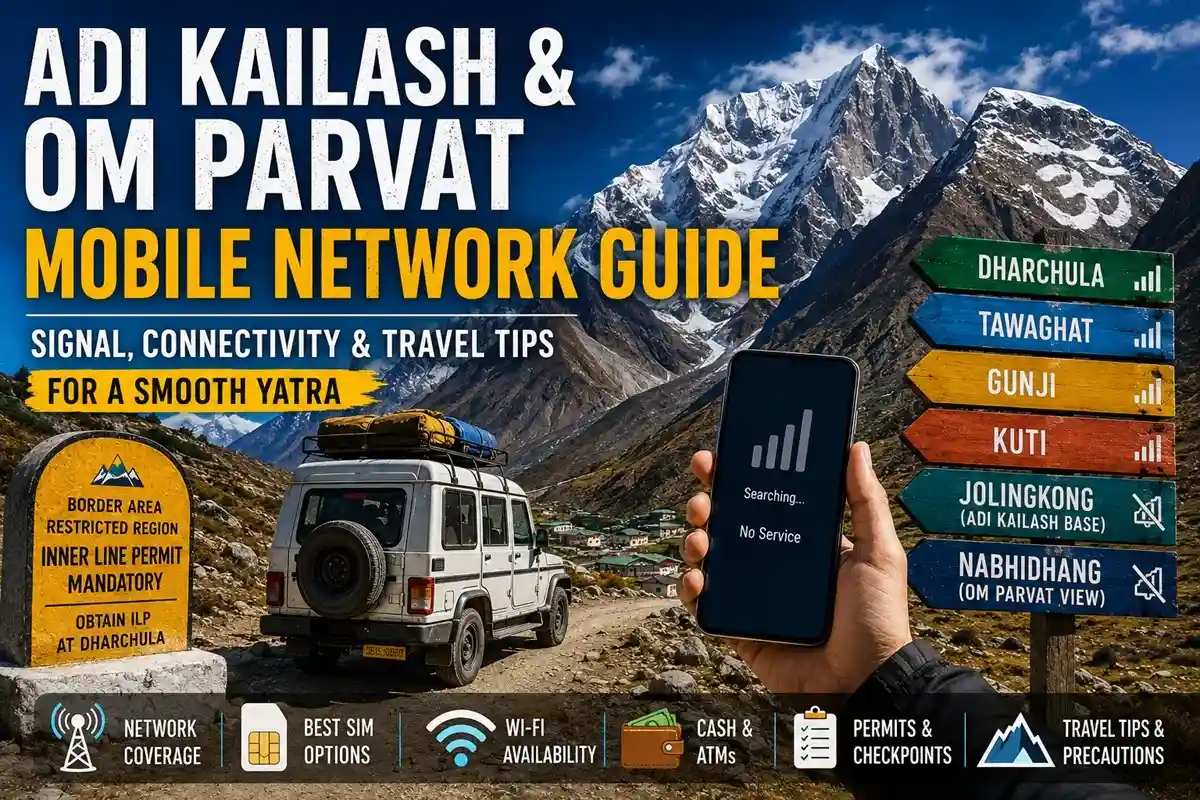
Adi Kailash and Om Parvat Are Two Different Destinations
A common source of confusion: Adi Kailash and Om Parvat are separate peaks, reached by separate branches of the same route, and both are viewed from a distance rather than climbed.
Gunji (around 3,200 m) is the junction. One branch goes via Kuti to Jyolingkong for Adi Kailash darshan; the other goes via Kalapani to Nabhidhang for the Om Parvat view. Network conditions differ slightly on each branch, and most itineraries visit both from the same Gunji base.
Where Mobile Network Typically Becomes Unreliable
| Location |
Approx. Altitude |
Commonly Reported Network Status |
| Dharchula |
~915–940 m |
Airtel, Jio, BSNL — generally reliable |
| Tawaghat |
~900–1,000 m |
Variable, drops quickly beyond town |
| Budhi |
~2,600–2,800 m |
Weak to no signal reported |
| Gunji |
~3,200 m |
BSNL reported in patches; Jio rare |
| Nabi village |
~3,200–3,300 m |
BSNL patchy; limited community Wi-Fi reported |
| Kuti village |
~3,600–3,700 m |
Limited Jio-related reports, not consistent |
| Jyolingkong (Adi Kailash base area) |
~4,400–4,600 m |
No dependable signal reported |
| Nabhidhang (Om Parvat viewpoint) |
~4,000–4,300 m |
No dependable signal reported |
Altitudes above are approximate and vary between mapping sources. Treat the table as a planning reference, not a live coverage map.
Route Distances at a Glance
| Route Section |
Approx. Distance |
| Dharchula → Tawaghat |
18–20 km |
| Tawaghat → Gunji |
70–80 km |
| Gunji → Kuti → Jyolingkong |
30–35 km combined |
| Gunji → Kalapani → Nabhidhang |
17–20 km combined |
Figures are approximate — actual distance and travel time depend on road conditions and your itinerary’s exact stops.
Best Time to Visit — and Why It Affects Signal Too
The season generally runs May to October, subject to snow clearance and district approval — official dates shift yearly, so confirm the current schedule before booking. Most experienced travellers favour May–June or September–October, when roads are stabler and BSNL towers face less pilgrim-load congestion.
July–August is monsoon season. Landslide risk on the Dharchula–Gunji stretch is high enough that permits have been paused temporarily in recent seasons, sometimes with little notice. If travelling in peak monsoon, check permit status directly with the Dharchula SDM office first.
Which SIM Tends to Work Best — BSNL, Jio, or Airtel?
Based on repeated traveller feedback, BSNL is the operator most often reported as usable beyond Dharchula. This isn’t a guarantee — even BSNL frequently fails past Kuti.
- BSNL — Most commonly reported working in patches at Gunji and Nabi.
- Jio — Some travellers report limited signal near Kuti village; not consistent enough to rely on.
- Airtel — Generally reliable up to Dharchula, then unreliable.
- Vodafone-Idea — Least reported working of the four beyond the road-head.
If you’re travelling from outside Uttarakhand, carrying a BSNL SIM as backup alongside your regular number is a commonly recommended precaution.
Registration, ILP, and Carrying the Right Documents
An Inner Line Permit (ILP) is required for Indian travellers, since the route passes through a restricted border zone. Permits are issued from the SDM office in Dharchula; online pre-registration is available, but physical collection remains part of the process.
Your permit is checked physically at multiple checkpoints beyond Dharchula. Since there’s no signal to pull up a digital copy if something goes wrong, carry several photocopies of your ILP and ID.
Cash, UPI, and Digital Payments Beyond Dharchula
Mobile data is unreliable past Dharchula, so UPI and card payments often fail. Homestays, porters, and roadside dhabas from Tawaghat onward mostly run on cash.
- Withdraw what you need in Dharchula — the last stop where ATM access is generally dependable.
- Carry enough cash for your full itinerary plus a buffer; ask your operator what’s already included.
- Don’t assume a homestay in Gunji or Kuti can scan a QR code — treat digital payment only as backup.
Practical Tips for Staying in Touch
- Share your day-by-day plan with family before leaving Dharchula, your last dependable network point.
- Check in whenever you catch a BSNL patch at Gunji or Nabi, rather than waiting for a stronger signal.
- Some homestays in Nabi occasionally offer limited Wi-Fi — confirm locally rather than relying on it.
- ITBP checkpoints have their own communication channels reserved for genuine emergencies.
- Download offline maps (Google Maps offline or Maps.me) before Dharchula — your backup once GPS loses data.
Latest 2026 Update
As of mid-2026, the yatra has already seen a temporary suspension of Inner Line Permits due to heavy monsoon rainfall — a pattern seen in recent seasons too. This doesn’t affect network directly, but it’s a reminder that both road access and connectivity here depend heavily on weather. Reconfirm permit status and road conditions with your operator close to your travel date, especially in July–August.
Senior Citizen and Family Travel Tips
Senior citizens are often advised to carry a BSNL SIM and a printed list of emergency contacts. Families commonly nominate one member to check in whenever signal appears, rather than everyone calling separately.
A power bank in the 10,000–20,000mAh range is strongly recommended, since charging options can be limited beyond Gunji and cold drains batteries faster.
Key Takeaways
- Dharchula is generally the last point of consistent, multi-operator network — not a guaranteed hard cutoff, but the safest assumption.
- BSNL is the operator most often reported working in patches beyond Dharchula.
- Jyolingkong and Nabhidhang rarely have usable signal, based on traveller reports.
- UPI and cards frequently fail past Dharchula — carry sufficient cash.
- Permits and connectivity both depend on weather; reconfirm close to your travel date.
FAQs
Does BSNL work at Adi Kailash?
Patchy BSNL signal is reported at Gunji and Nabi, but not at Jyolingkong.
Is there mobile network at Om Parvat?
Nabhidhang rarely has usable signal from any operator, per traveller reports.
What’s the last reliable mobile network point before Adi Kailash?
Dharchula, where Airtel, Jio, and BSNL generally work.
Which SIM works best for the Adi Kailash Yatra?
BSNL is most commonly reported as the more useful backup beyond Dharchula.
Can I use UPI during the Adi Kailash Yatra?
It often fails beyond Dharchula — carry cash as your main payment method.
Is Wi-Fi available anywhere on the route?
Limited, unreliable Wi-Fi is sometimes reported in Nabi village.
How many checkpoints check the ILP on this route?
Multiple ITBP checkpoints beyond Dharchula, though the exact number can vary.
Is Jio available near Kuti village?
Some limited signal is reported, but it isn’t consistent enough to rely on.
Does the yatra route stay open all year?
No — the region generally closes for winter, though exact dates vary yearly.
Are permits ever suspended during the yatra season?
Yes, temporarily during heavy monsoon rain — this has happened in recent seasons.
Is there an ATM after Dharchula?
Dependable ATMs are not commonly reported beyond Dharchula — withdraw there.
Should senior citizens carry a specific SIM?
BSNL is generally recommended alongside a printed emergency contact list.
Final Word
Adi Kailash and Om Parvat sit deep in a restricted Himalayan border zone, and that remoteness is part of what makes the pilgrimage powerful — but Adi Kailash Om Parvat mobile network access stays limited for most of the route. Treat Dharchula as your last dependable contact point, carry a BSNL SIM as backup, keep enough cash on hand, and confirm both permit status and signal expectations with your operator before departure. Go prepared for limited connectivity, not guaranteed coverage.


 Call
Call Enquiry