Last Updated on 17/06/2026
The Kailash Mansarovar Yatra by helicopter is a sacred pilgrimage of profound spiritual significance for followers of Hinduism, Buddhism, Jainism, and Bon. Mount Kailash — the divine abode of Lord Shiva — and Lake Mansarovar hold a revered place in all four traditions.
For those seeking a more accessible option, the helicopter route offers faster travel and reduced road time compared to traditional overland treks. However, it does not eliminate the high-altitude Kailash Parikrama — unless you choose a package that specifically skips the Kora. This guide covers the complete helicopter route itinerary, 2026 status, verified cost range, altitude data, and practical tips.
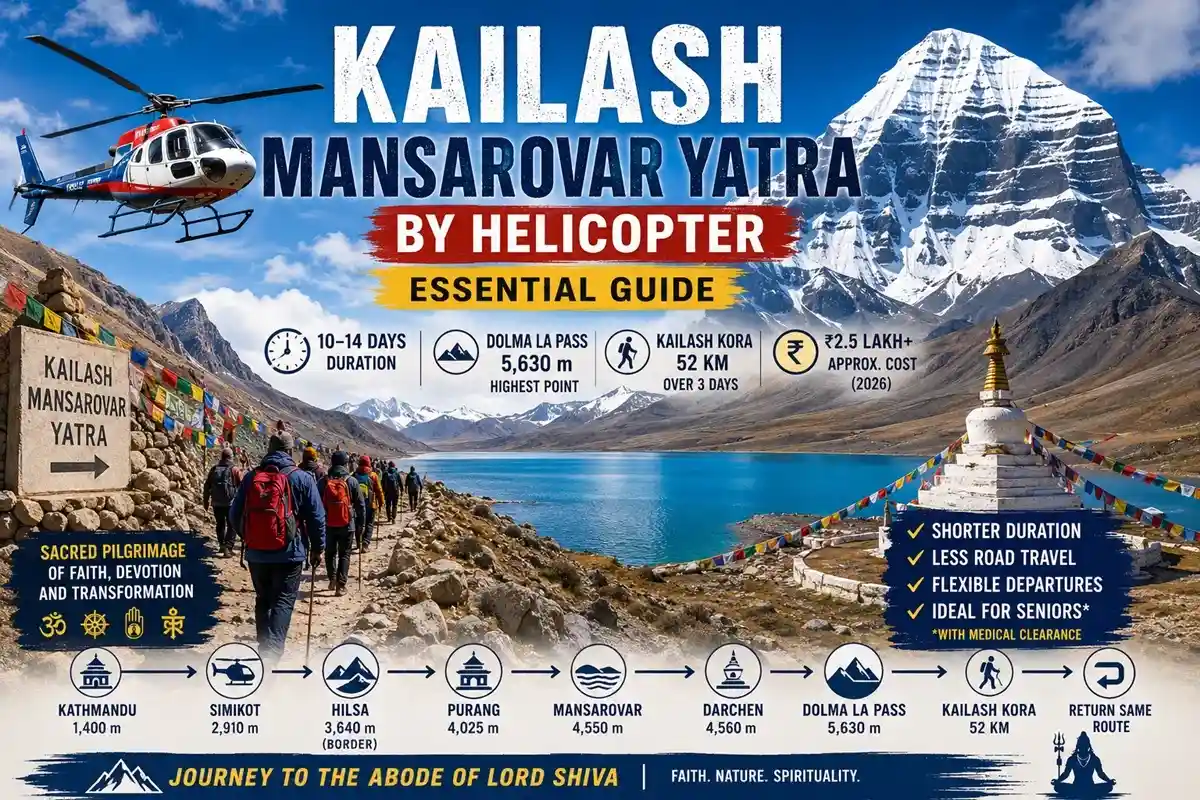
Kailash Mansarovar Yatra 2026 – Current Status
2026 Update: The Kailash Mansarovar Yatra was suspended from 2020 due to COVID-19 and India-China diplomatic tensions. It resumed in 2025 as confirmed by the Ministry of External Affairs (MEA), Government of India. The Yatra is currently open for 2026 via the Nepal helicopter route and MEA government routes. Verify the latest status at mea.gov.in before booking.
⚡ Quick Answer – Kailash Mansarovar by Helicopter:
- Route: Kathmandu → Nepalgunj → Simikot → Hilsa (helicopter) → Purang → Mansarovar → Darchen → Kailash Kora
- Duration: 10–14 days (standard); 5-day express packages also available
- Cost 2026: ₹2.5 lakh+ depending on operator, accommodation, and inclusions
- Highest Point: Dolma La Pass — 5,630 m (18,471 ft)
- Trek Distance: Kailash Kora ≈ 52 km over 3 days (pony/porter option available)
- Best Months: May–June and September
Key Altitudes on the Helicopter Route
| Location |
Altitude |
Role in Yatra |
| Kathmandu |
1,400 m (4,593 ft) |
Departure; acclimatisation start |
| Simikot |
2,910 m (9,547 ft) |
Last Nepali town; helicopter to Hilsa |
| Hilsa (Border) |
3,640 m (11,942 ft) |
Nepal-Tibet border crossing |
| Purang (Taklakot) |
4,025 m (13,205 ft) |
First Tibetan town; acclimatisation |
| Lake Mansarovar |
4,550 m (14,928 ft) |
Sacred lake; holy dip; 105 km parikrama by bus |
| Darchen |
4,560 m (14,960 ft) |
Base camp for Kailash Kora |
| Dirapuk |
4,890 m (16,043 ft) |
Day 1 night camp; North Face view |
| Dolma La Pass |
5,630 m (18,471 ft) |
Highest point of Kailash Kora |
| Zutulphuk |
4,760 m (15,617 ft) |
Day 2 night camp |
| Mount Kailash |
6,638 m (21,778 ft) |
Sacred peak — circumambulated, never climbed |
Kailash Mansarovar Helicopter Route – Step by Step
Here is the complete entity map and travel flow for the helicopter Yatra:
| Stage |
Location |
Transport |
Key Activity |
| 1 |
Kathmandu (1,400 m) |
Fly from India |
Rest, briefing, Kathmandu darshan |
| 2 |
Nepalgunj (150 m) |
Domestic flight |
Transit; hotel rest |
| 3 |
Simikot (2,910 m) |
Domestic flight |
Rest; acclimatisation; board helicopter |
| 4 |
Hilsa (3,640 m) |
Helicopter (20 min) |
Border crossing; Nepal & China immigration |
| 5 |
Purang/Taklakot (4,025 m) |
Road (45 min) |
Acclimatisation day; market visit |
| 6 |
Lake Mansarovar (4,550 m) |
AC Volvo bus (2 hrs) |
Holy dip; 105 km lake parikrama by bus; puja |
| 7 |
Darchen (4,560 m) |
Short drive |
Kailash Kora preparation; rest |
| 8 |
Dirapuk (4,890 m) |
Trek 10–12 km |
Day 1 Kora; North Face darshan |
| 9 |
Dolma La (5,630 m) |
Trek |
Day 2 Kora; highest point crossing |
| 10 |
Zutulphuk (4,760 m) |
Trek |
Day 2 night camp |
| 11 |
Darchen → Purang |
Trek 8 km + drive |
Day 3 Kora complete; return to Purang |
| 12 |
Purang → Hilsa → Simikot |
Road + Helicopter |
Return border crossing; helicopter Hilsa–Simikot |
| 13 |
Nepalgunj → Kathmandu |
Domestic flights |
Return journey; home |
Advantages of Choosing the Helicopter Route
- Time Efficiency: Reduces total duration from 3+ weeks (overland) to 10–14 days. Ideal for pilgrims with limited leave.
- Flexibility: Unlike MEA government routes (lottery-based, fixed batches), the Nepal helicopter route via private operators allows direct booking with flexible departure dates.
- Accessibility: Recommended for medically fit senior citizens and those who cannot manage extended road journeys. However, the Kailash Kora (52 km, 3 days) still requires good physical fitness unless you choose an express package that skips it.
- Reduced Road Fatigue: Eliminates the long overland drives of the Lipulekh route. Most transit is by air or short road segments.
Cost Note: Nepal helicopter packages typically start from approximately ₹2.5 lakh per person, depending on operator, accommodation standard, permit costs, and inclusions. Prices change seasonally — always request a current quote from your operator before booking.
MEA Route Cost: The Indian Government MEA routes (Lipulekh/Nathu La) are generally more affordable, with estimates in the ₹1.7–1.9 lakh range as per the latest available MEA information, subject to annual revision. MEA routes operate on a government lottery system.
Medical Note: The helicopter route does not reduce altitude risks. Purang is at 4,025 m, Mansarovar at 4,550 m, and Dolma La at 5,630 m. Altitude sickness risks are identical for all routes. Medical clearance is mandatory for all pilgrims.
Helicopter Route vs Overland Routes – Comparison
| Factor |
Helicopter (Nepal) |
Private Overland (Nepal) |
MEA Lipulekh (Govt) |
| Duration |
10–14 days |
13–16 days |
~22 days |
| Approx. Cost |
₹2.5 lakh+ |
₹2–2.4 lakh |
₹1.7–1.9 lakh (est.) |
| Booking |
Direct, flexible |
Direct, flexible |
Government lottery |
| Road travel |
Minimal |
More road travel |
Long road sections |
| Best for |
Seniors, time-pressed |
Budget-flexible |
Budget-conscious |
| Trek required |
Kora 52 km (optional) |
Kora 52 km |
Kora 52 km |
Detailed Itinerary – Kailash Mansarovar Helicopter Yatra
Day 1: Arrival in Kathmandu (1,400 m)
Transfer to hotel on arrival. Rest and acclimatisation. Optional: explore Kathmandu’s markets and temples. Briefing about the upcoming Kailash Mansarovar helicopter journey. Overnight Kathmandu.
Day 2: Kathmandu to Nepalgunj
Domestic flight to Nepalgunj. Transit day. Hotel check-in, briefing session, rest. Overnight Nepalgunj.
Day 3: Nepalgunj → Simikot → Hilsa → Purang
Early morning flight Nepalgunj to Simikot (~45 min). Short rest. Helicopter Simikot to Hilsa (~20 min, spectacular views of River Karnali gorge). Complete Nepal and China immigration. Drive ~45 min to Purang (Taklakot, 4,025 m). Overnight Purang.
Day 4: Acclimatisation in Purang (4,025 m)
Full rest day at Purang. Essential for altitude adjustment before proceeding to 4,550 m and above. Short gentle walks permitted. Explore local market. Overnight Purang.
Day 5: Purang to Lake Mansarovar (4,550 m)
Drive ~88 km by AC Volvo-category bus (~2 hours). En route: Rakshas Tal and first view of Mount Kailash. Arrive Lake Mansarovar. Perform 105 km lake parikrama by bus, take holy dip, perform puja. Overnight guesthouse near Mansarovar.
Day 6: Mansarovar to Darchen (4,560 m)
Short drive to Darchen, base camp for Kailash Kora. Rest and mental preparation for the 52 km trek. Overnight Darchen.
Days 7-9: Kailash Parikrama (Kora) – 52 km
- Day 7: Darchen → Yamdwar → Dirapuk (~12 km, 4–6 hrs). North Face of Kailash darshan.
- Day 8: Dirapuk → Dolma La Pass (5,630 m) → Zutulphuk (~22 km). Most challenging day.
- Day 9: Zutulphuk → Darchen (~8 km, 2–3 hrs). Kora complete. Drive to Purang.
Days 10-11: Return to Kathmandu
- Purang to Hilsa: Road transfer (~25 km, ~45 min). Note: return is by road Purang→Hilsa, then helicopter Hilsa→Simikot — not a direct Darchen-to-Hilsa helicopter.
- Hilsa to Simikot: Helicopter (~20 min).
- Simikot to Nepalgunj: Domestic flight (~45 min).
- Nepalgunj to Kathmandu: Domestic flight. Overnight Kathmandu.
- Day 11: Onward flight home.
Kailash Parikrama (Kora) – Key Facts
- Distance: ~52 km total circuit from Darchen
- Duration: 3 days standard (some complete in 1 day, not recommended)
- Highest point: Dolma La Pass — 5,630 m (18,471 ft)
- Direction: Clockwise (Hindus, Buddhists); anti-clockwise (Bon pilgrims)
- Ponies/Porters: Available at Darchen; recommended for elderly or less fit pilgrims
- Skip option: Yes — express packages exist that skip the Kora; darshan from Darchen only
- Climbing: Mount Kailash is NEVER climbed — circumambulation only; climbing is prohibited
Weather on the Kailash Mansarovar Helicopter Route – Month by Month
| Month |
Temperature |
Conditions |
Recommendation |
| April |
5°C to 12°C day; -5°C night |
Cool, some snow, early opening |
Early season; possible delays |
| May |
8°C to 16°C day; 0°C night |
Clear, Saga Dawa festival |
★ Best season |
| June |
10°C to 18°C day; 3°C night |
Ideal, long daylight |
★ Best season |
| July |
10°C to 20°C day; 5°C night |
Tibet dry; Nepal border has rain |
Good — Tibet route preferred |
| August |
10°C to 20°C day; 5°C night |
Similar to July |
Good |
| September |
5°C to 15°C day; 0°C night |
Post-monsoon, clear views |
★ Best season |
| October |
0°C to 10°C day; -5°C night |
Cold nights; season closing |
Late season; plan early departure |
| Nov–Mar |
Extreme cold; routes closed |
−15°C to −25°C nights |
Avoid — inaccessible |
Practical Information for the Helicopter Yatra
Mobile Network and Internet Connectivity
- India (before Nepal): Indian SIM cards work until the Indian border. Do not rely on Indian SIM in Nepal or Tibet.
- Nepal: Nepali SIM cards (Ncell, NTC) work in Kathmandu, Nepalgunj, and Simikot.
- Tibet: Only Chinese SIM cards work in Tibet. Indian or Nepali SIMs have no service in Purang, Mansarovar, or Darchen.
- Recommended: Purchase a Chinese SIM at Hilsa or Purang. Internet is very limited and slow. Inform family members in advance about expected communication blackout zones.
- Satellite phones: Available with most tour operators; strongly recommended for emergency communication in Tibet.
Currency on the Route
- India: Indian Rupee (INR) — carry sufficient cash before entering Nepal.
- Nepal: Nepali Rupee (NPR). Indian INR ₹100 and ₹200 notes are accepted in Nepal.
- Tibet: Chinese Yuan (CNY/RMB) is the only currency accepted in Tibet (Purang, Mansarovar, Darchen). Your tour operator will exchange currency on the Tibet side.
- ATMs: Available in Kathmandu. Very limited in Nepalgunj. None in Simikot, Hilsa, or beyond in Tibet.
- Carry cash: Withdraw sufficient cash before Simikot. No ATMs on the Tibet stretch of the route.
Food on the Route
- Kathmandu & Nepalgunj: Wide variety of Indian, Nepali, and continental food available.
- Simikot: Basic Nepali food; vegetarian options available.
- Tibet (Purang, Mansarovar, Darchen): Chinese and Tibetan food. All meals on tour are strictly vegetarian (no non-vegetarian food served during the pilgrimage). Jain food requests can be accommodated by some operators — inform in advance.
- Water: Do not drink tap water. Carry water purification tablets. Bottled water (Tibetan) available at Purang and Mansarovar at cost.
- Carry: Energy bars, dry fruits, glucose biscuits, and instant soup sachets for the Kailash Kora trek where stalls are absent.
Oxygen Availability
- Portable oxygen: Available at Darchen and most guesthouses at Simikot, Purang, and along the Kora route.
- Oxygen cylinders: Can be purchased at Purang market (carry local currency). Your tour operator typically includes emergency oxygen.
- Important: Oxygen is a supplement, not a cure for AMS. If severe symptoms occur, descent is the only effective treatment. Do not rely solely on supplemental oxygen.
Helicopter Baggage Limit
- Simikot – Hilsa helicopter: Strict weight limit of approximately 10–15 kg per person including hand luggage (varies by operator and helicopter type).
- Domestic flights Nepal: Standard 15–20 kg checked + 7 kg cabin baggage; verify with airline.
- Recommendation: Pack light. A single 40–50 litre backpack is ideal for the Kora. Large suitcases are impractical and may be left in Kathmandu.
Preparing for the Kailash Mansarovar Helicopter Yatra
Health and Altitude
Altitude risks are the same on all routes — Purang 4,025 m, Mansarovar 4,550 m, Dolma La 5,630 m. Consult your doctor before travel. A medical fitness certificate is required by most operators.
Documentation and Permits
Indian nationals do not require a visa to enter Nepal — a valid Indian passport is sufficient. However, an Indian passport is mandatory (not just Aadhaar or Voter ID) for Tibet entry, as the Tibet Travel Permit and Chinese Group Visa require passport details.
Required for Tibet: Tibet Travel Permit (TTP), Alien Travel Permit (ATP), Military Permit, and Chinese Group Visa — all arranged by your tour operator via Kathmandu. OCI card holders and foreign nationals should clarify requirements with their operator in advance.
Travel Insurance
Standard travel insurance is insufficient. Ensure your policy covers high-altitude pilgrimage above 5,000 m and helicopter medical evacuation from remote Tibet.
Packing Essentials
Thermal innerwear, windproof/waterproof jacket, warm gloves, balaclava, UV sunglasses, high-SPF sunscreen, trekking poles, waterproof boots, altitude medication (doctor-advised), personal medicines, energy snacks, water purification tablets.
Cultural Sensitivity
Perform Kailash Kora clockwise. Respect local Tibetan customs at all gompas and monasteries. No littering on the sacred route. Ask permission before photographing locals.
Conclusion
The Kailash Mansarovar Yatra by helicopter via Nepal offers a time-efficient sacred pilgrimage — ideal for those with limited time, seniors (with medical clearance), and pilgrims who prefer booking flexibility without a government lottery. The route spans Kathmandu → Nepalgunj → Simikot → Hilsa → Purang → Mansarovar → Darchen → Kailash Kora in 10–14 days.
For 2026, Nepal helicopter packages start from approximately ₹2.5 lakh per person — more than the MEA government route but offering guaranteed bookings and schedule flexibility. Whatever route you choose for this Mount Kailash helicopter tour, prepare thoroughly for high altitude, carry all Tibet permits, and allow acclimatisation days. The Kailash Mansarovar pilgrimage is one of the most transformative spiritual journeys on earth.
Frequently Asked Questions
Q1. What is the Kailash Mansarovar helicopter route?
Kathmandu → Nepalgunj → Simikot (flight) → Hilsa (helicopter, 20 min) → Purang (road) → Mansarovar → Darchen → Kailash Kora (52 km, 3 days) → return same route. Total: 10–14 days.
Q2. How many days does Kailash Mansarovar by helicopter take?
Standard packages take 10–14 days from Kathmandu. Express 5-day packages are available for pilgrims who skip the Kailash Kora. Duration varies by operator and number of acclimatisation days included.
Q3. What is the Kailash Mansarovar helicopter tour cost in 2026?
Nepal helicopter packages generally start from approximately ₹2.5 lakh per person in 2026, depending on operator, accommodation, and inclusions. Prices are seasonal and change based on currency rates and permit costs — always request a current quote before booking.
Q4. Is the helicopter route cheaper than the MEA government route?
No. The helicopter route costs more than the MEA Lipulekh route, which is estimated at ₹1.7–1.9 lakh as per the latest available MEA information (subject to annual revision). The helicopter option offers booking flexibility and shorter duration but at a higher price.
Q5. What altitude does the helicopter route reach?
Purang (Taklakot): 4,025 m. Lake Mansarovar: 4,550 m. Darchen: 4,560 m. Dolma La Pass (Kailash Kora): 5,630 m (18,471 ft) — the highest point. Mount Kailash stands at 6,638 m but is never climbed.
Q6. Is Kailash Mansarovar helicopter Yatra open in 2026?
Yes. After suspension from 2020–2024, the Yatra resumed in 2025 as confirmed by the MEA, Government of India. In 2026, the Nepal helicopter route via private operators is operational. Verify current status at mea.gov.in or with your operator.
Q7. Can senior citizens do Kailash Mansarovar by helicopter?
Yes, for medically fit senior citizens with doctor’s clearance. The helicopter route minimises road travel. However, Dolma La Pass at 5,630 m is physically demanding. Pony and porter services are available for the Kora. Express packages skipping the Kora are also available.
Q8. Can I skip the Kailash Parikrama (Kora)?
Yes. Some express packages offer Kailash Mansarovar Yatra without the full 3-day Kora trek. These include Mansarovar visit, Darchen darshan, and aerial or road view of Mount Kailash without completing the 52 km circumambulation. Inform your operator at booking.
Q9. What permits are required for the helicopter route?
Indian passport (mandatory for Tibet), Tibet Travel Permit (TTP), Alien Travel Permit (ATP), Military Permit, Chinese Group Visa. All Tibet permits are arranged by your operator via Kathmandu. Indian nationals do not require a Nepal visa — a valid passport is sufficient.
Q10. Is oxygen available on the Kailash Mansarovar helicopter route?
Yes. Portable oxygen cylinders are available at Purang market, most guesthouses along the route, and at Darchen. Most tour packages include emergency oxygen. However, supplemental oxygen does not cure AMS — descent remains the most effective treatment for severe altitude sickness.
Q11. Can diabetics go on the Kailash Mansarovar Yatra by helicopter?
Diabetic pilgrims can undertake the Yatra with proper preparation and doctor’s clearance. Key precautions: blood sugar monitoring becomes more challenging at altitude; pack sufficient insulin/medication; inform your tour operator in advance. Most operators have experienced medical staff accompanying groups.
Q12. Is an Indian passport mandatory for the Kailash helicopter route?
Yes, an Indian passport is mandatory. Aadhaar card, Voter ID, or other IDs are not accepted for Tibet entry. The Tibet Travel Permit and Chinese Group Visa are issued against passport details. Ensure your passport is valid for at least 6 months beyond your travel date.
Q13. Can women travel on the Kailash Mansarovar helicopter Yatra?
Yes, women of all ages can undertake the Kailash Mansarovar Yatra by helicopter. There are no gender restrictions. Pregnant women beyond 6 weeks and those with serious health conditions should consult their doctor. Most tour groups include women pilgrims.
Q14. What is the mobile network situation on the helicopter route?
Indian SIMs do not work in Nepal or Tibet. Nepali SIMs (Ncell, NTC) work up to Simikot. Chinese SIMs are needed in Tibet — purchase at Purang. No internet connectivity at Mansarovar or Darchen. Inform family of expected communication blackout zones before departure.
Q15. What is the baggage limit on the Simikot-Hilsa helicopter?
Approximately 10–15 kg per person including hand luggage (varies by operator and helicopter type). Pack light — a 40–50 litre backpack is ideal. Large suitcases can be stored in Kathmandu. Excess luggage may be charged extra or left behind.
Q16. What currency is needed on the Kailash helicopter route?
Indian Rupees until Nepal border. Nepali Rupees in Nepal (₹100/200 INR notes accepted). Chinese Yuan (CNY/RMB) in Tibet — no other currency accepted. Withdraw sufficient cash at Kathmandu ATMs as there are no ATMs beyond Nepalgunj on this route.
Q17. What food is available on the Kailash helicopter route?
All tour meals are strictly vegetarian. Tibetan and Chinese food is served in Tibet. Jain food can be arranged by some operators if requested in advance. Carry energy bars and dry fruits for the Kailash Kora where food stalls are absent.
Q18. What is the Kailash Mansarovar helicopter fitness requirement?
Good cardiovascular fitness is essential for the Kailash Kora (52 km over 3 days at 4,560–5,630 m). Start walking 5–10 km daily at least 6–8 weeks before the Yatra. Yoga and breathing exercises help with altitude adaptation. A medical fitness certificate from your doctor is required by all operators.


 Call
Call Enquiry