Last Updated on 26/05/2026
Every year, millions of pilgrims cross high Himalayan passes to complete the Chardham Yatra — visiting Yamunotri, Gangotri, Kedarnath, and Badrinath. It is one of the most spiritually powerful journeys a Hindu can undertake. But it is also one of the most physically demanding. Altitudes crossing 10,000 feet, narrow mountain roads, rapidly shifting weather, and patchy mobile connectivity make it essential to be prepared.
What most people don’t think about before leaving: what actually happens in a genuine emergency up there?
This guide covers every emergency contact number you need for Chardham Yatra 2026, along with verified hospital details for all four Dham routes. Every figure here is sourced from official Uttarakhand government press releases (March–April 2026) and confirmed news reports. Nothing random. Nothing generic. Save these numbers before you leave — not after you need them.
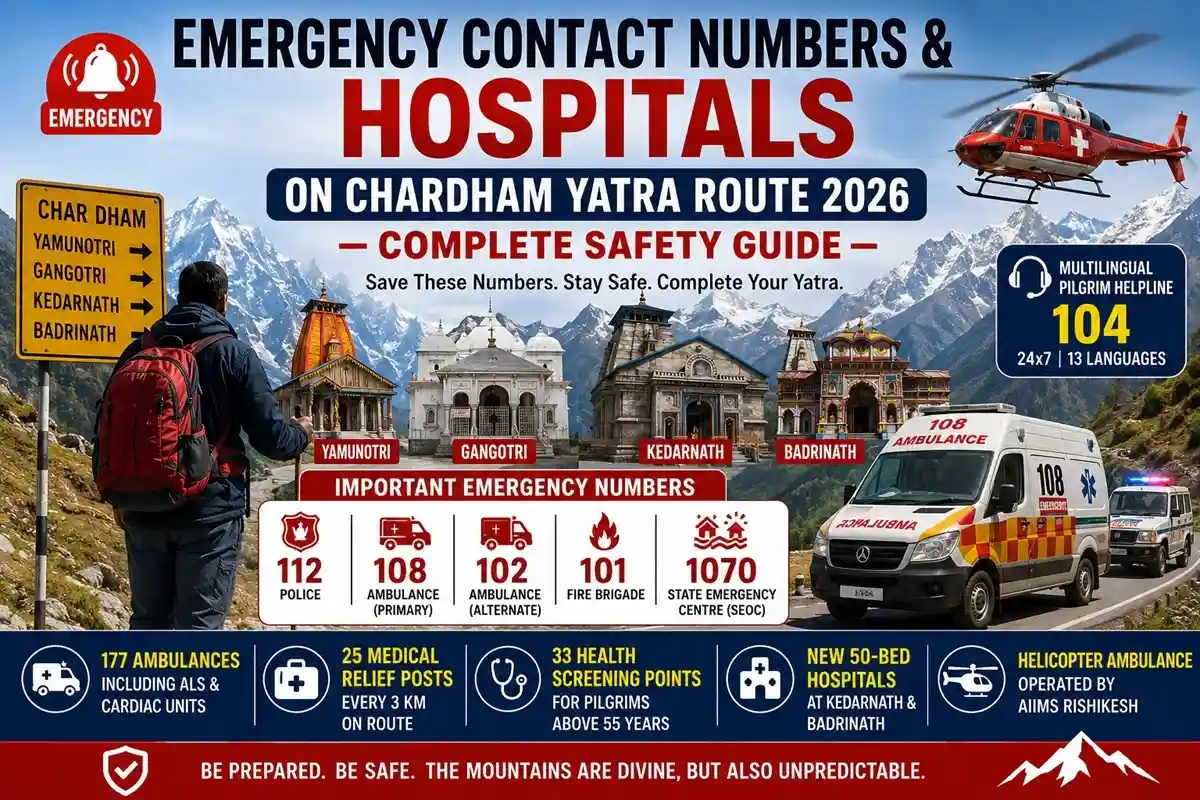
Quick Overview
Important Emergency Contact Numbers for Chardham Yatra 2026
Save every number below on your phone before the journey starts. Also write them on paper — mountain areas frequently have no signal, and you cannot search in a panic.
Police & Law Enforcement
- Police Control Room: 112 — Works across Uttarakhand. Your first call for accidents, road incidents, missing persons, or any threat to personal safety.
- Women’s Helpline: 1090 or 1800 180 4111 (toll-free) — For women pilgrims facing harassment or safety concerns anywhere on the route.
- Traffic Helpline: 7300702033 — For road accidents, highway jams, or vehicle breakdowns on Yatra routes.
- Anti-Corruption Helpline: 1064 — If a transport operator, guide, dharmshala staff, or official demands illegal payments.
- Cyber Crime Helpline: 1930 — For digital payment fraud, UPI scams, or phishing attempts targeting pilgrims at booking points.
Ambulance & Medical Emergency
- Ambulance (Primary): 108 — The main ambulance helpline across Uttarakhand. Covers 108 emergency service vehicles, Advanced Life Support (ALS) ambulances, and cardiac ambulances. (Source: Newsonair/AIR, March 17, 2026)
- Ambulance (Alternate): 102 — Use if 108 is busy or unreachable. Also works for medical transport of elderly pilgrims.
- Uttarakhand Tourism Helpline: 0135-1364 — For Yatra registration issues, e-pass queries, or general route guidance.
- Multilingual Pilgrim Helpline: 104 — Active 24×7 during 2026 Yatra season. Provides assistance in 13 languages including Hindi, English, Tamil, Telugu, Gujarati, Marathi.
Disaster Management & State Emergency
- State Emergency Operation Centre (SEOC): 1070 (toll-free) or 0135-2710334 — For landslides, floods, cloudbursts, road washouts, or large-scale natural disasters. Operated by Uttarakhand SDMA.
- District Emergency Operation Centre (DEOC): 1077 — For district-level emergencies and coordinated rescue operations.
- Fire Brigade: 101 — For fire emergencies at hotels, dhabas, camps, or forest fires near the route.
- Child Helpline: 1098 — If a child is lost, separated, or in distress along the Yatra route.
At-a-Glance Emergency Numbers Table
| Service |
Number |
When to Use |
| Police Control Room |
112 |
Accidents, crime, missing persons |
| Ambulance (Primary) |
108 |
Medical emergency, cardiac arrest, injuries |
| Ambulance (Alternate) |
102 |
Medical transport if 108 unreachable |
| Fire Brigade |
101 |
Fire at hotel, vehicle, forest |
| SEOC – State Disaster |
1070 / 0135-2710334 |
Landslides, floods, major disasters |
| DEOC – District Level |
1077 |
District emergencies & rescue coordination |
| Tourism Helpline |
0135-1364 |
Registration, e-pass, general Yatra queries |
| Multilingual Helpline |
104 |
Help in 13 languages — 24×7 |
| Women’s Helpline |
1090 |
Harassment, safety complaints by women |
| Anti-Corruption |
1064 |
Illegal demands by operators or officials |
| Child Helpline |
1098 |
Lost child, child in distress |
| Cyber Crime |
1930 |
Online fraud, UPI/payment scams |
2026 Chardham Yatra Medical Infrastructure — What’s Actually in Place
The Uttarakhand government launched a comprehensive healthcare overhaul for the 2026 Yatra season, announced officially on March 17, 2026 by Health Minister Dr. Dhan Singh Rawat through the e-Swasthya Dham initiative. Here is exactly what is deployed — all figures from verified government sources:
- 177 Ambulances: Across all four Yatra routes — includes 108 emergency service vehicles, Advanced Life Support (ALS) ambulances, and dedicated cardiac ambulances. (Source: Newsonair, AIR official broadcast, March 17, 2026)
- 25 Medical Relief Posts (MRPs): Stationed every 3 km on the route — reduced from the earlier 8–10 km spacing. Distribution: 8 on Kedarnath route, 7 on Badrinath route, 5 on Gangotri route, 4 on Yamunotri route.
- 33 Health Screening Points: Where pilgrims above 55 years undergo mandatory checks — blood pressure, blood sugar, and ECG. (Source: Newsonair, March 17, 2026)
- 13 Primary Screening Corridors: Between Rishikesh and Jankichatti. A ‘Fit to Travel’ certificate is issued only to those whose health clears screening.
- New 50-Bed Hospitals at Kedarnath AND Badrinath: Announced February 28, 2026 by Health Minister Dr. Dhan Singh Rawat. Both hospitals equipped with oxygen support systems, emergency wards, and critical care units. (Source: TirthaYatra.org, Feb 28, 2026)
- Helicopter Ambulance — AIIMS Rishikesh: One helicopter ambulance deployed and operated through AIIMS Rishikesh. Critical patients airlifted directly to AIIMS Rishikesh or Doon Medical College.
- Boat Ambulance — Tehri Lake: One boat ambulance stationed at Tehri for water-based emergencies in that stretch.
- 100 Swasthya Mitras (Health Volunteers): Trained local youth stationed every 2 km on trekking routes. Each carries portable oxygen and first-aid kit. First responders before ambulance arrives.
- Medical Staff on Rotational Duty: 16 specialist doctors, 46 medical officers, and 85 paramedical staff deployed on 15-day rotational roster throughout the Yatra season. (Source: Newsonair, March 17, 2026)
- e-Swasthya Dham Portal: Real-time health monitoring system. Pilgrims fill health data at registration — high-risk pilgrims are flagged and monitored at altitude checkpoints.
- Drone Medicine Delivery: Drones being used to deliver emergency medicines to high-altitude points including Kedarnath, where road access for supply is limited.
Note on ambulance figures: Some earlier planning articles from 2025 mentioned ‘154 ambulances’ — that was the 2025 season target. The confirmed 2026 deployment figure is 177 ambulances, as officially announced by Uttarakhand Health Minister Dr. Dhan Singh Rawat on March 17, 2026 (Newsonair/All India Radio).
Hospitals on Chardham Yatra Route — Verified District-Wise List (2026)
Below is a district-wise list of government hospitals and Community Health Centres (CHCs) serving each Dham route. Contact numbers are sourced from official Uttarakhand Health Department records. Call ahead when possible — mobile signal near the temples can be unreliable.
Kedarnath Route — Hospitals in Rudraprayag District
Rudraprayag district covers the entire Kedarnath Yatra route. Gaurikund is the last road-reachable point — from there, pilgrims trek 16–18 km uphill to reach the temple at 11,755 ft. The District Hospital Rudraprayag and the new 50-bed hospital at Kedarnath (operational from April 2026) are the primary care points.
| Hospital / Facility |
Contact Number |
Location |
Key Specialties |
| District Hospital Rudraprayag |
8938062775 |
Rudraprayag Town |
Orthopaedics, General Surgery, ENT, Gynaecology, Paediatrics, Ophthalmology |
| CHC Augustmuni |
9501968083 |
Augustmuni (Kedarnath route) |
Paediatric Medical Management, General Care |
| CHC Jakholi |
7055632408 |
Jakholi |
General Care |
| New 50-Bed Hospital, Kedarnath |
— (Operated by State Govt) |
Kedarnath Temple area |
Oxygen support, Emergency ward, Critical care, High-altitude sickness (Operational from April 2026) |
| Swami Vivekanand Charitable Hospital, Kedarnath |
Contact via route MRP |
Near Kedarnath Dham |
Pilgrim first aid & emergency (Seasonal) |
Badrinath Route — Hospitals in Chamoli District
Chamoli district covers the Badrinath Dham route. Badrinath is road-accessible — making it the most accessible of the four Dhams for elderly pilgrims. Joshimath serves as the key transit town. Gopeshwar (district HQ) has the main referral hospital, and the new 50-bed hospital at Badrinath adds significant on-ground capacity in 2026.
| Hospital / Facility |
Contact Number |
Location |
Key Specialties |
| NS Bhandari Memorial District Hospital, Gopeshwar |
7668377541 |
Gopeshwar, Chamoli |
General Surgery, ENT, Orthopaedics, Oncology, Ophthalmology, Gynaecology, Paediatrics |
| CHC Joshimath |
9917118242 |
Near Narsingh Mandir, Joshimath |
Gynaecology, Paediatric Management |
| CHC Karanprayag |
8475076045 |
Karanprayag |
Surgery, Orthopaedics, ENT, Oncology, Gynaecology, Paediatrics |
| CHC Gairsain |
9582479042 |
Gairsain, Chamoli |
Orthopaedics, Gynaecology, Paediatrics |
| CHC Tharali |
6395423255 |
Tharali |
Gynaecology, Orthopaedics, Paediatrics |
| CHC Pokhari |
9761804595 |
Vinayakdhar |
Orthopaedics, Gynaecology, Paediatrics |
| CHC Ghat |
7895126155 |
CHC Ghat |
Paediatrics, Gynaecology |
| Arihant Advanced Surgical Centre |
7055705579 |
Main Badrinath Road, Chamoli |
Emergency, General Surgery, General Medicine |
| New 50-Bed Hospital, Badrinath |
— (Operated by State Govt) |
Badrinath Temple area |
Oxygen support, Emergency ward, Critical care (Operational from April 2026) |
Gangotri & Yamunotri Routes — Hospitals in Uttarkashi District
Uttarkashi district covers both Gangotri and Yamunotri. Gangotri is road-accessible via Uttarkashi town. Yamunotri requires a 5–6 km trek from Janki Chatti (Barkot is the base town). The District Hospital Uttarkashi is the primary referral point — serious cases are transferred to AIIMS Rishikesh.
| Hospital / Facility |
Contact Number |
Location |
Key Specialties |
| District Hospital Uttarkashi |
9412394912 |
Uttarkashi Town |
ENT, General Surgery, Gynaecology, Paediatrics, Ophthalmology, Orthopaedics |
| CHC Chinyalisour |
8979353440 |
Chinyalisour, Uttarkashi |
General Care |
| CHC Naugaon |
8755805188 |
Naugaon, Uttarkashi |
General Care |
| CHC Purola |
8859515594 |
Purola, Uttarkashi |
Paediatric Care |
| Swami Vivekanand Charitable Hospital, Gangotri |
Contact via route MRP |
Near Gangotri Dham |
Pilgrim first aid & emergency (Seasonal) |
Tertiary & Referral Hospitals — For Critical & Surgical Cases
Any life-threatening emergency from any of the four Dhams ultimately gets referred to these hospitals via ambulance or helicopter. These are the end-point nodes of the Uttarakhand emergency chain:
| Hospital |
City |
Contact |
Role in Chardham Emergency System |
| AIIMS Rishikesh |
Rishikesh |
0135-2462900 |
Primary helicopter-receiving hospital. Operates helicopter ambulance for Yatra emergencies. Government’s top referral node. |
| Doon Medical College & Hospital |
Dehradun |
0135-2758300 |
Major government referral centre for critical pilgrim cases transferred from Yatra route. |
| Srinagar Medical College |
Srinagar, Garhwal |
01346-252162 |
Tertiary referral centre for Badrinath-Kedarnath corridor cases. Closer than Rishikesh. |
| Shri Guru Ram Rai Hospital |
Dehradun |
0135-2520700 |
Multi-specialty private referral hospital for Dehradun-based evacuation cases. |
Medical Relief Post (MRP) Distribution — Route-Wise
The 2026 season has 25 active Medical Relief Posts covering all four Yatra routes, spaced every 3 km — down from the previous 8–10 km spacing. Each MRP has a doctor or trained paramedic, oxygen supply, basic medicines, and communication equipment:
| Dham Route |
No. of MRPs (2026) |
Spacing |
Key Points Covered |
| Kedarnath Route |
8 MRPs |
Every 3 km |
Sonprayag, Gaurikund, Jungle Chatti, Bheembali, Lincholi, Rambada, Kedarnath base |
| Badrinath Route |
7 MRPs |
Every 3 km |
Joshimath, Govindghat, Pandukeshwar, Badrinath approach |
| Gangotri Route |
5 MRPs |
Every 3 km |
Uttarkashi, Harsil, Lanka, Gangotri approach |
| Yamunotri Route |
4 MRPs |
Every 3 km |
Barkot, Janki Chatti, trek route to Yamunotri |
Step-by-Step: What to Do in a Medical Emergency on the Yatra Route
Stay calm. Work through these steps in order:
- Call 108 immediately. This is the fastest route to ambulance response. State your location as specifically as possible — nearest town, km marker if visible, or landmark.
- If 108 is busy or no signal, call 112. Police coordinate emergency response and can alert ambulances faster in certain zones.
- Alert the nearest Swasthya Mitra — they are stationed every 2 km on trekking routes with portable oxygen and first aid. Or go to the nearest Medical Relief Post (every 3 km).
- For altitude sickness (AMS) — headache, nausea, confusion above 10,000 ft: Do NOT push forward. Move the person downhill immediately. Give supplemental oxygen if available. Call 108.
- For suspected cardiac arrest: Begin CPR if trained. Call 108 and 1070 simultaneously. Alert Swasthya Mitra and nearby pilgrims.
- For landslide or road blockage: Call 1070 (SEOC) or 1077 (DEOC). Do NOT attempt to cross a blocked or unstable road section under any circumstances.
- For a life-threatening case needing helicopter evacuation: Request through 108 or 1070. AIIMS Rishikesh’s helicopter ambulance is on standby. This is activated by the emergency coordination team — you cannot book it directly.
Common Mistakes Pilgrims Make — That Lead to Emergencies
- Hiding medical history during Yatra registration: The e-Swasthya Dham portal flags high-risk pilgrims for extra monitoring. If you don’t disclose BP, diabetes, or heart conditions, you lose this safety net. Be honest during registration.
- Rushing the Kedarnath trek: The 16–18 km climb to 11,755 ft is not a race. Overexertion is the leading trigger for cardiac and respiratory emergencies on this route. Pace yourself.
- Skipping acclimatization: Driving directly from Rishikesh to Kedarnath in one day is a risk, especially for first-time visitors. Resting a night at Guptkashi or Sonprayag helps your body adjust to altitude.
- Not carrying a first-aid kit: Basic items — ORS sachets, paracetamol, personal prescription medicines, and a pulse oximeter — are the difference between a mild inconvenience and a crisis. Keep them accessible, not buried in luggage.
- Ignoring early altitude sickness symptoms: Headache, nausea, and lightheadedness above 10,000 ft are not normal tiredness. They are early signs of AMS (Acute Mountain Sickness). Descent is the only reliable treatment.
- Storing emergency numbers only on the phone: Mobile networks cut out frequently on all four Yatra routes. Write key numbers on paper and keep it in your wallet or a ziplock bag in your bag.
- Booking helicopter tickets through touts: Kedarnath helicopter bookings are only through IRCTC or the official Uttarakhand government portal. Paying touts = losing money with no guarantee of service.
Pro Tips for a Safe Chardham Yatra 2026
- Register on the official portal: registrationandtouristcare.uk.gov.in — Yatra registration is mandatory for all four Dhams. Aadhaar is now compulsory as of 2026.
- Download ‘Tourist Care Uttarakhand’ app: Available on Google Play and App Store. Contains your e-pass, Yatra updates, and emergency contacts in one place.
- Carry a pulse oximeter: If SpO2 (blood oxygen saturation) drops below 90% at altitude, sit, breathe slowly, and seek help immediately. Normal range is 95–100%.
- Carry BSNL or Jio SIM: These networks have the best coverage in remote Himalayan areas. Other operators frequently lose signal in deep mountain valleys.
- Use the 104 helpline: If you or a family member speaks limited Hindi, call 104 for assistance in Tamil, Telugu, Gujarati, Marathi, English, and 8 other languages. Staff are trained to help pilgrims in distress.
- Night driving ban: 8 PM to 4 AM night driving is prohibited on all hill roads in Uttarakhand. Plan your stops around this — being caught on a mountain road after dark without a safe halt is dangerous.
- For senior citizens and heart patients: Badrinath is fully road-accessible. Gangotri is road-accessible. Yamunotri’s trek can be done by pony or palki. Kedarnath helicopter yatra (book via IRCTC) is the safest option for high-risk pilgrims.
Pre-Yatra Health Checklist — 2026
| Item |
Who Needs It |
Details |
| Pre-travel medical check-up |
Mandatory for age 55+; advised for all |
BP, blood sugar, ECG minimum |
| ‘Fit to Travel’ Certificate |
Mandatory for age 55+ or with conditions |
Issued at 13 screening points from Rishikesh |
| Pulse Oximeter |
All pilgrims — strongly recommended |
Monitor SpO2 at high altitude checkpoints |
| Personal prescription medicines |
All pilgrims taking regular medication |
Carry 7–10 extra days’ supply beyond trip duration |
| ORS sachets |
All pilgrims |
Essential for dehydration at altitude |
| Paracetamol & basic first aid |
All pilgrims |
For headaches, fever, minor injuries |
| Altitude sickness medication |
Recommended for Kedarnath / Badrinath |
Consult your doctor about Acetazolamide (Diamox) |
| Written emergency numbers |
All pilgrims — non-negotiable |
Copy this article’s numbers before you go |
| Travel insurance with air evacuation |
Strongly recommended |
Ensure policy covers helicopter evacuation from remote areas |
| Chardham Yatra e-Pass |
Mandatory for all pilgrims |
registrationandtouristcare.uk.gov.in — Aadhaar required |
Frequently Asked Questions
Q1. What is the ambulance number for Chardham Yatra 2026?
The primary ambulance number is 108. An alternate line is 102. Both are active 24×7 across Uttarakhand. In 2026, 177 ambulances are deployed across all four Yatra routes — including advanced life support and cardiac ambulances. This was confirmed by Uttarakhand Health Minister Dr. Dhan Singh Rawat on March 17, 2026.
Q2. Is there a hospital at Kedarnath temple in 2026?
Yes — for the first time in 2026, a 50-bed hospital has been established at Kedarnath Dham, announced by Health Minister Dr. Dhan Singh Rawat in February 2026. It is equipped with oxygen support, an emergency ward, and critical care facilities. Previously, only basic Medical Relief Posts were available. The nearest full government hospital remains District Hospital Rudraprayag (8938062775).
Q3. What is the Uttarakhand government helpline for Chardham Yatra 2026?
The official Uttarakhand Tourism helpline is 0135-1364. For state-level emergencies (landslides, disasters), call 1070 (toll-free). For multilingual assistance in 13 languages, dial 104 (active 24×7). For police, dial 112.
Q4. Which hospital is nearest to Badrinath temple?
A new 50-bed hospital is now operational at Badrinath itself (from April 2026). For advanced care, the nearest full district hospital is NS Bhandari Memorial District Hospital in Gopeshwar (7668377541). CHC Joshimath (9917118242) is also close and handles routine emergencies for pilgrims in transit.
Q5. How does the helicopter ambulance work during Chardham Yatra?
The helicopter ambulance is operated through AIIMS Rishikesh and is activated for life-threatening emergencies only. You cannot book it directly. To request it, call 108 or 1070 — the emergency coordination team at the State Emergency Operation Centre (SEOC) triggers the deployment. The helicopter can airlift pilgrims directly to AIIMS Rishikesh or Doon Medical College.
Q6. What should I do if I get altitude sickness at Kedarnath?
Stop immediately. Do not push forward. Sit down, breathe slowly. If a Swasthya Mitra is nearby (stationed every 2 km with portable oxygen), alert them. If symptoms worsen — confusion, inability to walk, chest tightness — call 108 and start descending toward Gaurikund. The new 50-bed hospital at Kedarnath base also has oxygen wards for this exact situation.
Q7. What hospitals are available on the Gangotri Yatra route?
The main government hospital is District Hospital Uttarkashi (9412394912). Along the route, CHC Chinyalisour (8979353440) and CHC Naugaon (8755805188) provide general care. A seasonal charitable hospital run by Swami Vivekanand Health Mission operates near Gangotri Dham during the pilgrimage season.
Q8. Is medical check-up mandatory for Chardham Yatra 2026?
Yes — mandatory for pilgrims above 55 years and those with conditions like heart disease, diabetes, asthma, or hypertension. There are 13 primary screening points between Rishikesh and Jankichatti where BP, blood sugar, and ECG checks are done. A ‘Fit to Travel’ certificate is issued before proceeding. Younger, healthy pilgrims are advised to get checked too — altitude affects everyone differently.
Q9. What is e-Swasthya Dham and how does it help pilgrims?
The e-Swasthya Dham portal is an Uttarakhand government initiative launched for the 2026 Yatra season. It allows real-time health monitoring of pilgrims at high-altitude checkpoints. When you register for the Yatra, you fill health information — the system flags high-risk travelers, and medical staff at screening points are alerted to monitor them more closely. It is accessible via the Tourist Care Uttarakhand app.
Q10. Which Dham is safest for elderly or heart patients?
Badrinath is the safest — the road goes right to the temple, no trekking required. Gangotri is also road-accessible. Yamunotri has a 5–6 km trek that can be done by pony or palki. Kedarnath has the highest physical demand (16–18 km trek, 11,755 ft altitude) — for heart patients, helicopter yatra booked through IRCTC is the recommended option. Carry a cardiologist’s clearance certificate.
Q11. How do I report overcharging by a transport operator on the Yatra route?
Call the Anti-Corruption Helpline at 1064. Note the vehicle number, operator name, and exact location. You can also report to the Traffic Helpline at 7300702033 or file a complaint at the nearest police checkpost. The Tourist Care Uttarakhand app also has a grievance reporting option.
Q12. Is travel insurance required for Chardham Yatra?
Not mandatory, but strongly recommended. There is no government pilgrim insurance scheme for medical emergencies as of 2026. Buy a private travel insurance policy before starting the journey — ensure it specifically covers helicopter air evacuation, as standard policies often exclude this. An air evacuation from Kedarnath to AIIMS Rishikesh without insurance can be financially significant.
Q13. Are there Swami Vivekanand charitable hospitals on the route?
Yes — the Swami Vivekanand Health Mission runs seasonal charitable hospitals at both Kedarnath Dham and Gangotri Dham during the pilgrimage season. They offer basic emergency care and first aid to pilgrims at no charge. For non-emergency care, these are useful first stops before reaching district hospitals. Contact the nearest Medical Relief Post to reach them if unsure of location.
Q14. What are the symptoms of altitude sickness to watch for?
Early symptoms of Acute Mountain Sickness (AMS): persistent headache, nausea, dizziness, loss of appetite, and fatigue that doesn’t improve with rest. Severe AMS: confusion, inability to walk straight, breathlessness at rest, lips or fingernails turning blue. If you or someone near you shows severe symptoms above 10,000 ft — descend immediately and call 108.
Q15. Where can I verify updated hospital information for the Yatra route?
The official Uttarakhand Health Department portal (sha.uk.gov.in) has a complete hospital directory. For Yatra-specific updates, the Tourist Care Uttarakhand app and the registration portal (registrationandtouristcare.uk.gov.in) are updated during the season. The Tourism helpline 0135-1364 can also direct you to the correct facility for your location.
Conclusion: Go Prepared, Return Safe
Chardham Yatra is not just a journey — for millions of families, it is a life goal. Elderly parents who have waited decades to visit Kedarnath, couples who planned this pilgrimage for years, first-time solo travelers who need the clarity only the Himalayas can offer. The journey deserves that same seriousness in preparation.
In 2026, the Uttarakhand government has made its most significant investment in pilgrim healthcare to date: 177 ambulances, new 50-bed hospitals at both Kedarnath and Badrinath, 25 Medical Relief Posts spaced every 3 km, 100 health volunteers on trekking routes, a helicopter ambulance via AIIMS Rishikesh, and a real-time digital health monitoring system. The safety net is there.
Your part is straightforward: save these numbers, carry your medicines, register honestly, and listen to your body at altitude. That is all it takes to complete the Yatra and come home.
Har Har Mahadev. Jai Badri Vishal.
━━━ Verified Sources ━━━
- Newsonair / All India Radio (Official Govt broadcast, March 17, 2026): uttarakhand-govt-introduces-e-swasthya-dham-for-real-time-health-monitoring-during-char-dham-yatra
- TirthaYatra.org (Feb 28, 2026): Char Dham Yatra 2026: 50-Bed Hospitals in Badrinath & Kedarnath — confirmed by Health Minister Dr. Dhan Singh Rawat
- The Statesman (April 21, 2026): Char Dham Yatra 2026 — Dates, routes, registration and new rules explained
- India TV News (April 22, 2026): Char Dham Yatra 2026: Kedarnath opens — routes, registration, helicopter booking and new rules
- TravelVaidya.com (Uttarakhand Health Dept data): Emergency Contact Numbers & Hospitals in Char Dham Yatra


 Call
Call Enquiry