Last Updated on 28/05/2026
Uttarakhand, also known as Dev Bhoomi — the Land of Gods — is considered one of the most sacred pilgrimage destinations in India. Thousands of pilgrims and travellers come to this land every year to seek blessings at its mountain shrines, breathe its clean air, and find peace of mind. The Panch Prayag Yatra is one of those journeys that provides the serenity and stillness that the soul, mind, and body so deeply need. The literal meaning of Panch Prayag is the five confluences of the holy rivers flowing through the Garhwal Himalayan ranges of Uttarakhand.
Hindu mythology states that when Goddess Ganga was descending to earth to bless humanity, the earth could not bear the force of her flow. Lord Shiva divided her into multiple streams. After passing through the five sacred confluences, the River Ganga completed herself and regained her full strength to purify humanity.
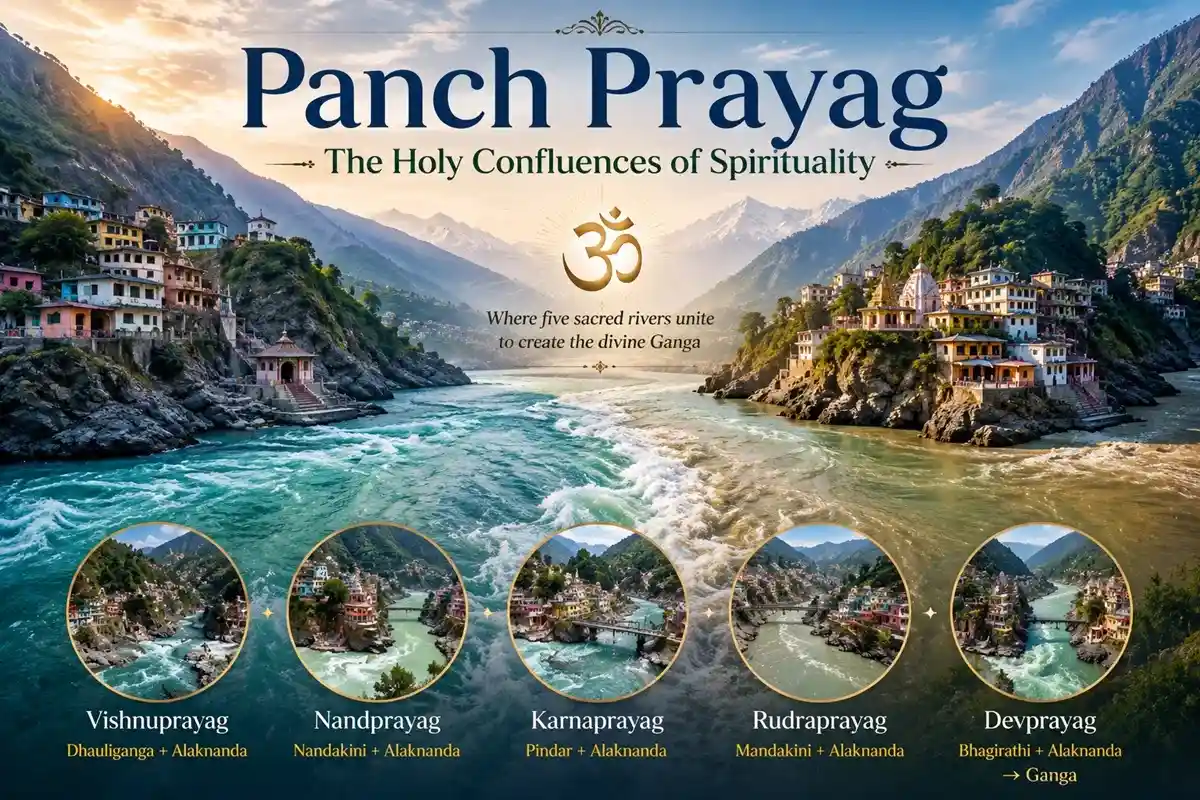
The Panch Prayag Yatra includes visiting all five sacred confluences of the Ganga. These are Devprayag, Rudraprayag, Karnaprayag, Nandprayag, and Vishnuprayag. The Alaknanda river flows through all four upper confluences — absorbing the Dhauliganga at Vishnuprayag, the Nandakini at Nandprayag, the Pindar at Karnaprayag, and the Mandakini at Rudraprayag — before finally meeting the Bhagirathi at Devprayag, the fifth Prayag, where the sacred Ganga comes into existence. The five Prayag destinations are described below in their order of descent from the Himalayas.
Panch Prayag at a Glance
| Prayag |
Rivers Merging |
Altitude |
District |
| Vishnuprayag |
Dhauliganga + Alaknanda |
1,372 m |
Chamoli |
| Nandprayag |
Nandakini + Alaknanda |
1,358 m |
Chamoli |
| Karnaprayag |
Pindar + Alaknanda |
1,459 m |
Chamoli |
| Rudraprayag |
Mandakini + Alaknanda |
895 m |
Rudraprayag |
| Devprayag |
Bhagirathi + Alaknanda → Ganga |
472 m |
Tehri Garhwal |
Vishnu Prayag
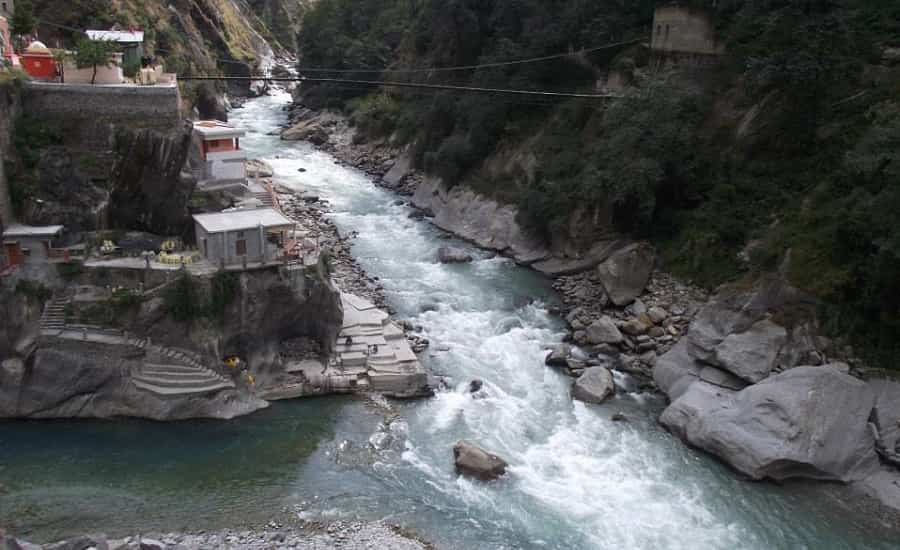
Vishnuprayag is the first and highest of the five Panch Prayags, sitting at an altitude of 1,372 metres in the Chamoli district of Uttarakhand. It is the sacred confluence of the Dhauliganga (also called Vishnu Ganga) and Alaknanda rivers. Near the sangam stands an ancient temple of Lord Vishnu, situated beside a small sacred pool known as Vishnu Kund. According to local tradition, this is the place where Narada Muni performed intense penance and was blessed by Lord Vishnu — giving this confluence its name.
Pilgrims undertaking the Char Dham Yatra pass through Vishnuprayag on their way to Badrinath, and many take a ritual dip at the sangam before proceeding. The surrounding landscape — lofty peaks, dense forests, and the sound of two rivers merging — makes it one of the most naturally powerful spots on the entire Garhwal circuit.
Places to Visit In and Around Vishnuprayag
Badrinath Temple
One of the four Char Dhams and one of the 108 Divya Desams, Badrinath Temple is located in the Chamoli district at an altitude of 3,133 metres, dedicated to Lord Vishnu. It is accessible by motorable road and is among the most visited pilgrimage destinations in India. In 2026, the Badrinath kapat (doors) opened on 23 April. Badrinath is 40 km from Joshimath, which is the closest major town to Vishnuprayag.
Auli
Auli is situated at 2,519–3,049 metres in the Chamoli district and is Uttarakhand’s premier skiing destination, set against views of Nanda Devi, Trishul, Dunagiri, and Mana Peak. It offers skiing in winter and trekking in summer. The Auli Ropeway — among the longest in Asia at 4 km — connects Joshimath to Auli in about 25 minutes, making it a popular detour on the Badrinath route.
Nandprayag
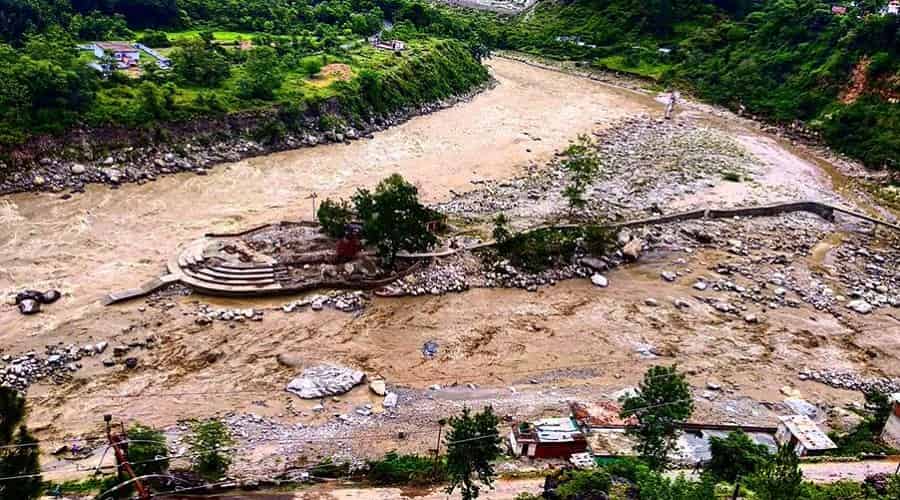
At Nandprayag, the Nandakini river joins the Alaknanda at an altitude of 1,358 metres in the Chamoli district. The town takes its name from King Nanda, the Yadava king whose devotion to Lord Vishnu was so great that he was blessed with a son who embodied the divine qualities of Vishnu himself. According to tradition, Nandprayag is the same place where the beloved story of King Dushyanta and Shakuntala began. The small town of Nandprayag is 22 km from Karnaprayag and about 194 km from Rishikesh. The Gopal Ji (Lord Krishna) Temple here is a well-known place of worship.
Places to Visit Near Nandprayag
Chamoli
Chamoli is the district headquarters, once known as Kedar-Khand, steeped in mythological significance. It is a convenient halt on the Char Dham route with the Alaknanda flowing through it and views of snow-capped peaks. The serenity of this place is reflected in the creative writing of Kalidasa, who is said to have drawn inspiration from these Himalayan landscapes.
Tungnath
Tungnath is one of the Panch Kedar — the five sacred Shiva shrines of Uttarakhand associated with the Pandavas. It is the highest Shiva temple in the world at 3,680 metres, reached by a 3.5 km scenic trek from Chopta. According to mythology, Lord Shiva’s arms were found here when he submerged into the earth as a bull to evade the Pandavas. The views of the Garhwal Himalayas from Tungnath are exceptional, and Chopta itself is known as the “Mini Switzerland of Uttarakhand.”
Karnaprayag
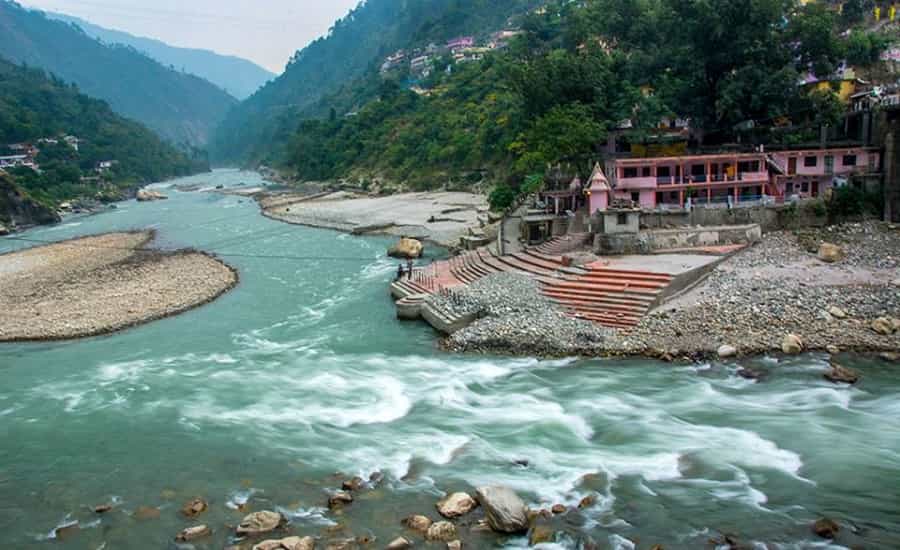
Karnaprayag is one of the most storied of the five Panch Prayags. Here, the Pindar river meets the Alaknanda at an altitude of 1,459 metres in the Chamoli district. The town is named after Karna, the great warrior and tragic hero of the Mahabharata. It is here, according to tradition, that Karna performed intense penance and worship of Surya Dev, the Sun God. So moved was Surya Dev by his son’s devotion that he appeared before Karna and gifted him the divine Kavach (armour) and Kundal (earrings) that would make him nearly invincible in battle. The Karna Temple, dedicated to this great warrior, still stands in the town today.
The town is also home to Chandika Mata Mandir, Uma Devi Temple, and Adi Bari Temple. The lush green meadows and snow-covered peaks surrounding Karnaprayag give it a distinctly peaceful character. It is 22 km from Nandprayag and 146 km from Rishikesh.
Places to Visit Around Karnaprayag
Gopeshwar
Gopeshwar is the district headquarters of Chamoli and home to the ancient Gopinath Temple — a magnificently carved 10th–12th century temple dedicated to Lord Shiva. The University of Garhwal is also situated here, adding an educational dimension to the town. The surrounding dense oak forests and mountain views make Gopeshwar a peaceful halt on the Char Dham route.
Valley of Flowers National Park
The Valley of Flowers National Park is spread over 87 sq. km. in the Chamoli district at an altitude of 3,352–3,658 metres. Declared a UNESCO World Heritage Site in 2004, the valley is one of the largest biosphere reserves in the region and is home to over 520 species of alpine flowers. The valley blooms in July–September, and the trek from Govindghat is 14 km. It is among the most visually extraordinary places in the Garhwal Himalayas.
Rudraprayag
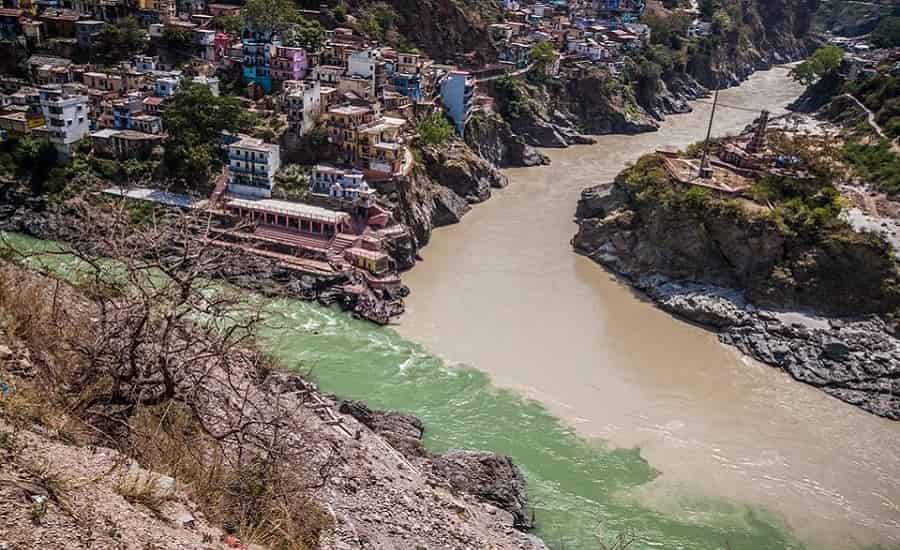
Rudraprayag is the confluence of the Alaknanda and Mandakini rivers, situated in the Rudraprayag district of Uttarakhand. This place takes its name from Lord Shiva, who is said to have manifested here in the form of Rudra. It is deeply believed among Hindu pilgrims that bathing at this sangam washes away accumulated sins. Rudraprayag is also a major route junction on the Char Dham circuit — the road to Kedarnath branches off here via NH-107, while the main highway continues towards Badrinath. For pilgrims, nature lovers, adventure seekers, and those in search of peace, Rudraprayag offers a rare combination of spiritual and scenic richness.
Places to Visit Nearby Rudraprayag
Kedarnath Temple
Kedarnath Dham is one of the twelve Jyotirlingas and one of the four Char Dhams, situated at 3,553 metres in the Rudraprayag district near the source of the Mandakini river. The temple is reached via a 16 km trek from Gaurikund. In 2026, the Kedarnath kapat opened on 22 April. Helicopter services operate from Phata, Sersi, and Guptkashi. Kedarnath is one of the most visited Shiva temples in India and stands surrounded by the Kedar, Bharatekuntha, and Sumeru mountain peaks.
Ukhimath
Ukhimath (also called Okhimath) in the Rudraprayag district is the winter seat of the Kedarnath and Madhyamaheshwar deities. When the temples close in November, the processional idols are brought to the Omkareshwar Temple at Ukhimath, where worship continues through winter. The town offers views of Kedarnath, Chaukhamba, Nanda Devi, and Neelkanth peaks — some of the finest Himalayan panoramas accessible by road in Uttarakhand.
Devprayag
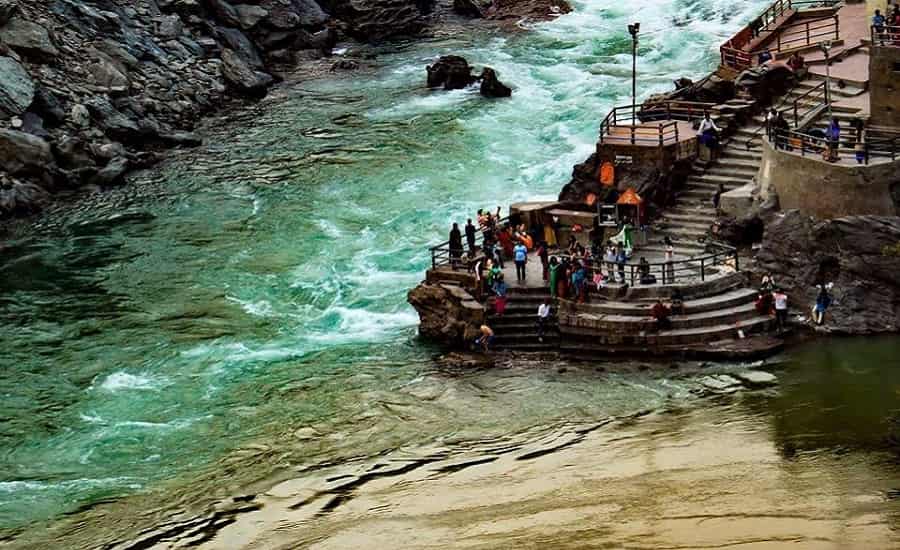
Set in a breathtaking natural setting, Devprayag is the last and most significant of the five Panch Prayag confluences. Here, the Alaknanda — having absorbed four tributaries at the four upstream Prayags — finally meets the Bhagirathi river. At this confluence, the sacred River Ganga comes into existence. This revered spot is located in the Tehri Garhwal district, 73 km from Rishikesh, and draws devoted pilgrims throughout the year.
According to Hindu mythology, this is the same place where Lord Rama and Lakshmana performed penance to atone for the killing of Ravana — who, though a demon king, was also a learned Brahmin, and whose death required ritual purification. The ancient Raghunath Temple here houses a 15-foot black granite idol of Lord Rama. Four smaller shrines dedicated to Annapurna Devi, Lord Hanuman, Adi Shankaracharya, and Garud stand nearby. The town also holds a historically significant collection of around 3,000 manuscripts — the earliest dating to 1677 AD.
Places to Visit around Devprayag
Teen Dhara
Teen Dhara is a rest stop on the Rishikesh–Devprayag Highway (NH-58) where three natural water streams flow alongside the road above the Ganga. It is a popular resting point for travellers on the Char Dham route, with small dhabas, cold drink stalls, and local eateries. The village has a small population and the stream-side setting makes it a refreshing break before or after Devprayag.
Raghunath Temple
This ancient temple — believed to be over a thousand years old — is dedicated to Lord Rama and features the striking 15-foot black granite idol. The temple also houses idols of Lord Lakshmana and Goddess Sita. Regional folklore attributes its construction to Raja Jagat Singh of Kullu, who is said to have brought the idol from its original location as an act of devotion and atonement.
Spiritual Significance of the Panch Prayags
In Hindu tradition, a Prayag — the confluence of rivers — is one of the holiest categories of sacred space. The coming together of waters from different origins is believed to multiply spiritual merit manifold. Pilgrims come to the Panch Prayags for three primary purposes:
- Sangam Snan (ritual bath) — bathing at a Prayag is believed to cleanse sins accumulated over lifetimes
- Pind Daan — rituals for ancestral peace (shradh) are performed at Devprayag, Rudraprayag, and Karnaprayag by pilgrims seeking to honour their ancestors
- Meditation and spiritual practice — the confluences are considered especially powerful sites for meditation, and many sadhus and spiritual seekers have historically chosen them for extended retreat
For pilgrims on the Char Dham Yatra, the Panch Prayags are not roadside stops — each one marks a deepening of the journey as the pilgrim ascends toward the dhams. Devprayag, as the birthplace of the Ganga, is the most significant for most pilgrims.
Best Time to Visit Panch Prayag
The Panch Prayags lie along the main Char Dham highway and are accessible for most of the year, but conditions vary significantly by season.
- March to June — The best window. The Char Dham season opens in April (Kedarnath 22 April, Badrinath 23 April in 2026), roads are clear, and the rivers are flowing well. Late March and April have the added beauty of spring blooms on the lower hillsides.
- September to November — Excellent post-monsoon clarity. The rivers are fuller and more dramatic after the rains, and the skies are crystal-clear with Himalayan views. Slightly cooler, fewer crowds than May–June.
- July to August (Monsoon) — Not recommended for self-drive. The Rishikesh–Devprayag corridor has multiple active landslide zones. Roads can close suddenly. Experienced travellers can manage, but first-time visitors should avoid this window.
- December to February — Upper Prayags (Nandprayag, Karnaprayag, Vishnuprayag) can be very cold and occasionally snowy. Char Dham temples are closed. Devprayag and Rudraprayag remain accessible but are quiet.
How to Reach Panch Prayag
All five Panch Prayags lie along NH-58, the main Char Dham highway from Rishikesh to Badrinath. Rishikesh is the starting point for most travellers.
- By Air: Jolly Grant Airport, Dehradun (35 km from Rishikesh). Flights from Delhi (1 hr), Mumbai, and Bengaluru. Taxi from airport to Rishikesh: 45–60 minutes.
- By Train: Haridwar Railway Station (24 km from Rishikesh) has direct trains from Delhi, Mumbai, and most major cities. Shared taxis and buses run regularly from Haridwar to Rishikesh.
- By Road: Rishikesh is 240 km from Delhi (5–6 hrs via NH-58). Regular buses from Delhi ISBT. From Rishikesh, all five Prayags are connected by the same highway: Devprayag is 73 km, Rudraprayag 139 km, Karnaprayag 146 km, Nandprayag 194 km, and Vishnuprayag 272 km.
Frequently Asked Questions
Q. What are the five Panch Prayags and which rivers merge at each?
Vishnuprayag (Dhauliganga + Alaknanda), Nandprayag (Nandakini + Alaknanda), Karnaprayag (Pindar + Alaknanda), Rudraprayag (Mandakini + Alaknanda), and Devprayag (Bhagirathi + Alaknanda — birthplace of the Ganga).
Q. Which is the most important Prayag among the five?
Devprayag is the most significant. It is here that the Ganga officially comes into existence — the Bhagirathi (from Gaumukh/Gangotri) meets the Alaknanda (which has already absorbed four tributaries at the upstream Prayags), and the combined river takes the sacred name Ganga from this point onward.
Q. Are the Panch Prayags on the Char Dham route?
Yes. All five Panch Prayags lie along the main Char Dham highway from Rishikesh. Pilgrims travelling to Badrinath pass through all five. Those heading to Kedarnath branch off at Rudraprayag. Most Char Dham yatris see at least three or four Prayags naturally on their journey.
Q. Can I visit all five Panch Prayags in one day?
Technically possible but not recommended. The road distance from Devprayag to Vishnuprayag is about 200 km through winding Himalayan ghat roads — roughly 7–8 hours of driving without stops. To visit all five meaningfully, with ritual dips and time at each, plan at least 2–3 days. Most Char Dham Yatra itineraries cover all five naturally over the journey.
Q. What is the best time to visit the Panch Prayags?
March to June and September to November are ideal. The Char Dham season (April–November) coincides with the best road and weather conditions. Avoid July–August if possible — monsoon rains bring landslide risk on the Rishikesh–Devprayag stretch.
Q. Is Devprayag accessible from Rishikesh as a day trip?
Yes. Devprayag is 73 km from Rishikesh (about 2.5 hours by road). It is the most accessible of the five Prayags and can comfortably be visited as a day trip from Rishikesh or Haridwar. The famous V-shaped confluence, where the colour difference between the Bhagirathi and Alaknanda is clearly visible, is reached by a short walk down stone steps from the road.
Q. What rituals are performed at the Panch Prayags?
The main rituals are Sangam Snan (ritual bath at the confluence), Pind Daan (ancestral rites, especially at Devprayag and Rudraprayag), and offerings at the associated temples at each Prayag. Many pilgrims also perform prayer and meditation at the confluences.
Plan Your Panch Prayag Yatra
The Panch Prayags are among the most rewarding spiritual and scenic experiences in the Garhwal Himalayas. Each confluence has its own mood, mythology, and setting — from the forested drama of Vishnuprayag to the V-shaped birthplace of the Ganga at Devprayag. If you are planning the Char Dham Yatra, you will pass through most of these naturally — build in a few minutes at each for a dip and a moment of stillness.
Planning your Uttarakhand trip? Call or WhatsApp us at +91-9711616316 — we can help you plan the complete Char Dham or Panch Prayag circuit.


 Call
Call Enquiry