


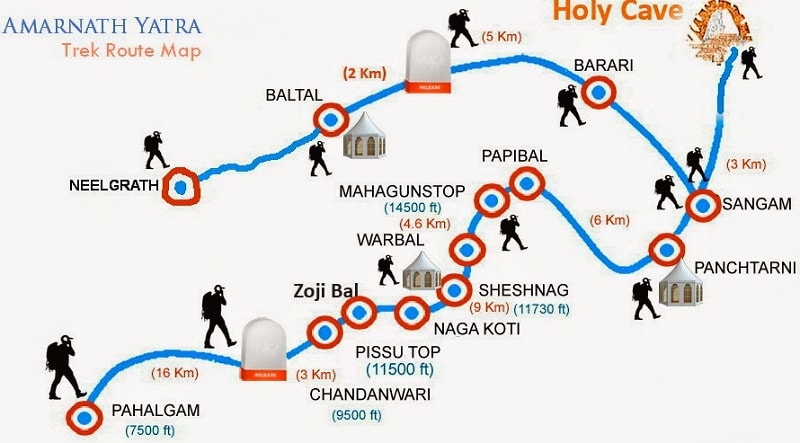
Reaching the Amarnath Dham is not about distance alone. The terrain, altitude, weather, and your own physical condition matter far more than most people expect. On paper, routes look simple. On the mountain, everything feels different.
There are two official ways to reach the cave — one through Pahalgam, the other through Baltal.
Both routes take you to the same destination, but the experience is completely different. One is slow and steady. The other is short but harsh. Choosing between them should depend less on time and more on your health, stamina, and mental comfort with steep terrain.

Baltal Route – Short, Steep, and Physically Demanding
Baltal → Domali → Barari → Sangam → Holy Cave
This route is about 14 km one way. That sounds manageable. But once you begin walking, you quickly realise why this path is considered difficult.
The climb is steep almost throughout. There are stretches where the slope does not ease at all. Breathing becomes heavy early, legs tire faster, and short breaks become necessary even for fit people.
Distance breakup:
- Baltal to Domali – around 2 km
- Domali to Barari – around 6 km
- Barari to Sangam – around 4 km
- Sangam to Cave – around 2 km
There are no pony services on this route because of safety concerns. Everyone walks or uses dandi (palanquin). This itself changes the entire experience. You cannot rely on animal transport when your energy drops.
Most yatris complete the up-and-down in one or two days, but that usually means long walking hours, minimal rest, and tired legs by nightfall.
People often underestimate this stretch. The thin air, cold winds, and steep climb together create fatigue much earlier than expected.
This route suits:
- Young pilgrims
- Physically fit travelers
- People used to trekking
It is not ideal for:
- Senior citizens
- Heart or breathing patients
- Knee or back pain sufferers
- First-time trekkers
Many experienced pilgrims prefer going up via Pahalgam and returning via Baltal, because coming downhill is far easier than climbing this steep slope.
Pahalgam Route – Longer, Slower, and Easier on the Body
Pahalgam → Chandanwari → Sheshnag → Panchtarni → Cave
This is the traditional path. It is longer, but far more forgiving.
First, you travel 16 km by road from Pahalgam to Chandanwari. From here, the trekking begins.
- Chandanwari to Sheshnag – about 13 km
- Sheshnag to Panchtarni – about 4.6 km
- Panchtarni to Cave – about 6 km
In total, pilgrims walk around 36 to 48 km, usually spread across 3 to 5 days.
What makes this route easier is not just the gradient, but the overall support system. Medical camps, food stalls, resting points, pony services, and wide walking tracks make a huge difference.
The ascent is gradual, which gives your body time to adjust to altitude. This reduces exhaustion and lowers the risk of altitude sickness.
Still, it is not easy. Long walking hours, unpredictable rain, cold nights, and crowd pressure remain part of the journey.
This route works well for:
- First-time pilgrims
- Senior citizens
- Families
- People who prefer steady pacing
For most people, this is the safer and more comfortable option.
How to Reach Amarnath – Practical Travel Reality
There is no direct transport to the cave. Every pilgrim must first reach Jammu or Srinagar, then continue by road to Pahalgam or Baltal, and finally trek or use helicopter services.
Distance from Delhi: roughly 638 km
By Air – Most Comfortable Option
The nearest airport is Srinagar.
From Srinagar:
- Pahalgam is about 95 km
- Baltal is about 71 km
Flying saves both time and physical energy. For elderly travelers and families, this usually makes the entire journey much smoother.
By Train – Budget Friendly, Time Heavy
The nearest railway station is Jammu Tawi.
From Jammu, travelers continue by road. While trains are economical, the combined rail and road journey becomes long and tiring, especially before trekking even begins.
By Road – Flexible but Exhausting
Long-distance buses and taxis operate from Delhi and other cities. Travel time can stretch beyond 12–30 hours, depending on distance and road conditions.
Road journeys before trekking often leave people tired even before the yatra starts.
Coming from Other Major Cities
- Kolkata → Amarnath: ~1804 km
- Mumbai → Amarnath: ~1714 km
- Hyderabad → Amarnath: ~1896 km
For such long distances, the most sensible approach is:
Flight or train → Srinagar / Jammu → road → base camp → trek
It saves energy and reduces physical stress.
Things People Rarely Plan For (But Should)
- Sudden rain or snowfall
- Strong cold winds
- Slippery tracks
- Long waiting queues
- Night discomfort at camps
- Breathlessness due to altitude
These are normal parts of the journey. Planning slowly and patiently makes the difference.
Who Should Pause and Reconsider
- People with serious heart problems
- Chronic respiratory illness
- Severe joint issues
- Recent surgery patients
- Very young children
Medical consultation is strongly recommended before planning.
Simple Ground-Level Advice
- Walk slowly
- Drink water even if not thirsty
- Rest when your body asks
- Start early in the morning
- Avoid heavy food during trekking
- Carry only essentials
Common Questions Pilgrims Actually Ask
1. Which route is better for first-time pilgrims — Baltal or Pahalgam?
Pahalgam is usually better. The climb is gradual, and the body gets time to adjust.
2. How fit do I need to be for the yatra?
If you can comfortably walk 6–8 km a day, you should manage well. Some prior walking practice helps a lot.
3. Do people face breathing problems during the trek?
Some do, especially at higher points. Walking slowly and taking breaks makes a big difference.
4. Is the Baltal route risky?
Not risky, but very steep and tiring. It suits fit and experienced walkers.
5. Can senior citizens do this yatra?
Yes, mainly through the Pahalgam route or by helicopter, after medical clearance.
6. How many days should I keep for the full journey?
Around 4 to 7 days, including travel, trekking, and return.
7. Is weather a serious issue?
Yes. Rain, cold winds, and sudden changes are common, so flexibility is important.
8. Are medical facilities available on the route?
Yes, government medical camps are set up at regular intervals.
9. Is network connectivity available during the trek?
Very limited after the base camps. Don’t rely on mobile coverage.
10. Should I choose helicopter or trekking?
If health or time is a concern, helicopter helps. Otherwise, trekking gives a fuller experience.
Final Advice
Amarnath Yatra is deeply spiritual, but it is also physically real. The mountains don’t adjust to your comfort — you adjust to them.
If you move slowly, listen to your body, and choose the right route, the journey becomes meaningful instead of exhausting.
For most people, slow and steady through Pahalgam is far wiser than fast and punishing through Baltal.
Check out:
How to Register for Amarnath Yatra 2026

 Call
Call WhatsApp
 Enquiry