


Approved by
Ministry of Tourism,
Government Of India
History of Delhi
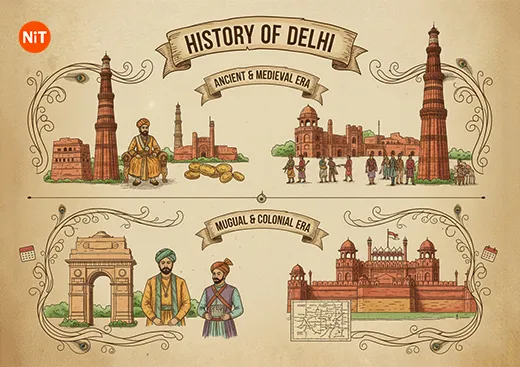
Delhi is among the most historically oriented cities of the world and it occupies a special position in Indian history. Delhi has been the centre of power of the various dynasties and empires throughout the millennia, resulting in its status as the national capital today. Its strategic position as a Yamuna River, fertile plains, and strategic location as a trade route meant that it was an obvious destination of rulers who sought political and economic dominance. The city has had a number of different periods of destruction, reconstruction, and redefinition, which has made it referred to as the land of many cities. Every stage of the Delhi development shows the cultural, political, and social transformation India has passed through in the course of its history.
Delhi history, which can be traced back to ancient times, and the present-day government. The mentions of the city can be found in mythology, religious writings, history, and archaeological findings. During centuries, it drew warriors and saints, merchants and scholars; they made unforgettable impressions on its landscape. The forts, mosques, temples, tombs, and colonial age buildings that dot the city of Delhi tell the tale of ambition, war, and coexistence. Delhi is the Indian civilization that is always on the move; one desires to know it.
Ancient and Early Medieval History of Delhi
The first time that Delhi was mentioned is in ancient Indian epics. There is a common understanding that the capital of the Pandavas, which is referred to as Indraprastha in the Mahabharata, was situated in the area of modern-day Delhi. Archaeological excavations in places like Purana Quila indicate that there were human settlements dating back as far as 1000 BCE. These natives had the advantage of fertile alluvial rocks of the Yamuna basin that promoted agriculture and trade.
- In the 3rd century BCE, Delhi was conquered by Emperor Ashoka during the Mauryan period.
- Mauryan influence in Delhi is evident through inscriptions and archaeological relics found in the region.
- After the decline of the Mauryan Empire, Delhi came under the control of various ruling dynasties.
- Prominent rulers after the Mauryas included the Shungas, Kushanas, and Guptas.
- During the Gupta Empire, Delhi experienced a period of relative peace and stability.
- The Guptas were notable patrons of art, learning, culture, and religion, contributing to Delhi's cultural development.
Following the fall of the Guptas, political instability and changes of power regimes were witnessed in Delhi. Rajput dynasties started to take over the area in the beginning of the Middle Ages. The Tomara Rajputs had their reign established at the 8th century and are attributed to having formed the city of Dhillika which formed an initial version of Delhi. The Chauhan Rajputs later replaced them with Prithviraj Chauhan, being one of the most eminent rulers. His loss to Muhammad Ghori in 1192 was a historical event in the life of India and it also paved the way to the Islamic rule in North India.
Delhi Sultanate Period
The triumph of Muhammad Ghori resulted in the formation of the Delhi Sultanate that reigned for more than three hundred years. It was the Slave Dynasty of Qutb ud-Din Aibak who established the basis of the Muslim rule in Delhi. It was the time when major architectural work was done, such as the Qutub Minar, which was the representation of the new political order.
According to Delhi Sultanate history, the region was ruled successively by the Slave, Khalji, Tughlaq, Sayyid, and Lodi dynasties. The expansion and administration of the empire were driven by each dynasty. Alauddin Khalji is remembered due to his military conquests and economic reform, and Muhammad bin Tughluq is known due to his policy ambitions, though controversial. Firoz Shah Tughlaq concentrated on the development of infrastructure such as canals, roads, and new cities.
- During the Delhi Sultanate era, Delhi emerged as a major center of learning, commerce, and culture.
- Scholars, poets, and traders from Central Asia and the Middle East migrated to Delhi, enriching the city's cultural diversity.
- The period also witnessed significant intellectual and economic growth due to increased trade and knowledge exchange.
- Despite its prosperity, Delhi faced frequent invasions and internal conflicts.
- The most devastating attack occurred in 1398, when Timur (Tamerlane) invaded Delhi.
- Timur's invasion resulted in widespread destruction, loss of life, and severe devastation of the city.
Mughal Rule in Delhi
The Mughal Empire was founded in 1526 after Babur conquered the final Lodi, Ibrahim Lodi, in the First Battle of Panipat. Delhi underwent a golden age of both architecture, administration, and culture under the Mughals. Akbar established a strong empire by means of good governance and religious tolerance, and both Jahangir and Shah Jahan made it even more prosperous.
The reign of Shah Jahan was an epitome in the history of Delhi. He established a city by the name Shahjahanabad, which is presently referred to as Old Delhi, and constructed some of the most famous structures like the Red Fort and Jama Masjid. These buildings indicated the magnificence and artistry of the Mughal building. Delhi was a symbol of royal authority and civilized culture.
Later Mughal was, however, characterized by decline. The long military expeditions by Aurangzeb undermined the empire and the invasions by Nadir Shah and Ahmad Shah Abdali were also destabilizing Delhi. By the 18th century, the Mughal rule had also largely shrunk, which led to the domination of the British.
Delhi under British Rule
In 1803, the British East India Company conquered Delhi, although the Mughal emperor was still a symbolic ruler. In 1857, the Revolt turned out to be a turning point in the history of Delhi. Following the quelling of the revolt, the British sent back the final Mughal emperor Bahadur Shah Zafar and officially brought to an end the Mughal rule. The state of Delhi was placed under direct British rule.
In the year 1911, the British announced that they would transfer the capital of British India out of Calcutta to Delhi. New Delhi was built by architects Edwin Lutyens and Herbert Baker and brought along wide streets, cumbersome government buildings, and colonial town design. New Delhi represented imperialism and contemporary rule.
Post-Independence and Modern Delhi
Delhi was made the capital of the Republic of India in 1947 when India got its freedom. The division of the country resulted in a huge number of refugees changing the demographic and social makeup of the city. Delhi grew at a very fast rate and became a major metropolitan area despite the challenges it faced initially.
Delhi today is a city that exists with an ancient history and contemporary life. It is a political giant, an economic hub and a cultural amalgamation. Delhi is an embodiment of Indian history due to its strength, heterogeneity, and permanence as it travels through time along with the ancient ruins and its modern infrastructure.
FAQS
Q1. Why is Delhi historically important?
Ans: Delhi is historic in the sense that it was the seat of a number of great empires throughout centuries such as the Mauryas, Mughals, and the British. Historians are of the opinion that Delhi was constructed and reconstructed severally, resulting in a blend of ruins, monuments, and forts.
Q2. How old is the city of Delhi?
Ans: History of Delhi goes back more than 2,500 years. According to ancient manuscripts, the area is known as Indraprastha and dated back to the Mahabharata period, and thus Delhi is one of the oldest continuously inhabited cities in the world.
Q3. Which dynasties ruled Delhi?
Ans: Delhi was under the control of various great dynasties such as Tomaras, Chauhans, and the rulers of the Delhi Sultanate, the Mughals, and the British Empire. The architecture, culture, and political significance of Delhi were added by each dynasty.
Q4. Which are the most popular historical monuments in Delhi?
Ans: The red fort, Qutub Minar, the tomb of Humayun, Jama Masjid, and India Gate are some of the most renowned historical monuments in Delhi. These monuments are an indicator of various stages in the long and varied history of Delhi.
Q5. What was the impact of the British rule on Delhi?
Ans: Delhi turned into a capital of administration during the British reign. The city of New Delhi was constructed by the British which were the work of Edwin Lutyens, with a wide avenue access, and iconic buildings such as Rashtrapati Bhavan and the House of Parliament, as well as the current New Delhi.

 Call
Call WhatsApp
 Enquiry