


Badrinath Yatra Package from Delhi 2026
Home » India » Uttarakhand » Badrinath » Badrinath Yatra Package from Delhi
Tour Overview
Badrinath is one of the four sacred Char Dhams and among the 108 Divya Desams dedicated to Lord Vishnu. Situated at 3,300 metres on the banks of the Alaknanda, flanked by the Nar and Narayan mountain ranges with the Neelkanth peak rising behind it, Badrinath is not just a temple - it is the northernmost point of India's most important pilgrimage circuit. This 5-day Badrinath Yatra package from Delhi covers the complete road route: Haridwar, all five Panch Prayag confluences, Joshimath, Badrinath, and Rishikesh on the return - giving you the full spiritual and scenic experience of Garhwal Uttarakhand.
Badrinath Tour from Delhi - At a Glance
| Detail | Information |
|---|---|
| Tour Name | Badrinath Yatra Package from Delhi |
| Duration | 5 Days / 4 Nights |
| Starting Point | Delhi (Airport / Railway Station / Hotel pickup) |
| Ending Point | Delhi (drop at Airport / Railway Station) |
| Route | Delhi → Haridwar → Rishikesh → Joshimath → Badrinath → Rudraprayag → Haridwar → Delhi |
| Distance (one way) | ~560 km from Delhi to Badrinath |
| Badrinath Altitude | 3,300 m (10,279 ft) above sea level |
| Badrinath Opening 2026 | 23 April 2026 (Akshaya Tritiya) |
| Badrinath Closing 2026 | November 2026 (exact date TBA by temple committee) |
| Best Time to Visit | May-June | September-mid October |
| Starting Price | ₹23,500/person |
| Package Type | Budget | Deluxe | Premium |
| Trekking Required | No - Badrinath is road accessible |
| Ideal For | Families, senior citizens, first-time Uttarakhand pilgrims, NRIs |
Badrinath Temple Opening Date 2026
| Temple | Opening Date 2026 | Closing Date (Tentative) | Altitude |
|---|---|---|---|
| Badrinath | 23 April 2026 (Akshaya Tritiya) | November 2026 (announced by BK Temple Committee) | 3,300 m (10,826 ft) |
Badrinath Temple is open from 4:30 AM for the Maha Abhishek Puja (the first ritual of the day), and general Darshan begins at 6:00 AM. The temple closes at 9:00 PM with a mid-afternoon closure from 3:00 PM to 5:00 PM. Do not plan early morning Darshan unless you specifically want to attend the Maha Abhishek Puja - general Darshan is most comfortable between 6:00 AM and 11:00 AM.
How to Plan a Badrinath Tour from Delhi
Best Time for Badrinath Yatra
The Badrinath temple is open from late April to November. Within this window, two periods offer the best conditions:
| Season | Months | Temperature | Conditions | Recommendation |
|---|---|---|---|---|
| Summer / Peak Season | May - June | 8°C to 18°C | Clear skies, snow on peaks, roads stable | Best for first-time visitors. Book 30-45 days ahead. |
| Post-Monsoon / Shoulder | Sep - mid Oct | 5°C to 15°C | Clear skies, fewer crowds, green landscapes | Best overall value - less crowded, good weather |
| Monsoon | July - August | 10°C to 18°C | Rain, fog, landslide risk | Avoid for road travel. High cancellation risk. |
| Winter (temple closed) | Nov - April | Below 0°C | Temple closed, heavy snow | Not operational - Badrinath dham is closed |
Mid-September to mid-October is the best window that most experienced pilgrims do not know about. The crowds are 60-70% lower than May-June, the landscape is green from the monsoon, and the Neelkanth peak views are crystal clear.
Route and Distance - Delhi to Badrinath
The road distance from Delhi to Badrinath is approximately 560 km. The journey takes 2 full driving days with one overnight stop en route. Trying to cover Delhi to Badrinath in a single day is not practical - the mountain roads after Haridwar average 25-30 km/hour.
Route: Delhi → Haridwar (220 km / 6 hrs) → Devprayag → Rudraprayag → Karnaprayag → Nandprayag → Joshimath (270 km / 8-9 hrs) → Badrinath (45 km / 1.5 hrs)
There is no trekking involved in Badrinath - unlike Kedarnath, which requires a 16 km trek. The Badrinath temple is directly road accessible and is just a short walk from where the vehicle parks.
Cost of Badrinath Yatra from Delhi
Our Badrinath Tour Package from Delhi starts from ₹18,999 per person for a group of 6, going up to ₹33,999 per person for a premium 2-person package. The price includes accommodation, all-inclusive vegetarian meals (breakfast and dinner), private vehicle, toll taxes, and driver charges. All packages are fully customizable.
Badrinath Package from Delhi - Pricing by Group Size
| Category | 2 Passengers | 4 Passengers | 6 Passengers | Vehicle |
|---|---|---|---|---|
| Budget (Standard Hotels) | ₹23,500/person | ₹20,999/person | ₹18,999/person | Swift Dzire or similar |
| Deluxe (Comfortable Hotels) | ₹29,999/person | ₹25,999/person | ₹20,999/person | Toyota Innova or similar |
| Premium (Best Hotels) | ₹33,999/person | ₹29,999/person | ₹27,999/person | Toyota Innova / Crysta |
All prices are per person, per night, based on double/triple sharing. Single occupancy is available at additional cost. GST (5%) is charged extra on all packages. Prices may vary by specific travel dates in peak season.
EMI option: Easy monthly installment payment available for bookings above Rs.15,000. Ask at time of booking.
Package Categories - What Each Includes
Budget Package - Best Value
Budget packages cover the essential Badrinath pilgrimage without extras. Standard hotels (clean, functional), private vehicle (non-AC on hill roads - all operators follow this), vegetarian meals (breakfast and dinner), all toll taxes and driver charges.
- Hotels: Standard category near temples - basic attached bathroom, hot water (may be limited)
- Vehicle: Swift Dzire or similar sedan (exclusive - no sharing with other groups)
- Meals: Breakfast and dinner included at hotels
- Ideal for: Solo pilgrims, small groups, those comfortable with basic facilities
Deluxe Package - Comfortable Pilgrimage
Deluxe packages balance comfort and cost. Better hotels, more consistent amenities, and spacious rooms - practical for families with elderly members or anyone who wants a hassle-free pilgrimage without luxury pricing.
- Hotels: Comfortable mid-range properties with attached bath, hot water, and room service
- Vehicle: Toyota Innova or similar (better legroom and suspension on mountain roads)
- Meals: Buffet-style breakfast and dinner
- Ideal for: Families, senior citizens, couples
Premium Package - Best Available
Premium packages use the best available hotels at each destination - properties like Sarovar Portico in Badrinath and Golden Tulip or Crystal Ganga in Haridwar. Innova Crysta or equivalent vehicle. Priority Darshan arrangements. If you want to arrive at Badrinath, walk to the temple without queuing, and return to a well-equipped hotel - this is that package.
- Hotels: Best available at each stop - Sarovar Portico / Snow Crest (Badrinath), Golden Tulip / Crystal Ganga (Haridwar)
- Vehicle: Innova Crysta or equivalent
- Meals: Full buffet breakfast and dinner
- Ideal for: NRIs, senior citizens with health conditions, high-end travelers
Helicopter Package
Badrinath is accessible by road, but helicopter packages are available from Sahastradhara Helipad in Dehradun. The flight takes approximately 1 to 1.5 hours. Helicopter packages include VIP Darshan, meals, and sightseeing. This option is particularly suited for pilgrims with very limited time or those who cannot manage the long mountain road journey.
Note: Direct helicopter service from Delhi is not available. Fly to Dehradun (1 hour from Delhi) and take the helicopter from Sahastradhara Helipad.
Senior Citizen Friendly Packages
Badrinath is one of the most senior-friendly Char Dhams because there is no trekking. The temple is road accessible and just a short walk from the parking area. Our senior citizen packages include:
- Vehicles with good suspension (Innova / Crysta) - critical for long mountain roads
- Ground floor hotel rooms where available - request at booking
- Flexible meal timing at hotels - important when drives run long
- Portable oxygen cylinder in vehicle - standard in all vehicles above Budget category
- Wheelchair assistance at Haridwar Ghat and major temples - on request
- Medical fitness certificate recommended for pilgrims above 65 or with cardiac/respiratory conditions
Badrinath Temple - Significance and History
Badrinath temple stands at 3,300 metres above sea level on the banks of the Alaknanda river, flanked by two ranges: Nar Parvat to the left and Narayan Parvat to the right. Behind it rises the Neelkanth peak at 6,596 metres - one of the most dramatic backdrops of any pilgrimage site in India.
The original temple is believed to have been established by the Pandavas, who visited Badrinath on their way to Swargarohini (the ascent to heaven). Adi Shankaracharya revived the shrine in the 8th century AD, installed the existing idol, and established it as one of the four Char Dhams of India - a pilgrimage circuit he designed to unify Hindu religious practice across the subcontinent.
The Idol
The primary deity is a 1-metre black Shaligram stone image of Lord Vishnu in a meditative posture - believed to be Swayambhu (self-manifested, not carved by human hands). Lord Vishnu is depicted here as Badrinarayan, seated in Padmasana (lotus posture). According to Vaishnava tradition, this is one of the 108 Divya Desams - sacred Vishnu temples mentioned in the hymns of the Alvars.
Badrinath - Jnana Yoga
In the context of the four Char Dhams, Badrinath represents Jnana Yoga - the path of wisdom and self-realisation. Lord Vishnu, the preserver of the universe, is worshipped here as the embodiment of cosmic knowledge. The name Badrinath comes from 'Badri' (the Indian jujube or ber tree) and 'Nath' (lord) - the place where Goddess Lakshmi, according to legend, took the form of a Badri tree to protect Lord Vishnu during his meditation from the harsh Himalayan cold.
Joshimath - Winter Seat of Badrinath
When Badrinath closes in November each year, the idol of Lord Badrinarayan is ceremonially transferred to Joshimath (45 km below Badrinath), where it is installed at the Narsingh Temple for the winter season. The small flame that burns in the temple sanctum is kept alive through the winter - it is believed that when this flame extinguishes on its own, the present Badrinath shrine will cease to function and the gods will shift residence to Bhavishya Badri in the Niti Valley. The left arm of the Narsingh idol in Joshimath is said to be gradually thinning, and local belief holds that when it withers completely, this transition will occur.
Hotels in Badrinath Yatra Package from Delhi
| Destination | Budget Hotels | Deluxe Hotels | Premium Hotels | Meal Plan |
|---|---|---|---|---|
| Haridwar | Vandana / Shree Hari Ganga / Similar | Hari Ganga / Divine Ganga / Similar | Golden Tulip / Crystal Ganga / Similar | Breakfast + Dinner |
| Joshimath / Pipalkoti | Basic guesthouse near helipad area | Uday Palace / Madhubhan / Similar | Snow Crest / Sarovar Portico Pipalkoti | Breakfast + Dinner |
| Badrinath | Hotel Urvashi / GMVN / Similar | Hotel Devlok / Badri Park / Similar | Sarovar Portico / Snow Crest / Lords Palace | All Meals |
| Rudraprayag | Shagrila Resort / Similar | Monal Resorts / Similar | Samrat Resort / Monal Grand / Similar | Breakfast + Dinner |
| Rishikesh (if night halt) | Zostel / Natraj Guesthouse | Divine Ganga / Shiv Shakti Ashram | Rishikesh Nirwana / Ananda (luxury) | Breakfast + Dinner |
Note: Badrinath hotels are limited in number and quality due to the remote high-altitude location - they operate only 6 months per year. All-meals is included at Badrinath because restaurant options are very limited. At Haridwar and Rishikesh, breakfast and dinner are included; lunch is on own account.
Badrinath Temple Darshan - Timings, Tips, Pujas
| Darshan / Puja | Timing | Notes |
|---|---|---|
| Maha Abhishek Puja | 4:30 AM - 6:00 AM | First ritual of the day. Idol bathed with milk, ghee, honey. Prior booking via temple counter or online required. |
| General Darshan Opens | 6:00 AM | Morning Darshan - least crowded between 6-8 AM |
| Mid-Day Closure | 1:00 PM - 3:00 PM (approx) | Temple may close for 1-2 hours in afternoon for rest period |
| Afternoon Darshan | 3:00 PM - 6:00 PM | Moderate crowds |
| Swarna / Chandi Aarti (Evening Aarti) | 6:00 PM - 7:00 PM | The main evening Aarti - most attended. Arrive 20 min early. |
| Shayan Aarti (Closing) | 9:00 PM | Temple closes after this rite |
Important Darshan Tips
- Mobile phones are not permitted inside the temple - leave at hotel or with your coordinator.
- Dress code: Traditional attire preferred - no shorts, no sleeveless shirts. Shawl or dupatta for women.
- Take a dip at Tapt Kund before temple entry - this is a sacred ritual, not optional.
- The Maha Abhishek Puja at 4:30 AM is worth the early wake-up - the most intimate darshan of the whole trip.
- VIP Darshan passes reduce queue time from 2-4 hours to 30-45 minutes in peak season.
- For Brahma Kapal Pind Daan ceremonies, contact the Brahma Kapal Samiti - our coordinator can assist with arrangements.
Special Pujas at Badrinath
| Puja Name | Cost (Approx) | When | What Happens |
|---|---|---|---|
| Maha Abhishek Puja | ₹4,500-₹5,000/person | 4:30-6:00 AM | Ritual bathing of the idol with milk, ghee, curd, honey |
| Rudrabhishek Puja | Available at Kedarnath - not Badrinath | ||
| Pind Daan at Brahma Kapal | ₹500-₹2,000 (priest fees vary) | Any time during Darshan hours | Ancestral rites. Considered more powerful than Gaya. |
| Swarna Aarti Participation | Free (public Aarti) | 6:00-7:00 PM | Attend the main evening Aarti - no booking needed |
Places to Visit in and Around Badrinath
Mana Village - Last Village of India
Mana (3,200 m) is 3 km from Badrinath on the road to Tibet - the last inhabited Indian village before the border. The village has an Indo-Mongolian tribal community with unique weaving traditions. Must-see sites within Mana:
- Vyas Gufa: The cave where Sage Vyasa is believed to have dictated the 18 Puranas and the Mahabharata to Lord Ganesha. A simple but deeply significant cave in the rock face.
- Ganesha Gufa: Adjacent to Vyas Gufa - where Ganesha is believed to have scribed the text.
- Bhim Pul: A massive natural rock bridge across the Saraswati river. Bhima, second eldest Pandava, is believed to have thrown this rock to help Draupadi cross. The river disappears underground just beyond this point.
- Saraswati River: Mana is the only visible point of the Saraswati river, which according to legend flows underground through most of India. The river emerges briefly here before joining the Alaknanda.
Brahma Kapal
The flat rocky riverbank on the Alaknanda just below the Badrinath temple. This is where Pind Daan - the ancestral rite for departed souls - is performed. The tradition holds that Pind Daan at Brahma Kapal is more effective than at Gaya (the standard sacred site for ancestral rites) because Lord Brahma himself offered rites here for the devas. Many families on the Badrinath route visit specifically for Pind Daan.
Tapt Kund
The natural thermal hot spring on the bank of the Alaknanda, approximately 15 metres below the temple level. Water temperature: approximately 45°C. Bathing here before entering the temple is a mandatory ritual for devoted pilgrims - the heat is said to purify the body before approaching the deity. There are separate bathing areas for men and women.
Charan Paduka
A sacred rock 3 km above Badrinath (short uphill walk - 30 minutes). The rock bears imprints believed to be Lord Vishnu's footprints from when he chose this spot for meditation. The view of Badrinath valley and Neelkanth peak from here is exceptional.
Vasudhara Falls
Vasudhara (meaning 'stream of wealth') is a magnificent waterfall 9 km from Badrinath - 2 km motorable, then a 4 km walk to the base, or 4 km further to the source. The waterfall drops from a height of approximately 400 metres. According to legend, the water does not fall on people who have committed sins - the spray avoids them while drenching the pure of heart. A popular sightseeing addition for physically active pilgrims.
Joshimath - Essential Stop
45 km below Badrinath at 1,875 metres. The winter seat of Badrinath. Key sites:
- Narsingh Temple: Winter residence of the Badrinath idol. The gradually thinning arm of the Narsingh idol is one of the most discussed mythological prophecies in Garhwal.
- Adi Shankaracharya Math: One of the four original Maths established in the 8th century.
- Auli by ropeway: India's premier ski resort - accessible by 4 km ropeway from Joshimath. In summer, offers unobstructed views of Nanda Devi (7,816 m), Trishul, Hathi-Ghoda peaks. 15-minute ride up, 15-minute ride down. Worth the detour.
Yogdhyan Badri - Panch Badri
Yogdhyan Badri is one of the Panch Badri - five sacred Vishnu shrines in Garhwal. Located at Pandukeshwar village, it enshrines a four-armed idol of Lord Vishnu in yogic meditation. Easy detour from the main Badrinath route - 10 minutes off the Joshimath road.
Valley of Flowers - Optional Extension
The Valley of Flowers National Park (UNESCO World Heritage Site) is accessible via Govindghat, 13 km from Joshimath. The 17 km trek from Govindghat reaches Ghangaria (base camp), from where a 5 km trail leads into the valley. Season: August-September (peak bloom). This is a 2-day extension to the standard Badrinath tour - if you have the time and physical fitness, it is one of the most spectacular landscapes in the Indian Himalayas.
Panch Prayag - Five Sacred Confluences on the Route
One of the most unique aspects of the Delhi-Badrinath road journey is that you pass through all five sacred river confluences - the Panch Prayag - in sequence. No other Char Dham destination offers this. On most days, you see at least three in a single drive.
| Prayag | Location | Rivers | Religious Significance | Drive from Delhi |
|---|---|---|---|---|
| Devprayag | Tehri Garhwal | Bhagirathi + Alaknanda = Ganga | Most sacred - birth point of the Ganga river as we know it | ~95 km |
| Rudraprayag | Rudraprayag dist. | Mandakini + Alaknanda | Named after Lord Shiva. Junction to Kedarnath route. | ~140 km |
| Karnaprayag | Chamoli dist. | Pindar + Alaknanda | Associated with Karna from Mahabharata. Small ghats on both banks. | ~175 km |
| Nandprayag | Chamoli dist. | Nandakini + Alaknanda | Peaceful, less visited - serene confluence in green valley. | ~200 km |
| Vishnuprayag | Chamoli dist. | Dhauliganga + Alaknanda | Named after Lord Vishnu. Closest Prayag to Badrinath. | ~260 km |
How to Reach Badrinath from Delhi
By Road (Recommended - This Package)
Delhi to Badrinath by road is 560 km - 2 days of driving with one overnight stop. This is the standard and recommended option for this package. The road is well-maintained (PMGSY/BRO maintained) up to Badrinath.
| Segment | Distance | Drive Time | Overnight Stop |
|---|---|---|---|
| Delhi → Haridwar | 220 km | 5-6 hours | Haridwar (Day 1) |
| Haridwar → Joshimath | 270 km | 8-9 hours | Joshimath / Pipalkoti (Day 2) |
| Joshimath → Badrinath | 45 km | 1.5 hours | Badrinath (Day 3) |
By Train + Road
Take train from Delhi to Haridwar (3-4 hours by Shatabdi/Jan Shatabdi) or Rishikesh (3.5-4.5 hours). Our representative picks you up from Haridwar or Rishikesh railway station and the road journey begins from there. This reduces total road time by 5-6 hours.
By Flight + Road
Fly Delhi to Dehradun (Jolly Grant Airport) - 1 hour. Car pickup from Dehradun airport and drive to Badrinath (310 km / 8-9 hours). Route: Dehradun → Rishikesh → Haridwar → Badrinath. This adds cost but reduces the Delhi-Haridwar road section.
By Helicopter
Direct helicopter from Delhi is not available. Fly to Dehradun (1 hour), then take the helicopter from Sahastradhara Helipad to Badrinath (approximately 1 to 1.5 hours). This option is available as an add-on to the road package or as a standalone package. Contact us for helicopter package pricing.
Badrinath Yatra Registration 2026 - Mandatory
Registration for Badrinath Yatra 2026 is mandatory for every pilgrim - without a valid Yatra Registration Number you cannot enter the temple premises. Registration is free and takes 10 minutes online.
- Go to: registrationandtouristcare.uk.gov.in
- Create account with mobile number and email ID.
- Enter details for all pilgrims - name, age, ID type, ID number.
- Select planned travel dates.
- Submit - receive Registration Number and QR Code by SMS and email.
- Carry the QR Code - checked at temple entry.
Foreign nationals and NRIs: Register with passport details. Aadhaar alone is not sufficient for foreign passport holders.
Registration is completely free. Do not pay any agent for this process.
Package Inclusions and Exclusions
Inclusions
- All transport by private vehicle (Swift Dzire / Innova / Crysta as per package)
- Accommodation as per package category - standard / deluxe / premium
- Meals: Breakfast and dinner at all stops (all meals included at Badrinath)
- Driver allowance, parking fees, and toll taxes throughout
- Pickup and drop at Delhi airport / railway station
- GST included in stated price - no surprise additions
- Portable oxygen cylinder in vehicle (deluxe and premium packages)
Exclusions
- Airfare or train tickets to/from Delhi
- Lunch throughout the tour
- Temple entry fees, ropeway charges, boat charges
- Special pujas - Maha Abhishek, Brahma Kapal Pind Daan (can be arranged at additional cost)
- Personal expenses - laundry, tips, shopping, phone calls
- Travel and medical insurance
- Any expense arising from natural calamities, roadblocks, or weather delays
- Auli ropeway (₹600-800 return) - available as add-on + ADDED
- Priority Darshan passes (can be arranged at additional cost - recommended for peak season)
Packing Guide
Clothing
- 1 warm jacket - down or synthetic, not cotton. Badrinath at 3,300 m drops to 5-8°C at night even in summer.
- Thermal inner wear - top and bottom - essential.
- 2-3 woollen sweaters or fleece layers.
- Woollen cap, gloves, muffler.
- 1-2 traditional outfits for temple visits - kurta/salwar or dhoti-kurta.
- Waterproof rain jacket - thin, packable.
- Comfortable, closed-toe walking shoes - flat soles.
Medical Kit
- All personal prescription medicines - enough for 8-10 days including a buffer
- Altitude sickness medication - Diamox (acetazolamide): Consult doctor before taking. Effective prophylaxis if started 24 hours before ascent.
- Paracetamol / pain relievers
- Cold and flu tablets
- Motion sickness tablets - for the winding mountain roads
- ORS sachets - 10-15 packs for hydration
- Basic first aid: band-aids, antiseptic cream, bandages
- Pulse oximeter - strongly recommended for pilgrims above 60 or with any cardiac/respiratory history. Monitor SpO2 at altitude. Available for Rs.500-800 at medical stores.
- Portable oxygen can - available at Haridwar / Rishikesh medical stores.
Documents and Essentials
- Original Aadhaar Card - Indian citizens (photocopy not accepted at temple entry)
- Original Passport - NRI / foreign nationals
- Chardham Yatra Registration QR Code - from registrationandtouristcare.uk.gov.in
- Cash - minimum Rs.5,000 - ATMs after Joshimath are unreliable. Do not depend on UPI in the mountains.
- Sunscreen SPF 50+ and UV-protection sunglasses
- Lip balm - mountain air causes severe dryness
Optional but Useful
- Small thermos - for hot water or tea en route (stops for chai are infrequent on some stretches)
- Neck pillow and light blanket for long drives
- Foldable tote bag for Prasad or shopping at Badrinath bazaar
- Camphor - some pilgrims carry it for breathing ease at high altitude
Badrinath Temple - FAQ & Specific Information
Temple Architecture
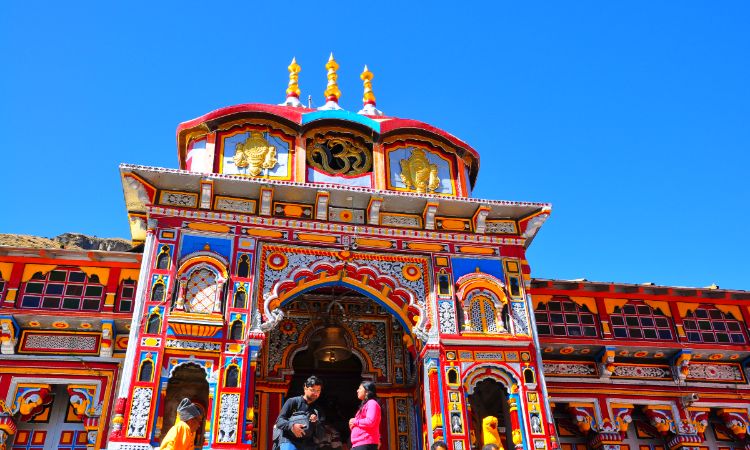
The Badrinath temple is a brightly coloured structure in the Garhwali architectural style - not the typical dark stone style of most Himalayan temples. The facade has three arched windows and a small turret, painted in vivid saffron, white, and grey. The main gate (Singha Dwar) is flanked by the idol of Garuda (Lord Vishnu's vehicle) with folded hands - the only Char Dham temple where the vehicle idol faces the sanctum from outside.
The sanctum enshrines the 1-metre Badrinarayan idol in black Shaligram stone, seated in Padmasana with four arms. The idol holds a Shankha (conch), Chakra (discus), Gada (mace), and Padma (lotus). The idol is believed to be Swayambhu - not created by human hands but self-manifested in the rock.
Day-wise Badrinath Yatra Itinerary from Delhi
Day 1 :Delhi → Haridwar (220 km / 5-6 hours)
This 5-day itinerary covers the full route from Delhi to Badrinath and back, including Haridwar, the Panch Prayag confluences, Joshimath, Mana Village, and Rishikesh on the return.
Our representative picks you up from Delhi airport, railway station, or hotel. Drive to Haridwar - the first spiritual stop on the Badrinath route.
Haridwar means 'Gateway to God' - it is one of the seven holiest cities in Hinduism, situated where the Ganga exits the Himalayan foothills and enters the plains. Har Ki Pauri Ghat is the most sacred spot, where according to legend, Lord Vishnu's footprint is imprinted on a stone in the riverbed.
- Evening Ganga Aarti at Har Ki Pauri: The evening Aarti at 6:00-7:00 PM is one of the most spiritually charged experiences on this entire tour. Hundreds of Diyas (oil lamps) float down the river as priests perform synchronized rituals. Reach the Ghat 30 minutes before the Aarti to get a good viewing spot.
- Mansa Devi Temple: Reached by cable car from Haridwar - goddess believed to fulfil wishes. Visit if time permits before the Aarti.
- Chandi Devi Temple: Another cable car ride from a different station. Can be combined with Mansa Devi on the same afternoon.
- Night stay: Haridwar
Distance: 220 km | Time: 5-6 hours
Day 2 :Haridwar → Joshimath via Panch Prayag (270 km / 8-9 hours)
After breakfast, drive from Haridwar towards Badrinath. This is the most scenic day of the entire journey. The route follows the Alaknanda river upstream through the Garhwal hills, passing through five sacred confluences known as the Panch Prayag.
The Panch Prayag - Five Sacred Confluences
| Prayag | Rivers Meeting | Significance | Distance from Haridwar |
|---|---|---|---|
| Devprayag | Bhagirathi + Alaknanda = Ganga | Where the holy Ganga is born. Most sacred of the five. | 95 km |
| Rudraprayag | Mandakini + Alaknanda | Junction point to Kedarnath. Named after Lord Shiva (Rudra). | 140 km |
| Karnaprayag | Pindar + Alaknanda | Associated with Karna from Mahabharata. | 175 km |
| Nandprayag | Nandakini + Alaknanda | Peaceful confluence - named after Nanda tribe. | 200 km |
| Vishnuprayag | Dhauliganga + Alaknanda | Closest to Badrinath - named after Lord Vishnu. | 260 km |
You will pass Devprayag, Rudraprayag, Karnaprayag, and Nandprayag en route today. Vishnuprayag is passed the next morning before Badrinath. At each Prayag, a short stop allows for a photograph and a moment of reflection at the river bank.
En route to Joshimath, also visit Dhari Devi Temple - a Shakti shrine mid-river between Rudraprayag and Srinagar. The idol here is believed to be the upper half of the Kali statue (whose lower half is at Kalimata Temple in Badrinath). The temple is situated dramatically on a rock in the middle of the Alaknanda.
- Night stay: Joshimath or Pipalkoti (44 km before Joshimath)
Distance: ~270 km | Time: 8-9 hours
Day 3 :Joshimath → Badrinath (45 km / 1.5 hours)
Short morning drive to Badrinath - the climax of the journey. The road follows the Alaknanda upstream through increasingly dramatic mountain scenery.
Joshimath (1,875 m) is the last major town before Badrinath and the winter seat of the Badrinath deity.
Check into hotel. The priority on arrival is the Tapt Kund - the natural thermal hot spring on the bank of the Alaknanda, just below the temple.
- Mana Village (3 km): Last village on the Indo-Tibet border.
- Brahma Kapal: Sacred ghat for Pind Daan.
- Charan Paduka: Sacred rock with Lord Vishnu footprints.
- Evening Aarti: Around 6:00-7:00 PM.
- Night stay: Badrinath
Day 4 :Badrinath → Rudraprayag (165 km / 6-7 hours)
Early morning Maha Abhishek Puja (optional). After breakfast and Darshan, drive back towards Rudraprayag via Joshimath.
Rudraprayag is one of the Panch Prayag confluences - where the Mandakini meets the Alaknanda.
Day 5 :Rudraprayag → Rishikesh → Delhi (355 km / 9-10 hours)
Drive to Rishikesh, passing Devprayag Sangam en route.
Explore Ram Jhula, Laxman Jhula and attend Ganga Aarti.
Continue drive to Delhi. Tour ends.
Distance: ~355 km total | Time: 9-10 hours including stops
Price Details
| Tour Name | Badrinath Yatra from Delhi |
|---|---|
| Duration | 5 Days / 4 Nights |
| Destinations | Delhi - Haridwar - Badrinath - Joshimath |
| Tour Price | On Request |
Chat with specialist who can help plan your tour!
Trip Highlights
- Visit Mansa Devi Temple and receive divine blessings throughout the evening at the grand Ganga Aarti ceremony at Har Ki Pauri Ghat
- Visit to the Tapt Kund a holy Kund with a thermal water spring
- After the divine warm bath visit the shrine of Badri Vishal to seek blessings and have a Darshan
- Explore nearby the Brahma Kapal, Vyas Cave, Charan Paduka, and the last Indian Village (Mana Village)
- Visit the temple again in the evening to participate in the grand evening Aarti ceremony
- At the confluence of the rivers Dhauliganga and Alaknanda, Joshimath, also known as the second home or winter home, is beautifully enlisted as one of the most important "Maths" established by Adi Shankaracharya.
- Explore Lakshman Jhula and Ram Jhula at Haridwar
Frequently Asked Questions
Q1. Which permits or documents are required for Badrinath Yatra?
Ans. Original government-issued photo ID (Aadhaar for Indians, Passport for NRIs/foreigners) - photocopy not accepted at temple entry. Chardham Yatra Registration Number from registrationandtouristcare.uk.gov.in - free and mandatory. Carry 2-3 photocopies of all documents for checkposts and hotel check-ins.
Q2. What are the Darshan timings at Badrinath Temple?
Ans. Maha Abhishek Puja (idol bathing ritual): 4:30 AM. General Darshan: 6:00 AM. Mid-day closure: approximately 1:00 PM to 3:00 PM. Evening Aarti (Swarna/Chandi Aarti): 6:00-7:00 PM. Shayan Aarti (closing): 9:00 PM.
Q3. Can I get a helicopter to Badrinath from Delhi?
Ans. Direct helicopter service from Delhi is not available. You can fly Delhi to Dehradun (Jolly Grant Airport, 1 hour) and then take a helicopter from Sahastradhara Helipad, Dehradun to Badrinath (1-1.5 hours). Helicopter packages from Dehradun include VIP Darshan, meals, and sightseeing. Contact us for helicopter package details.
Q4. Is Badrinath safe for senior citizens?
Ans. Yes - Badrinath is one of the most senior-citizen-friendly Char Dhams. There is no trekking involved. The temple is road accessible and the walk from the vehicle parking to the temple entrance is short and level. We provide: vehicles with better suspension (Innova/Crysta), portable oxygen in the vehicle, flexible meal timing, and ground floor hotel room requests. A medical fitness certificate is recommended for pilgrims above 65 with any cardiac or respiratory condition.
Q5. Is there a minimum age limit?
Ans. No formal minimum age. Children under 5 are not recommended due to altitude (3,300 m) - consult a paediatrician before taking young children. Elderly pilgrims above 70 should carry a fitness certificate from their physician.
Q6. What is the mobile network situation on the route?
Ans. BSNL and Jio are the most reliable networks on the Badrinath route. Airtel works well up to Joshimath but becomes patchy near Badrinath. Do not depend on UPI beyond Rishikesh - carry sufficient cash. WhatsApp communication with your tour coordinator is best done during network zones (Haridwar, Rishikesh, Rudraprayag, Joshimath).
Q7. What should I buy at Badrinath?
Ans. Badrinath Bazaar is a short market near the temple. Items: Tulsi and Rudraksha malas, Shaligram idols and small Badrinarayan idols, Chyawanprash, dried fruits (local khubani/apricot and walnuts), Garhwali woollen shawls, traditional handmade jewellery, Uttarakhand honey, and various puja samagri. Prices are moderate - no aggressive bargaining culture here.
Q8. What glacier is visible near Badrinath?
Ans. The Satopanth Glacier (25 km from Badrinath) is accessible by a 3-day trek from Mana Village. The easier Vasundhara route (9 km from Badrinath) passes through high-altitude meadows with glacier views. The Neelkanth peak glacier is visible directly from the Badrinath temple premises - no trek required.
Q9. What is the Garuda idol at the temple gate?
Ans. The idol of Garuda - Lord Vishnu's divine eagle-vehicle - sits at the main gate (Singha Dwar) with folded hands, facing the temple. This is the only point where Garuda is positioned with hands in prayer - most Garuda idols are shown in a protective stance. It symbolises the devotee's arrival at the divine threshold.
Q10. Can I extend the tour to Valley of Flowers or Auli?
Ans. Yes. Both are easy extensions from the Badrinath route. Auli is accessible by ropeway from Joshimath (15 minutes, ₹600-800 return) - can be added as a 2-hour detour on Day 2 or Day 4. Valley of Flowers (UNESCO World Heritage Site) requires a 2-day extension - accessible via Govindghat (13 km from Joshimath). Best season for Valley of Flowers: August-September. Contact us for extended itinerary pricing.
Helicopter Tours
- Chardham Yatra by Helicopter
- Badri Kedar Yatra by Helicopter
- Badrinath Yatra by Helicopter
- Kedarnath Yatra by Helicopter
- Do Dham Yatra by Helicopter
- Char Dham Yatra by Helicopter
- Gangotri Yatra by Helicopter
- Manimahesh Yatra by Helicopter
- Muktinath Yatra by Helicopter
- Kailash Mansarovar Yatra by Helicopter
- Vaishno Devi Yatra by Helicopter
- Amarnath Helicopter Yatra from Baltal
- Amarnath Yatra by Helicopter

 Call
Call WhatsApp
 Enquiry